Get the unmissable news stories of the day.
This is the Beijing Hour.
Examining the events that impact and shape China and the rest of the world.
This is the Beijing Hour.
One hour of news and information brought to you every weekday.
Now here's your host...
Shane Bigham with you on this Monday, December 2nd, 2024.
You're listening to the Beijing Hour coming to you live from the Chinese capital.
On the day's program, China and other countries are calling for peace in Syria, following a rebel offensive in Aleppo.
US President -elect Donald Trump has threatened a 100 % tariff against the BRICS group that includes China.
And current US President Joe Biden's pardoned his son, Hunter, wiping away convictions on gun and tax charges.
In business, China's factory activity expands at the fastest pace in five months.
And today we bring you the seventh episode of a nine -part special report that delves into China's journey towards sustainable development.
Now checking the day's top stories.
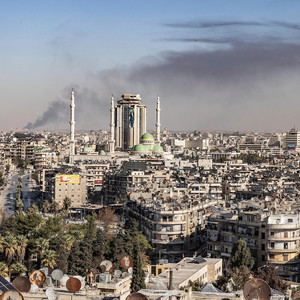
Syria is facing renewed violence in a new offensive by rebel forces.
A coalition of rebel groups launched a surprise offensive in the western countryside of Aleppo last week, sweeping into parts of the northwestern Syrian province for the first time in eight years.
The rebels captured key territories in Aleppo and Idlib provinces in advance in Hama, taking control of multiple towns and villages in the central Syrian province.
Syrian government forces launched a counteroffensive in the northern countryside of Hama on Sunday, reclaiming key areas from the rebel groups.
Army Chief General Abdel Karim Mahmoud Ibrahim conducted a field tour in the province, meeting with army members.
This is our land, our honor and our dignity.
But anyone who is a mercenary or acting outside law and tries to open fire will be dealt with on the spot.
The war is back to square one.
We've since forgotten by the people of Aleppo for eight years after a relative calm that governs the city.
As a result of understanding between Russia, Iran and Turkey.
The understanding now seems to have collapsed.
In a surprise attack, a broad coalition of armed opposition groups headed by HTS, which is listed as a terrorist organization by the U .S.
Department of State, launched an attack on the west of Aleppo, taking over villages and strategic routes before reaching the provincial city of Aleppo and taking complete control of it.
The thousand militants who participated in the offensive and the equipment used all signal their involvement by international and regional actors in the city of Aleppo.
What's happening there is the control of the city by global terrorism.
The Syrian military announced earlier that its forces are regrouping on the outskirts of the city, saying its troops are forming a defense line and preparing for counteroffensive to regain the capital of northern Syria.
Aleppo is seen as the economic capital of Syria, but with many of its people working in business and the influx of opposition groups flooding into their city.
And the governments fought to retake it.
Thousands of civilians have decided to leave by seeking safety, as the war could ramp up at any moment.
The scenes are appalling.
Everyone is trying to leave.
And those who are still there, they do not have gasoline for their cars to get them to a safe area.
Thousands of people are leaving.
It's an entire city, and this is what is happening right now.
The offensive came as Iran -linked groups, primarily given as Hezbollah, which has backed Syrian government forces since 2015, have been preoccupied with their own battles at home.
A cease -fire in Hezbollah's two -month war with Israel took effect Wednesday, the day Syrian opposition groups announced their offensive.
Israel has also escalated its attacks against Hezbollah and Iran -linked targets in Syria over the last 70 days, pluralizing the mobility of the Syrian troops across Syria.
I hope the city will be regained by any means.
I believe the experience accumulated by the Syrian military will likely enable it to regain the city with few losses to the lives of innocent civilians or to their property.
A curfew was imposed on the city of Walipo by insurgents, starting from 5 p .m.
to 7 a .m. daily, with basic items now growing scarce in the market.
It is a status quo that could accelerate the counteroffensive by the Syrian military, which has been mobilizing its troops for two days.
The loss of Walipo marks a crucial moment in the 14 -year -long Syrian conflict.
It also marks the end of the security and the political understanding between the major foreign countries involved in Syria.
An understanding that kept Syria conflict dormant for four years and is now falling apart.
That was a high -dart kaswini reporting from Damascus.
A civil defense group in Syria known as the White Helmets says Syrian military airstrikes have killed at least three civilians and wounded 11 others in Idlib.
Survivor Mohammed Bazzarbashi spoke at the hospital that's treating his family.
I was getting ready for the ASR prayer.
My daughter was laying down inside.
My wife was also sitting in the room.
The roof of the house fell.
All of it. Dust surrounded us.
I tried to remove the cement block, but I couldn't lift it alone.
I called on charitable people to come help.
My neighbor Abu Mohammed lifted the roof with me.
We lifted it and got the girl out and brought her to the hospital here.
Syrian government troops have been trying to push back insurgents who launched a two -pronged attack on Aleppo and the countryside around Idlib last week before moving toward neighboring Hama Province.
Surge in -fightings raise the prospects of another violent destabilizing front reopening in the Middle East.
The UN resident coordinator and humanitarian coordinator for Syria has urged an immediate cessation of hostilities in Aleppo.
Adam Abdelmoula says the escalation of violence in the province has resulted in the tragic loss of innocent civilian lives, damage to civilian infrastructure and the suspension of critical services.
He's called on all parties to prioritize the protection of civilians and aid workers urging dialogue.
The UN official reaffirmed the commitment of the humanitarian community to delivering lifesaving assistance to the affected populations.
The international community has called for de -escalation and dialogue among conflicting parties in Syria.
A Chinese Foreign Ministry spokesperson Lin Jian says the country is concerned about the situation in northwest Syria.
He says China supports Syria's efforts to safeguard national security and stability, and that it's willing to contribute to preventing the situation from further escalating.
United Arab Emirates President Sheikh Mohammed bin Said Al Nayan says his country stands with Syria and supports it in combating terrorism, unifying territories and achieving stability.
Russia and Jordan also express support for Syria's territorial integrity and national sovereignty.
The United States, France, Germany and the United Kingdom have called for de -escalation in Syria.
They have also urged protection for civilians.
Wang Jin is the director of the Center for Israel Studies at Northwest University in Xi 'an, and he says escalating tensions in Syria are possible.
The U .S. has previously held the anti -government forces, and Iran and Russia have already sent a signal that they will provide enough support for the Syrian government to launch new offensive.
That was Wang Jin, director of the Center for Israel Studies at Northwest University in Xi 'an, assuring his insights on the situation in Syria.
Thousands of people have taken to the streets across Israel to demand the government reach a hostage deal with Hamas.
This comes after Hamas released a video of an American -Israeli hostage on the weekend, who is pleading for the freedom of all hostages remaining in Gaza.
Israeli Prime Minister Benjamin Netanyahu has promised to take every action possible to bring the hostages home.
Sarah Coates has more from Al Aviv.
This video release has really seen an outpouring of emotion, an outpouring of grief right across Israel.
It's a fairly difficult video to watch.
It's a young 20 -year -old man pleading for his life, pleading for lives of other hostages being held in the Gaza Strip and pleading with the Israeli Prime Minister Benjamin Netanyahu to strike a deal with Hamas.
Now this video release really saw thousands of people take to the streets right across Israel.
A very large demonstration here in Tel Aviv overnight.
People attending this rally were really calling on Benjamin Netanyahu to do a deal, do it now, saying that really the time is right.
It's enough. These people need to come home.
Here is what one of those people had to say.
The video is shaking me and my family.
While it gives us hope, it also shows how difficult the situation is for Edan and the other hostages and how desperately they are crying out for us to rescue them.
A recent poll here in Israel really does show overwhelming support for a deal.
71 percent of people want this to happen compared to just 15 percent who do not and 14 percent who say they don't know with intelligence and has been gathered by the United States and also Israel suggesting that only half of these 101 hostages being held in the Strip are still alive.
That was Sarah Coates reporting.
Mass leaders have held talks with the Egyptian security officials on a ceasefire in Gaza.
The negotiations on Sunday came as the UN Palestinian aid agency said its halting aid deliveries through the main cargo crossing into the Strip due to the threat of armed gangs who have been looting the convoys.
Rami Al -Mahari has more from Gaza.
The recovery of aid on the ground is not seen as regularly as before.
For the past few months, a couple of months, there have been no real quantities of food aids entering the Gaza Strip.
The United Nations has suspended its delivery of aid into Gaza because citing a number of restrictions, mainly the looting by some gangs in Gaza of the food aid and citing the exact date in 16th of November.
That's what has been reported and has been said by the Commander General of Unurwa.
A number of gang militants had looted the aid.
Other restrictions related to the restrictions imposed by the Israeli side as cited by the Commander General of Unurwa in the territories.
Actually, this situation is further pressing on the population and the shoulders of the population.
There have been reports about delivery and the flow of a flower into the household.
But as of this moment, nothing has entered and has been delivered to the household that are in desperate need for that flower amidst very severe shortage.
And this severe shortage has been reflected on the death of some people lining up any queues for their getting some bread from a limited number of bakeries, mainly in the central Gaza Strip in both Nusayrat and Dar al Bala.
This situation can be sorted out as we had already spoken to one of the officials of Unurwa can be sorted out by some kind of a breakthrough or a political solution for the situation in the Gaza Strip amidst continued Israeli army actions and strikes in different parts of the Gaza Strip in which more
than 50 people have been killed in Nusayrat in Rafa in Rafa in the south Nusayrat in the central Gaza Strip Gaza City and also in the northern Gaza Strip which had the main the biggest share of the distal about 40 people killed in a home in the northern Jabalia refugee camp that was a Ramy Amagari reporting
on the Gulf Cooperation Councils called for an immediate ceasefire on the Gaza Strip and more humanitarian assistance to residents.
At its 45th summit in Kuwait the GCC focused on issues like strengthening economic integration and maintaining international and regional security.
GCC Secretary General Jassim Muhammad al -Budali urged international efforts to end the ongoing conflict.
The Supreme Council called for an end to the crimes of killing and collective punishment in Gaza the displacement of the population and the destruction of civilian facilities and infrastructure including health facilities schools and places of worship in clear violation of international law and international
humanitarian law. Kuwait's Amir expressed optimism regarding the ceasefire agreement between Hezbollah and Israel believing that it'll help ease tensions in the region and he said that Kuwait will support the GCC countries to stabilize the situation.
Coming up Donald Trump's latest tariff threats targeting China and its BRICS partners.
Dive into news like never before with Deep Dive the podcast from CGTN Radio.
Join our global reporters for captivating stories and thought -provoking conversations.
Search Deep Dive on your favorite podcast platforms and get ready to dive in.
At 15 minutes past the hour US President -elect Donald Trump has threatened a 100 % tariff against BRICS members if they create a currency or back any other one to replace the US dollar.
It's not the first time that Trump has issued such a threat.
Cao Chufeng has more on the tariff threats issued by the US President -elect and the responses of the countries concerned.
The US President -elect Trump has been actively threatening other countries with tariff increases.
Just days before he threatened BRICS countries, he posted on his social media that he would charge a 25 % tariff on all goods coming from Canada and Mexico and he would impose an additional 10 % tariff on products from China.
He plans to do this on his first day in the office.
He says it has to counteract drugs coming from all three countries and illegal immigrants from Canada and Mexico.
In response, Mexican President Claudia Chambon immediately wrote a letter to Trump threatening retaliatory tariffs.
She says Trump's proposal tariffs could hurt the economies of the US and Mexico equally.
Canadian Prime Minister Justin Trudeau's response was much softer.
He flew to Florida to meet Trump and claims to have had an excellent conversation.
Canadian Public Safety Minister Dominic LeBlanc says Canada has promised Trump tougher border controls.
Liu Peng -yu, the spokesperson for the Chinese embassy in the US, reacted to Trump's announcement saying the idea of China allowing drugs to flow into the US runs completely counter to facts and reality and nobody can win a tariff war.
China has already faced tariff threats from Trump multiple times.
During Trump's presidential campaign, he floated proposals to impose a 10 to 20 % tariff on all imports as well as a 60 % tariff on all Chinese products.
China's response has been consistent.
Different government officials and departments agree Trump's proposals go against international trade order and China wishes to have a stable business relationship with the US.
Since his first term in the office, Trump has often been using tariff threats as a tactic to negotiate deals with other countries.
Some cases turn out to be empty threats while others face tariffs.
If these tariffs take effect, it could cause widespread ripple effect.
That was Zhao Jufeng reporting.
And for more on the tariff threats, Cass Turie Manikam spoke to political analyst Dr.
Azmi Hassan. Now I want to first talk about Trump's threat to BRICS countries.
How do you read this?
This is a classic example of Trump's method, I guess, using threats in order to negotiate with other countries.
So 100 % tariff. That was his promised campaign.
If a BRICS nation tried to create another currency beside the greenback, I guess there is a blessing here.
Because what happened in Kazan a few weeks ago, the BRICS summit, there's still some disagreement on which currency that they should use.
So I guess the 100 % threat, I guess, will not come into effect.
And it will be an advantage to China.
China can say, Beijing can say to Trump, well, we do not impose any greenback alternative, so you should not put tariff on 25%, 30 % on China products.
So in this way, I think it's a blessing in disguise for BRICS nation, including China, India, and also Brazil.
Now, Dr. Hassan, what about the impact on NAFTA where the US, Mexico, and Canada are part of?
Mexico president did meet the president -electron, and the Mexico president said a good negotiation.
And Trudeau is something else.
He went then to Mar -a -Lago in Florida.
But again, NAFTA, one of the main objectives of NAFTA is to reduce tariff.
But Trump used tariffs on Mexico and also Canada.
It's got nothing to do with economy.
It's got to do with illegal immigrants.
It's got to do with fentanyl or drugs, the input of drugs.
But again, NAFTA has not survived this particular threat from imposing tariffs to Mexico and also Canada.
That was political analyst Dr.
Asmih Hassan sharing his insights on the US president -elect's tariff threats.
China and the five Central Asian countries vowed to further advance cooperation.
This comes after four ministers from the country held their fifth meeting in Southwest China.
Discussions at the China Central Asia Foreign Ministers' Meeting in Chengdu focused on advancing cooperation and making preparations for the second China Central Asia Summit next year.
The participants have pledged to continue to implement the agreements reached by the heads of state at the first summit in Xi 'an last year.
Leo Yong has more. The foreign ministers of five Central Asian countries gathered in Chengdu demonstrating the firm belief of both sides in working together for common development.
Chinese Foreign Minister Wang Yi said the meeting reached the five consensus from adhering to the leadership of the heads of state and strengthening the China Central Asia mechanism to promoting trade in industrial investment and green minerals.
We must accelerate the development of the new productive forces, expand cooperation in new industrialization, artificial intelligence, new energy, aviation, aerospace, smart agriculture and other fields, and help our respective industrial monetization.
Wang Yi also said that all sides will continue to strengthen coordination international and regional affairs and promote solidarity and cooperation in the global south while opposing any form of decoupling.
The goal of the gathering the fifth China Central Asia foreign ministers meeting is to further implement the outcomes of the China Central Asia Xi 'an summit and prepare for the second summit to be held in Kazakhstan in 2025.
In recent years, more cooperation has been seen in many fields such as cross -border infrastructure development, new energy, and oil and gas mining.
China has become the largest trading partner and a major source of investment in Central Asia.
The foreign ministers also attended the departure ceremony of the Tianfu cross -border trucks on a Central Asian route.
Currently, the shuttle bus reaches 20 cities in five Central Asian countries, transporting more than 40 kinds of goods and will cover major cities in Central Asian countries in the next three years.
Experts say that China and Central Asia need to accelerate digital trade cooperation and promote road docking and mutual recognition of standards and a shared development experience in fields such as artificial intelligence, big data, and 5G with Central Asian countries.
It's believed these will continue to drive China and Central Asia economic and trade cooperation.
That was Liu Liang reporting.
Work in new energy and low -carbon intelligent production models is helping transform the environment in Zhongwei, Ningxiahui Autonomous Region.
Du Yuseo has more from the northwestern Chinese city.
Tang Xingming, 60 years of age, has dedicated his entire life to transforming the Tanger Desert into a green oasis, having witnessed the adverse impact of sand storms on the lives of local people.
He decided to pioneer innovative methods to combat desertification.
At that time, I was under tremendous pressure thinking every day about how to solve this problem.
Tang Xingming eventually developed a tool that boosted the survival rate of seedlings by planting them deep enough to reach the moist layer of sand.
However, he's not alone in this effort.
In the same region, China's largest renewable energy base is also making significant advances in combating desertification while harnessing solar energy.
This solar base generates power for 150 ,000 households and reduce carbon emissions by 1 .398 million times annually.
Here we are in the field of photovoltaic panels.
By raising this instrument up to 3 meters, it helps to collect solar energy while creating space for plants to thrive thereby increasing the overall vegetation coverage.
Our main strategy involves generating power above, planting in between, and restoring the ecosystem below the panels.
We use grass grids to stabilize sand and spread about 42 tons of grass seeds annually.
By planting desert -adapted varieties like the sand sagebrush, we have improved the vegetation coverage from less than 0 .5 % to 20 to 25%.
Their efforts are bearing fruit in this vast desert through long -term practices and exploration in combating desertification.
A new model of stabilization first, treatment later, has been developed.
This approach involves first stabilizing the moving sand to prevent it from spreading, followed by planting vegetation in those stabilized areas to improve coverage.
As a result, the tanger desert has now retreated 20 kilometers from the urban area.
That was due use reporting.
Coming up, President Joe Biden's son will not be going to prison on gun and tax charges.
Discover the realities and responses to our changing climate with Climate Watch.
Uncover critical issues such as the Maasai Morris disrupted roller -beast migration and the drop in the Panama Canal's water levels.
Delve into solutions for a sustainable future.
Tune in to Climate Watch on your favorite podcast platform.
Become more eco -conscious and take action to protect our planet.
25 minutes past the hour, US President Joe Biden's pardoned his son, Hunter Biden.
The move reversed his earlier stance of not using executive power to pardon or reduce his son's sentence.
Hunter Biden was convicted in June for purchasing a firearm in 2018 while addicted to crack cocaine, marking the first time a sitting president's child had been convicted of a crime.
He is set to be sentenced next week.
Hunter Biden's also scheduled to be sentenced in two weeks for federal tax evasion charges, to which he pleaded guilty in September.
It is Tian Chen as more.
There's it's receiving quite a bit of reactions, not just because of a reversal of the decision of President Joe Biden, but also the timing of this decision.
Now, since these convictions came earlier this year around June, President Biden has always been very clear about not using his pardoning power as a president for his family members.
Repeatedly, both him and his wife, First Lady Jill Biden, who has also spoken about these on interviews back in June, for example, where she said, both Joe and I respect the judicial system, and that's the bottom line.
So they've been very clear about their position on this, but that obviously has reversed now.
And then not just the decision itself, the reversal, but as I mentioned, the timing is quite critical.
Because if Biden wanted to use these powers, he could have done so throughout the summer.
But many people are reacting to this and they're saying that would have caused a political backfire back then when he was still campaigning for president.
And even later, when he dropped out of the race, this could still be used against the Democratic party.
So many people are sort of questioning the timing of this decision, which came weeks after the election itself.
That was Ita's Tian Shen reporting.
Georgia's Prime Ministers warned protesters that there will be legal consequences if they break the law.
There have been days of demonstrations across Tbilisi.
After the government announced the suspension of EU accession talks last week, the Interior Ministry said 27 protesters, 16 police, and one media representative were hospitalized following protests on Saturday.
Prime Minister Iraqi Kobahidze assured people that it doesn't mean the end of efforts to join the European Union and called on demonstrators to put an end to the unrest.
I urge everyone to remain calm and abide by the law.
I remind everyone that any violation of the law will be met with the full rigor of the law.
Neither will those politicians who hide in their offices and sacrifice members of their violent groups to severe punishments escape responsibility.
Protesters gathered outside parliament, throwing stones and setting off fireworks.
Police fired tear gas at crowds and were seen dragging people away.
We're at 28 past the hour now.
Beijing's down to three degrees on Monday evening.
Tuesday we'll see sunny skies and seven.
Anchon's at 10 overnight and then cloudy and 20.
Elsa and Asia, Islamabad's at nine this evening.
Tuesday we'll see sunny conditions in 22 degrees.
Vientiane's down to 20 and then sunny in 31.
Phnom Penh's at 26 overnight then sunny in 34.
In Africa, Nairobi will be getting sunny skies and 26 degrees on Tuesday.
Kampal is down to 19 and cloudy in 28.
Finally to Oceania.
Port Vila is 23 overnight then sunny in 31.
Apia will see sunny skies Tuesday.
The high is at 26 degrees Celsius.
It's time for a short break.
So far this hour, China and other countries are calling for peace in Syria, following a rebel offensive in Aleppo.
US President -elect Donald Trump has threatened a 100 % tariff against the BRICS group that includes China.
And current US President Joe Biden's pardoned his son Hunter wiping away convictions on gun and tax charges.
Shane Beggar with you.
Stay with us here on The Beijing Out.
The best military commander is not he who fights 100 battles and wings every one of them.
The best military strategy does not lead to the desiccation of the enemy's capital city.
Decoding the art of war will help you understand why there's no art in war and how since the state undefeatable using the science of war with fun stories and insightful breakdown of famous battles.
Find Decoding the Art of War wherever you listen.
Remember? Thank you.
Fate. Take care! What do they truly mean?
Embark on a century long journey with CGTN Radio's latest offering.
Echoes of Kulean. A gripping audio drama series inspired by real -life tales.
Has anyone heard of a Kodachan?
From unexpected encounters to heartfelt reunions, immerse yourself in a narrative of love, peace, and enduring friendship.
He's a piece of my lost childhood!
Listen to Echoes of Koolia on radio .cgtn .com and all major podcast platforms.
Bing 'an. Bing. Bing 'an.
Bing 'an. Examining the events that impact and shape China and the rest of the world.
This is the Beijing Hour.
One hour of news and information brought to you every weekday.
Now, here's your host.
Shane Bingham with you on this Monday.
Still to come? In business, China's factory activity expands at the fastest pace in five months.
And today, we bring you the seventh episode of a nine -part special report that delves into China's journey towards sustainable development.
To contact us, you can email radio at cgtn .com or follow our X account at cgtnradio.
Now, checking the day's headline news, here's Tian Year.
Thank you, Shane. Chinese Foreign Minister Wang Yi has called on the country and Germany to advance cooperation based on mutual respect and understanding.
He made the remarks while co -chairing the seventh round of China -Germany's Strategic Dialogue on Diplomacy and Security with his German counterpart Anna Baerbach in Beijing.
Wang Yi also called on Germany and the European Union to resolve trade disputes with China through dialogue and consultation.
Baerbach said Germany appreciates China's contributions to responding to climate change.
She added that her country supports the EU and China to continue to negotiate on the anti -subsidy probe into Chinese electric vehicles.
China and Central Asian countries have agreed to promote trade, industrial investment and green mining.
Foreign ministers from China and five Central Asian countries met in Chengdu and pledged to make preparations for the next summit while they keep working on the outcomes of the first China -Central Asia summit.
Chinese Foreign Minister Wang Yi called for closer ties in regional and international affairs.
We must accelerate the development of the new quality productive forces, expand cooperation in new industrialization, artificial intelligence, new energy, aviation, aerospace, smart agriculture and other fields, so as to achieve our respective industrial modernization.
The Chinese diplomat also stressed cooperation among the global south while standing against decoupling.
Foreign ministers at the meeting in southwest China also attended the launch ceremony of the Tianfu cross -border freight truck service.
It now connects 20 cities in Central Asia and transports more than 40 kinds of goods.
China says it opposes any form of official contact between the Taiwan region and the United States and U .S.
support to separatists.
The foreign ministry spokesperson urged Washington to follow the Wang -China principle in the three joint communiques and stop interfering in China's internal affairs.
The mainland officials said the U .S.
should realize the separatist nature of Taiwan leader Lai Chang Teh and the Democratic Progressive Party Authority as well as the harm of their separatist attempts.
The state council of Taiwan office earlier called on the U .S.
to handle the Taiwan question with caution.
Lai arrived in Hawaii during a trip to the so -called diplomatic allies in the Pacific.
Meanwhile, China's defense ministry is calling on the U .S.
to stop arming Taiwan after a US $385 million arms sale.
An official said the People's Liberation Army is determined to defeat any separatist attempt and external interference.
The spokesperson warned the DPP authority that colluding with the United States will lead to its own demise.
Chilean foreign minister Alberto van Claverin Stork will pay an official visit to China this week.
The visit runs from Tuesday to Thursday.
The Gulf Cooperation Council has called on all parties concerned to immediately implement a permanent ceasefire in Gaza.
The GCC made the call at its 45th summit in Kuwait.
Its members also called for efforts to provide local residents in a strip with necessary humanitarian assistance to meet their basic needs.
The U .S. president has issued an official pardon for his son Hunter Biden, who is facing sentencing for two criminal cases related to tax evasion and the purchase of a firearm.
The pardon comes after Joe Biden has repeatedly said he won't intervene in his son's legal troubles.
And finally, negotiators working on a treaty to curb plastic pollution have failed to reach an agreement and agree to resume talks next year.
They had been in Busan, South Korea, but remained divided over whether a proposed treaty should reduce the total plastic on Earth and to limit toxic chemicals used to make plastics.
Into governmental negotiating committee chair Luis Vallaz felt visa urged more efforts.
We have made significant progress in Busan in our collective effort to address plastic pollution, including its impact on the marine environment.
However, our work is far from complete and we must remain pragmatic as we continue collaborating toward our shared goal.
He said countries also disagreed on financing and the principles of the treaty.
UNO'd Nations Environment Programme Executive Director Ingrid Anderson led the closing session and pledged commitment to resolving the challenges.
We may close this session today, but the world will still be watching tomorrow and the plastic pollution will still be arriving on our shores and so our work will continue.
And I assure you that we from UNEP will do everything that we can because our work will also not stop because together we can and we will beat plastic pollution.
South Korea's foreign minister said although there was no treaty at the conclusion of the talks, delegates have brought the world closer to a unified solution to ending global plastic pollution.
More than two years ago, 175 countries agreed to make the first legally binding treaty on plastic pollution, including in the oceans by the end of this year.
Alright, thank you very much.
That was Tian Yu rather with headline news.
This is Shane Bingham in the Chinese Capital.
Coming up in business, China's factory activity expands at the fastest pace in five months.
Ever wondered what's actually going on in Africa through the perspective of an African?
How are things really going between China and Africa?
What's the narrative of this relationship?
Well, get a perspective with China Africa talk.
Hear from African diplomats, entrepreneurs, academics, Chinese natives and more.
Get on our wavelength every week to find out what's real with China Africa talk.
Find us on your favorite podcast.
We'll see you there.
37 past the hour now.
Turning to business and here's Wang Zihang.
Thank you, Shane. First up, we take a look at the equity market in China.
Stocks on the Chinese mainland saw an upward trend for the day.
Timothy Pope has more details.
The latest manufacturing data, obviously, was very warmly welcomed by the market.
Rises, of course, reported in both the official and private surveys of the sector that were released over the weekend.
The private Sichin PMI survey locked in its biggest or best reading in five months.
New export orders were rising for the first time in four months.
Analysts say that these numbers suggest the economy is turning a corner, but improvement still needs to be seen in the labor market.
The Shanghai composite index added 1 .1 % on the strength of those numbers, and the Shenzhen component and China export each added 1 .4%.
Automakers were one of the best -performing sectors on Monday.
There was some solid sales data from several Chinese EV companies.
We saw deliveries in November by X -Pong and Li Auto.
Both show double digit percentage increases, and leap motors deliveries were up 117%.
All that helped to drive a sub -index tracking auto stocks, which trade on the Chinese mainland, up by 4 .8%.
Real estate stocks were also rising.
That was following a bit of news for that sector.
One headline that came out of that was that mortgage lenders in several major Chinese cities, including like Hangzhou, in Zhejiang Province, were raising their mortgage interest rates saying that the property sector is showing some signs of recovering.
There was Timothy Pope reporting.
The Hong Kong stock market also ended higher on Monday.
The Hansang index was up 0 .6%.
In Japan, the Nikkei rose 0 .8%.
China's factory activity expanded at the fastest pace in five months.
The Tsaijin Manufacturing Purchasing Managers Index for November rose to 52 from 50 .3 the previous month.
It's above the 50 threshold that separates growth from contraction and it was the highest reading since July.
The growth was mainly pushed up by an increase in new orders, including those from abroad, leading to a solid rise in production, pushing manufacturers' optimism degree to an eight -month high.
Tsaijin said business showed confidence in better economic conditions and continued support from government policies.
For more insights on this, Lili Lu spoke to Liu Jieqin, a senior research fellow at the Zhongyang Institute for Financial Studies of Remen University.
First of all, what are the main factors contributing to the increases in factory activity reported by Tsaijin in the latest survey?
And how does this indicate the overall economic recovery in China?
I think I believe that reflects the overall indication that the development in the last several months in China will be very positive and optimistic.
From Tsaijin indexes, we are very happy to see in the past five or four months all these major positive figures are in good performance.
That really comes from the high confidence, comes back from the market, and secondly also from the market condition itself has been greatly improved and upgraded to a high level of consumption in the past three months, especially also last month has a good performance.
And third, we see that government organizations and departments have done their best to stimulate, to promote all kinds of business activities in order to get a better result and performance.
So all these are three factors from policy, market and entrepreneur that contributed a good performance and a good figure from Tsaijin indexes.
And also another thing that we noticed is the rebounding external market demand, particularly new export orders.
So what are the implications for China's manufacturing sector and also its economic outlook as we move into new year?
Actually, the Chinese experts have already done all the preparations to upgrade the quality of the products.
And second, they have more dynamic design and a new fashion, a design for new products.
And third, it's very important that China has produced and promoted new idea of consumption, especially for high -tech consumption and AI also smart technology combined together with traditional models.
So all this could become the major stream of the market in the future.
By the end of this year, I think that there's a big height of consumption in different ways, in domestic and also in external.
So that's why the foreign companies are trying to have more importer from China, and China also try to have more products prepared for domestic market.
There was Liu Jijin on the latest recovery trend in China's manufacturing sector.
China's recent decision to extend its visa -free policy to Croatia and eight other nations has been well received across different countries.
China announced last week that ordinary passport holders from nine more countries, including Bulgaria, Croatia and Japan, will enjoy a visa -free entry on a one -year trial basis starting from last Saturday.
This brings the total number of countries eligible for visa -free access to China to 38.
Ideal travel is a Croatian travel agency.
CEO Gabriela Koshchisa talked about the significance of the visa -free policy for China and Croatia.
It will be much easier for our customers to just to go without China visa.
So we do expect a lot of China new destinations and more cities to visit from Croatia.
And also there will be a part of the people that want to visit China and expand their businesses.
Under the new regulations, visitors can stay in China without a visa for up to 30 days for purposes such as business, tourism, family visits, exchanges and transit.
And finally, the 21st China International Agricultural Trade Fair has concluded in Guangzhou with the contract value amounting to 23 .6 billion yuan or over 3 .2 billion US dollars.
The fair in southern China attracted more than 100 ,000 attendees and nearly 50 ,000 buyers.
It offered activities including a forum on empowering agriculture and promotional events for farm produce from areas just lifted out of poverty in China.
Thank you very much.
That was Wang Zheng with Business.
You're listening to The Beijing Hour.
Coming up next, our special report, Greener China, a journey to 2060.
The heated sports discussions covering events that are happening in China and around the world.
45 past now and it's time for our special report Greener China, a journey to 2060, a nine part program dedicated to exploring China's efforts in carbon reduction.
In this episode, part seven, young Guang takes us to northeast China, where the first industrial base for the country has been stepping up efforts to promote low carbon transformation.
When I hear carbon dioxide, the first thing that comes to my mind is Coca -Cola and then the greenhouse effect.
It's cool for us carbonated drink lovers, but at the same time, CO2 emissions really threaten the global climate.
I grew up in an industrial city and I'm concerned about the carbon dioxide emission from industrial production and how it affects our health and environment.
It reminds me of global warming and rising sea levels.
According to a 2022 report from the International Energy Agency, the industrial sector is the second largest carbon emitter after power generation, responsible for over a quarter of global CO2 emissions.
China has set the goal to peak carbon dioxide emissions before 2030 and achieve carbon neutrality by 2060.
It makes me wonder what role the country's traditional industry sector can play in reaching the targets.
Northeast China refers to the resource rich provinces of Liaoning, Jilin and Heilongjiang.
In the early years, after the founding of the People's Republic of China, about 80 % of the country's industrial activities were centered in this region.
It was the heartland of the country's comprehensive industrial system, with a focus on heavy industries such as steel, machinery, oil and petrochemicals, and with cities like Anshan and Daqing serving as key industrial bases.
However, a 2022 environmental report revealed that these aging industrial cities contribute to over half of Northeast China's carbon emissions.
As the country strives toward a grainer future, these areas are in dire need to embrace low carbon transformation.
A veteran worker in Daqing recalls some outdated emission practices.
In the past, carbon dioxide generated during natural gas production was often released directly into the air if not reused.
The annual emissions were substantial.
But many people were unaware of the connection between carbon dioxide and environmental issues, addressing instead pollutants like dust and noise.
Former mechanical inspector Mark Yuchen worked at Unsteel Group in Anshan for nearly 40 years.
Back in the 1980s, carbon emissions weren't a concern for us.
We were more worried about the impacts of heat, dust and noise on our health.
Cai Xin Inside Group, a high -end financial information service platform, reported that in 2022, the Chinese steel industry accounted for more than half of the country's industrial carbon emissions.
Effective CO2 management in the industry has become a priority.
Anshan, the city we visited in Liaoning Province, is home to China's first steel production base, Unsteel Group, the third -largest steel maker in the world covers an area of 176 square kilometers, about a quarter of the city's urban area.
Huang Gao, director of Unsteel Coating Factory, emphasized the importance of upgrading their emission methods.
People nowadays expect a better living environment, so we've managed to automate our production lines and implemented fully -enclosed processes to make sure that CO2 emissions are strictly managed.
Everything is recycled and treated before release.
Inside the plant, I was surprised to see workers sitting at computers managing the production line digitally.
I believe this picture would definitely challenge many people's preconceived notion of a typical steel factory.
Back in the early 2000s, in response to economic decline and population loss in Northeast China, the Chinese government initiated a plan to revitalize the region, boosting funding and support for the old industrial bases to navigate its way to sustainable development.
Subsequent climate policies and low carbon goals have further encouraged the industrial bases to enhance their awareness of CO2 reduction.
Tian Youn, the strategic manager of Unsteel Group.
Initially, we saw it merely as energy conservation with CO2 emission reduction.
As we understood more and explored further, we realized that it's not just related to our production process, but also to our relationships with clients and the public.
A green brand attracts more clients.
In late 2022, the European Union reached an agreement to impose tariffs on carbon -intensive products entering its market by 2026.
We need to accelerate our green brand development.
Many leading steel companies in the world have established their own green brands, collaborating with them and adopting their advanced concepts.
We've launched our Anne Green brand.
By 2030, we will achieve over 90 % reduction in carbon emissions compared to traditional production methods.
According to the National Development and Reform Commission, nearly a third of resource -depleted cities in the country are found in Northeast China, which is also known as the country's Rust Belt region.
Daqing oilfield in Heilongjiang Province is the country's largest oilfield, spanning over 6 ,000 square kilometers, roughly the size of five New York cities.
It has over 6 billion towns of proven oil reserves, placing it among wealthiest oilfields worldwide.
On our way from the Daqing railway station to one of the oilfield factories, I saw many oil rigs working along the roadside.
The locals told me that this city almost sits on a sea of oil, but the manager of the oilfield's new energy department acknowledged a resource extraction bottleneck.
Daqing oilfield has a watercodd of over 94%.
That means for every 100 tons of extracted liquid, 94 is water, leaving only 5 to 6 tons of oil.
When the watercodd exceeds 98%, it becomes what we call a depleted oilfield.
The management at oilfield mentions they are seeking breakthroughs in extraction technology and has gradually realized that carbon dioxide can enhance oil recovery.
In the past, we burned off the associated gas from crude oil because we didn't know its value.
The traditional way of using water injection to force the oil toward producer wells no longer works here due to changing geological conditions.
The reservoir energy available to produce oil is insufficient.
We have explored various methods and finally found that injecting carbon dioxide could help replenish oil reservoir energy so that the oil could be forced out.
At an ecological park of Anstil Group, I was surrounded by blooming flowers and fruit trees.
Ecological restoration is another step that both Anstil and Daqing oilfield take in their transition to a sustainable economy.
Park manager Li Hui told me that this area used to be a mountain of mine waste rocks.
The rocky surface here gets really dusty, especially on windy days in spring and autumn.
Once the mountain reached a certain height, we could no longer pile it higher with rocks.
Then we knew we needed a change.
Our initial goal was to turn the area green.
In 2014, we decided to set up an ecological park to showcase our restoration efforts.
Two buses arrived, bringing students for educational trips.
I was told the park also serves as an education base for promoting grain development.
So far, we've cultivated over 63 ,000 square meters of flower fields.
Daqing oilfield has also built an ecological park in a former dormitory area.
The park director says they host promotional activities regularly, such as gardening and recycling to improve public awareness of a low carbon lifestyle.
This year we were certified as a provincial study base and received the highest assessment score.
We offer 10 courses related to carbon dioxide for students and the public.
With the promotion of grain and low carbon concepts, the local people's carbon and climate change awareness is notably improving.
I see tips on low carbon living everywhere, from news to ads to community bulletin boards.
This has really made me more aware of low carbon habits.
The first time I realized I needed to lead a low carbon life was after watching a video showing glaciers melting due to CO2 emission.
It was shocking. An increase in extreme weather events over the past couple of years has made me aware of the impact of carbon dioxide on climate change.
I've been sticking to grain travel for three years, walking or taking public transport instead of driving.
In other parts of the country, emerging grain industries are showing greater momentum in carbon reduction.
They are mostly concentrated in the more developed Eastern and Southern regions, including Shanghai and Guangdong.
A 2024 study conducted by Chinese Academy of Social Sciences highlights that the Eastern regions have achieved higher levels of low carbon development compared to the Northeast thanks to a stronger emphasis on innovations in clean production.
Dr. Zhao Jing, found an expert in grain development, shares his insights on overall carbon awareness in Chinese industrial areas.
New industrial zones have more advanced low carbon concepts and greater investments.
This makes their transition easier compared to the older industrial areas.
However, there is still room for improvement across all of China's international regions.
It's crucial for these areas to set their own carbon goals and roadmaps to turn awareness into action.
A report released in November 2024 by China's Ministry of Ecology and Environment reveals that the country's CO2 emissions per unit of GDP dropped by 34 % from 2013 to 2023.
But despite the improvement, carbon emissions from the Chinese industrial sector still account for around 70 % of the country's total CO2 emissions, according to the Ministry of Industry and Information Technology.
Achieving carbon neutrality remains a significant challenge.
Until then, bye -bye.
That was Yang Guang in Northeast China.
We'll continue our special report, Greener China, a journey to 2060 on Tuesday.
Don't forget to subscribe to our podcast, Climate Watch, for this series and more insights into climate change.
We're at 58 minutes past the hour now, and turning to the forecast before we go for the day in Beijing.
Down to minus one Monday evening.
Tuesday we'll see sunny skies and 7 degrees.
Nansheng's at 10 overnight, then cloudy and 20.
Elsewhere in Asia, Islamabad's down to 9, then sunny skies and 22 on Tuesday.
Vientiane's at 20 overnight, then sunny and 31.
Phnom Penh's down to 26 and then sunny and 34 degrees Celsius on Tuesday.
That's it for this edition of the Beijing Hour.
Making news today, China and other countries are calling for peace in Syria, following a rebel offensive in Aleppo.
The US President -elect threatened to 100 % tariff against BRICS countries that includes China.
On behalf of the staff, this is Shane Bingham in the Chinese capital, hoping you'll join us for the next edition of the Beijing Hour and open a window to the world together.
Take away Chinese where you can take some Chinese away and experience progress day by day.
Take away Chinese. We will promise you a difference.
Hello everybody. Welcome to Roundtable, coming to you live from Beijing.
Roundtable. Roundtable.
Roundtable. Connecting China and the world.
We bring you fun and timely discussions about what's affecting our lives everywhere, every day.
Tune in to Roundtable, where the East meets the West and understanding is the goal.
From North to South, East to West, people in China are chasing their dreams and leaving their mark.
Want to know how they beat their odds and made a difference?
Footprints brings you the true life stories of their journeys.