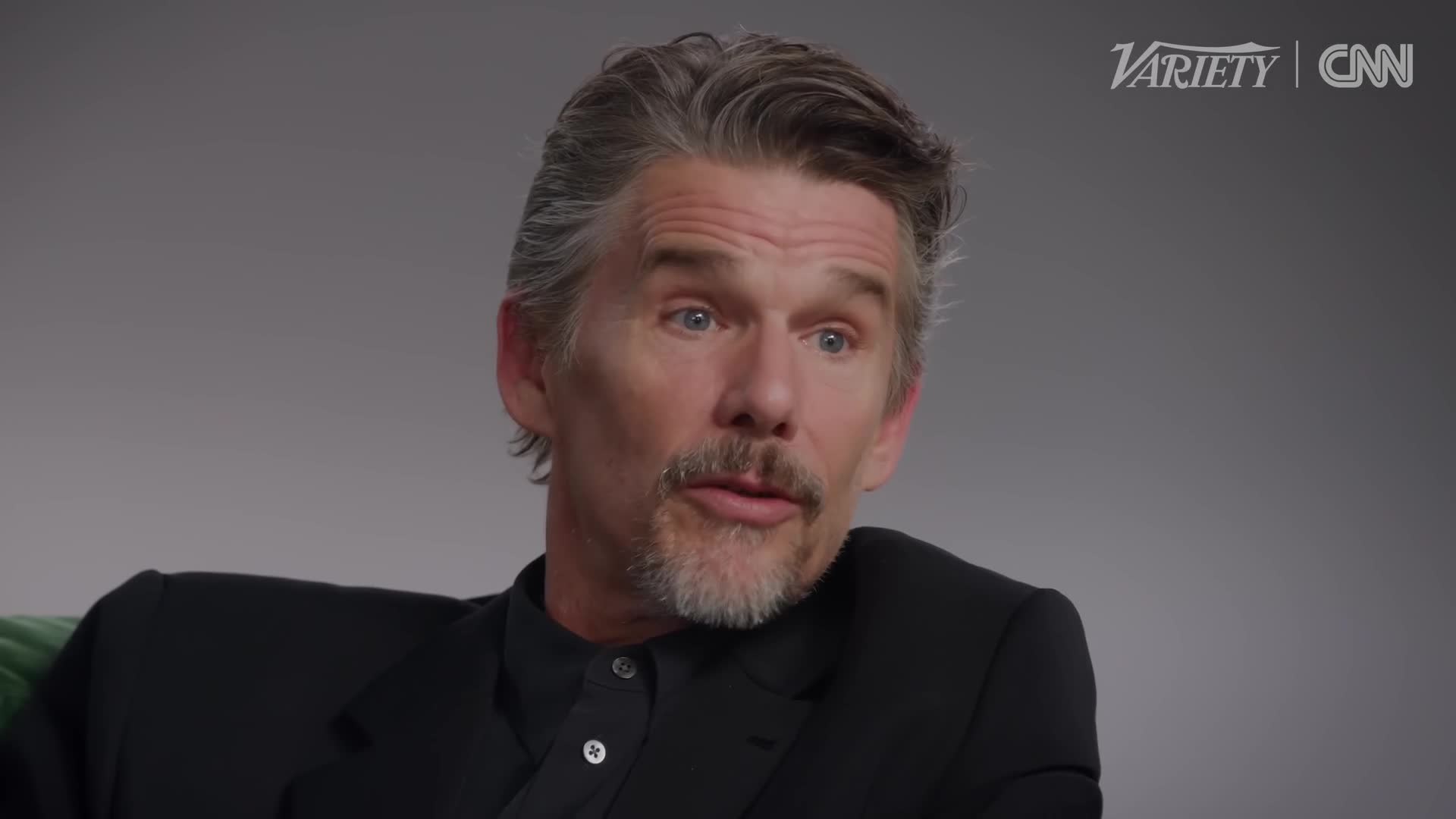
The damn program's called Actors on Actors, so I'm sure that's a really boring story, but if you want to get into the math No, I think everyone's going to love it.
I got a concussion, though.
You did?
I did.
You said that with pride.
You said, like... I was proud of it.
The guy was punching my hands so hard that I was hitting myself.
With these wheelchairs, we can do anything.
Where's the camera overhead?
Is that the camera?
Oh, wow, look.
Where?
Up there.
Oh, wow.
Wow.
This is some top notch.
That's God's POV right there.
Yeah, you guys are high speed.
Wow.
So it's Friday night, I've got plans.
I've got some things I wanna do.
My wife is actually out of town.
And my 17 year old, she's a senior in high school, has absolutely zero interest in me whatsoever.
And she texts me, she's like, what are you doing tonight?
It's Friday night.
Uh, nothing.
I'm like, why, what are you doing?
She goes, I don't know, you know, Phoebe just flaked on me and we were going to see a movie.
Do you want to go see a movie?
Are you guys in the same house texting each other?
No, she's at school.
Okay.
You know, she's at soccer practice or something.
School's over, you know, it's like that 4.30 mark on a Friday.
Okay.
And clearly her friends abandoned her.
Something had fallen through.
She had better plans.
But I wasn't really doing anything interesting either, which I was like.
Well, my daughter's asking me to go to a movie, so I'm doing this.
So I cancel what I'm doing, because she never wants to.
And I text her, I say, what do you want to see?
And she says, I really want to see the new Sydney Sweeney movie.
I'm like, Christy?
And she's like, yes, on it.
I get us tickets to the Alamo.
We order a couple Impossible burgers, and we kick back.
And we had one of the best nights we've had in a long time.
A, because the movie is fantastic.
B, she was so inspired by you and the way that her brain reacted to watching this movie.
She's like, dad, see, this is what you don't understand.
This is what you, I'm like, what don't I understand?
She's like, this woman is the best fighter in the United States of America.
And it's still virtually impossible to get out of a toxic relationship.
That's what so many women are against, Dad.
But she was just really, really inspired by your character and your performance.
And she was like, now that was a great performance.
And she had never seen anything like the relationship between you and Ben Foster is so complicated and so multifaceted, and so many things at once.
And she'd never seen such a complicated portrait of a male-female dynamic.
What's going on?
He's here.
He's watching us.
We had such a great conversation.
And so I'm so grateful to you and your collaborators who made that movie.
And so is my daughter.
And she wanted me to tell you that.
You know she is impressed and she's really glad that you told that story.
That's so beyond kind.
And I'm so glad you had that with your daughter.
I know, I am too.
It was really wonderful.
And she's a big athlete.
You know, she's captain of her soccer team.
And so women in sports is really important to her.
So did she know Christy's story going into it?
Not at all.
I mean, she didn't know anything.
Neither did I, actually.
Like 10 minutes into it, she's like, this is a true story.
Pretty sure.
Yeah.
Pretty sure.
Yeah.
And then I wasn't until you were on the, you know, your characters in the cover of Sports Illustrated was like oh yeah, I know this is a true story.
Like I remember that moment.
And I saw live one of the first fights when, when you're the undercard for Tyson.
Yeah.
You know I saw that fight and that was the first time I'd watched female boxing.
When you know, when it gets to the end, we were on the edge of our seat.
It was, first of all, it was also really well-made film.
No, David Michaud did an incredible job.
He did an amazing job in all the supporting acting, but particularly, Ben, he's astonishing in it.
He disappeared.
How does that happen?
I know that you're a producer on it.
I know you helped make that movie happen.
How does that come to be?
So I had been kind of circling a few different projects that were in, like, the MMA fighting space.
Let's stop there, then.
Why?
I grew up kickboxing and grappling.
You did.
I did.
So I really wanted to find something that I could do something a little more physical.
Yeah.
And I was choosing a few different stories.
And then my agent, Jennifer Millar.
She was like hey, there's a script going around about Christy Martin.
Why don't you read it?
And I was like, I don't even know who Christy is.
And I remember halfway through the script, I'm bawling my eyes out.
I couldn't believe that I had no idea who this woman was.
I've never learned about her.
And the moment I finished, I got on a Zoom with the director, with David.
And I was like begging him to please let me do this project.
I was like, I will do anything for you.
I will lose myself.
This is the most important story.
How did it feel to lose yourself like that?
I loved it.
It's a great feeling, isn't it?
You lost yourself.
Yeah.
I have this thing that when you do these kind of actors on actors, you do these kind of things where you generate a lot of attention for performance or something like that.
It's the actual antithesis of my favorite thing about acting, which is that the conversation starts to be about you, whereas the joy of doing it is actually completely losing yourself, and this feeling you have when you can disappear.
And when acting's really at its best, it is this feeling of it's not about you at all.
Leave yourself.
I know, and it's such.
It's a high that I've chased my whole life and it doesn't happen very often, But it looks like you lost yourself, and in the best way, where it's such a spontaneous performance.
You're so alive and you're still three-dimensional.
You're so many different things at one time Do you hear me?
Yes, sir Okay, so you did all this fighting, and was it fun to start training again?
I loved it.
I was able to box again.
I was working out twice a day, every single day.
I put on 35 pounds for it.
It was like I came to life.
I was like, I think I might quit acting and start boxing.
I loved it.
I remember I played Chet Baker in a movie.
He's a great trumpet player.
Did you actually learn how to play?
Yeah, and I got so into it that I was like I told my trumpet teacher, I was like you know, we got to put this movie off a year.
I said, we got to put this off a year.
I just want to play for a year, and then I'll be able to do it.
And my teacher said, it'd take a lot longer than a year.
No.
Like, close to Chet Baker.
I was like, really?
Two years?
He's like, I don't think you're ever going to get there.
He personally said, but in eight years, you could give it a go.
I was like, all right.
Let's just do this.
Let's make a movie.
Well, we convince ourselves we're so good at these things.
I know.
You have to.
You have to kind of believe yourself.
That's the trick.
The trick is, it ultimately doesn't really matter how good you are.
It's whether you believe.
Apparently, De Niro was a great boxer when he did Raging Bull.
Do you have a favorite sports movie?
I mean, Rocky.
I've always loved the Rocky franchise.
Can I tell you my story about Rocky?
Please.
So I saw Rocky and I decided I wanted to be a boxer.
Okay.
Yeah.
So I took boxing lessons and I got one fight.
You did?
Yeah.
I didn't like boxing anymore.
Wait, who did you fight?
Oh, I got my ass kicked.
What was awful about a real fight was is i was.
I felt like i was a pretty good defensive boxer, but the guy was punching my hands so hard that i was hitting myself, you know, and it was abs and i dropped it.
One fight, one fight i.
I did not like losing, i did not like getting beaten up.
How long did you train for this fight?
Six months, okay.
Yeah, you know, but no more from me.
You fared better than I did.
I fared a little.
I got a concussion, though.
You did?
I did.
You said that with pride.
I was proud of it.
You were?
Yeah.
I loved the fighting sequences in the movie.
Tell me about them.
We actually took all the real fights from Chrissy's real life.
So every fight that you saw in the movie was the exact combinations that she had in those fights.
And then I told all the stunt girls, I was like, I really want to be hit.
And they were down for me to hit them.
So everything you see, we were just going at each other.
There were bloody noses.
It was real.
It's kind of fun to know that you're not as fragile as we think we are.
It can take a lot.
Yeah, we're tougher than we think we are as human beings.
So you start the whole training process.
Then the whole psychology of her.
I mean, she's a really complicated woman.
She is.
The way a real person is, you know.
Her relationship with her mother just broke my heart.
I know.
That was the hardest relationship for me to play.
The first day was like day three, and it was Merritt's first day on set, Merritt Weaver.
And we had to do the scene where Christy goes to her mom and says, I need help.
At the party?
Yeah.
And it was one of the hardest scenes I've ever had to do.
I just could not understand a parent not being able to be there for their kid.
Yeah.
And it was really complicated.
I need help, Mama.
Oh, Christy.
You sound crazy.
And so many parents.
What I got from that scene that you're doing they have an agenda of who you are is reflecting them.
You're not an independent entity.
She had such an agenda with the woman she wanted you to be that she couldn't see the woman that you are.
At the end, Chrissy's apologizing for not being the daughter she wanted her to be.
That happens all the time in our profession.
There's so many parents that don't want their kids to be performers.
Did you want your daughter to start?
How was that?
You know, with my oldest, it was without complication.
I knew, when she was about four, that she was going to be an artist, and I knew that she was going to be a very good one.
That was her safe place, watercoloring, dancing, singing, all throughout her childhood.
There were a lot of things about her childhood where they were really really hard and complicated, and things I regret for her.
But anything that had to do with human communication, people understanding each other, was something she vibrated to.
I remember some teacher said, you know, her name is Maya Hawk.
And this teacher said, Maya, Are you happy?
Because they were worried about her.
And she said something to the effect of, do you really think that's the question?
And I thought, I love this kid.
How old was she?
She was about 13 or something.
I don't think that's a very interesting question.
I think there's a lot more interesting questions than whether I'm happy or not.
Am I happy?
No.
But I don't aspire to be happy.
She was very.
And so I never worried about her going into the arts because I knew that was going to save her life.
So you're all for it, supported it.
Yeah, yeah.
I completely support it.
But what I'm trying to say is no support was required.
There was no decision.
It was in her.
It was going to happen with or without my blessing, you know.
And she happens to be really good at it.
That's amazing.
Yeah.
And so what I can do is I can help her handle the vicissitudes of the profession, you know.
I can...
Truthfully, I can't give her anything but an example.
That's the thing as a parent.
It doesn't matter if I say, you shouldn't smoke if I smoke.
How many times do you see that?
Don't do this, kid.
It's terrible for you.
It's meaningless.
Don't drink.
Whatever you do, don't smoke pot.
So the kids are smart.
And the truth of the matter is that I've loved this profession.
How old were you when you started it?
It's like 12, 13.
Yeah, see, me too.
So it probably wasn't much of a choice for you either.
It was just in me.
I loved it.
And I think it works really well like that, because then you don't really have to have a fallback plan because you don't have one and you're not going to have one.
I used to say that because people would be like, what's your plan B?
I'm going to have a plan B because I'm not prepared to fail.
I was like 12 saying this.
You watch too many Kobe Bryant specials.
But I do think it's important in a way not to have a plan B.
You can have variations on plan A, Plan AA, plan BA.
But you got to stay on the course.
Here's a question for you.
When you have a big part like that and you really give it your all and you pour all of your heart and soul into it and it takes over your life, which is what I imagine that it did.
It did.
You're training, you're working with these people, you're getting to know Christy.
I mean, I can imagine what all that is like.
And it wraps.
How did you feel?
It was almost like this bittersweet emptiness where you're so proud of the work that you did.
It's a dream role.
You just experienced six months of everything you've ever wanted.
You poured everything into it.
And then everybody gives hugs, kisses, and it's a goodbye.
And you have to say goodbye to it forever.
And it was just like this really interesting moment where I remember standing in front of the mirror.
Of course, I still had the weight of Christy.
And I was like, I'll never get to do something like this ever again.
It made me really sad.
And I don't know if I've actually navigated the ending of that yet because we're still in press.
I'm getting to watch the movie all the time.
I'm with Christie all the time.
So I feel like that's still in my life.
But it was really bittersweet.
See, for me, sometimes there's so much talk.
People always ask you what it was like to get into character, how you prepared blah blah blah, blah blah.
And we can do lots of different games and imaginative exercises or hard work to invite the character into your space and you inhabit it.
But it's very hard to figure out how to let it go.
And nobody really talks about how to shed a character and they don't happen very often, but there's a great Paul Newman interview where he talks about part of how he grew as a person was taking the qualities that he really admired and the characters that he played and keeping them, and taking the qualities of characters that he played that he had no respect for but now he could see them in himself and he could try to shed them.
And so this accumulation of roles over a lifetime, he was constantly trying to gain this thing from pretending to be this person to kind of keep that thing that you loved and go like okay, I saw the jealousy, I saw the greed, I saw the malice, I saw the things that and go like okay, I don't, I know that's in me, you know, but I'm going to try to water that part down, you know, and I thought that was kind of cool way to think about it.
Do you feel like you carry your characters like that in a sense?
There's a handful.
I'll bet you any amount of money this is going to happen to you, and it's going to be awesome.
You ready?
It's going to be like 13 years from now.
And people like my daughter Clementine, who you don't know, are going to be 27, 28 years old.
They'll be your age now and they're going to come up to you, tell you stories about the way that the movie impacted them.
And it really makes you feel phenomenal that all is not lost, this idea that the void is this kind of negative space.
Um, the negativity and stuff is always the loudest, but there's so many like, amazingly wonderful people in the world and they absorb these people that you put out and they part, make.
It becomes part of their imagination and in that ways, these characters are still alive and and the performances are still alive, and that's Wonderful.
There's parts of me.
I did this movie when I was 17 Dead Poets Society, you know.
I say oh captain, my captain.
I stand on this desk and people still come up to me at a deli or something and say oh captain, my captain, you know.
I miss the start of my childhood, so.
Yeah, really?
Yeah.
There are things you learn about human psychology through playing these parts.
I got to talk to Vanessa Redgrave once, and she was one of the wisest people I've ever met.
I guess, when I had dinner with her once and she was in her mid-70s And through playing all these complicated people and all the complicated things that she went through with oh, different things that had happened in her lifetime where she was in favor and out of favor.
She'd learned she was really wise.
She was a profoundly wise human being because she'd spent all this time with these interesting characters that were a part of her.
So, yeah, I hope the characters stay with me.
Elizabeth.
Larry.
My irreplaceable Elizabeth.
I'm so happy to see you.
I was completely blown away by your transformation, your performance, just everything that you did with Blue Moon.
Thanks.
I mean, I could not take my eyes off the screen.
You captivated me.
I can only imagine what the script looked like.
I was telling you, I was like, did you have 60 pages of a monologue?
And you had so many ups and flows and so charismatic and it's such a complicated character as well.
Speaking of.
But I'd love to know your entire experience with Blue Moon.
All right.
Well, my entire experience with Blue Moon is complicated because when I was 23 or 24 years old, I auditioned for Richard Linklater and I got cast in this movie before Sunrise and started a friendship.
That's you know, over 30 years on now.
Yeah, because it's like your ninth film with him.
This is our ninth film together, yeah.
So he gave me the script, like, you know, over 10 years ago.
No way.
Yeah, and I was like, this is ice hot.
I don't know exactly what, but you know, sometimes you read something like you talked about.
When you first read Christie, you know I knew 20 pages in that I got to play this guy.
And I also.
If you start reading a lot of scripts, I also knew there was no way the quality of writing was gonna be this high.
The first 20 pages and not finish.
So when I got to the end, I called Rick, I was like, we gotta make this movie.
And he said, yeah, we're gonna make it, but not yet.
Like, wait, let's make it, let's make it now.
He said, no, no, you're not ready.
You know, he's like, you need to be older.
So let's work on the material and let's just keep dreaming about it.
It's going to be a hard movie to make.
You know, it's about such a specific thing.
It's in real time.
It's in one room.
There's a lot of reasons that everybody's going to tell you nobody wants to see that movie, right?
We do a reading and talk about it about every 18 months for almost 10 years.
But the magic of, and this is how Rick's process is, is you start dreaming about it.
And you start reading a book about Lorenz Hart.
You start listening to music and you come across Ella Fitzgerald's Rogers and Hart record.
And then you start a friendship with the writer, you know, and we start working on it, working on it.
And then finally we did a reading once and it was finished and everybody left.
We did it just at my kitchen table and everybody left.
And I looked at Rick and he's like, we're ready.
And we got the money together.
And then once I knew it was on, the fear came because I was so confident about it.
But then, once it was actually happening, I was like wait a second, this is so much verbiage and I need more time.
And he said, we don't have more time.
You got to work.
You know, I got an idea.
Why don't you not go out and movies on Friday night?
You know, and we're old friends.
So you know, but he started really laying it heavy on me about the level of dedication that was going to be required.
And I've been doing this for a while.
And I also knew that opportunities like this.
You can spend years hunting for an opportunity to play and Put that on the marquee.
Quite clearly approaches perfection.
Like Christie, Larry Hart is often two things.
I always call it the correlation of opposites.
There's this thing, like if you take an extremely heavy person and they have great grace, they're a great dancer or something.
You can't take your eyes off them.
It's when somebody is two things at the same time that seem opposing, that become kind of thrilling to watch.
Brando is the greatest example of it.
He's so intensely masculine.
He's also extremely feminine.
And it creates this tension in everything he does.
And Larry is like the smallest person in the room and the biggest person in the room.
He's gay and he's in love with a woman.
He's eroding from the inside with jealousy and warm and empathetic.
You know, any scene I'm playing the opposite of what I'm supposed to be playing is also true.
And so trying to get all of that in him and trying to get the words and speech effortless, you know, without any effort at all.
So you never had to hit the gas at all.
And there'd be, you know, always trying to.
You know, you did this movie Reality with my friend Josh Hamilton and it's an incredible movie and you're incredible in that movie.
And you really are.
It's really a staggering piece if people haven't seen it.
It's an amazing, hypnotic movie.
But Josh and I started a theater company together when we were younger and Our whole mission statement was to never act.
As soon as you see somebody acting, it sucks.
And that was our kind of thing.
Everything has to feel like it's spontaneously, organically coming out of you.
That's your thought.
And specifics create dynamics.
All the things you have to be so specific in your imagination so that everything makes sense and everything is alive and has the peculiarities of real life.
And so I wanted to have that level of naturalism in something that was asking me to walk differently, talk differently, look differently in a different way that you were going through.
I'm on the wagon.
I'm serious.
I've been drinking ginger ale all night.
Well, except for this second, because this second we have to celebrate.
How did you prep for something like that?
I mean, the immense amount of dialogue.
You really want to know?
I'm always interested in how other people memorize everything.
What I do, and I started doing this a really long time ago.
I handwrite everything like it's my journal.
When I'm memorizing, I'm not memorizing from a typewritten final draft page.
I don't want to have that in my brain and I don't want irrelevant stage directions to be part of, because sometimes scripts say this you know, upset he says can I have a drink?
And you can't undo it.
You see it in your brain.
You see it in your brain.
I said, can I have a drink?
It was like, sure.
There's a lot of ways to play upset.
It might be, can I have a drink?
You might laugh on it, and that would reveal.
It's like all these things.
You try to get rid of all that.
So I'd handwrite the whole script out.
This script took forever to handwrite out.
And then I do it again to see what I remember and what I don't remember.
Oh, you write it from memory.
I try to write it from memory.
And then I look and I see what I got wrong.
And that process really helps me go, oh, no, it's not that word.
That word's over here.
Oh, I already used that word.
It also helps me be extremely critical of the writer. in a positive way.
I can see, let's see, you know, it's interesting.
I'm using, using that word four times and these four different, I keep using that word.
It doesn't seem like I would use that word four times.
What's a, I think this is a better word.
Do you think it's, but you know, you can just start doing that kind of thing.
And then I try to record it with no acting.
I listen, if I think I have, I take three pages or something and you try to learn that.
And I try to record it with no acting.
And then I look at the script and see what I got wrong.
Sometimes I did something wrong that I like better and I kind of can work that in and figure that out.
Take Billie Eilish's Birds of a Feather, something like that.
I know all the lyrics to that song.
I don't know how I know all the lyrics to that song, right?
I didn't learn them.
I absorbed it at coffee shops and on the car radio.
And it's in me now, those words.
I think in an ideal place, especially if you have a lot of verbiage.
For it to feel effortless, you can't be trying to remember.
And so I would give myself tricks like, the truth is John Voight taught me this.
This is years, I was like 19, which is you unlace your shoe, right?
And you have to do the speech lacing your shoe, which if I was talking lacing my shoe, it would be no problem.
If I'm trying to remember something, then it's difficult to do.
Until you can do that, until you can do other things, you don't really know it.
And if you can try to learn it with absolutely no ideas about your performance, then you leave yourself incredibly open to the other actors and to a director and all your collaborators to shapeshift.
Thank you.
And it's not a problem if you don't have many lines, which is usually what most movies are, because it's easy.
But if you have a 15-page monologue or something, you have to work that tedious of a way.
The damn program's called Actors on Actors, so I'm sure that's a really boring story.
But if you want to get into the math of it, that's the great thing about trying to do one of those, like I played Henry IV and Macbeth and some of these big epic techs.
It's kind of like when you're training.
If you run with weight on, you know when you take the weight off it's so much easier.
It's the same thing with some of those big epic plays.
Once you've memorized, you know, one of these huge texts.
Do you find more of a love in theater than on screen?
Or what's something where you feel more alive?
If I'm working with a great film director, that's like my happy place.
But really I like being in the room with talented people.
The great thing about plays is the editor doesn't mess it up.
The director doesn't mess it up.
They don't put some lousy... You're there.
This is all the actors.
Yeah.
I control whether it goes fast or slow.
I control like if I'm...
If I want this scene to be angry, it doesn't matter what the director says, it's going to be angry.
They're not going to sit in an edit room and change it.
That sounds aggressive and hostile, but over time there's a great Fran McDormand quote about I don't need a great director, I need a good editor.
It's so true.
It's so true.
One of your first big experiences was on television, Euphoria, right?
That was a big thing in your life.
Do you have much experience on stage?
Is that something that interests you?
I have horrible stage fright.
A terrible stage fright.
You know what that is?
What?
Inexperience.
It really is.
No, honestly, because I didn't grow up doing it.
Yeah, if you don't grow up doing it, if you did it five times, it would go away.
I'd probably enjoy it, honestly.
I've seen so much of your work, and you're just an excellent actor.
Thank you.
I saw you in the Americana as well, which you're fantastic in.
Thank you.
And I think that you'd really enjoy it, because what you said earlier about disappearing The great thing about long takes why you like the fighting and stuff like that because you get to be in it.
You get to live in it.
You get to live in it.
Yeah.
I think that's why I've always been so amazed with so much of your work.
I truly feel like you're just, you're living in it so deeply.
And I want to come watch you in theater one day.
Oh, well, I'll drag you out.
I'd love that.
You won't watch.
You'll be there.
Oh, gosh.
Yeah, yeah, yeah.
We'll put you in.
Oh man, I might be really nervous the first time and then I'll get better.
Everybody's really nervous.
That's the fun of it.
It's like fighting in that way.
When you're on the other side of it, it's so rewarding.
You know, you must have been terrified to play Christie when it first started.
I was, but I found a strength within her that I fell in love with.
I was more nervous doing reality because of what you were saying of the immense dialogue.
Yeah, right.
And in most movies, it's quite a back and forth, and there's time, and you can sit down and relax.
But this was, you're on it the entire way through.
And it was the transcripts, so I'm having to memorize the ums and the ands in every beat.
And they were all so important.
Yeah.
And it gets, you get really nervous.
One of my favorite moments in Christie.
I love how happy you are when you get in the trailer home for the first time.
And you've got your own space.
And the way you played that, it's so human.
And I wouldn't have thought of it.
And it's just to see you light up finally a room of one's own.
There you are.
It was really beautiful.
Thank you.
What was euphoria like?
I think euphoria was the beginning of everything for me.
Like, I learned so much about the importance of a crew, everybody's jobs.
I learned to be more confident in myself.
I was really nervous.
And Cassie is a very emotional and heart-driven character, and so I had to be very free with every choice that I made.
I had to not question myself.
I had to just like dive in, make crazy decisions and not judge what I was doing.
And the more and more I did it, I just wrapped season three.
I am so thankful for it because I'm so free in all my choices.
Like I'm not scared to try something even if it's completely bonkers.
And we ended up having this thing where Sam would always go All right, let's just do a Cassie crazy take.
And they were always our favorite takes, because we would just let all rules or anything go and completely lose yourself to it.
I love it when directors do that.
Oh, it's so nice.
And you're just going to do anything.
There's no direction.
Just do whatever you feel in the moment.
It just comes to life.
Yeah, Linklater sometimes would say that on Blue Moon, too.
It's like, all right, we got this.
Why don't you do one?
Just do everything you ever thought of doing, but we're worried it was bad.
It's the best.
And then you're like, all right.
So you're like, it's for free.
It's like, nobody's going to see that but the people in the room and the editor.
But you might find something.
And invariably, you always do.
Always.
Especially with Cassie, I always find that those crazy takes are the ones.
I'll tell you this, you know, it's really, it's exciting to see somebody lay it all out there.
And, you know, I really believe this.
The world loves it when you take a dare you know.
And you took a dare you know and you're throwing yourself at your work and you're doing a great job.
And it's fun to get to talk to you at this moment in your life.
And I'm really happy to be here.
I'm incredibly honored to sit here and have this conversation with you.
This has been, I'll never forget this.
Thank you.
Killed that.
Great job.
No, you're incredible.
I'm sitting here being like, man, I wish you were my dad.