Imagine you're holding a marble and there's a paper cup about three arms lengths away.
Your task is to toss the marble into the cup and if you get it in, you win.
But how likely are you to sink the marble into the cup every time you toss it?
Even upon first attempt, you'd recognize how many factors go into a successful throw, like how hard you're throwing and how well you aim.
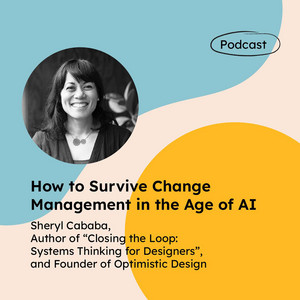
This is called systems thinking and it's a thought process that takes into account the complexities surrounding a specific challenge as opposed to linear thinking, which is like saying oh it's easy just throw the marble into the land in the cup and while this metaphor is obviously a huge oversimplification the crux of it is that complex circumstances call for a more holistic approach to problem solving my guest today is cheryl kababa author of closing the loop systems thinking for designers and the founder of optimistic design in this conversation cheryl applies the principles of systems thinking to
organizational change in other words making leadership decisions based on the nuances and complexities of real people in a time of dizzying change, and not on reductionistic or overly optimistic assumptions.
She also shares some useful tools for leaders and designers to develop better, more functional systems, whether that's a product feature, a team, or even an entire organization.
Let's jump in. Oh, by the way, we hold conversations like this every week.
So if this sounds interesting to you, why not subscribe?
Okay, now let's jump in.
Welcome back to the Product Manager Podcast. I'm here with Cheryl Kabalba.
Cheryl, Meryl, thank you so much for joining us today.
Yeah, thanks for having me.
So first of all, can you tell us a little bit about your background and how you developed your focus on systems thinking?
Yeah, so my background is as a product designer and design researcher and strategist. And I think when I moved from product design into design strategy, I was finding that I was doing a lot of work at the front end of the funnel for organizations.
And so I've been a design consultant now for about 15 years.
so there was this moment in time where I was working a lot with technology companies on emerging tech like VR and AR and things like that but I was also doing projects in global development so like you know global health that you see a lot of like philanthropies developing or funding efforts in places that are in the global south to solve problems there things like like eradicating malaria and things like that.
And I was feeling like in both spaces in different ways that the design process for me was kind of falling short.
So you've always described it as human -centered design.
And so the idea of, you know, designing first and foremost for end users and making sure that you work iteratively to engage them within the process of design saves lots of time and money, obviously, when you're developing expensive things and you want to make sure that you're designing the thing right before you build it.
But I was kind of seeing that there was sort of a lack of thinking around, for example, if we're thinking about technologies that aren't heavily integrated into, let's say, like society today, it's really important to kind of think about like unintended consequences.
It's also really important to kind of think about with intent about the kinds of use cases that you're thinking about those technologies should be solving for, even if it's still kind of like a wide world and you just want to like figure out what a new technology is good for.
And then on the global development side, it sometimes felt like there was some lacking cultural knowledge or there were people from Western places like coming into places in the global South and not having a great handle on how things work in a place like that.
And so you'd see a lot of interventions failing because there wasn't a great understanding of how communities operated either like culturally or economically or what have you.
And so I started doing a lot of reading around systems thinking, specifically Danella Meadow's book, Thinking in Systems. I found really inspiring this idea that, you know, you expand your lens towards thinking more broadly when you're looking at like the world as it exists today and the problems that are inherent.
and how you can kind of analyze that from a systems perspective to think about how potential solutions or ways of changing things might affect things broadly.
And that means like a lot broader notion of who your stakeholders are, as well as kind of thinking about different forces, like what people and groups are incentivized by.
So that's the long story short.
That's where I started really thinking about systems thinking, but as a designer, I was like, Like, I don't know how to actually integrate this in my work in a real practical way.
So I started experimenting with different frameworks and things like that.
And yeah, the result of that is the book that I wrote is kind of a reflection of my own journey through the intersection of design and systems thinking.
It's kind of the book I wish I had when I was going on this journey to begin with.
And so hopefully it's useful for other people too.
Absolutely. Yeah, I think there's a lot of really interesting concepts in it.
I think we'll definitely tap into a few of them as we're kind of moving through.
And then we'll have your book linked towards the end in the description box, because I think it's really worth checking out.
So today, we're going to be focusing on applying systems thinking specifically in the context of organizational change, especially since we're in this kind of a shifting tech landscape era.
So to kick us off, what have you found to be the biggest challenges around organizations that are trying to implement systems thinking during a time of organizational change?
Yeah, I think, first off, systems thinking and organizational change and organizational design go hand in hand for many decades.
You know, I did my little deep dive into the origins of systems thinking and you have really foundational books like Peter Senge's The Fifth Discipline.
And really, the relationship is super strong because organizations are kind of a dynamic set of different stakeholders and forces, many of whom have different incentives and ways of working and there's culture involved and basically every aspect you can kind of think of when it comes to, let's say, steep analysis, which is social, technological, economic, environmental and political.
and i think when if you know an organization is rightfully thinking about using systems thinking methods to kind of think about how to create organizational change i think there are you know some key sort of tenets and frameworks to engage in one of the ones that i refer to a lot is peter saying i had this kind of like principle that and i always say this wrong because i think it's i might be saying it backwards but the idea holds true it's like today's solutions are tomorrow's problems. So constantly thinking about how the dynamic forms of problem solving means that you might have to anticipate
or mitigate for the kinds of problems that problem solving might cause.
I think that's a really important thing.
Causality is like a really important concept for people and practitioners to kind of think about as they're looking to integrate systems thinking.
It's like, what are the things that kind of happen as a result of either decision decision making or problem solving that you might have to account for later.
So that's one thing like, if folks are thinking about systems thinking as a method to kind of hold that idea behind how they approach it.
I also think like, in terms of the shifting technology landscape, I think, you know, it's really about interrogating our assumptions about emerging technologies.
And, you know, knowing, you know, like your audience is oriented around like product design and development, I think organizational leadership tends to see either only the good or harm to technology, just kind of depending on what kind of organization it is.
If it's a technology that we're developing, there can only be good to it.
Like there's possible, you know, great things will come of it.
If it's a kind of technology that an organization is thinking about using or being forced to use, I think there's a lot of skepticism and there's like, oh my gosh, this is like, how can this harm our organization?
You see that happening today with AI, right?
It's like, or that are not developing AI, they're kind of looking for opportunities to use it.
Or you have like companies and organizations being like, we don't want to use this.
Like, it feels like there's very little control.
And then the kind of like companies that are developing it are like, oh my God, this is like game changing for everybody on earth.
And I think it's, it really is around thinking about, you know, how can we with intentionality consider the potential outcomes of using a technology or developing a technology, right?
If you're an organization that is using new technologies, you know, AI is a good example.
I do a lot of work in education and I think it was Ed Week just a few months ago, like released a survey of K -12 school districts and found that the majority of teachers said they weren't clear on the AI policies of their district for example I'm like this is kind of a big deal because a lot of students are just using it a lot of teachers are using it and I think for an issue like that AI or you know systems thinking is a good approach for unpacking with intentionality the problems that AI is meant to solve so you can create a theory of change about how this particular technology will affect your
organization, you can kind of look at the status quo of what are the problems today in your organization, like let's say like you are running a school district.
And where are the sort of points of intervention that when we think about AI as a possibility, that it would have an impact, and then creating sort of principles for use.
In addition to that, you can use systems thinking thinking methods like, you know, I use the futures wheel a lot, for example, to unpack potential consequences, both intended and unintended as an approach. And I think it helps you make decisions about your organization with intentionality in a way that you might not have thought about before.
And that you can do this with intention instead of just things being used organically and like finding out the hard way.
Yeah, I have so many reactions to this right now, because I this is really consistent with something that has really been on my mind and a lot of conversations that I've had recently with colleagues and other folks about how we're in this kind of discovery phase, a time of really extreme excitement over AI.
And we're kind of in this period where there's sort of shifting sands in which new solutions, like you said, create kind of problems in their wake or problems to be solved in their wake.
It's not really like a cure -all solution.
It's kind of just, you know, we're sort of moving the goalposts around a little bit for where exactly we need to be focusing on, you know, correcting different things that have moved as we kind of make new developments.
This is actually also reminding me a lot of a conversation we had some time ago with Samantha Gonzalez around ethical product strategy and having to really audit your approach when you're in this space around...
This was recorded before AI was even popular, by the way.
We were talking all about how it's so important for product leaders to be really evaluating the impacts, unintended and intended, of their product strategy.
strategy and that's something at this point that's kind of you're kind of relying on product leaders to take that approach of their own volition so yeah it's it's a very interesting time to be in the space but I want to dig into this further because I think that this is like you said this is so applicable to the space that we're in the time that we're in so in closing the loop you're talking about expanding stakeholder considerations beyond just end users so I'd I'd like to elaborate on that a little bit.
How can design leaders identify and map the broader stakeholder ecosystem when they're planning organizational change?
Like, what exactly do you mean outside of just the end user?
I love that you mentioned, like, that product leaders are expected to do all of this kind of work on their own volition, which is like, that's putting a lot on the shoulders of practitioners who really are oriented around just wanting to make things work.
they're building something it's fundamentally kind of like a build type of discipline and they just need the thing to work and then all of a sudden we're just kind of like oh yeah you got to be thinking about unintended consequences you have to be all these different stakeholders you have to be thinking about all these different people like beyond just end users so i i'm just acknowledging that's not super easy right and it's a really big task which is one reason i I try to like kind of engage in those kinds of activities in that kind of thinking in a really accessible way, which is like you should be
able to do like a one hour workshop where you do some of this analysis and then try to figure out like, are there takeaways from this?
So when I talk about something like stakeholder mapping, it's basically in many ways, like awareness is the first step.
You might be thinking, especially if you're in product organization, that the main stakeholder you're thinking about is an end user and what their experience is when they're in the moment of using a product that you're designing.
And we test products in that way too.
It's like, oh yeah, how is this usable?
How can we ensure that it's a quality experience, etc. But there's all these potential repercussions.
So go back to my work in education again with Optimistic Design.
It's kind of like we have product teams who are in ed tech and they're developing maybe software courseware for a teacher to use or deploy or you know for students to kind of walk through but they're not always explicitly thinking about all the different stakeholders in the system for whom there might be incentives and they might not even be thinking that much about to be honest students right and what students might need from these systems because maybe they're not the primary user maybe they're a secondary user so one way that I try to get sort of product teams to sort of engage in the syncing
is to put your end user kind of in the center of sort of radiating like ecosystem map.
And you're going to think about primary sort of relationships, secondary relationships and tertiary relationships.
And think about like, who are all the people who have an impact on that student's experience?
And then you can kind of do this as well for your organization.
So for your product team, who are all of the primary, secondary and tertiary stakeholders that we should be thinking about.
And you might be thinking about it might surface for you that your buyers are really different than your end users or that you have a huge intersection and are affected by regulation or by policymakers.
And like, how do you kind of understand what their incentives are?
And oftentimes what this means is kind of bringing them into the mix.
So you might want to be doing like interviews with policymakers or even engaging with them in workshops or something like that.
And we do kind of like a lot of that in our own practice.
And I think that goes a long way in just sort of like gaining alignment for like, what's the broader picture in which we need to be thinking about our product and kind of the impact it has on the world and not just the impact it has on end users.
Okay, I want to dig a little bit deeper into because you've mentioned a little bit about about incentives.
When we're talking about kind of an ecosystem of stakeholders, there's power dynamics at play as well.
How do you see design teams analyzing and navigating dynamics like this, especially now that we're kind of talking about more dynamic changes that are sort of happening rapidly over time?
Yeah, I mean, I think it's really about understanding, like if you're kind of designing experiences for end users, you have to kind of think about like, Like, what are they motivated by beyond just their use of your product?
And also, what are they affected by in terms of like the incentives of other people who are involved?
So if you have a student, for example, using courseware, it's like they want to learn through the courseware, right?
But at the same time, they're not necessarily the people who are buying the courseware.
So the people who are buying the courseware have like very different incentives.
They're incentivized by like, okay, is this system cheap and does it integrate well with our existing digital ecosystem?
And then you have, you know, teachers or instructors or what have you, and they are motivated by, okay, does this make my job easier?
Does this make my life easier?
And when we think about those kinds of incentives, do they actually align with the kinds of things that result in good student outcomes, for example?
And then on top of that, there's organizational leadership that are completely incentivized by other things.
And I think it's just kind of making sure that people let you have a good understanding of where people want to be and what they want to accomplish.
And I think it's, you might not always get kind of like a win -win situation.
And I think that's where things get sort of complicated, but at least you can kind of acknowledge that, right?
And I think, yeah, there's these kind of other dynamics too that come up when we talk and think about power.
We oftentimes do sort of, in some ways, self -reflection with product teams that we work with because we're like, okay, what are the power dynamics with you, for example, and where you sit in the system?
You're not just like an outside observer of the system.
You have your own incentives as well that are driven by things like quarterly profit or where your funding is coming from.
And what are the kinds of things that, you know, your funders are demanding, especially that you might have friction with?
And how do you resolve that?
We recently did this project called Modernizing Math, and you can actually look at it.
It's on modernizingmath .com.
And it's really around like the future of math education.
And one of the most interesting things that I felt like like I took away from that was, you know, it was kind of a futures thinking and systems thinking project where we were working basically with middle school students to kind of think about, like, what would you want out of math education if we're 20 years from now and we're thinking about different technologies and different scenarios that would exist at that time.
And one thing that constantly came up was they were like, when it comes to AI, like they don't want to be just like users of AI or any other important technologies.
Like, I want to be able to make that technology.
Like, I want to be in the room and they will point out, like, people who look like me are not in the room, you know, and kind of doing this work with mostly black and brown students.
And they're like, we know who's making AI right now, not representative of like who I am.
And so how do we change it so that I can get in that room and not just be like a user of these things that are coming and trying to figure out, like, how would we use this in math education?
I want to think about math education in terms of like how can I be empowered to actually create it or create things in a way that is not as like super centralized the way it is now or like these companies where there's very few people are designing these technologies for everyone else.
And I thought that was just like such a clever way for the kids to be thinking about this as well as just like, you know, it kind of means you sit up and just go like, yeah, kids are really smart.
like they got some thinkers inherently i think and you know bringing it to that even though that's not how we necessarily posed it to them was really interesting exercise yeah what i'm taking away from that is just really challenging the assumption that the resources that you have that you're designing for are not static like how do you kind of design a system in which you're facilitating and empowering stakeholders to move dynamically throughout your organization organization and so that yeah i think that's a really interesting takeaway to think about it not just you know who's a user now may not only
want to become a user in the future i feel like we could really dig into just anything here but we keep moving let's say we're talking about ai adoption and platform shifts how would you say that system thinking it can be helpful in avoiding common pitfalls you describe a system archetype called success to the successful in the book and some other systemic traps.
If you wouldn't mind just kind of summarizing what success and successful means and then just kind of, you know, how can we sort of use systems thinking to kind of mitigate some of these kind of tendencies for organizations to sort of create like what we mentioned before, unintended consequences?
Yeah, I love that you brought up systems archetypes.
Sometimes I myself like forget about that because like it's something that Danella Meadows talks about a lot and it's actually like a really good way to understand sort of like tangible versions of systems. So archetypes are kind of a way that system dynamics happen.
And there's a few like very notable archetypes, successful is one of them.
And, you know, a way that that's often described is like the rich get richer and the poor get poorer.
And you can think about that as, you know, we can also describe that as vicious cycle.
and i think it's about thinking about abs an abstract concept like that like oh a vicious cycle are there like vicious cycles in our ways of doing things where we're maybe incentivizing the wrong things or it's counterintuitive what do they call those perverse incentives right or yeah we're rewarding certain things that are actually resulting in an outcome that we don't want to see.
Okay. I have a perfect example of this.
Overdraft fees, I think is a great example of this.
To penalize people who don't have money by making them pay more money, which prevents them from becoming ultimately better customers in a banking context.
So it's something like that, in which you're kind of, you know, I can see the short -term thinking for it, but it's, yeah, it seems like it's one of those archetypes that's just kind of like a self -perpetuating, everybody loses kind of situation that's such a good example and so a lot of systems thinking frameworks there's like a system thinking framework about where you create causal loops for things if you create a causal loop for that you would exactly understand why this is unsustainable and at the end of the day it's about like are these forces sustainable and yeah if you overdraft fees are you
know just sending people spiraling and there's basically it's a race to the bottom them.
That's a sustainable system.
And there it's like worthwhile to think about like, what are different potential solutions for this?
An example I use from like sort of city policy, sometimes like plastic bags, because there's no wrong answer here, but it does help organizations maybe think about like, if we're trying to institute a policy, like what are the actual long -term outcomes we want?
So some plastic bag policies, there've been studies that show when there's a plastic bag ban that people buy more plastic bags for just things like lining their trash cans and things like that, rather than just using the reusable or the plastic bags that come from the supermarket.
And the problem with that is the sort of garbage bags they're buying, those use more plastic.
So is the goal to reduce the use of plastic bags that you're you're giving away for free, or is the goal to reduce the use of overall plastic entirely in the long term?
And it's like forces organizations to kind of think about like, what are the choices we're making about that?
Yeah. Okay. I'm so glad you brought that up because I have often thought the same thing in which you're either, because how many times do people go to the store, forget their plastic bag or forget their reusable bag and buy another reusable bag, which is going to go into another pile because those bags are one of the least useful.
They have a one purpose.
They can't be reused as garbage bags.
They can't be used as like food containers.
They're really only sort of the one purpose.
And those I'm sure are just absolutely the worst as far as biodegradability.
So it's just to me, like I'm thinking there's only a few grocery stores in my area that have just started using paper bags in lieu of the reusable ones, which to me is kind of like, it's an obvious choice.
Like that's probably the first thing that people are going going to opt for if they yeah yeah it's really interesting when you start like being intentional about surfacing those things and yeah you can use systems thinking frameworks to kind of surface and think about like well what is our theory of change when it comes to this is the impact we're seeking to use less plastic overall and is this going to lead to that and you can work backwards from that out too or is it we just want to reduce the number of plastic bags like is that the metric and it makes you more intentional too about metrics
i feel like in my book i didn't write enough about metrics i another edition comes up i'll write more about it like sometimes we measure the wrong things and a lot of organizations are guilty of that too so i think it's like thinking Thinking about what are the long -term outcomes that you want and how kind of constantly mapped that in a way that even the small decisions you're making, you know, you can kind of keep that in the back of your mind.
Yeah, you know, I think this is really relevant now, especially with AI.
Obviously, in my capacity, I'm pretty heavily in the content space.
And we're kind of looking at this as well in which old metrics that have kind of been long clung to have suddenly kind of overnight become obsolete.
It used to be a measure of productivity and of performance to just look at content volume and volume of production.
And now volume is a little saturated.
There's really more of a emphasis on quality of output and how can you measure the actual impact of what you're putting out rather than just kind of blasting out as many items as possible and then just hoping that they'll perform.
So yeah, I think that this is like, it's a really important thing kind of as a main takeaway for this conversation is to really be evaluating.
You know, it's not just about what you're doing, but like, what's the intent?
Like, what are you trying to achieve with what you're investing in here?
And being really intentional with how you're kind of mapping out the pathway to get there.
Okay, so I want to talk a little bit about something that you mentioned in your book, again, about designers as facilitators rather than solution creators.
I want to kind of talk Talk about that a little bit and what exactly you mean by facilitator role versus solutions creators.
I think that we've long thought about designers as solutions creators.
So how do you kind of describe that change in mindset?
And what are some of the processes that you'd suggest to support that kind of a transition in the organization?
It's kind of interesting because I've I spent the first half of my career as a product designer.
And then I moved into becoming a design researcher and science strategist. and I do feel like we're at a point in time where I feel like the practice of product design or UX design is starting to become really commoditized like especially in the I don't know more like production -y kind of roles or like junior design roles or what have you and this has everything to do with AI as well like and as well as things like design systems right design systems are meant to to make everybody's jobs easier.
But I do feel like everything becomes kind of systematized in a way that is like, oh, what does that mean for designers as practitioners, really, at the end of the day, as I'm thinking about educating future designers.
And I think being able to have a strategic lens on how decisions are made, and how maybe we educate others or like think think strategically about how things get made and built is maybe a better long -term spot to be in, which is kind of like the area in which I work, which is just thinking about how do we bring together different stakeholders for problem -solving purposes and basically facilitate and make explicit the decision -making or the broadening of the lens that design can help help facilitate which is yeah things like making explicit a theory of change making as explicit like what does the systems
map analyzing today and where the intervention points where can we look to potentially problem solve you know how do we imagine the future in a way that you know we can articulate through design so i in my book i write a lot about i don't write a lot about it but at the end i write about speculative design because i do think there is an intersection with thinking and systems and being able to create provocations around what the future might look like and what the future might hold.
And that's what I think about when I think about design as an active facilitation.
It's like, how can we help people make more explicit their ideas, whether it's organizations we're working with or various stakeholders who are kind of coming together to problem solve.
You know, we would do a lot of work and my studio with philanthropies and kind of thinking about where to direct their investments.
And design is actually a very good tool for facilitating those kinds of conversations because one, we can use sort of like our visual communication skills to create frameworks, principles, et cetera, for decision making, but we can also do design concepts, right?
So even if we're not building kind of like a shippable thing, it's about how can we imagine the future through artifacts that are around what might screens look like in the future?
Or how might people move through a journey of using different kinds of products?
And these are all acts of design that I think get me really excited because they are used for kind of like a really upstream decision making.
And so I encourage anyone who's kind of designer and if you know, if you're like a product designer, there are ways of integrating this into to your work as well that I think is like maybe doing some of that facilitation work, holding workshops with your team, et cetera, that might get them into the space of kind of thinking more broadly about where work in general sits.
Okay. I want to go kind of back to what we were talking about before.
It sort of overlapped that with what we're talking about right now.
And think about systems mapping techniques as far as anticipating unintended consequences.
Like we said before, there is some degree of volition involved in sometimes evaluating some of those less than desirable possible consequences.
I think there's often, especially when there's a lot of excitement and investment riding on an outcome, there can be a tendency to ignore or, you know, optimism away or potential negative consequences.
And if you have an anecdote, I think that'd be be really helpful but how would you advise design teams to try to start mapping out some of those unintended consequences before implementing new technologies or even organizational structures it's kind of funny because i think that in order to talk about unintended consequences especially with folks who are in kind of technology organizations you have to sort of trojan horse it it in a way to make it kind of a fun activity because I remember several years ago when you know I was doing some exercise around like harms or something and literally one
of the clients that we were working with just like we're like it's really our buzz kills like like why are we doing this little workshop like it's not fine you know we have to think about it but it's like not fun to think about and it actually puts people in a very defensive spot too too.
Because they're like, Oh, you're what you're accusing us of is that we don't think about harm or like, you know, we don't care about it or something.
Several years ago, I worked on this thing called the tarot cards of tech, it was with my previous firm.
And the goal was to get people to have these conversations.
But it's like these fun little characters that are a little bit like tarot cards.
And they have like different personalities, like one was called Mother mother nature.
And there were prompts on the back of it that were like, what if mother nature were your client?
There was like one that was called like the forgotten who's being left out of your thinking when it comes to the product or features that you're designing.
Yeah, people are using those cards to this day, which is really interesting because it's very simple.
And, you know, I found that people are using it for strategy, for education, also for basically basically product feature design.
And it's I think, because it, it sort of takes the blame away from you as a technologist, and kind of puts the onus on like this toolkit that is like prompting you.
It helps people have those like really tough conversations about what unintended consequences are, without it feeling accusatory.
The other tool I really like using is doing a futures wheel, a futures wheel is like, here's the thing we're going to do.
And then you think Think about the primary, secondary, tertiary, etc. effects of those decisions and like good things can come out of it and bad things can come out of it.
So when I've worked with organizations, for example, that are thinking, you know, I was working with one organization that was considering their work at home versus come back to the office policy.
policy and we kind of did an exercise around a futures wheel around the comeback to the office policy and then did it as well for like continuing to let everybody just work remotely and it was really interesting because in those scenarios like really like teams tend to especially technology teams they're like very optimistic people i mean this is why i got you know we called my studio do optimistic design, but they start with like the really positive potential effects.
And then it just kind of like organically goes into spaces where you're like, oh, that wouldn't work out that well.
Or people are going to start feeling really isolated if we just kind of let everybody kind of work from home in perpetuity, or if we force everybody to come back to the office, there's going to be some loss of autonomy that is going to be something really hard to deal with as an an organization.
And so they're able to have conversations around decision making that go beyond how they were initially thinking about this.
Because oftentimes, a team making decisions, they'll be like, okay, we have to create our back to the office strategy.
And it ends up being like a bunch of like rules.
And you know, like, what are what are like the rules around this?
And how How do we need to execute on this rather than what's like the philosophy behind this?
And how do we need to approach it in order to kind of think about those potential effects that we might want to mitigate?
And then you go into the tangible creating of the rules after that.
I think that analysis just helps broaden your thinking about, you know, what are the potential things that can happen?
in. And yeah, I think a lot of organizations are dealing with AI right now and aren't doing that sort of intentional, like what's our philosophy around this perspective before kind of doing the policy work of it and the rules and regulation work of it.
I really like the Office of Educational Technology.
I refer to this a lot where they're like, we recommend a philosophy that's around treating AI like an electric bike and not a robot vacuum cleaner.
You want it to be an assist that strengthens people's abilities versus something that just does a thing instead of the person doing it.
And I was like, even that, which is like, you know, very high level and maybe a little abstract gives you a little bit of guidance when you are thinking about that and creating your policies or your perspective as an organization with intentionality.
So I think that's a big part of kind of using these things that help you think about unintended and consequences will get you to that principal or policy place better yeah i want to end on this although i feel like we could continue for a long time because there's so many interesting things to dig into here but uh i did want to just kind of put a bow on things by talking a little bit about some of the processes around developing kind of to the point of the futures wheel and the example that you gave about designing back to work policies that is a really good example i think think of a situation in which conducting
stakeholder interviews and conducting workshops to kind of make sure that you're not operating just on the assumptions of people who are making those decisions and really getting like a very holistic picture of the people who are being impacted by those decisions.
And when we think about normally in product, we usually think about stakeholder interviews and workshops as kind of a user research or product development methodology.
So how do we kind of have to adjust our thinking?
And what's kind of the difference in procedure as far as using those techniques with the purpose of organizational change and facilitating better organization design?
Yeah, I mean, I treat it, I've done a few of these types of projects with various kinds of organizations, whereas technology organization or philanthropic organizations, and you basically kind of treat interviewing their internal internal stakeholders as a design research project.
Right. So it's like interviewing them, running workshops and doing some co -design with them or doing some like futures imagining or what have you.
And I think what's interesting is that and this is maybe the difference between doing like more traditional kind of design research is it's really great to do co -design with those kinds of stakeholders because the decisions that are going to be made are going to have a direct impact on them in a way that they could be involved in kind of designing the solution.
So, you know, creating these workshops where they feel part of it, one, it starts gaining alignment for the eventual decisions that you're going to make because people haven't been kept in the dark and, you know, you're no longer just like throwing something over the fence.
People are aware that this is happening.
And then, you know, kind of thinking about how to empower those who normally aren't empowered in these processes, because organizations are made up of people from all different levels of power, right?
Some who don't feel like they're ever consulted on anything.
And so even if they're just being interviewed, it is a way of consulting with them.
And it does feel like they're being pulled into the process, even if at the end of the day, maybe you're not entirely doing what they think should be done.
be done there is some value in engaging with folks like throughout the organization in order to create policy that is intended to have an impact on them or are their own ways of working so all these systems mapping exercise really good for that so i've done like iceberg mapping which is like thinking about what are sort of the visible problems and then how do you kind of look at the patterns below that, the sort of systemic kind of infrastructure, and then the mental models.
And I always find that members of an organization have just really meaningful reflection on things that go below the surface.
So if you're like, Oh, we're having a lot of attrition in this organization.
It's like, okay, well, you have to kind of think about like, why is that happening all the way down to the mental model.
And are we doing anything as like a sort of system infrastructure that is actually contributing to that that we didn't intend to?
So it forces you to look at your existing policies and things like that.
All that to say, I do feel like kind of putting these sort of visual frameworks in front of people help them have the conversations that maybe they wouldn't have if it were just like them sitting in a conference or just talking to each other.
Things come out because you're making it explicit through the act of like filling out a framework.
It's like, it seems really simple, but I noticed like people have like a lot of valuable conversations they might not otherwise feel like they could have without those tools.
Yeah, and I can only imagine just the stark contrast and buy -in from folks who are part of the process, even in some small way versus just kind of being delegated their change in their role and just kind of hearing about it as like, this is the marching orders.
And I think that can be a huge, especially for scaling organizations, such a huge challenge to mitigate, like kind of trying to make sure that you're managing the organization in which everybody feels like they understand the reasons for shifting priorities.
Anyway, I really, really dig this.
Like the systems thinking approach is, I think, so applicable to so many different disciplines and in organizational design, I can really see the connection is very clear between the work and the outcome.
So I really appreciate your time talking about this today, for those who are like me and are keen to continue this conversation where can people of all your work online you can see the work of my studio at optimistic dot design you can find you know a bunch of our client work and case studies and things like that up there as well as our approach you can find my book which is called closing the loop systems thinking for designers at my publisher site which is rosenfeld media and so yeah hopefully this has been an an interesting conversation.
Every now and then I talk about something and I feel like I'm just stating the obvious, but it's kind of like just connecting the dots on these things, I think is meaningful.
But I and I hope that people kind of experiment with these methods in the organization.
I hope so, too. Well, thank you so much for joining me.
Yeah, absolutely. Thanks for having me.
Thanks for listening in.
For more great insights, how -to guides and tool reviews, subscribe to our newsletter at theproductmanager .com slash subscribe.
You can hear more conversations like this by subscribing to the product manager, wherever you get your podcasts.