Sources and methods, the crown jewels of the intelligence community.
Shorthand for how do we know what's real?
Who told us?
If you have those answers, you're on the inside.
And NPR wants to bring you there.
From the Pentagon to the State Department, to spy agencies.
Listen to understand what's really happening and what it means for you.
Sources and methods, the new national security podcast from NPR.
You're listening to Shortwave from NPR.
When Katie Burns was a kid, she remembers being sicker than her brother and sister.
More colds, more sinus infections, more ear infections than my brother and sister.
Then the abdominal pain started when she was around 10.
It was so bad she went to the emergency room thinking it was appendicitis.
But the doctors ruled that out.
And they sent me home.
And then I remember from there on having more and more pain.
But it wasn't really until I started menstruating.
That kind of my whole world was just completely shifted upside down.
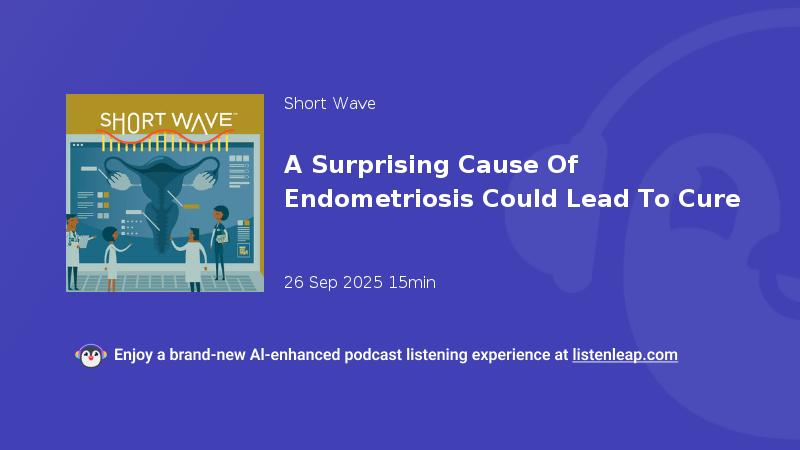
Katie has endometriosis, a disease where the tissue that lines the inside of the uterus grows outside of the uterus, often causing debilitating pain and fertility issues.
Because of her pain, Katie avoided making friends for fear of having to cancel plans.
I didn't live, I don't think, as long a normal teenager growing up.
The adults around katie told her the pain was normal, that they were growing pains and to ignore it you would get your period and it would hurt and you move on with life.
And that's what i did.
I don't know if they understood the magnitude of the pain.
Katie wouldn't get an endometriosis diagnosis until she was 20.
A diagnosis was validating, but it didn't provide relief.
To manage the pain and exhaustion, she would take naps during the week and sleep through the weekend.
She tried acupuncture, diet changes, even hypnosis.
One outlet that helped distract Katie from the pain was studying, which led her to a research career.
Eventually, she decided to study endometriosis.
As she published her findings, science reporter Meredith Wadman took notice.
I found Katie because this force of nature named Linda Griffith, who's at MIT and develops endometriosis organoids, put me on to Katie's work that was quite new and exciting and said this is worth looking at.
That new and exciting work revolved around the origins of endometriosis.
Previous thinking pointed to hormones as the root cause of the disease, but Katie's work was pointing in a different direction.
The first clue was that hormone treatments in people with endometriosis didn't always work.
You can quiet disease, but you don't cure it.
You don't get rid of it.
Then an experiment in mice showed a completely unexpected result.
I tried to convince myself that I did something wrong.
The data wasn't making sense.
Katie did the experiment over and over again and kept getting the same results.
It really showed that the immune system seems to be that important starting piece and not the hormone receptors.
Today on the show, science journalist Meredith Wadman tells us how researchers are piecing together the surprising origins of a disease that affects millions of people worldwide.
And how it could lead to a simple, non-invasive test, better treatments and, perhaps one day, a cure.
I'm Regina Barber, and you're listening to ShoreWave, the science podcast from NPR.
This message comes from the Michael J. Fox Foundation.
Did you know that every six minutes someone in the U.S. is diagnosed with Parkinson's?
It's the fastest growing brain disease in the world.
Chances are you or someone you know is impacted by Parkinson's.
The Michael J. Fox Foundation is on a mission to find a cure.
Now is a critical time for Parkinson's research, and your support will help drive progress toward a cure.
Get involved today.
Visit michaeljfox.org slash get involved.
This message comes from Dell Technologies.
Dell AI PCs are newly designed to help you do more faster.
That's the power of Dell AI powered by Intel Core Ultra processors.
Upgrade today by visiting dell.com slash deals.
I'm Peter Sagal.
NPR is very serious, mostly.
It treats newsmakers with all due respect, almost all the time.
It brings you the most important information about the issues that really matter, usually.
And it never asks famous people about things they don't know anything about, except once in a while.
Join us for the great exception.
Listen to Wait, Wait, Don't Tell Me, the news quiz from NPR.
So Meredith, before Katie and other scientists like her began looking into the immune system as a potential culprit for this disease, what was the main theory as to why researchers thought people were getting endometriosis?
Well, there've been theories about the cause of the disease dating back literally hundreds of years.
The most prominent and still the leading one, is that something called retrograde menstruation is leading to endometriosis in the people who get it.
Most menstrual blood goes out as it should, down through the cervix and out the vagina.
But some of it refluxes.
It goes back up the fallopian tubes, which are open-ended.
They open into the pelvic cavity.
And, believe it or not, 90 of women have some degree of menstrual blood going back out into the pelvic cavity.
Wow.
Why 90 of women don't get endometriosis.
That's the question that people are pursuing, in essence, by trying to get to the root causes of the disease.
And it's really well established that estrogen secreted by the ovaries as a normal reproductive hormone kind of supercharges this tissue that's growing where it shouldn't be and resists the calming effects of another key reproductive hormone made by the ovaries, which is progesterone.
So it's definitely driven, or not calmed, by these reproductive hormones, but we all have them and everyone doesn't have endometriosis.
This is really fascinating.
Research now is turning to the immune system.
Like in your article in Science Magazine, you write about a study that Katie did, that she had kind of this light bulb moment that she started connecting the immune system to endometriosis.
Like, can you tell me about that study?
Well, let me preface this by saying at the time, estrogen was the name of the game for many decades as the driver of endometriosis as the cause.
But at this point in time, which was kind of in the aughts, Katie did this experiment where the mice he developed were deprived of estrogen, their ovaries were removed and they were engineered not to have key estrogen receptors.
And, at the same time, the mouse donors whose uteruses were sliced up and injected also lacked estrogen receptors.
And what she found was that, even in the absence of this estrogen influence, the absence of the receptors, the absence of almost any internally generated estrogen, these mice developed rudimentary endometriosis lesions.
They weren't very healthy, they didn't thrive, they didn't grow, but they were there and they were getting established.
And that was a light bulb moment for Katie where she said something is helping these get established.
That does not have to do with estrogen.
Yeah.
And how did she get to the point where that something was related to the immune system?
Well, she went on to do further experiments in which she actually watched what happened in in these recipient mice in the earliest hours, 24 to 48 hours after the minced uterine tissue was injected.
And she found that the peritoneal cavity, the pelvic cavity essentially, was flooded with these innate immune cells called neutrophils and macrophages that were on the scene.
And she proposed out of this a model that said it's these cells that are needed to get these errant deposits of endometrial-like tissue growing where it shouldn't be.
And then only after about 72 hours is estrogen absolutely required and becoming the primary actor.
So since then have other scientists kind of connected the dots between endometriosis and the immune system.
Oh, yes.
There have been ranks and ranks of scientists, often unsung, probing the role of the immune system in endometriosis.
Yeah.
What are some of the things they found?
Yeah, they have found a lot and even more since that 2012 paper by Katie Burns.
They have found that natural killer cells that should be targeting and removing and zapping this misplaced tissue are few in number and they're not effective putting out the cell-killing substances they should be.
They found that neutrophils are hanging around the scene and getting old and being inflammatory instead of quick zooming in and doing their hoovering up function and disappearing.
And they found that macrophages, which are another early player at the scene of tissue turning up where it shouldn't be, are really helping the tissue launch and nurturing it as it gets embedded in places it shouldn't be, instead of vacuuming it up and removing it.
And genetics is clearly a piece of all of this.
Probably about 50 of endometriosis is down to genetics, but it's not simple and straightforward like there being an endometriosis gene.
So what does this mean for like treatment if the immune system is the culprit?
Like, given that a lot of endometriosis, like you said, focuses on estrogen therapies, what could be a different treatment?
Right.
So this is, you know.
What's really promising, and yet virtually almost entirely unrealized, is that the immune system could present targets for drugs that would be more effective.
And endometriosis in one woman or person is not the same as in another.
Like, it's more complicated.
And so what a drug that works for one person might not work for another.
But basically...
The immune system could allow, for instance, antibodies manufactured to attack a particular inflammatory product of the immune system, a so-called cytokine.
These antibodies could target these cytokines and basically calm everything down, stop the inflammation that is driving the pain in these people.
And there are other approaches, like a team at the University of Edinburgh that is just about to launch a human study of a drug called Nibrozetone, and it goes after macrophages.
I shouldn't say goes after.
It improves their ability to clean up cells that are growing where they shouldn't be.
So Meredith researchers have also started collecting menstrual fluid to try and understand endometriosis.
What have they learned so far from that?
Oh, they're learning a lot.
And really hats off to this group at the Feinstein Institutes for Medical Research on Long Island, who pioneered this more than 10 years ago, and we're getting laughed at.
And it was messy.
It was icky.
Why would you study menstrual blood?
And they persisted, and they have are well on their way to developing what's hoped will be a diagnostic test.
Why is that important?
Because right now the only way you can get an ironclad diagnosis of endometriosis is by having surgery and having it visualized.
And that really needs to change.
Yeah.
That would be amazing.
So, after reporting on this topic and like taking stock of what's been going on for 10, 15 years of research, what is your outlook for the future of this field?
I wish I could say that it was like fantastically exciting.
And it is by virtue of the researchers doing great things with not nearly enough money.
I want to note for the nth time that the National Institutes of Health, the world's largest funder of medical research, spent something like 003 of its budget on on this disease in 2024, which affects probably around 1 in 10 women of reproductive age.
Meredith, thank you so much for talking with us today.
I learned a lot.
I'm glad you did.
I really enjoyed speaking with you, Gina.
For her part, Katie is hopeful about her future research, while worrying about the future of research funding.
We have some really exciting discoveries that I want to take forward, but the uncertainty with NIH is palpable.
I have never felt such stress from everybody around me.
If I don't get grants approved, then the lab shuts down.
For the sake of endometriosis, for the sake of the young girls that are trying to avoid living the life that I did.
That's what drives me.
This episode was produced by Burleigh McCoy, edited by Amina Khan, and fact-checked by Tyler Jones.
The audio engineer was Robert Rodriguez.
I'm Regina Barber.
Thank you for listening to Shorewave from NPR.
Military commanders, intelligence officials, diplomatic power players.
They know things you may not about where the world is headed.
And we will pull back the curtain on what they're thinking on Sources and Methods NPR's new national security podcast.
Our team will help you understand America's shifting role in the world.
Listen to Sources and Methods from NPR.
Here at LifeKit, we take advice seriously. we bring you evidence-based recommendations.
And to do that, we talk with researchers and experts on all sorts of topics.
Because we have the same questions you do.
Like what's really in my shampoo?
Or should I let my kid quit soccer?
Or what should I do with my savings in uncertain economic times?
You can listen to NPR's Life Kit in the NPR app or wherever you get your podcasts.