Brought to you by the Capital One Venture X card. If you love to travel, Capital One has a rewards credit card that's perfect for you.
With Venture X, earn unlimited double miles on everything you buy and turn all of your purchases into extraordinary travel.
And you get premium benefits at a collection of luxury hotels when you book through Capital One Travel.
Plus, you'll get access to over 1 ,000 airport lounges worldwide.
Capital One. What's in your wallet?
Terms apply. See CapitalOne .com for details.
We have some breaking news right now from the Supreme Court that we need to bring in.
We're just getting a decision having to do with transgender care for minors.
Specifically, the Supreme Court upholding a Tennessee law restricting gender -affirming care for those minors.
The other states out there, 20 -plus of them, who have these laws, will also take great reassurance that the court is signing off on what they've done.
Advocates say today's ruling is a huge setback for trans rights across the country.
Hi, my name's Olivia.
We live in New Hampshire, and my 11 -year -old is likely to be impacted by this Supreme Court ruling.
He is on the verge of entering puberty and is likely to not be able to get the gender -affirming therapy that he needs.
Now, a lot of people might think, well, 11 years old, how does your child at 11 know anything about this?
And the truth of the matter is he has known since he was three years old.
And just to briefly share the story, he's—all of his meltdowns at this point, her meltdowns would end up in mommy, kill me now, mommy, I want to die.
And I really just didn't know what to do.
my husband and i were like at a loss of like well what are we doing so wrong that our child just wants to die we changed pronouns we allowed him to dress up however he wanted and never again has he had one of those meltdowns there was never any push to tell our child you should be a male he knew he always knew and he still knows and he has not wavered to him the idea of going into puberty is absolutely traumatizing our doctors have already told us brace yourselves for the worst you're going to have to either find somewhere in Vermont maybe Massachusetts Canada has some really good services which is crazy
crazy to think that this is the route that we have to go you've been in treatment for what over seven years the fact that they're taking that away leaves kids like mine just flailing like what do what do we do what do we do now From The New York Times, I'm Natalie Kitrowef.
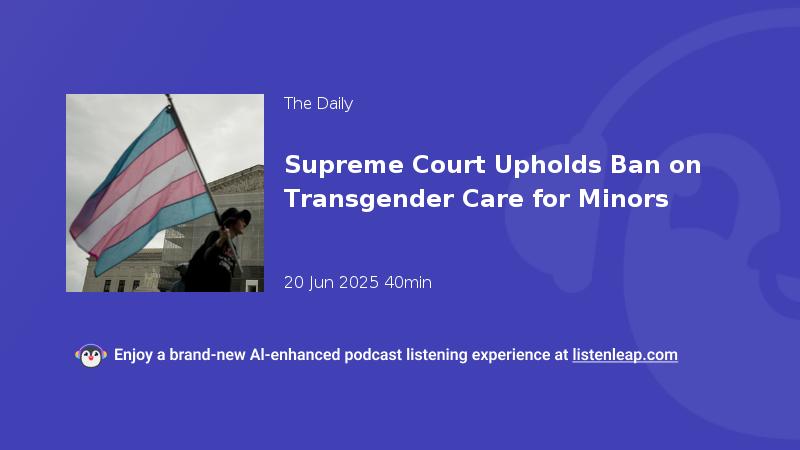
This is The Daily. This week, the Supreme Court handed down a landmark ruling that effectively upheld bans on medical treatments for transgender youth in nearly half the country.
In his majority opinion, Chief Justice John Roberts cited a lack of evidence over whether the care actually worked.
Today, my colleague Azeen Qureshi on the debate over what the science says and why the court's decision leaves families more in the dark than ever.
It's Friday, June 20th.
Azeen, it's so good to have you on the show.
Thank you for having me.
You've been covering transmedical care for years.
Put this ruling into context for me.
How important is it?
It's incredibly important.
So in the past few years in the United States, we've seen nearly half of the country pass these bans against gender -affirming care for minors.
So these are treatments like puberty blocking drugs, hormones, in rarer cases, surgeries that are used to treat adolescents with gender dysphoria.
So a deep sense that their inner sense of their gender does not line up with their bodies.
And this case was about one of those bans in particular.
And it was about the ban in Tennessee, which was passed in 2023.
And the case was brought by three families with trans kids and a doctor in the state of Tennessee.
And they argued that this Tennessee law discriminated against their kids based on their biological sex and their transgender status, that it violated the Constitution's Equal Protection Clause.
So on Wednesday of this week, the Supreme Court issued their ruling, and they upheld the Tennessee Ban 6 -3.
And they ruled that the ban did not violate the Constitution and that it did not discriminate on the basis of sex or trans identity.
And this decision also means that the bans that have been enacted in more than 20 other states can also stand.
And what was the court's reasoning behind the decision?
So the justices ruled that the ban in Tennessee is not sex discrimination.
And to argue that, they say, you know, for one, it's still available for adults.
Adults can still get this care.
And second, they say that it's about the use of these medications, why these medications are being used, and what they are being used to treat in kids.
So because they concluded that sex discrimination wasn't a factor in this ban, the ban is not subject to what's known as heightened scrutiny.
scrutiny. Instead, Tennessee just has to clear a really low bar.
They just have to show that they have a valid reason for banning these treatments in minors.
And here, the justices concluded that there were valid reasons.
And specifically, they pointed to the scientific questions that surround this care.
So Chief Justice Roberts makes this really clear in his majority opinion.
He writes that there are, quote, And he calls this an evolving field.
And he said that the fact that there are these questions, that there are these debates happening, means that they should be resolved by, quote, that these are not questions for the court to decide.
In a sense, this is basically a case like Dobbs, that case that overturned Roe, where the court essentially said this should be left up to the states.
And what Justice Roberts is saying, if I understand it, is that a state like Tennessee has a solid justification for a ban like this for preventing young people from getting this care because there are such live scientific debates around it.
Yes. He's saying that, you know, these are really active questions, open questions that the states should be able to weigh in on.
Okay, let's get into those discussions because I know this is something you've been reporting on for the past few years.
What is Justice Roberts getting at when he talks about these debates?
Take me into them. Yeah, so I think to really understand this, we have to go back to the beginning.
And the beginning is actually—it's not that long ago because this is a relatively new field of medicine.
So this approach to treating kids with gender dysphoria really started in the Netherlands in the late 80s, 90s, and really picked up in the 2000s.
And this involved a small group of doctors there who were starting to treat trans kids, who were seeing patients who, you know, had had and felt like they were basically born in the wrong bodies for most of their lives, who were approaching puberty and having a tremendous amount of distress about that.
And these doctors had already started to recognize that puberty was this really pivotal moment for this group of patients because they had seen in their adult patients that, you know, even though many of the adult patients that they worked with were really happy about being able to access these treatments to be able to get hormone therapy and surgeries, they were still having a lot of difficulty in their lives.
The Dutch researchers thought that was because they had gone through a puberty that did not match their gender identity.
So for a trans woman, she has already shot up in height, she has broader bone structure, she's got maybe an Adam's apple, a beard. Those are things that are going to make living as a woman harder for that person.
So this group of clinicians was starting to see these younger patients and they were thinking, this might be a way for us to have trans patients have better outcomes in adulthood.
They're basically keying in on this moment of puberty as a pivotal moment at which potentially they could intervene.
Yes, and lead to better outcomes for these patients.
And so the protocol that they came up with, it became known as the Dutch protocol.
They would treat kids with puberty -blocking drugs at age, around age 12, hormones at around age 16, so estrogen or testosterone.
And then in adulthood, these patients could get surgeries.
And the Dutch Protocol was not just these medications.
It was also their whole approach. A big part of the Dutch Protocol was this assessment period of six months to a year where they were regularly meeting with these kids, meeting with their families, asking questions about sort of how long the kids had felt this way about their gender, looking at, you know, other psychological issues the kids might be dealing with, other issues in the family, other issues at school.
It was meant to be this long period where the clinicians working with these kids could really be as certain as possible that they were treating the kids who were least likely to regret it in adulthood, to make sure that they were, at least in their eyes, picking the kids they were most certain would benefit from these treatments.
Okay, so it sounds like it was a pretty rigorous set of standards.
What happens next? So they're treating this ultimately pretty small group of kids, but they're also studying this group of kids.
And so they published their first research on how the kids who had gone through the Dutch protocol were doing in 2011.
And they found that on the whole, these kids were doing better.
They saw declines in depression and anxiety You know, they followed them up then through getting hormone treatment and getting surgeries.
And they found that these kids, you know, now adults who had gone through this treatment were comparable with, you know, cisgender peers in the Dutch population.
So really, like to zoom out, they found pretty promising results.
And those results immediately caught the attention of doctors worldwide.
So across Europe and in Canada and the United States, there was a lot of excitement about the possibilities for this new treatment option for these kids.
And what do those doctors do?
So some of them actually go to Amsterdam to observe the Dutch doctors and sort of their approach and assessment and, you know, how these kids are doing.
And then they go back to their countries and set up gender clinics.
So in the Nordic countries, in Western Europe, in the United States, clinics start opening up that are using this Dutch approach to treating kids with gender dysphoria.
And as more parents of trans kids are actually hearing about this possible treatment option, demand increases.
So more clinics are starting to open up to help meet that demand.
It's a small number of patients, but it's growing very quickly.
So in a really short time, you have this whole field of treatment taking off.
Exactly. And it's not just demand.
It's around 2015, demand increases a lot worldwide.
But around this time also, clinics around the world are reporting that the actual patients kind of seeking out this care are also starting to change.
So while in the early Dutch papers, it had been slightly more natal boys who had been coming in for treatment.
At around this, you know, mid -2010s time, it shifted really heavily to kids who were born as girls.
And there was a more sort of complex set of psychological issues, psychiatric issues that the patients were also struggling with.
And they were more likely to be kids who came out with with gender dysphoria sort of later in their teenage years after puberty.
Got it. It's a really different profile than the one you saw in the DUSH study.
Yes. And, you know, while this patient group is starting to change, the actual approach to providing the care starts to change too.
How so? So? So first is this sort of logistical issue.
In Amsterdam, everyone lived within a drive's distance, basically, from the Dutch clinics.
So people could go there regularly.
They'd be seeing the same clinicians, and they'd really be working with them closely over a long period of time before they got this care.
Right. But the U .S. is a big country.
You know, in the early days when there weren't that many clinics, patients would have to be flying across the country sometimes times to get this care.
And then also as the demand starts to increase, there isn't time to work with patients in this sort of slow long -term way before they can get care.
And there's also the question of whether health insurance would even cover long -term mental health care as a part of a process like this.
So there are these logistical problems that just sort of immediately became clear when this care came to the United States.
But then there's also this sort of philosophical shift that's occurring around this time in 2015.
There was a lot more visibility.
There was a lot more acceptance and understanding of trans identity as an identity.
And there were doctors who were questioning, you know, why should we be requiring these patients to go through six months to a year of assessment?
You know, why are we requiring that they go through therapy?
These are pathologizing practices.
You know, this is a sort of vestige of an old school way of providing this care, where we should actually just believe patients when they say they are trans.
Kids know who they are, and we should be following their lead.
It sounds like there's multiple things going on.
There's this sense among some of these doctors that the Dutch way of doing things just doesn't make sense in the U .S. It's taking too long logistically.
It's very complicated.
And then there's this other thing you're pointing to, which is this fundamental disagreement with the approach on the basis that there's a sense it forces people into proving that they deserve the care and that that seems unfair to these doctors.
Yes, that is right.
But, you know, over the years, as this shift is happening, some providers started speaking out about their concerns, basically just saying that, you know, a lot is changing really quickly.
Do we know that what we are doing is doing right by these kids?
And this is not just in the U .S., this is across the world.
You have doctors and clinicians in the U .K., in Sweden, in Finland, and in the U .S. And I have to ask, Azine, whether some of that concern is around the fact that the only evidence that existed up until this point was the Dutch protocol, which, as you said, was based on a different approach with this earlier, smaller group of kids.
Yeah. So some of them are very clearly pointing to the Dutch protocol and saying, look, we are seeing a really different group of kids than what the Dutch doctors first, you know, reported these positive results about.
Are we sure that we are treating all of the right kids?
Are we sure that there aren't other reasons, other problems that some of these kids might be having that might be leading them to experience distress about their gender?
And specific to the U .S., is this shifting approach happening in some clinics here or most, or what do we know about that?
So Reuters actually did an investigation in 2022 where they spoke with 18 clinics in the United States that provide these treatments.
And none of the clinics had the sort of months -long assessment process that the Dutch described.
But seven of these clinics actually said that that assuming there were no red flags, that the parents were on board and, you know, in line with their kids' feelings, that they would feel comfortable prescribing puberty blockers or hormones on the first visit.
So that's just, you know, again, we cannot draw conclusions about how every clinic is practicing here.
This is clearly some clinics and not all clinics, but a lot changed really fast. You've talked about the Dutch Protocol as obviously the evidence that that jumpstarted this field of care?
Was there any evidence to support this newer approach?
Well, the Dutch data was definitely the strongest data that we had at that point.
But the clinicians that had been treating these kids, they also had their clinical experience.
And what they said was they saw countless times in their exam rooms, kids who came in feeling feeling depressed, not socializing in life and going through transition and thriving.
They saw that this care could actually be life -saving for some of these kids, that it's not just about these small improvements, that this is really this profound help for these kids and that it really mattered that they were able to access this care.
And it's not just the doctors that are saying this.
It is parents who are saying this.
It is trans kids themselves who are saying this.
It's this firsthand experience of how important this care can be.
Right. What you're talking about is a really deep shift that these doctors are seeing firsthand, and they're saying, we shouldn't ignore this.
This is improvement, and we're watching it happen.
Yes. But the problem with that is the clinical experience is fundamentally different from data, from what you get in a study or a controlled study.
In evidence -based medicine, you need data and you need clinical experience, and you can't go based on clinical experience alone.
And at the same time, there were people starting to come out and publicly express that they had a really negative experience in this care.
So it's a small group of patients who were getting a lot of attention for saying that they did not get the care that they needed, that their doctors actually neglected them or weren't paying attention to other mental health issues that they had and that they actually regretted transitioning.
Right. This was anecdotes on the other side.
Yeah, exactly. And this has all been playing out very publicly.
And around 2020, some European countries with nationalized health care systems, they're pointing to the rising numbers.
They're They're pointing to the small numbers but still increased number of people who are speaking out about detransitioning.
They're pointing to the fact that these are treatments with lifelong impacts for kids.
And they say we need to actually take a step back and look at what the evidence actually tells us here.
And they commission what are called systematic reviews of the evidence.
And what do those reviews find?
So they pool all the studies they can find.
They grade them based on how strong the studies are, you know, how big they are, how long they follow up patients for, whether they had a control group.
And then they weigh everything together to basically figure out how confidently can we conclude that a treatment led to a specific outcome.
And basically, these countries do these systematic reviews and consistently they find that the evidence in this field is weak.
that even though a lot of these studies are reporting positive outcomes that line up with the clinical experience that we're hearing from these doctors, there's a lot of uncertainty in what we can actually conclude from that.
And probably the most high -profile version of one of these reviews was out of England, and it was called the CASS Review.
That came out last year.
It was commissioned by the National Health Service in England and led by a pediatrician named Hillary Cass.
And, you know, like the other reviews in these other countries, it concluded that the evidence to support these treatments was, and these are her words, remarkably weak.
Not that this treatment doesn't work for some kids, but that we just don't have a strong enough understanding of who these kids are and who is going to benefit into adulthood.
And the report goes on to say that, you know, The evidence was actually being interpreted by people on all sides of this debate as telling us something a lot more clearly than we actually know.
That the certainty is being exaggerated on all sides about both the benefits of this treatment and the harms. I remember when this report came out, it was extremely controversial at the time.
Yeah, so it's absolutely a controversial report.
There have been multiple critiques that have been published about it since.
And, you know, one of the big things was that Dr. Kass had never treated these kids, that she was really missing that critical component of clinical experience that we were talking about earlier.
I think Dr. Cass would reply that she didn't just look at the evidence.
You know, her team interviewed a thousand people, patients, parents, doctors who are providing this care.
And she found that there was actually not a clear clinical consensus, that there were doctors who had really, really positive accounts of what this care could do.
But she also heard from doctors who had real concerns.
So based on the recommendations of the CAST report in the UK, the NHS stopped routinely prescribing puberty blockers, and they limited prescription puberty blockers just to clinical trials.
They said that prescribing hormones to teenagers 16 and up should be prescribed with extreme caution.
They basically scaled back how the care could be provided in England.
And we saw this in some of the other European countries, too, that they said that psychotherapy should be the first line of treatment or that treatment should be reserved for extreme cases or cases that just match the original Dutch protocol populations.
But it's also really important to note that it's not all countries.
Germany has actually taken a really different approach where they said, yeah, the evidence is uncertain, but they said, we're going to value clinical experience more, and we're going to continue to recommend this care.
So this is absolutely a live issue that is playing out in all of these countries, and they're coming to really different conclusions about how the care should be approached.
What happens in the U .S.?
How is it received here?
So it played out really differently in the U .S., as opposed to the European countries that I just described, where this discussion is really being led by the medical authorities and the medical groups.
In the U .S., this debate has mostly been playing out in the politics.
So the medical groups in the U .S. haven't really engaged with these questions about the evidence.
They have really been focused on pushing back against these bans.
And I think there has been a fear that raising questions about the evidence will somehow further politicize this care.
And then, of course, like clockwork, when the CAST report dropped, it was immediately weaponized.
It was immediately sucked into this political fight.
You know, all of the questions that are being raised about the evidence are used to argue that these bans are justified.
And it actually came up this week in the majority opinion written by Chief Justice Roberts.
And he actually cited directly from the cast review for reaching his conclusions.
And he said that we cite this report and NHS England's response, not for the guidance they might provide on the ultimate question of United States law, but to demonstrate the open questions regarding basic factual issues before medical authorities and other regulatory bodies.
So he's saying, look, these are valid discussions to be be having.
And in this country, that means letting states decide whether they want to ban this care.
We'll be right back.
This podcast is supported by Strawberry .me.
Unlike any class, book, or podcast, Strawberry .me Career Coaching gives you something truly unique.
A professional partner who's 100 % focused on your success.
It's not just advice, it's like therapy for your career.
Your coach will ask the right questions, helping you uncover hidden strengths, break through obstacles, and move forward with confidence.
If you're ready to unlock your full potential, Visit strawberry .me slash thedaily to claim your $50 credit.
That's strawberry .me slash thedaily.
I gave my brother a New York Times subscription.
She sent me a year -long subscription so I have access to all the games.
We'll do Word Old Mini, spelling bee.
It has given us a personal connection.
We exchange articles.
And so having read the same article, we can discuss it.
The coverage, the options, it's not just news.
Such a diversified desk.
I was really excited to give him a New York Times cooking subscription so that we could share recipes.
And we even just shared a recipe the other day.
The New York Times contributes to our quality time together.
You have all of that information at your fingertips.
It enriches our relationship, broadening our horizons.
It was such a cool and thoughtful gift. We're reading the same stuff.
We're making the same food.
We're on the same page.
Connect even more with someone you care about.
Learn more about giving a New York Times subscription as a gift at NYTimes .com.
OK, I want to talk about what's going to happen to patients and to families as a result of this ruling.
What do we know? So I think, you know, in the states where bans have been passed, families have already been navigating these really, really difficult situations.
situations. So I spoke with a provider who was the head of a clinic in a state where care has been banned.
And he was talking about even with the existing patients that they had in his clinic, they were facing these really difficult scenarios.
Kids on puberty blockers will now not be able to continue on to hormones in this state.
Patients could not change medications that they were on.
They could not start new medications.
And I'm hearing from a lot of families that are having having to go out of state to get this care.
I was talking with a parent the other day who the care got banned in their state.
So they went to the state next door.
They got their kid into a clinic there.
And then the care got banned in that state.
And so now they're having to go to a state, you know, four states over where they're having to drive really long distances to get this care.
There are families who I have talked to who have moved to blue states in order to get this care for their kids.
Just relocated altogether, together, not just traveling, but total relocation.
Yeah. And when you talk to these families, it's like not an option for them to stop treatments that they've already started for their kids.
I've heard from parents of kids who, you know, from the age of three or four, their kid has identified as the opposite gender.
You know, some of these kids are even in school.
They are just boys or girls in school.
They're not trans boys or girls.
Like this is something that is so part of their lives.
And for a kid who's on blockers, you know, stopping that is going to see that kid going through a puberty that does not match their gender identity.
So forcing those changes just does not seem like an option for these parents.
And they're going to go, you know, to the ends of the earth to find this care for their kids.
And Azeen, for those families and patients who have either moved or are going to blue states, how are they feeling right now?
I obviously, when the Trump administration is attacking trans rights, generally speaking.
And I have to wonder whether even in blue states, there is some sense that this care could be at risk.
Yeah, I would say that there is a really broad sense of uncertainty and fear right now.
The state bans are just one part of how this care is being approached in the United States As of today, it will henceforth be the official policy of the United States government that there are only two genders, male and female.
President Trump, from the day he took office, has really gone after this population and this care.
I also signed an order to cut off all taxpayer funding to any institution that engages in the sexual mutilation of our youth.
He put out an executive order saying that hospitals that provide this care are at risk of losing federal funding.
And now I want Congress to pass a bill permanently banning and criminalizing sex changes on children and forever ending the lie that any child is trapped in the wrong body.
This is a big lie. I think that the clinics in the blue states are also feeling a lot of pressure, and we've already seen this from some clinics that have announced that they are closing.
Probably the most notable example of this is the gender clinic at Children's Hospital Los Angeles, which was the biggest clinic in the country, announced that they were shutting down.
And they actually cited all of the pressure from the Trump administration and just the liability concerns they're facing right now.
And look, there is a lot going on here.
We can't say that that was directly as a result of the Trump actions, but these clinics are absolutely facing pressure.
And I have tried to reach out to clinics in blue states that I have heard patients are, you know, getting on wait lists for, you know, driving across state lines to get care at.
And frankly, none of them will talk.
I think there is a sense that no one wants to have a target on their backs.
No one wants to draw attention to themselves in this moment.
So when I've spoken with parents, they actually spoke with a mom yesterday who said that, you know, she is in these networks with other moms and they have spreadsheets that they're constantly updating with which clinics are accepting new patients and, you know, how long the wait lists are where and which clinics have shut down.
and it's very hard to get that information because it's happening as we speak and there's a lot of uncertainty so I don't want to say that clinics in blue states are all going to be shutting down I don't think we know that but I think everyone agrees that this is not just a red state issue at this point right what you're saying is that even in places where the care is legal you're starting to see the effect of these threats by the Trump administration like the threats themselves cells are so credible and potentially damaging that hospitals and clinics in these states are starting to react.
Yes. And the ruling this week, while it doesn't directly impact these blue states, the Trump administration has made clear that they do not think that hospitals should be providing these treatments.
The Department of Justice has said that they'll prosecute doctors.
The FBI has asked for tips about doctors that are providing these treatments.
I mean, it's just coming from from all sides.
And of course, anything that actually happens will likely be challenged in court.
Advocates and civil rights groups that are fighting these legal fights will absolutely challenge those actions in court.
But the actions of the Supreme Court this week basically take one really powerful legal argument that they could make, that this is sex discrimination against trans minors off the table.
And there are other arguments that they could make and that they will will make.
But this just hurts their ability to fight this with everything that they can.
The point being, the ruling could actually, potentially, we don't know, indirectly have an impact on the availability of care in blue states because, in a way, it sort of defangs a potential legal defense against these Trump actions.
Yes. One legal defense, but one pretty powerful legal defense.
You know, we've talked about these parents and families who are navigating this moment while being in the middle of this care.
But this ruling kind of sets the U .S. on a path that is going to be the way we look at this care in the future, this patchwork of laws where in one state it's banned and they're telling you that it's, you know, terrible for your kids.
And in the other, they're telling you that it's lifesaving.
And I have to ask about all of these parents who aren't on this journey yet, but might be soon.
And where that leaves them.
Like, what do you do in a situation where you're getting such conflicting messages?
Yeah. All of these parents and all of these families that I've spoken to, no matter where they stand on this issue, just want, you know, clear guidance on what is the best thing for their kids.
And I think, you know, something that the bans do that doesn't get enough attention is that it's also shut down a lot of institutions in the United States that were producing the research that we need to answer some of these really big questions about the best way to support these kids and, you know, which kids will be most likely to benefit and what helps them.
Right. There's something ironic in that the reason why these bans were put into place in the first place is in part because of a lack of evidence.
And you see the Supreme Court seizing on that in its ruling.
And yet the situation we're in now makes it harder than ever to gather that evidence.
evidence. Yeah, it's unclear what the evidence tells us.
It's unclear which doctors to listen to.
What state you live in determines whether you can even get access to this care.
So it's just making what should be a purely medical decision into more and more of a politicized issue, which just makes it harder for these families to navigate what to do.
Azeen, thank you so much. Thanks for having me.
You can hear more of Azeen's reporting on this story in a new six -part series from NYT Audio called The Protocol.
It's the full story of the history of this care and how the medical questions came to be so consumed by the politics in the U .S. Search The Protocol anywhere you get your podcasts.
We'll be right back.
I'm Anna Martin, the host of the Modern Love podcast. In every episode, we peek into an intimate corner of someone's life and learn about what love means to them.
You know, I can tell you, 35 years with another person, I've never spent that much time with anyone else either.
So we both kind of said I love you pretty fast. My advice is that it's okay if it's hard. You can listen to Modern Love wherever you get your podcasts.
Here's what else you need to know today.
On Thursday, President Trump pushed back his timeline for deciding whether to attack Iran, saying he would make a decision within the next two weeks given that there's what he called a substantial chance of negotiations with Iran in the near future.
Trump had spent the last several days openly considering the possibility of ordering American forces to bomb Iranian nuclear sites and had suggested that strikes could be imminent.
Foreign ministers from Britain, France and Germany are planning to meet with their Iranian counterpart in Geneva on Friday in hopes of de -escalating the conflict between Iran and Israel.
If the talks take place, they'd be the first face -to -face discussions between Iran and the West since Israel began attacking the country last week.
In a TV interview on Thursday, Israeli Prime Minister Benjamin Netanyahu said Israel can achieve all its goals in Iran alone, saying it was up to Trump if he wanted to join in or not.
Netanyahu said regime change in Iran wasn't one of those goals, but could be a result of the aggression.
Today's episode was produced by Shannon Lin, Nina Feldman, and Stella Tan.
It was edited by Devin Taylor and Lisa Tobin.
It contains original music by Diane Wong, Dan Powell, Marion Lozano, and Alicia Baitube, and was engineered by Chris Wood.
Our theme music is by Jim Brunberg and Ben Landsberg of Wonderly.
That's it for The Daily.
I'm Natalie Kitchoew.
See you on Monday. mechanics behind big debt crises.
Larry Summers says Dalio's brilliant, iconoclastic approach is an invaluable resource, and Hank Paulson says it provides a solution to what is the biggest and most certain threat to our prosperity.
Read it to understand the greatest economic issue of our time.
Available now wherever books are sold.