A quick note before today's show.
The Sunday Daily is meant to be a break from the week's news, which is exactly what today's episode is.
But there is big news this weekend.
A massive winter storm that will affect at least half the country.
And the second fatal shooting of an American citizen by federal immigration agents in Minneapolis.
We're going to bring you the latest on both of these stories starting on Monday.
Okay, here's today's show.
From The New York Times, I'm Michael Barbaro.
This is The Daily on Sunday.
The Neanderthals' struggle for survival must have been difficult.
He knew nothing about growing food or of making pottery or weaving.
For 150 years, we thought we knew what Neanderthals were.
Primitive, brutish, and generally inferior to humans.
Scientists are fairly certain that the Neanderthal never attained a highly developed social organization.
But in the past year alone, a raft of major new studies touching on everything from the nuances of their love lives to their elite hunting skills have made one thing abundantly clear
We badly underestimated the Neanderthal, and it's now time for an official re-evaluation of the species.
Today, my colleagues Carl Zimmer and Franz Litz explore the scientific revelations that are vindicating our closest ancient relative.
It's Sunday, January 25th.
Franz and Carl, welcome to the Sunday Daily.
Thanks for having us.
Yes, thanks.
So, both of you are longtime students of Neanderthals.
And that's what we're going to be calling them, Neanderthals, because we are not Neanderthals.
We know the difference.
Okay, all right, okay.
I'm a Neanderthal guy, but I totally accept Neanderthal people as well.
I welcome all people who are interested in these critters.
So I'm curious, what is it about them that has captivated you for so long?
Franz, let me start with you.
Well, when I was in fourth grade, there's a wall in the classroom that displayed this huge chart called the March of Progress, which was subtitled The Road to Homo Sapiens.
Supposedly it showed the 25 million years of human evolution and the first figure on the left was a stoop chimp.
And from there, every hominid got progressively straighter.
So there's Java Man, Peeping Man, who my teacher jokingly referred to as Peeping Tom Heidelberg Man, Nanderthal Man, Cro-Magna Man and finally modern man.
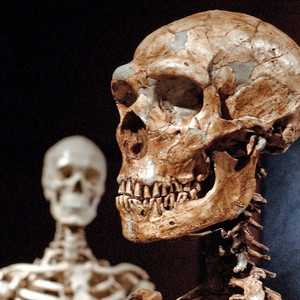
Now Neanderthal man has had this kind of gnarled face and he was shaggy and he looked like a cross between Yogi Berra and a hairball.
And he was a sad caveman who kind of bridged the gap between monkeys and modern man.
Neanderthal was always represented as this kind of low-hanging fruit on the family tree of humanity.
So it was from that point that I really became interested in Neanderthals.
And Carl, your captivation story.
Well, I was always aware of Neanderthals.
I mean, ever since I was a kid.
I mean, everybody was.
Everybody is.
And it's kind of weird that we all know what Neanderthals are.
But that's just because Neanderthals have this hold on our imagination and they've had that hold for over a century.
And then, as a journalist, I started writing about evolution and I started writing about Neanderthals.
And pretty much every story I would write about Neanderthals was about some kind of science that was overturning all those old ideas that we all share about Neanderthals.
And it turns out that they're just way cooler than people gave them credit for.
Well, that's going to be what we are talking about here how our collective understanding of Neanderthals has really dramatically changed over the past few years.
But before we jump into that history, I think we need a really basic definition of a Neanderthal to work from.
So, Carl, I'm nominating you for that.
A Neanderthal belongs to a lineage of humans that split off from our lineage about 600000 years ago.
And so, while our species was still evolving in Africa, Neanderthals expanded into Europe and into parts of Asia and the Near East, and they flourished across that whole area for hundreds of thousands of years.
And then, around 40,000 years ago, they disappear.
Got it.
Basically...
They're long-lost cousins to humans.
They're another branch on the human family tree.
Okay, so back to this idea that we misunderstood these cousins of ours.
Where does that story begin, Franz?
Well, in the summer of 1856, quarry men in Germany's Neander Valley which has got to be the only place in the world where calling a local a Neanderthal is not an unambiguous insult dug up part of a fossilite skull with a receding forehead.
And so the foreman of the quarrymen thought it was a cave bear and he brought it to an anatomy professor at the University of Bonn and they decided it was a primitive member of our race.
Huh, and they concluded that Right away.
Exactly.
But it's confusing because they have this huge brow ridge and they have these other features that seem like you don't see them in the people walking around Germany at the time in the 1800s.
So what do we make of it?
And so people had all sorts of different theories.
Someone claimed that it was a Cossack soldier who rode too much on horseback and so on.
And then over the years, scientists started to find more fossils of this same mysterious species.
And they thought, well, what are these Neanderthals?
It was clear that they actually lived at some point across Europe and maybe beyond.
And it wasn't until the early 1900s that Neanderthals really came into focus, with the discovery of a complete skeleton.
And what happens with that complete skeleton, Franz?
Well, that's actually where the caricature of Neanderthal as a shambling simian derives.
And it was largely from a specimen called the Old Man of La Chapelle, which was excavated in southern France.
And paleontologist Professor Boole reconstructed it.
It was the first real reconstruction of a Neanderthal skeleton.
And he put it together almost like he was blindfolded.
The specimen had, in his view, chimp-like opposable toes and its head and hips jutted forward, is actually because there was a bent spine that kept him from standing upright.
So the skeleton was kind of sloppy.
Yeah, the reconstruction was wrong.
But this old man of La Chapelle, he becomes an icon.
I think partly because there was an illustration of what he looked like in real life and the artist took this reconstruction of this ape-like creature and then added on lots of hair, as if it had, like you know, a body covered in hair like apes do.
And this really just locked in this homo-stupidist image of Neanderthals as just being synonymous with savage or dumb or whatever you want.
And that really stuck for decades, for generations.
So basically, a pretty bad skeleton ends up as an illustration, presumably the same one Franz, you saw on the wall in your fourth grade classroom.
And that was the illustration that launched a thousand parodies and caricatures of the Neanderthal.
Yeah.
In fact it was even worse than the one on the chart I saw in fourth grade, because it was almost completely bent over.
And it wasn't until 1957 that the old man's dysmorphia was recognized as kind of being caused by several deforming injuries and severe osteoarthritis.
Yeah, just imagine that some aliens didn't know anything about modern humans and they found the skeleton of LeBron James.
And they said aha, here is this species, all of whom are like over seven feet tall and have incredible athletic prowess.
They would be surprised if they landed on Earth and actually got to see us all in all our variety.
And saw you and saw me.
Yeah, they'd be, wait a minute, you're not human.
So really it would only come much later as archaeologists would dig up more and more pieces of the Neanderthal skeleton from individual Neanderthals.
They could kind of start to get a picture of what the population looks like.
And indeed...
This was not a typical Neanderthal.
This was more an exception.
Exactly.
And it only was in the 1950s that scientists started to realize hmm, we kind of have a weird Neanderthal here.
But by then, it was too late.
Too late, why?
So the idea that Neanderthals were these shambling creatures, inhuman brutes, carried over into popular culture, most notably, I guess, in the 1953 film Neanderthal Man.
My transformation was complete within 25 minutes, the fastest period to date.
In which a mad scientist injects himself with a serum that he developed and turns him into a Neanderthal.
All my Basic animal instincts were enlarged and inflamed.
And the tagline of the movie is that he's half man, half beast.
What happens is he becomes a sex-crazed maniac who has to be put down.
Yeah, and that image of Neanderthals has persisted, I mean, even today.
Using fossil records, modern computer models are now able to reconstruct these primitive men.
Just think about Neanderthals that you see in TV commercials.
It's so easy to use Geico.com, a caveman could do it.
What?
Not cool.
Nobody has to explain to you what you're seeing on an ad.
It's a Neanderthal.
We all know.
We all recognize this caveman.
And this image kind of calcified into sort of a bias against Neanderthals.
It didn't just... applied to how they looked, it applied to their minds as well.
And honestly, this was a bias that you can find not just in pop culture but, for a long time, in science as well.
So that you would actually have these situations where paleoanthropologists would be going into caves and digging up tools.
And if those tools look like they were sophisticated well, of course, those must have been made by us, by modern humans.
They couldn't have been made by Neanderthals.
And that was just an assumption that was kind of baked into the research for quite a long time.
So if it was good, it was attributed to us.
And if it was If it was caveman-like, it was attributed to the Neanderthals.
Yeah, there was an assumption that Neanderthals were just incapable of all sorts of things that modern humans can do, and that that's the secret to why we're here and they're not.
Okay, we're going to take a very quick break.
When we come back, we're going to talk about all these new things we've learned about Neanderthals and how that is directly challenging our views of what our prehistoric cousins were actually capable of.
We'll be right back.
So when does this perception finally start to change?
I would say, you know, maybe late 1990s and into the early 2000s.
You know, as archaeologists are starting to take a fresh look at the evidence,
And some of the most exciting research actually involved doing something that people really thought was impossible, and that is to actually get evidence Neanderthal DNA out of fossils.
Oh, wow.
How do you even do that?
Well, what you do is you take a Neanderthal bone and you take a piece of it and you grind it into powder and you add a bunch of chemicals to it to see if you can isolate any surviving DNA in the bone.
And it turns out that you can.
Now, at first, scientists were able to get just a few little fragments out of it.
But over time their methods got better and better and they were able to pull more and more DNA out of these fossils.
And so that by 2010, scientists could say, we have an entire Neanderthal genome.
Wow.
All the DNA that a Neanderthal might have.
And you can look gene by gene and compare those genes to our genes.
And what was found when that comparison was finished, Franz?
Well, what it showed was that there was so much overlap that the only conclusion you could reach was that Neanderthals and Homo sapiens had interbred.
Huh.
And that is a big deal.
Why?
Well, you know, you have to start to think, well, what's involved there?
I mean, sex is involved there.
Yeah, sex, exactly.
And all that that entails.
In other words, that these were groups of people who would come into contact with each other somehow and there would be sex.
And not only that, but there must have been children produced from at least some of these unions, so that you would have these hybrid groups, modern human slash, Neanderthal kids running around and that they were cared for and that they could then pass down their genes.
Because pretty much all humans on earth today have at least a little bit of Neanderthal DNA.
It's different from person to person.
One person may have 1, one person might have 2, but we all carry this vestige of these Neanderthals within us.
Yeah, up to 4% or 5%.
And I think I have 2%.
Wait, how do you know you have 2%?
Because of those ancestry tests.
I actually went a little overboard when I was working on a book a few years ago.
I got my whole genome sequenced and had scientists not only show me what my Neanderthal DNA was, but actually give me a catalog of the genes.
And so I have this list of hundreds of genes that are my Neanderthal genes.
And Michael, you have a different combination of Neanderthal genes.
And Everybody does.
So it's really fascinating that you can start to appreciate Neanderthals on this incredibly intimate level.
I can see that in you, Carl.
But there's an interesting facet to that too, in that until very recently it was thought that anyone whose ancestors were strictly from Africa had no Neanderthal genes in them.
And that has been sort of scrambled lately.
Yeah, I reported on that.
People used to think that Africans did not have any Neanderthal DNA.
The idea was that humans expanded out of Africa.
They encountered Neanderthals, and then the descendants Europeans Asians, Native Americans inherited that.
But it turns out that people in the Near East appear to have moved back into Africa and had interbred thousands of years ago and brought with them some of that Neanderthal DNA.
So across Africa you can actually find people with a little bit of Neanderthal DNA, but it really does unite all of us.
And, in fact, when European anthropologists and archaeologists started realizing that Neanderthals were European, their ideas about Neanderthals started shifting, that there could be some intelligence there after all.
That's fascinating.
Well, talk through what the DNA of the Neanderthal really starts to reveal, especially about this idea of intelligence.
If you look at the genes in Neanderthal DNA that we know are related to building brains, they have a lot of the same ones that we do.
So when you take that into account, you take into account that Neanderthals had brains that were just as big as ours.
That's pointing you towards an image of Neanderthals as really intelligent.
So once we know how big this brain is and that it shares a lot of our DNA, suddenly all kinds of things seem possible.
Yeah, we're in a totally new chapter of studying Neanderthals and thinking about Neanderthals because of Neanderthal DNA, but also because at the same time as scientists were discovering Neanderthal genes, they were starting to take a fresh look at that archaeological evidence.
And not only that, but they would then go on to make even more discoveries in caves and other places around Europe, around the Near East, around Siberia.
Just to give you a few examples scientists have found sites where Neanderthals buried their dead bodies.
And they even put flowers and other sorts of decorations around them.
So think about what that means for someone's mind.
Think about what a Neanderthal is thinking about other Neanderthals.
Right, because a burial implies empathy, ritual, systems.
Exactly.
But that's just one of many examples.
So, for example, Neanderthals were able to make fire.
They had tools that they could use to start fires when they needed them, where they needed them, which is an incredible power to have, because that allows you to cook food or to have fires to create special materials exactly when you need them.
Right.
Fire on demand is... an essential innovation to modern life.
They were also innovative in the sense that they could melt tar to secure spear points on their weapons.
And then, right now, it's thought that they probably had a language of their own.
Wow.
They communicated to each other.
Yeah.
On top of that, scientists have actually found that they also like to look good.
They were aware of their appearance.
They would wear jewelry.
So, for example, one fashion item among Neanderthals was a necklace made of talons from eagles.
Maybe that was a way of saying I am a member of this group, or maybe it was a way of saying I am the top of this group.
It's saying something.
And there's signs that Neanderthals were making art, that they were making patterns on the walls of caves, for example.
And these kinds of discoveries just, they keep happening.
So just last year, for example, there was a study where scientists found what looked to be a 42000-year-old crayon that Neanderthals appear to have been using to make some of their art.
Wow.
And so scientists are using all of this evidence the archaeological evidence, the evidence from DNA to really try to understand.
Well, how did these people behave?
How did they act?
What were their societies like?
I mean, there was even a study last year that came to the conclusion that Neanderthals kissed people.
And so, you know, you start to look at these humans no longer as basically a you know, one step up from an ape and being a whole lot like us.
Right.
Lovers, fire starters, crayon users, jewelry wearers.
And from what you're saying, this re-evaluation of Neanderthals is still very much happening right now in real time.
It is changing really fast.
I mean, this is a kind of field that keeps us reporters very busy.
And, you know, scientists aren't just discovering new things about Neanderthals.
They're even discovering new kinds of humans.
Well, on that evolutionary cliffhanger, let's take a break and talk about this new kind of human when we come back.
So Carl, right before the break, you were describing how scientists have now discovered a new kind of human.
I know you have spent a fair amount of time trying to understand that new kind of human.
So introduce us to these people.
We call these people the Denisovans.
That name comes from a cave in Siberia called Denisova, where scientists in the early 2000s were digging up bits of bone and they started looking in them to see if they could find any DNA in them.
And a little pinky bone had some DNA that showed that it wasn't like living humans.
It wasn't like Neanderthals either.
It was a third lineage.
And so now, the way that scientists think about this third lineage, this third human, is that all of us Denisovans, Neanderthals and modern humans we all descend from some ancestral human group in Africa, maybe about a million years ago.
And then at some point, maybe 700000, 600000 years ago, The ancestors of Neanderthals and Denisovans spread out from Africa.
The Neanderthals headed west.
The Denisovans headed east.
And these Denisovans actually lived for hundreds of thousands of years across a huge area, because scientists are now finding little clues for Denisovans in other parts of the world.
They are even now finding bits of DNA and protein in fossils that had been discovered a long time ago and no one knew what to make of them.
So we have Denisovans in Tibet.
We have them in Taiwan.
We have them probably in the jungles of Laos.
They're all over the place, and we didn't even know they existed.
And now here they are.
And what do we know about what Denisovans looked like?
Is there an arthritic skeleton out there representing the Denisovans, basically a parallel to the old man of La Chapelle for the Neanderthal?
No, no, not like that.
No.
For about 15 years, we were in a pretty crazy situation where we were seeing all of this DNA from Denisovans, but from tiny little fragments of bone.
You know, a pinky bone here, a tooth here.
Scientists were even figuring out how to get Denisovan DNA out of the dirt in that cave at Denisova.
But what did they look like?
I mean, it was really hard to say because no one was finding their skeletons.
But there are a bunch of fossils of humans, but scientists weren't quite sure what to make of them.
That are already in museum drawers in places like Beijing, for example.
And so scientists have gone back and looked at these and said, hmm.
Are these Denisovans?
And you know, in a really spectacular case that I reported on not long ago, a whole skull turned out to be definitively a Denisovan.
And so if you want to think about what they look like, they had a massive head.
They had huge teeth.
They were quite tall.
Their bodies may have been more slender than a Neanderthal's body.
But they would have really stuck out if you had put them in a lineup with Neanderthals and modern humans.
They were their own people.
I mean inevitably.
That raises the question are there other humans out there?
We haven't even yet discovered.
I am quite confident that there are other humans that we have yet to find.
There are hints of them out there.
Even if you look at people's DNA, you can see that here and there, people have DNA that tells you that they have inherited from some ghost lineage.
So there are Neanderthals who have passed down their DNA to living humans.
Turns out Denisovans have as well.
So people in the Philippines or in New Guinea or in East Asia?
They have Denisovan DNA in them today.
So there was interbreeding with them as well.
And on top of all that, There seems to be some DNA that living people carry.
That looks kind of funny and it doesn't quite match other people's DNA and it seems like it might come from some of these other lost humans.
And we just have to go out and find them.
So Carl and Franz, what does all of this add up to for each of you?
What does it mean that we have these close ancestral relatives, that we didn't even know about, the Denisovans, and that we are so interrelated to Neanderthals?
And what does it tell us about ourselves?
That, especially when it comes to the Neanderthals, we had this need for so long to denigrate what turns out essentially to have been a previous version of ourselves.
A version of us that's still a part of us this day.
I mean carl, let's start with you.
I think it really highlights that for a long, long time, we have been trying to understand what sets us apart from the rest of nature.
We feel that we humans are super, super special uh, and so therefore, there must be this long, long list of things that make us different from everything else on earth and everything else that ever lived on earth, And I think when you look at Neanderthals, you see that they suffered from this perspective for a long, long time.
And now what they do?
Is they really force us to challenge ourselves about what it really means to be human?
If you talk to scientists about Neanderthals these days, they will call Neanderthals humans.
Now, they didn't have the same genes as we do like you can tell them apart from us and yet we were able to interbreed and carry some of those genes.
So if we think about, well, what about language?
What about making tools?
What about abstract kinds of thought?
All these sorts of things that we would say, like, oh, yeah, we've got that.
That makes us special.
No, it's not true.
It blurs out into our extended family tree.
And Franz, how are you thinking about this new understanding?
So for me the story of Neanderthals speaks to the whole tapestry of inhumanity of humans, how much they have to denigrate each other and call each other subhuman.
And throughout history, and maybe even prehistory, this pattern has emerged and found some of its worst manifestations in the Holocaust in the United States, in slavery.
I guess I hadn't really thought of it that way, but you're saying in some real sense, our inability to conceive that the Neanderthal is a lot like us.
That's very interrelated to some of our worst instincts as a species, as humans.
That instinct to immediately fear and be hostile to those we see as different.
Yeah, that's exactly how I feel.
One thing I hope for this new science and as people absorb it, is that they dismantle some of those mental images they have in their head about humanity.
That march of progress where, you know, you have some sort of superior human at the end.
Let's take that down and let's replace it with this much richer, more complex view of humanity that extends way beyond what we might have once been willing to extend it to.
Well, Franz and Carl, thank you both very much.
We appreciate it.
Thank you.
Thank you, yes.
Today's episode was produced by Luke Vanderplug, with help from Alex Barron and Tina Antolini.
It was edited by Wendy Dorr, contains music by Dan Powell and Marion Lozano, and was engineered by Afim Shapiro.
Special thanks to Devin Schwartz.
That's it for The Daily.
I'm Michael Barbaro.
See you tomorrow.