This message comes from the Center for U.S. Voters Abroad Foundation.
If you're a U.S. citizen living abroad, the Center for U.S. Voters Abroad
turnout projects online form will walk you through requesting your ballot in just five minutes.
Visit internationalvoter.com.
This is Planet Money from NPR.
Asher Speer is preparing for the biggest job interview of his life,
and he's feeling pretty nervous about it. There are potentially dozens of other
qualified candidates in the running, and Asher hasn't had a job in a very long time.
How long have you been unemployed?
11 years.
And why is that?
I'm a child. I can't have a job.
Yeah, we should mention Asher hasn't worked for 11 years because he is, in fact, only 11 years old.
I mean, I can do stuff like mowing people's lawns and stuff,
but these dang laws prevent me from a real pain job.
Dang you, child labor laws.
Dang you! Asher cannot wait to get his first W-2.
So this summer, when he and his parents were looking into potential fun camps,
they decided to send him to a place where he can pretend to join the workforce.
Where in the world are we right now?
The very nice, beautiful Biztown.
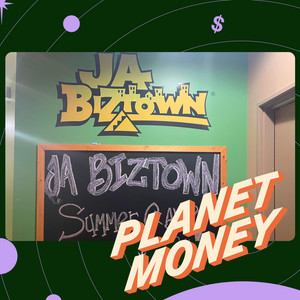
We are at J.A. Biztown Summer Camp. They happen all over the country. This one's in Portland, Oregon.
What does it look like in here?
Um, slight chaos. I mean, it is about 80, 90 kids, so.
This is not the kind of camp where you go canoeing or pop on a horse.
We did not see a child make a single friendship bracelet.
No, no. J.A. Biztown is a camp where kids between 10 and 14 years old
learn to fill out paperwork or open a checking account.
Let's talk about debit cards.
They learn how to track their personal spending.
Should you give your pen to anybody?
No.
Definitely not.
And how to calculate the interest on a loan.
Anyone know what an Excel spreadsheet is?
It's for words.
Yeah, it's a spreadsheet that adults use for lots of things.
In a lot of ways, Biztown is about giving kids a glimpse into adulthood.
All of these lessons lead up to the centerpiece of camp.
A day-long, simulated economy inside of a fake little town.
Biztown.
And Biztown runs on child labor.
The kids there take on jobs.
They can be a CEO or a chief financial officer or a regular worker bee.
One of the most coveted jobs is Anchor at the fake TV station, BZTV.
A lot of people also want to run for mayor.
As for Asher Speer.
I'm very much hoping that I get CEO of Unite as a key bank.
Asher is looking to be at the center of the financial action.
He wants to be the CEO at one of the two banks that fuel this whole miniature economy.
Technically, one's a bank and one's a credit union.
Why do you want Unite as a key bank?
Because the CEO is going to manage all the loans, and I want to manage business loans
because it's fun.
Asher and the other kids here pick their top three jobs.
They fill out an application.
And then it is time for their job interviews.
We catch up with Asher and a line of other kids,
all nervously clutching their paper application forms.
How are you feeling?
Ah, scared.
He's going to make it work.
When it's Asher's turn, he heads to a storefront in the corner of Biztown.
He sits down across from his interviewer, who's an adult volunteer at the camp.
Why do you want this job?
I'm good with money management.
I do stocks on the side.
I also have great leadership and social skills.
All around Biztown, Asher's fellow applicants are playing out similar scenes.
What skills do you have that will help you in a job at JABiztown?
I don't have a fear of public speaking, so I shouldn't freeze up,
and I am pretty good with improv and politics.
Um, I can speak with a loud and clear voice and pronunciate stuff.
I'm really good at spelling, and I am very confident.
Some of the kids are really selling themselves.
Really, I'm a fast typer, so I can get things done in an instant on computers.
Others go with radical honesty.
All right, are you a leader?
Uh, no, I'm not a leader.
Interviewers, this is your one minute line.
One minute.
The counselors score the applicants and sort them in what else?
An Excel spreadsheet.
Adults do use them for lots of things.
Then the kids gather to learn their vocational fate.
They sit crisscross applesauce at the center of Biztown.
The head counselor calls out their names one by one
to come retrieve the envelopes containing their offer letters.
And the kids wait for the signal to rip them open.
I have too much energy.
Like, I have the zoomies, like, my dog.
They really build up the suspense, huh?
Yeah, just, like, hand the envelopes out faster.
I want to know my job.
Finally, the big moment arrives.
Please remember, we will not change your jobs.
This is one week out of all the weeks in your life.
You will have lots of opportunities to try other jobs.
Are you ready?
Are you set?
Open those envelopes!
I have a CFO achieving!
Yay!
It's literally shaking.
I am shaking.
All around the room, the kids are frantically
waving their offer letters in the air.
Some seem disappointed.
But our aspiring banker, Asher Speer,
he got exactly the gig he wanted.
CEO of Biztown's local credit union.
CEO of Unitis, my dream job.
Oh my gosh, how are you feeling?
Good.
I've been wanting this job for, like, my whole life.
This week I went for it, I got it.
And what's that gonna mean?
I manage every single person's loans.
You're gonna make and break dreams.
Why do you want to manage all the loans?
I just like money.
Moneys.
Money.
Hello, and welcome to Planet Money, Money's Money.
I'm Alexei Horowitz-Gazi.
And I'm Sally Helm.
Summer camp is one of the classic American rites of passage,
a place where kids come to make new friends,
pick on new challenges, and learn a little bit about who they are.
But what if it were also a place where they came to learn how to survive
in a ruthless free market economy?
Today on the show,
Planet Money goes to capitalism summer camp.
We follow the money through this miniature economy
as the kids scramble to get out of debt to the banks.
If Shark Tank meets Lord of the Flies.
Available balance, negative $24.
We're encrypting debt.
Support for this podcast and the following message come from Wyse,
the app that makes managing your money in different currencies easy.
With Wyse, you can send and spend money internationally
at the mid-market exchange rate.
No guesswork and no hidden fees.
Learn more about how Wyse could work for you at Wyse.com.
This message comes from NPR sponsor Oracle Cloud Infrastructure.
AI may be the most important new computer technology ever,
but AI needs a lot of processing speed and that gets expensive fast.
Upgrade to the next generation of the cloud.
Oracle Cloud Infrastructure or OCI.
OCI is the single platform for your infrastructure,
database, application development, and AI needs.
Do more and spend less like Uber, 8x8, and Databricks Mosaic.
Take a free test drive of OCI at oracle.com slash planet.
Less than 24 hours after receiving their job offer letters,
80 or so kids gather at the center of BizTown.
They are ready to take this dollhouse economy into their own tiny pits.
J.A.BizTown citizens, attention!
J.A.BizTown citizens!
We are going to play our national anthem in just a moment.
The national anthem starts to play, they cover their hearts, some of them salute.
And just to paint the scene here, BizTown looks kind of like the set of a kids TV show.
It's essentially a warehouse with a ring of tiny storefronts facing a town square.
There are generic shops like a cafe and an old-timey general store called the Mercantile.
There are also brand name businesses,
companies that have actually paid the camp for the privilege of setting up shop here.
There's a little Walmart painted with the real Walmart blue with the real logo up top.
There's a UPS store, even an all-state insurance.
And today, all of these real-looking stores will be run entirely by children.
Coincidentally, some of the sponsors here also sponsor NPR, KeyCorp, UPS, and Comcast.
Anyway, as the final notes of the national anthem ring out.
All right, J.E., BizTown is now open for business.
The kids fan out across the room and take up their positions.
The CFOs scoot into chairs behind their little desks.
The Walmart sales managers put on child-sized blue vests,
pretending for the day to be a part of the American workforce.
And that is kind of the point of BizTown.
The nonprofit behind the program, Junior Achievement,
builds it in part as a way to give kids all over the country
a basic understanding of the free enterprise system.
Camp counselor John Duffy explains BizTown like this.
The core economic lessons that we're teaching is that the system relies on all parts of the whole,
that by taking care of yourself, you're taking care of the rest of society too,
because they're relying on you.
You know, I think it's a very like standard capitalist model.
It's like free market capitalism with some training wheels.
Absolutely. 100%.
And the first central economic lesson here is that the BizTown economy runs on debt.
All the businesses start their day with zero dollars.
Before they can do anything, they have to take out a loan from one of BizTown's two banks.
The goal for every CEO and CFO is to pay back that loan with interest by the end of the day.
To get their business out of debt before they get picked up by their parents.
So the first thing that all of the CEOs and CFOs have to do
is figure out the size of the loans they'll need to take out.
Do some math.
We walk over to the old-timey mercantile store.
It is decked out with an old kettle, a little tiny rocking chair.
There's an old-timey barrel in the mix.
There we find 11-year-old store manager Penny Petralia and her CFO,
Isla Hather.
They're adding up numbers and calculating their expenses for the day.
So we have advertising costs, property tax, health care, rent, philanthropy,
office equipment, business insurance, business sign, technology fees and utilities,
and then obviously the cost of what we have to pay everybody, which is kind of expensive.
Once they tally up their operating costs,
the CEOs of each business then have to get their loan applications approved
by one of Biztown's two banks, Keybank or Unitas Community Credit Union.
And that is where we find 11-year-old banking CEO Asher Speer.
Holding court as a string of pre-teen CEOs stream through with their loan agreements.
Asher, how many papers do you think you've signed today?
Easily 20.
Is your hand getting tired?
I'm good. I've trained for this.
You've trained for this how?
I signed stuff all the time. I need more pencils.
Now, Asher isn't doing due diligence on these loans.
He's not asking for collateral or pulling anyone's credit score.
No. His job here is just to make sure that each CEO has done their math correctly.
If it all checks out, he is able to approve their loans and transfer the funds.
And Asher is taking all of this super seriously.
Not only because he wants to do a good job, but because in his mind,
Unitas Credit Union is in a head-to-head competition with Biztown's other financial institution, Keybank.
Make more money than us.
Okay, so the goal is beat Keybank.
Yes.
Feed them.
And in order to beat them, Asher wants to collect all of his debts before Keybank can collect theirs.
His business rival is the CEO of Keybank, Elise Nicholas.
On the other side of town, she's going over her own stack of loan applications,
inside what looks like a real Keybank branch with fake marble columns and a big red key logo
over the entrance.
Elise is already in the thick of it.
She's going over the loan application from Biztown's cafe when she discovers a problem with their math.
The cafe, their loan amount is $129 and they wrote $159.
Okay, so it says loan rejected successfully.
We tell Elise what we heard over at Unitas Credit Union.
They're sort of hoping to beat you guys today. Do you feel that way?
Definitely. I mean, me and Asher were talking when we first got our jobs
and we agreed that we were business rivals.
Now look, there is nothing in the rules that says Keybank and Unitas are in competition.
But clearly, both of these CEOs just cannot resist the urge to win.
So Elise is taking her loan approvals extra seriously.
She bolts off to the cafe to tell them to resubmit their loan.
Excuse me, where is your guy's CFO?
Um, your loan was rejected because the information was wrong.
So I think you have to review it and re-enter the information.
Just then, Asher from the credit union rushes into the cafe to check up on his competition.
How are you not stressed?
I'm stressed. I had to reject a loan.
You rejected the cafe's loan?
Yes, they were wrong.
Eventually, the cafe does get the math right.
Elise and Asher approve loan after loan until finally, Asher has just one more left.
Then the next phase of Biztown will begin.
And then they just have to pay their debts.
All right, so you're almost done with getting them all into debt.
Now you need to get them to pay back.
Bingo.
Finally, all the CEOs have secured their loans.
Now the kids can focus on actually running their businesses and generating revenue.
And just like in the adult world, as the money starts flowing out,
you can see the gears of the economy grind into motion.
The workers get to work.
Employees at UPS wearing the company's signature brown uniforms
start distributing supplies to the businesses.
Utility workers in hardhats and vests start making the rounds to read the town's fake gas meters.
The construction workers appear to just be building a single Adirondack chair.
Do you know if this is a wrench or not?
That is a wrench.
Can confirm.
Finally, the counselors announce that it's time for the first shift of workers
to get their paychecks and go on break.
All right, everyone.
So we're going to start our first Red Group break.
So if you're not in the Red Group, you're going to keep working.
A third of the kids line up under fluorescent lights at the bank or the credit union to get
their money.
And that is where we find Edhem Alawadi, CEO of the Office Supply Company,
in line at the bank holding his executive-level paycheck.
I got $8.82.
How does that feel?
It's nice because other people make less and I got the most paying job.
All right, so you're at the top of the food chain?
I'm at the top of the food chain, yeah.
The kids are all paid in the local currency, which are called Biztown Bucks.
They look kind of like Monopoly money.
And as a CEO, Edhem is in the highest pay grade in Biztown.
CEOs get paid $9 per pay period.
That is before taxes, which are indeed deducted.
CFOs make $8.50.
And everyone else, the cashiers, the construction workers, the meter readers,
they all make a minimum wage of $8 flat.
This, of course, is one of the big places where the Biztown economy diverges from the real one.
The CEO at the UPS in Biztown, for example, makes exactly one Biztown buck more than the
lowest-paid delivery worker.
While in real life, the CEO of UPS has recently made more than 500 times the starting pay
for UPS drivers.
All right, so Edhem, highly paid CEO, but not that highly paid.
He steps up to a child bank teller.
Count number?
$240.
$240.
Gets his money.
And yes, I would like cash back $2.
Got you.
And immediately heads off to the cafe.
And this is where we see the next part of the Biztown economy spring to life,
as some of these workers transform into consumers.
Popcorn?
Yep, we have no snack.
Popcorn.
The cafe is already bustling.
Popcorn.
Popcorn?
I'll put it on my card.
What are you doing?
Popcorn.
Okay.
They're serving real sodas, rice crispy treats, and popcorn.
My goodness, everyone wants popcorn.
The cafe workers, again, all children, they are overwhelmed.
Holy moly.
Oh, it's already that messy.
It's madness.
And at one of the cafe tables, we run into Isla Hather,
the CFO of the old-timey mercantile store.
She is happily munching on her first bag of popcorn.
The person who took my order was like, what do you want?
Did they seem stressed at the cafe?
Yeah, I think I'm glad I've never signed up for a job like that.
That sounds very bad.
The service industry can be tough when things get slammed.
Yeah.
How are you feeling about your job so far?
Our company is in like $200 of debt, but pretty good.
Do you feel like you'll be happy or sad depending on how things turn out for the business?
I mean, you can ask the CEO, but like, eh, as long as I get everything I need.
And while that may not be exactly the kind of self-interest that Adam Smith had in mind in
The Wealth of Nations, it does feel like all around the room you can see the invisible hand
at work, as the kids scramble to supply the demands of their peers.
How much are those little squishy things?
The squishy balls?
250.
Can I use the other card for the 50 cents?
We only put the other card.
Squishy balls at Walmart are a hot commodity.
So are the sodas and bags of popcorn at the cafe, of course.
But the most coveted commodity in all of Biztown isn't really a commodity at all.
It's a puppy!
Well, it's a stuffed animal puppy.
Yes, it is available from Biztown's only nonprofit,
The Humane Society, for a $9 adoption fee.
And as we look around the town, it starts to become clear that some businesses should
be able to make a profit no problem, while others seem like they might be kind of doomed
to default on their loans.
I mean, the cafe?
Packed.
Walmart?
Pretty packed too.
Confusingly, a storefront called The International Sign Company is swamped.
Indeed, because they sell signs, but also apparently a coveted giant pencil.
I wanted one.
I mean, good luck!
However, some of the stores are not really bringing in customers.
Like, no one is spending their break at the copy and print shop.
No one really seems to want any old-timey products from the old-timey mercantile store.
And the company that seems most doomed to fail is Allstate Insurance.
Yes, they are selling fake car and life insurance to the kids of Biztown.
And keep in mind, children are maybe the worst possible market for insurance.
They have no dependents.
They are the dependents.
They haven't been alive long enough to understand long-term catastrophic risk,
and a lot of them think of themselves as invincible.
The Allstate employees are so strapped for customers that one of them actually pitches
us on a policy.
Can you guys buy some car and life insurance from Allstate, please?
Sorry, I can't, I don't think I have any Biztown bucks.
You think I need life insurance?
I'm a little older than you guys, I guess.
Yeah.
As the day goes on, this cycle of consumption repeats over and over again.
Yellow group, this is your two-minute warning.
Yellow group, two minutes.
Different groups of kids go on break and spend their paychecks.
Green group, you are now on break.
By early afternoon, the most popular items are scarce.
The cafe runs out of root beer.
There are no more giant pencils.
All the puppies are sold out for my break.
No way.
Yeah.
All the puppies are gone?
All the puppies.
Had you been saving up for it?
Yeah, I was saving up.
I had enough money.
Oh man, what are you going to spend it on now?
I don't know, I don't know.
These very popular businesses have been raking in the money and steadily making payments
on their loans.
But some of the businesses are struggling.
And that is a problem, not just for them, but also for our two bankers, Asher and Elise.
Remember, they are competing to see which bank will get paid back first.
So Asher decides to take matters into his own hands.
He drops by the old-timey mercantile store to see what's going wrong.
And he talks to Isla, the CFO.
You won't pay me a loan.
That's because we don't have any money to pay the loan.
How do you get the money?
By selling stuff and nobody's buying stuff.
So no one's bought anything here?
Not really.
Well, you won't do that.
Have fun.
Elise from KeyBank, meanwhile, has decided to skip her break entirely to keep working.
Why didn't you want to go and break, Elise?
I want to keep doing my job, because I only have a few things left.
And then I can help my employees.
Do you feel like you're a little bit of a workaholic?
Maybe.
I think next break I might probably enjoy it, but right now I really am on edge and want to get back to my job.
The kids are getting more and more frazzled.
And for CEOs and CFOs, the pressure to pay their debts is getting intense.
I mean, the interest is piling up.
And a few of them start to get creative in order to make more money.
For example, the biztown fire marshal, Nivalis de Padua, who works at City Hall,
he's decided to work straight through his break
in order to catch as many businesses as possible with code violations.
Still messy.
It was cleaned up!
Let me see, let me see.
You still want to!
Nivalis can issue fines for things like having a messy workspace.
Why are you going to work again?
Because we need to pay off our loan.
So you're just trying to get money for the city?
And fines are $60.
That's a lot of money.
Oh, that's a lot.
I'm trying to go do a complete route very quickly so I can get back around
so they won't have cleaned up by the time I'm around and I'll get to find them.
So you're trying to make sure that you almost trick them, almost make it harder than it should be.
You're nodding.
Another innovation?
The Comcast CEO Gabrielle Samore has decided to start offering additional Wi-Fi routers
to the other businesses for free so we can start billing them for extra Wi-Fi.
We've already charged every business for Wi-Fi, but we need more money than that.
So Wi-Fi routers are free now because more Wi-Fi routers equals more bills.
All right, so it's like a promotion.
Others might call that a scam.
I don't know, they're getting double Wi-Fi to know the problem.
But even with this frenetic push to make as much money as possible,
by the late afternoon, Asher at United's credit union,
he's still feeling the pressure when he looks at his books.
You know, they are full of outstanding notes.
None of the CFOs have paid their debts yet.
How do you feel about the fact they haven't paid you back?
Oh, I'm mad.
They're not giving me the money.
What happens to your business if you don't get the money back?
We go in debt and then we die.
But you'll go under unless they pay you back.
Yep.
After the break, will the children of Biztown be able to get out of debt to their lenders?
Or will a string of defaults cause the whole Biztown financial system to come crashing down?
And we learn that things in Biztown might not be as they seem.
Support for NPR and the following message come from Bolin Branch.
For the coziest bed this fall, start with Bolin Branch's organic cotton sheets.
To get 15% off and free shipping on your first set of sheets,
visit BolinBranch.com and use code NPR.
Exclusion supply, seaside for details.
This election season, you can expect to hear a lot of news.
Some of it meaningful, much of it not.
Give the Up First podcast 15 minutes, sometimes a little less,
and we'll help you sort it out.
What's going on around the world and at home.
Three stories, 15 minutes, Up First every day.
Listen every morning wherever you get your podcasts.
When voters talk during an election season, we listen.
We ask questions, we follow up, and we bring you along to hear what we learned.
Get closer to the issues, the people, and your vote at the NPR Elections Hub.
Visit NPR.org slash elections.
It's a high-stakes election year, so it's not enough to just follow along.
You need to understand what's happening so you are fully informed come November.
Every weekday on the NPR Politics Podcast, our political reporters
break down important stories and backstories from the campaign trail.
Do you understand why it matters to you?
Listen to the NPR Politics Podcast wherever you get your podcasts.
Apparently, I'm getting fined or something?
Yeah, for $40.
What?
As the Biztown simulation enters its final quarter.
Come on, Q4.
Things are getting heated.
Our bankers, Asher and Elise, are busy reminding their debtors that the clock is ticking.
And one by one, many of the businesses do start to pay off their loans in full.
But in the final minutes, there are still a few stragglers
struggling to get across the finish line.
All right, paper company, how are we doing?
Horrible.
Loans are not looking good right now.
Yeah, we need to do, we're due.
The CFO goes to double-check the company's account balance
when she notices something strange.
Oh, actually, never mind.
We have, we can repay our business loan of $200.
Yeah, we can pay back our business loan.
All right, do it right now.
Yeah.
So yeah, everything's doing great.
How did that change so fast?
I have no idea.
I just know of my job.
All I know is I'm at football and I'm ready to punt it at someone.
Somehow, the paper company has pulled it off.
They have gone from hopelessly insolvent to profitable.
Then we drop by the Mercantile store to check in with CFO, Isla Hather.
Yeah, all day, the Mercantile has been struggling.
And they are still about $100 in debt.
But when Isla checks her company's account.
Funds available for loan are paying $209.
What?
Okay, so some money has mysteriously appeared in your account?
We just got random money and none of us know how.
So I'm just going to give it to the bank to hopefully repay a few things.
A suspicious pattern seemed to be emerging.
Was this money coming from some sort of angel investor?
Was it a last-minute bulk order of old-timey curios?
Whatever the case, Isla types the remaining loan balance into her computer
to send it over to Asher and his team at United's credit union.
She holds her breath and then clicks confirm.
Our loan is fully paid off!
I've got to go find Penny.
Isla pairs across Biztown in search of her CEO, Penny,
who she eventually finds mid-shopping spree.
Penny! Penny! Penny! Penny!
All of our loans are paid.
Wait, how?
We have no dues!
Penny, how does it feel?
Good. I didn't expect that.
Why did we get $200? I have no clue.
But we probably paid off our stuff.
I don't really know. I'm excited.
Okay. What do you think's the lesson here?
Just be hopeful, I guess.
Just, like, don't give up.
Just hang in there?
Yeah. I'm going to go Walmart because I still have $5.
Some of these businesses have had a mysterious windfall.
The kids seem to chalk it up to luck.
Or hopefulness.
And over at United's credit union,
Asher Speer has been watching the loan payments come in.
Finally, he gets word that they have all been repaid.
We're done.
You're done.
Yeah, I'm just going to go tell KeyBank that we beat them.
Aw, this feels good.
Asher strides confidently into the middle of KeyBank,
where he finds his financial nemesis, Elise.
Hey, we beat you.
What do you mean?
We paid back our loans quicker.
Well, everybody else is paid off except Allstate.
Oh, Allstate.
They had an impossible task before them,
selling fake insurance policies to 11-year-olds.
The other businesses have somehow made ends meet,
but not Allstate.
In the last 10 minutes of the simulation,
we go over to visit them.
So far, they've only sold three policies to their kid customers
for a total of around $15.
We ask the CEO, Gweny Hayden, how they're doing with the loan.
Not very well.
Really?
Yeah, and I'm kind of stressing out
because we only have a little bit to pay it off, so yeah.
Do you think you guys are going to still have time to make it?
Gweny turns to her CFO, who nervously checks the computer in the corner.
How much money do we need for the loan?
$72.25.
Oh, so you still owe $72.
Yeah.
And how much money do you have right now?
Zero.
Zero dollars, okay.
No mysterious extra money for them.
But a couple minutes later,
one of the camp counselors comes to check in on the group.
Can I speak with the CFO?
Have you paid off your loan yet?
The kids explain, no, we're $70 in the hole.
The counselor tells them to sit tight
and heads quickly back to a computer at the center of Biztown.
We decide to follow her.
So what's happening over here?
It sounds like Allstate didn't get enough income to pay off their loan.
And so we have the ability to subsidize.
And so I'm going to add like $75 to their account
so that they can pay off their loan.
So this is where the money's been mysteriously appearing.
Yes, it has.
That we've seen popping up in accounts.
Yes, it has.
So now I'm going to go tell them to see if they can pay off their loan
and they should be able to.
Okay.
That's a pretty successful day.
I wouldn't call it a free market.
We're learning.
Isn't that what the point of this is?
The counselor walks back to Allstate
where the kids suddenly discover their last minute change of fortune.
They send the money over to KeyBank.
All of the companies have paid back their loans
thanks to this last minute capital infusion.
Some would call it a bailout.
Yeah, but they're too cute to fail.
Yes.
And there is something undeniably joyful and positive,
seeing the kids finally breathe a sigh of relief
as their financial woes fade into the background.
But it also cast what we'd been seeing at BizTown in kind of a new light.
Because on the surface when we first arrived,
BizTown seemed like this straightforward introduction to the free market.
But the fact that at the end of the day,
there seems to be no way for any of the campers of BizTown to fail
made it feel like they're coming away with a kind of rose-tinted view
of how our economic system actually works.
We asked camp counselor John Duffy
to explain what we'd seen in those crucial final minutes.
The big magic wand at the end of the day
is if they have put anything towards their loan,
we give them a subsidy for the rest.
Because sometimes the salesmen at Allstate only sell three policies
and they feel terrible about it, so then we come around with a subsidy.
And it's like, listen, you did what you could do.
You did the work.
So it's like, from each according to their ability,
you kind of give subsidies to each according to their needs?
Yeah. Yeah, yeah, yeah.
Isn't that just socialism?
It's, it's, uh, yeah, and sure, John says,
you could see what's going on here as a way of selling the free market to children
with all the warm, fuzzy feelings of socialist equality.
You know, capitalism with training wheels.
But that isn't the entire picture.
We realized Biztown is also kind of like an initiation
into some of the essential economic rituals of adulthood,
filling out a job application, cashing a paycheck.
It shows kids that we're all connected by the flow of money.
Listen, Jamie Biztown is now closed.
We are going to take the next five minutes
and we're going to tidy up our businesses
and try to make it look exactly like it did.
After the last loan has been paid and the last stuffed puppy has been sold,
the kids return to their little mini workplaces to clean up.
They're plugging in cables, putting pencils back in drawers,
arranging the paperwork into neat piles for the next workers of Biztown.
Finish your closing staff, closing the business off.
This is nice.
When you ask the kids themselves what they'll be taking away from their time at Biztown,
the epiphanies feel bite-sized.
What advice would you give to the next CEO of Unitis?
If you can, don't forget about paperwork.
And use your breaks well.
Get your money.
Get your popcorn.
Get your soda.
Sit down with some friends.
Drink and eat as quick as you can.
So it sounds like all this advice is kind of like how to not be too stressed.
Yeah.
So next time you'd say do some things to be less stressed.
Definitely.
Yeah, next time Asher would be more relaxed.
Maybe focus less on competition and more on another goal that he had also had that day,
which was to drink two different kinds of soda at the same time.
Because at the end of the day, going to Biztown is a chance for kids to just
vacation in the land of adulthood.
They are not yet permanent residents.
Even if someday they will have to join the big Biztown, where the rest of us live.
This episode was produced by absolute genius, James Sneed.
It was edited by Jess Jane and fact-checked by Sierra Juarez.
Engineering by Gilly Moon.
Alice Goldmark is Planet Money's executive producer.
Special thanks to Shannon Wakeman, Barbara Smith,
Jerilyn Breimer, and Tom Russell.
I'm Alexey Horwitz-Gazzi.
And I'm Sally Helm.
This is NPR.
Thanks for listening.
Christian nationalists want to turn America into a theocracy.
A government under biblical rule.
If they gain more power, it could mean fewer rights for you.
I'm Heath Drewson, and on the new season of Extremely American,
I'll take you inside the movement.
Listen to Extremely American from Boise State Public Radio, part of the NPR network.
Okay, so tell me if this sounds like you.
You love NPR's podcasts.
You wish they weren't interrupted by sponsor breaks like this one.
And you want to support NPR's mission of creating a more informed public.
If this does sound like you, then it's time to sign up for perks across more than 20 podcasts
with the NPR Plus bundle.
Learn more at plus.npr.org.