Hello and welcome to Women in Retail Talks, the podcast where C-suite executive women in the retail space share their stories of professional growth leadership development, personal journeys and more.
I'm Marie Albajez, Senior Editor of Women in Retail, a membership-based community of executive women at leading retailers and brands.
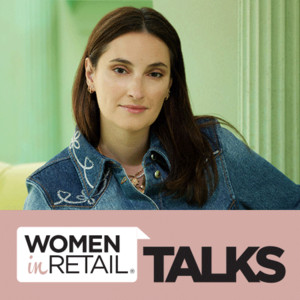
Today I'm joined by Anna Harmon, the CEO and founder of Studs, the ear piercing and earring brand that has sought to modernize the ear piercing experience.
Anna will share the origin story of Studs, how the brand is approaching the harmonization of digital and physical, and what lessons that she's learned along the way as a female startup founder.
So Anna, thank you so much for joining me.
Thank you so much for having me.
Yeah, I'm excited to hear about, you know, the origin story of Studs.
I've been following the brand since its launch.
And so I was wondering if you could kind of give us the origin of how Studs was started?
Sure.
So about five years ago now, I went to get another piercing, my second lobe, actually.
And I went to a very premium place in New York City, and I was told I would have to wait two hours.
They didn't take appointments.
And because it was quite premium.
I would have had to spend probably somewhere between 500 and 750 to get just one piercing.
And I thought to myself, that's way too expensive and I don't want to wait two hours.
And I ended up going to a tattoo parlor with my now co-founder to get my second piercing done.
And while the piercing experience was great at the tattoo parlor, I really liked my piercer.
My piercing was done with a needle.
The environment really wasn't meant for me and I felt very personally out of place.
And it was also expensive and I didn't really like the jewelry.
And I started to wonder at that moment well, if you're me and you want to go get an affordably priced piercing done with a needle, with cute jewelry, at a place where you feel is welcoming and safe and hygienic, where would you go?
And the answer was really the tattoo parlor.
And I felt like that was an inadequate answer.
Mm hmm.
What were you doing before then?
Are you, do you have a background in retail?
Like where did the entrepreneurship and you come out?
Sure.
Well, it's funny that you mention it because I feel like I've always been a little mini retailer.
So I used to.
When I was very, very little, I used to create stores in my room with all of my toys and I would resell all the things my parents had bought me back to them.
And so I feel like I've always had retail in my blood.
But in particular for the last few years.
Prior to starting Studs, I was working at Walmart actually.
So obviously, you know, Nations and maybe the world's biggest retailer.
And so retail has always been part of my career.
I love that story of you know.
You knew that it was.
You had a destination, you knew what you wanted, but there was obstacles along the way, such as you felt out of place, the earrings were too expensive and you wanted to kind of find a place where all of those problems could be solved.
And so walk me through from its founding until now.
What are kind of the significant milestones that you've had?
Well, we started with our first store, which is in Nolita in late 2019.
And we had just opened our second store in late February of 2020 when COVID hit.
And so obviously, COVID was the milestone that nobody wanted, and so we spent six months with stores closed in 2020 and then really uh, started reopening stores in 2021 and then into 2022 and 2023 and now have 23 stores.
I would say the most significant milestones along the way have been one opening the first store and really seeing product market fit for studs, meaning the customer was really excited about what we were doing.
And then, I think, really seeing, now that we're on store, you know 23 really seeing wow, this could be a big national brand.
And that's really exciting for us because obviously as a founder, you always sort of believe that.
And part of being a founder is having the confidence and sort of the imaginative thinking to be like the thing I want to bring to life will be things that customers want, but to see it actually come to fruition is very cool.
Yeah, that's awesome.
I bet that's such a great feeling.
And your audience is super interesting.
I mean.
From what I understand it's primarily Gen Z, which I think a lot of retailers out there are trying to get that generation to become their customer.
So how did you identify a gap in this market specifically for that target audience?
What do you think it is about studs that is appealing to Gen Z?
Yeah, so I would say our core audience is 18 to 35.
So obviously that includes Gen Z, but also millennials.
And Studs is really, that's meant for everyone, right?
So we pierce as young as 13 and we've had people in the studios who are over 90.
And so I would say we were very focused on making Studs highly inclusive, even if the branding is positioned toward Gen Z or millennial audience.
In terms of why I think it is appealing to that customer.
The most important thing I would say is my own experience of going to a tattoo parlor is many customers' experience and it is not their preferred experience.
It's suboptimal to them.
Said differently, sort of in more consumer speak.
Many of these customers have graduated from Claire's.
Claire's was an iconic brand for them when they were getting their first piercings and tweens.
And they're looking for the place that they're going to get either their second piercing and beyond or their 15th piercing.
And there really wasn't a place to do that that had a branded experience where you could feel confident that you were going to have an expert piercer and really great piercing jewelry options and feel like you were in a space that was inviting and you could take social media content in.
And so Studs was born out of this idea that the audience would want this.
And in fact, they do.
I like that you called.
I'm going to latch on to one thing that you said, which is I like that you call them studios.
Why is that?
I think you know, for us it's we're really focused on the art of ear scaping, and ear scaping is the combined art and science of creating, getting customized piercings up your ear and creating a personalized look on your ear.
And so that is for us both. piercings and buying earrings.
And so we wanted to name the physical environments in line with that idea.
Yeah, I have a note in here that you have that concept of curated earscapes.
And I'm glad you brought that up.
Can you share more about that and how you approach kind of designing these unique looks?
Yeah, so my co-founder Lisa, created the term and we trademarked it, which is really exciting, and obviously it derives from the idea of a tablescape and using your ear as a canvas to self-express.
And so, for us, we've been very focused on How do you actually combine the look that you're trying to achieve, which is, most people are not getting ear piercings to have holes in their ears.
They're getting ear piercings to tell the world something about themselves, right?
I feel cool today.
I'm eclectic, et cetera.
And so how do you actually use your ear as a canvas to self-express?
And then our piercers are really the experts at helping you do that, both in terms of your anatomy, i.e. what piercings can you get and what will look great on your ear in terms of jewelry.
So they're not just piercing ears.
They're recommending.
You know, this piercing would look good here with this type of earring, that sort of thing.
Exactly.
And so, for example, you know, asymmetry is really in.
So you want to focus on having asymmetrical piercings on your ears in order to create an optimal ear scape?
That's really cool.
What role, if any, does the customer and personalization really play into that?
The customer obviously comes in, I think, with ideas about what they're interested in.
One thing we realized when we were starting the business was the way many people get inspired to get more piercings is that they see piercings on other people their friends celebrities influencers, et cetera that they are inspired by.
And so the customer will often come in with an idea of what they want to accomplish.
And they've saved pictures typically on their phone or they've saved Instagram posts, etc.
Like they've made themselves a little lookbook.
And we try to sort of act in service of that idea.
So it's almost like I mean I walk into a hair salon with pictures of on Pinterest of what I want to do.
It's the same thing, but for hair piercings.
It's awesome.
So, you know, you mentioned that you target a younger audience.
I think you said 18 to 35.
And that audience, especially kind of the younger Gen Z, is primarily, you know, the e-commerce, social commerce shopper.
And yet, you know, you mentioned that you have 23 stores, 23 and I think – and counting, right?
It sounds like you're expanding.
Yes.
So what –
Where do you see kind of the digital and the physical?
I think the word, the trendy word that people are using is digital, right?
Where do you see that kind of working together as you're growing, as you're anticipating these new store locations?
What kind of impact will that have on customer engagement?
How are you tying digital and physical together?
Sure.
So one thing we're lucky obviously about is that you can't get your ears digitally pierced.
So physical was always not just the strategy but the only way the business could really come to life.
Right.
And so that has been great for us.
And then in terms of the digital experience, I would talk about it in two different ways.
One way is how do we think about our website?
What role does our website play in the customer journey?
And so we're really focused on creating a really wonderful booking experience on our website, hosting aftercare tips on our website, creating CRM experiences around booking and post-piercing that help you understand what's going to happen at your appointment and how do you heal your piercing.
So I think digital plays in really nicely to the service aspect of the business.
Then separately, there's our social channels, which are quite large.
And we really use those as the combination of inspiration and education.
And we call it often ear education.
We use a lot of puns.
And we're really trying to focus there on teaching people and helping people understand what piercings might you want.
Painful will it be.
How hard will it be to heal that piercing?
What will look great on your ear, et cetera?
I can't have a podcast episode lately without asking about AI.
And so you mentioned you're using your website a lot more through all these digital avenues.
Is there a place where AI comes together to kind of simulate the modeling of ear piercing?
People upload a They're ear piercing in the same way that I can go on Wayfair and sample a rug in my living room.
Is that something that you're exploring or any other kind of AI testing that you guys are doing?
It's interesting.
We're using AI more, I would say, internally as a company than we are in a customer facing way.
And so we're using a lot of the new AI creative tools to create imagery for stuff that we use on social on our website.
But I wouldn't say that we're using it yet for the customer.
Interesting.
Okay.
And correct me if I'm wrong, but you can also buy earrings digitally on your website, right?
Yes, yes, yes.
You can buy all of our earrings for your healed holes on our website.
Okay.
And so how much, how often are you kind of using one to drive folks to the other?
I think that there's this kind of at least we've seen in 2023 and 2024 this reinvigoration of stores in a way that we hadn't seen, you know, prior to the pandemic and certainly during the pandemic.
And so how are you kind of using the two to drive awareness and drive more customers to both digital and your stores?
Sure.
So one thing that we really focus on is that when we're opening new markets, we really try and hone in on where do we have a pre-existing e-commerce customer, because that is a good leading indicator for us of where we should open a store.
Similarly, we focus on how do you drive the retail customer to e-commerce?
And we do that through, pretty frankly, traditional mechanisms where you would prompt omnichannel behavior, like encouraging your retail customer piercing or hearing buyer who bought in store to purchase, for example, online on Black Friday.
Gotcha.
That makes sense.
So Studs has seen... pretty significant growth.
I mean, we've already talked about this since its inception five years ago.
So I'm curious about you know, I want to shift gears a little bit and talk about the company culture.
And here, you know, as you're growing, how is your company culture shifting?
How are you ensuring that your brand values are consistent and are still reflected as Sure.
So I would say one of our core brand values that's been in both the outward facing brand identity and internal brand and culture is we are all ears.
We use a lot of ear puns.
I love it.
Yeah, so We're All Ears means a few things.
One, it means we only focus on ears.
We only do ear piercings.
We only sell earrings, right?
It also means we're hyper focused on the art of ear piercing.
And then for our internal team.
It means we are extremely feedback oriented and very transparent with one another and really encourage open dialogue at the company level.
And that's been the case since the company's inception and is still the case today.
And I think one of the things that really draws people to want to work at Studs is that at Studs we are really focused on the employee being able to have a voice and really trying to elevate the employee in that way.
How does that look in practice?
Could you share maybe, an example of the feedback that you've given and received, or what that looks like on a day-to-day basis with your employees?
Sure.
So I visit stores frequently and employees will send me emails directly giving feedback on studio processes and how we think about changes that we're rolling out.
My door is always open.
I feel very connected to the field team and I would hope the field team feel very connected to me, because they certainly use the channel in a two-way way.
Then we do things that are pretty typical, I would say, of all companies.
We have anonymous feedback forms.
We do ask me anything at town halls.
I have office hours, things like that.
You kind of touched on this a little bit, but any advice for those in a leadership position who are trying to kind of improve that feedback?
What are some of the first things that they should be doing in order to create a culture where their employees are comfortable coming for feedback and coming to give you feedback?
I think, for me at least, the idea behind feedback really came from.
I spent a bunch of time in my career before I went to Walmart at Bridgewater.
And Bridgewater is a huge asset manager that is known culturally for having an intense feedback culture environment, et cetera.
And I went there because I was interested in that culture.
And I also sort of personally identified with it.
And so I've taken some bits of that to studs.
And I think the most important thing for other leaders to think about when it relates to feedback is feedback only really works if you are, as Bridgewater sort of taught me, radically open-minded, like you actually can hear and absorb feedback.
That doesn't mean you always have to agree with the feedback, but you have to be open enough to listen to it and absorb it.
And I think you know, for us at studs, That's the approach that I've taken with the team, which is we're going to hear everybody out.
Again, that doesn't mean decision by committee.
That doesn't mean we're always going to agree, but we're going to listen and have an opinion about the feedback that we're being given.
That is so crucial.
It's a lesson that I've learned, probably in the last year or so, is like learning to take the feedback and then not react, but just sit with it, absorb it, process it And then, you know, take a beat.
Especially for I think it's it's dependent on whether you're introverted or extroverted.
It definitely has something to do with how you receive feedback.
But that's such a crucial distinction to make.
So thank you.
I also think that one thing that Bridgewater really taught me, which I thought was a really sort of wise analogy was imagine that you're taking a tennis lesson or a skiing lesson.
Let's say right.
And obviously the instructor gives you feedback all throughout that experience, right?
And you never would take that personally.
So it's interesting that people have trouble in the professional environment taking feedback, because to me it's no different than learning to be a better athlete, right.
Right.
Like you're trying to get better at your job, just like you're trying to get better at tennis or skiing or swimming or whatever.
And it's to me, it's very much focused on being able, to your point, to really listen, absorb and take your ego out of it, if that makes sense.
Oh, yeah, it definitely makes sense for all the athletes out there.
I can relate.
And I'm glad you mentioned sports.
Bridgewater and Walmart.
I was wondering if you could share some of your other kind of pivotal moments in your career that have kind of shaped your approach to both the entrepreneur in you and then also just your leadership style at Studs.
Any kind of significant leadership styles or leadership changes that have kind of helped you to be the person that you are today.
I would really focus on my experience when I was at Walmart with Mark Lorre.
And Mark, you know, had been the founder of Jet and Jet had been bought by Walmart.
And when I was working at Walmart, I spent a lot of time working on a product that Mark had incubated at Walmart called Jet Black.
And Jet Black was a text-to-shop service.
And it was really interesting being there because Mark is, and was, deeply customer obsessed and that was really influential to me because he was really focused on if you create amazing customer experience, the customer will come, and we've been very focused on that at studs, i think, as a result, so he was very affecting to me about creating customer obsession and me really trying to understand, deeply empathize with the customer and what the customer is expecting, et cetera.
And I think we've done a really good job at that.
Our Google reviews are incredible.
And I think part of the reason people want to come to Studs is because they see that they're going to have a great experience there.
And then they do, and then they tell their friends.
When you're looking towards the future of Studs, is there a certain legacy or imprint that you hope to leave as a leader?
It's interesting.
I don't know that I'm.
I think the best legacy or imprint that I could leave as a leader is to create a great company, right.
Where the employees feel valued and feel like they're having a good experience and simultaneously, that the customer is having a great experience.
And I think those things are deeply intertwined.
Yeah.
Anna, in the last kind of minute or so that we have left, could you share or reveal any kind of you know we've kind of teased this throughout the whole conversation of the growth and expansion that we can expect at Studs.
So anything that you're particularly excited about, any kind of upcoming initiatives or partnerships that you could share with us today.
Sure.
So we have a more than 10 stores coming this year, which is really exciting, and we've opened two of them so far, but a bunch of them will be online and new ones by the time your listeners hear this, so we will have opened it's now march and it will be it sounds like june by when your listeners hear this.
So we will have opened uh, two more stores by then, one in san diego and one another one in new york in the meatpacking district.
That's awesome, well advanced.
Congratulations, uh for that and uh, Thank you so much for joining me on this podcast.
I really enjoyed our conversation and I cannot wait to see what Studs has in store.
Thank you so much for having me.
I really appreciated it.
Thanks for listening.
For more information on this podcast, please go to womeninretail.com slash podcasts for show notes.
Women in Retail Talks is available on Apple podcasts, Google podcasts, Stitcher and Spotify.
Make sure to subscribe on our podcast channel page as well.
If you've enjoyed this episode, please take a few moments to rate and review our show.
Lastly, if you're a female retail leader interested in joining our community at Women in Retail Leadership Circle, visit womeninretailcom.
Thanks.
And until next time, this has been Women in Retail Talks.