Stress is an ancient superpower that's slowly killing you.
It evolved as one of the most powerful tools for survival, but has turned into a double-edged sword in the modern world.
It grants your wish to rise to a gnarly challenge or to work harder, but claims a chunk of your life force in return.
Unless you learn how to use it right.
What is stress?
Why is it harmful?
And what can you do to escape its consequences?
All living things strive for homeostasis, a state where their body is in balance.
To maintain this balance, they make adjustments like moving into the sunlight or eating nutrients.
But the world is a cruel place, with death lurking behind every corner, and organisms need a way to react to extreme situations.
This is how stress evolved as a physical response to a stressor which is anything challenging or dangerous.
Stress is a very fast, drastic change of the state of the body that prioritizes survival.
An emergency program that lets the organism push way out of its comfort zone to survive.
To understand how stress works in humans, let's visit a scene 50,000 years ago.
The superpower awakens.
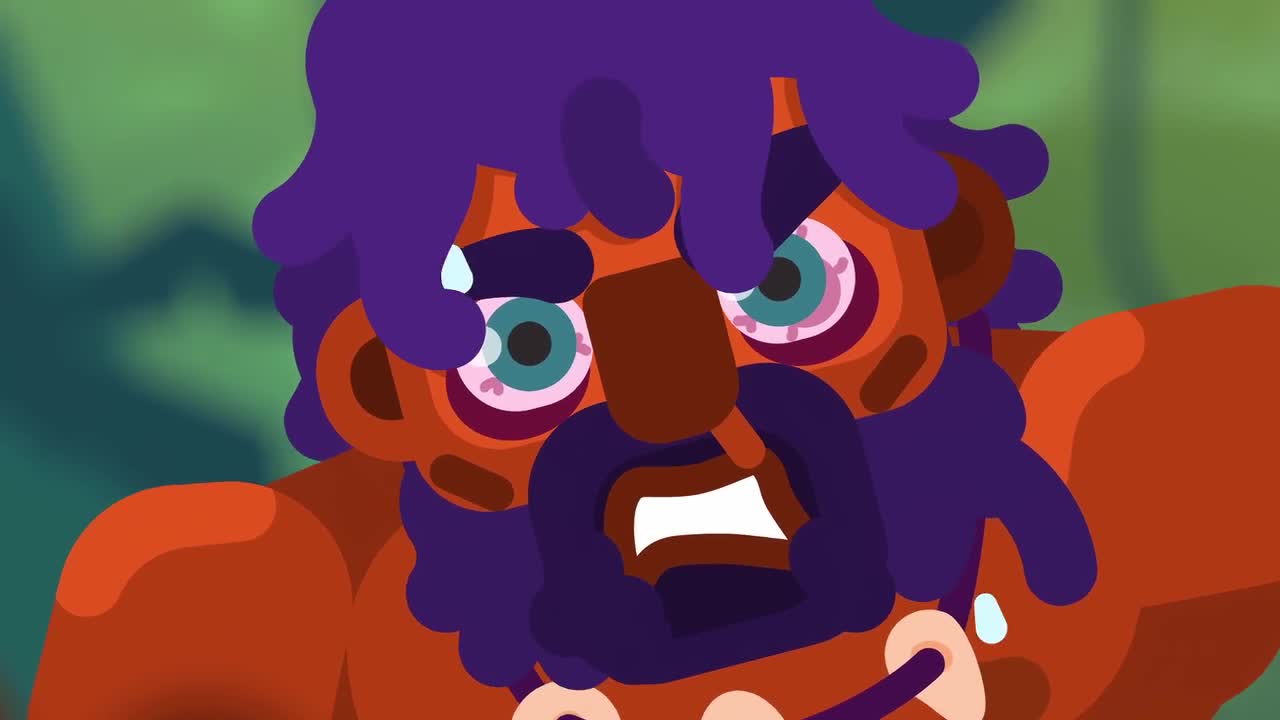
A group of early Homo sapiens are huddled around a fire when suddenly a desperate and starving saber-toothed tiger attacks their camp.
Their leader, Ur the Bear Smasher, jumps up as time slows down.
His brain classifies the tiger as a critical stressor and unleashes the stress response.
Adrenal glands pump out adrenaline that rushes through Ur's body, activating fight-or-flight mode.
His heart starts beating faster and his lungs accelerate, providing an emergency supply of nutrients and oxygen to all critical systems.
Adrenaline dictates that his muscles have energy priority over his other organs and activates them for rapid action.
Their strength and speed are ramped up.
Pain and fatigue signals are muted while his senses become super sharp and lock in on the threat.
Ur perceives every detail with maximum clarity and realizes the tiger is getting ready to pounce.
There's only a split second to react.
Adrenaline forces Ur to make a quick, impulsive decision.
Without thinking about it, he chooses to fight and attacks with full force.
But the battle is long and arduous.
The animal is desperate and will not back down.
Our humans risk exhaustion.
A new hormone joins the battle, cortisol.
Cortisol is the slower, more strategic hormone that manages a longer stress response.
It orders a total shift of all body systems, ramping up the fuel supply while suppressing all non-essential functions like resting, disease defense or digestion.
Urs body isn't his own anymore, it belongs to stress.
Finally, Ur the bear smasher deals the killing blow.
The tribe gathers in celebration.
Their bodies shut down fight or flight and activate rest and digest.
Wounds begin to hurt and muscles cry in exhaustion.
It's time to recover and heal, bond and tell stories about how they killed the angry tiger god.
Some fall asleep, others eat to replenish.
The tribe relaxes and homeostasis is being restored.
These people are your ancestors.
When did this amazing superpower turn into a curse?
The deadly email.
Our world has changed so quickly and profoundly that our biology couldn't keep up.
Stress is still the same it was 50,000 years ago.
Sense a stressor.
React immediately and with full force.
Prioritize present moment survival.
Make sacrifices if necessary.
That works well when you have to jump out of the way of a car.
But most stressors we encounter nowadays are abstract, acute and more numerous, often intangible, persist for much longer and usually don't even require physical action.
The tigers of the past are now angry emails deadlines, online dating, rush hour traffic or doom scrolling the news and social media.
But our brains are built to take fear very seriously.
So if you experience even a short burst of anxiety over an email or because you scrolled through Twitter, the helping hand of stress springs to action.
You can have dozens of these micro-stressors per day, constantly activating your stress response, even if you barely notice anymore.
While these micro threats stack up, we also have to deal with bigger stressors like unpaid overtime, angry clients, rising rents, inflation and healthcare or tariffs and chaos making our future more uncertain.
But the boost we get from stress can also be extremely helpful if you have to study for an exam, run a marathon or complete a big project.
It's a proper superpower and can feel exhilarating, even addictive.
So many of us end up abusing it.
Especially if you work in a competitive field, you may keep pushing and challenging yourselves and others, relying on stress to get your best performance possible.
The problem is that stress was only ever intended to be used in short spurts and critical situations.
If it's activated over days, weeks and months with no release, it becomes chronic stress, one of the deadliest conditions for humans.
The price of chronic stress is the slow destruction of every part of your body and brain.
As the stress cascade is activated over and over, adrenaline and cortisol keep flooding your body.
Your fight or flight systems are overactivated, while your rest and digest functions are constantly suppressed.
Your muscles tense up for a fight that never comes.
Instead, your back, shoulders and neck scream under the tension and you get pounding headaches.
Your digestive tract cramps and suffers, either holding things in too long or rushing things out.
Your fat metabolism is disrupted and starts slowing down fat breakdown, while increasing fat buildup in your belly area.
Your cells become less responsive to insulin, increasing your risk of metabolic diseases.
Your heart keeps pounding, eager to supply your body with fuel, but your blood vessels aren't built for this constant overactivation and get destroyed in the process, massively increasing your risk of a heart attack or stroke.
Your immune system gets weaker and stronger at the same time, in a way that causes maximum damage to you.
The parts that protect you from disease are suppressed, because who cares about a cold if you have to fight a tiger?
This increases your risk of infections, cancer and autoimmune diseases.
Meanwhile, cells that cause inflammation for wound healing are massively boosted, inflaming your tissue all over.
Your brain gets rewired to serve stress.
Perceiving an ongoing critical emergency.
It slows down calm reflection and thinking, instead favoring quick and rapid reactions.
You literally get worse at thinking clearly and lose wisdom points.
You're much more likely to make bad, impulsive decisions like breaking up, eating junk food or using drugs.
You become worse at solving your problems while creating new ones.
Under chronic stress, you're simply a worse version of yourself.
If this persists, your memory and cognitive abilities get worse as you slide into anxiety and depression.
So your chances of getting out of a stressful situation in the modern world worsen the longer you're chronically stressed.
A hellish, vicious circle.
If you can't escape it, odds are that you may die earlier and suffer greatly along the way.
How to use stress as intended.
And stress can be your friend.
In measured doses.
Acute stress enables you to conquer mountains and push beyond your comfort zone.
Helps you to improve your skills and grow as a person.
And it can make it feel amazing to perform at your very best.
But to get the good without the bad, it's critical that you properly wind down your fight or flight response and relax.
Listen to your body.
If you feel stressed, you are stressed full stop.
There's no universal threshold you have to reach before you're allowed to do something about it.
Next ask yourself is your stress response productive in your situation and is there an end in sight?
If you're studying for exams or moving house, stress is a superpower helping you unlock your full potential.
But your health needs breaks from fight-or-flight mode, be it meeting friends, working out or going for a walk in nature.
Relaxation is not being lazy, this is serious self-care.
If you relax actively and regularly, you'll keep stress from claiming a price on your body and mind and still be able to use its power.
If you can't do this at the moment, plan active relaxation time as soon as you can, without this stressing you out.
Okay, but what if you suffer from constant unhelpful stress?
You can't control your body's stress response, but you can influence it.
As annoying as this is mindfulness, like meditation or yoga, is scientifically proven to take the edge off stressful situations and to tell your brain that this email is not a deadly tiger.
But the single most effective way to remove stress from your life is to remove the stressor itself.
Become your own personal assistant and assess where tiny bursts of stress are coming from during your day.
Do you feel stressed when you doom scroll?
Social media doesn't show us what we want, but what makes us engage.
And negative emotions make us engage the most.
So simply getting rid of the apps or unfollowing stressful people can actually remove a lot of stress from your life.
Especially with the really big problems, removing the stressor is extremely effective.
If you live in a dangerous neighborhood, move.
If you're bullied at school, see if you can change your environment.
While this is drastic advice and may not be easy, it will have the biggest impact on your chronic stress levels.
So think about what you can change in the midterm.
Of course there are situations where you can't just eliminate the stressor or meditate the chronic stress away.
If your brain is stuck in stress mode for too long, it will get worse and worse at solving problems.
You may not be able to think clearly to get out of your situation.
In these cases, the most powerful move is to ask for help.
Open up to friends or family or get professional help.
An extra pair of hands can make a huge difference.
In the end, life will throw stressors your way.
This is unavoidable.
And that's okay.
Stress is your superpower.
Use it, but never forget to get to the other side of it.
That's why we created a health journal.
We've collected all the latest health science and designed a framework to help you figure out what actually works for your life, without pressure or guilt.
If you want to reduce stress, start with the rest and mental health chapter, or dive into nutrition or physical fitness.
Each chapter is packed with real science, lots of examples and inspiration to get you started.
But you can make it completely your own to fit your needs.
In the end, you'll have built a custom health mix that works for you.
We also made it as beautiful and fun as possible, as taking care of your health should always be.
And you're not doing this alone.
We'll check in from time to time and we'd love to hear from you.
Share your progress and inspire other burbs on their health journey.
After the gratitude journal and the habit journal, this is the third part in our best-selling journal series.
To kickstart your health journey, we've also created some exclusive Health Club merch for you.
Wear them as companions to remind you of your goal.
Just give yourself one month.
Try it.
See where it takes you.