This BBC podcast is supported by ads outside the UK
Join us for the day's top stories from BBC News twice a day on weekdays, daily at weekends.
Search for the Global News Podcast wherever you get your BBC podcasts.
If video killed the radio star, has streaming killed the TV stars?
They get to the point where they think that everybody loves them, no matter what and no matter what they say, or do people keep coming back for more?
The streaming services are increasingly aware that the machines have won and the humans have lost.
Welcome to World Business Report from the BBC World Service.
I'm Sam Fenwick.
Streaming has reshaped how we watch, listen and spend our money.
So today we're looking at what the shift means for film, television and music.
From Netflix taking Stranger Things to the cinema, to MTV closing some of their channels across Europe.
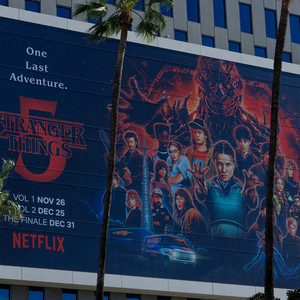
So nearly ten years after it first appeared on Netflix, Stranger Things is coming to an end.
I need you to fight.
One last time.
The show helped shape global culture from fashion to music.
It's so unfair to you.
Your childhood was taken from you.
You've been attacked.
Now, in its final ever episode on New Year's Eve, Netflix is doing something very unexpected, showing it in 500 movie venues across the US and Canada, as well as on its streaming platform.
Fight for a world beyond Hawkins.
So why is a company built on disrupting cinemas now embracing them?
And what does it tell us about how hits and money is made in the streaming age?
Well, let's introduce our guest who will be with us throughout the show.
Tom Noonan is the founder of Bullseye Entertainment.
He won the Oscar for the best picture in 2006 for Crash.
He joins us from Los Angeles.
Susan Schmidt is a portfolio manager at Exchange Capital Resources in Chicago.
She's going to bring us the views of the markets on media and entertainment today.
And Alejandro Roas is from Parrot Analytics.
It's a global entertainment data company which tracks demand for film and television around the world.
Tom, let's come to you first of all.
Netflix has built its business by keeping people at home watching binging TV programmes.
What does it tell us, then?
That Stranger Things is now going to be shown online in the cinemas for this sort of one-off last episode.
Well, thanks for having me.
This move by Netflix to take Stranger Things into cinemas across the United States is just one more example of, as you put it in your intro, the unexpected behavior of this digital giant.
They are doing this as much to support the Duffer brothers who created the show and who love to see their stuff on big screens, as they are to just keep the consumer off balance.
It's a marketing move by Netflix.
The United States has about 40,000 screens when it comes to movie theaters.
So 500 theaters really is not much of a footprint.
But it's a great marketing move and it's very artist friendly.
What do you think, Alejandro?
Does it do something for Stranger Things, putting it in the cinema?
Will it increase demand or is it just to create attention, as Tom was saying?
Yeah, I mean, all of the above, right?
So for us, when you think about demand, you think about how do you quantify attention and how do you grab people's attention.
And these sort of activities and activations actually do really well, because what happens is you activate your hardcore audience.
And these are the people that are going to just basically talk up about the show.
And that's really what you want in today's world.
The big competition is all about how do you compete for people's attention?
And anything that you can do to get people's attention is going to...
It's going to make you a winner.
And that's what really Netflix is doing, especially now that they have a brand like Stranger Things that has such a vibrant audience.
And they can leverage that in many, many ways.
And we are seeing in the data that actually is having a really positive impact.
Susan Schmidt.
From an investor's point of view, does this look like innovation or does it look like a sign that maybe streaming has hit a ceiling?
I think investors are looking at this as potential and innovation.
People also thought when cable first launched that maybe that was innovation or TV had hit a ceiling.
We're at another big change in the entertainment industry, and investors are trying to figure out where the profits will be.
Go on, Alejandro, just quickly.
What I'll do now is we'll just turn to music.
Ladies and gentlemen, rock and roll.
Because for decades, MTV helped decide what became a hit.
It didn't just play music, it shaped style, taste and global culture.
A little bit like Stranger Things.
But tonight, New Year's Eve, MTV is closing some of its channels which broadcast across parts of Europe and the UK.
At its peak, MTV was a place where artists wanted to be seen and where audiences discovered new music.
Hughie Morgan is the frontman of the New York hip-hop rock band Fun Loving Crimals.
The group reached their peak in the late 1990s and Hughie credits much of that success to MTV.
Oh yeah, I think it was a great platform for different kinds of music to get out there, because it relied on the audience more than it had before.
Something landed with the people, like, for instance, Scooby Snacks.
We did two videos for that.
Our first video, which is kind of like a homespun Scorsese kind of thing.
And then we did a big Hollywood one because EMI was like, oh, we need a big Hollywood for an MTV.
And they were right.
We did the big Hollywood Scooby Snacks video.
And that's the one that got us over the mark.
You credit it with that.
You credit it so much that it got you over the mark.
Oh, yeah.
I mean, the music that we were playing was very niche.
It still is, you know, frankly.
But what it did have was some appeal to people.
In those days, you didn't have to really break big to recoup your advance and stuff like that.
And as far as the record companies went, at that point, you were a success.
And was it expensive then?
How did you film these videos?
We did a Love Unlimited video and I think it cost like $25,000 to do.
It was 5000 to shoot the thing and 20000 to rent a helicopter due to a tracking shot that lasted 10 seconds in the video.
You look at it now, it's like a drone could do that for like 80 cents.
There was always that kind of element of let's push this out as far as we could, because back then people were buying music.
Now, who knows how any of these musicians are making any of their money.
Is that why then do you think that maybe MTV is rethinking its business plan?
It's closing some of these channels.
I heard an analogy that I really thought really hit the mark.
It's kind of like MTV were cigarettes and whatever we got now are the vapes.
A cigarette is a drug delivery system, right?
And so are vapes.
They're delivering nicotine to people's brains.
So if you're going to deliver music to somebody, you have to set out a matrix to do that.
And now we've kind of shifted with the internet.
It's kind of dumbed it down to the point where you don't have to really go out of your way to find good music.
Music's just thrown at you to such an extent now that it's like Demolition Man, where it's like all jingles 20 second little clips you hear on videos and stuff where it doesn't really make a difference if it's good or not.
If it pushes the product, it works.
Streaming services do promise the people that use their streaming services that they will actually give them more choice from bands that might not have always been signed by a label.
I think what we've kind of seen over the last three or four years is the way people consume music.
You know, you have Tidal and you have Spotify and Apple Music and stuff.
And they put out studies saying people don't listen to the whole song.
They change the song after like 20 or 30 seconds to the next song or whatever.
The attention span of the human being has gone down so much.
Where is our nuance?
Where is our mystique?
And it reflects in the music.
The music is a reflection of how we are as a society today.
It's crass.
It's immediate.
It's without nuance.
It's without style.
You've made it sound a bit sad.
You've made it sound a bit depressing.
And maybe younger people listening to this would say you're a man of a certain generation.
Well, you could say that, but I'm also a man who has eyes, you know?
You could tell me not to believe what I see and hear.
I've been in the music business 30 years.
Every week I do a radio show.
Every week.
I listen to tons of new music, tons of old music and tons of people telling me what I should be listening to as well right,
And what I've come to realize is that people don't care about music as much as they used to.
I mean I still do and I always will.
But to kind of like just push me off to that dad category is kind of whack.
When you look back at your days on MTV, where your videos were playing, do you think that they could have changed more quickly so that they wouldn't have to have now be closing their channels?
I look back on it and it was kind of like yeah, whoever was running MTV, let the inmates run the asylum for a bunch of years.
And that's what happens.
You get people who are music centric and they kind of just do stuff for the love of music.
And that's not really good when it comes to being a commercial endeavour.
So they maybe lost sight of their viewers, their consumers, effectively.
They kind of slipped and didn't even see the whole streaming thing coming until it was way too late.
I mean, I remember telling dudes back in 1999 about this Napster thing.
The fact that you can download music onto an MP3 file.
I kept telling them that, yo, you guys got to get ahead of this.
They just were looking at me like, no one's going to touch us.
And this is kind of the hubris that we see in a lot of these institutions that get knocked down.
That was Hughie Morgan from Fun Loving Criminals.
So on MTV, producers and presenters decided what we were going to listen to and when.
Streaming promised something different.
Choice on demand with power shifting from broadcasters to consumers.
And to explain what that change has meant for the music business, here's Will Page, former chief economist at Spotify.
Streaming has changed the way we consume music, and it's done so by replacing the broadcast model of top-down human curation where, if you think about it, we got what we were given.
We all listened to that same radio show together.
We all appreciated that same song.
And what streaming has done is?
It's transformed it into a bottom-up model where the consumers become the new broadcasters and we all choose what we each want.
But yet here at the end of 2025 Sam, we are still finding community moments like Spotify Wrapped or Apple WePlay, where we share our own individual experiences.
So rather than share the band, we're actually sharing the brand.
How was your wrap this year, Sam?
How was your wrap this year, Will?
We share our experiences with the streaming platforms, as opposed to the songs on those streaming platforms.
And I suppose the big difference for me personally is that my rap was the same this year as it was last year, the year before and the year before that.
Because of the algorithm of the way I listen, it's not really picking me out any new music.
That might be the algorithm to blame.
It might also be yourself.
I have a long theory that what really drives music listening and streaming is inertia, and that is we always do what we've always done.
And not to go too deep for your listeners goes to a long-held belief that the music that we listen to when we go through puberty, when our bodies are going through the maximum amount of change, is what sticks with us for the rest of our life.
So it's interesting to think about not just the algorithm, but inertia.
Our choices have remained the same over the years.
You mentioned Spotify Unwrapped.
You said that you were there when it was launched.
Is Spotify and streaming services aware that they need to have these communal moments in order to keep the brand going and keep it relevant to big parts of the population?
I think the streaming services are increasingly aware that the machines have won and the humans have lost, in that the algorithm has definitely taken over.
In addition to that though, we're seeing that the human created playlists on streaming services are struggling.
So Top Hits UK or New Music Friday, those human curated playlists on Spotify no longer move the needle.
And that means effectively the algorithm is our new boss.
It's deciding who wins and loses.
And that for me is a puzzle.
Is that what really did for these MTV channels which are closing on the 31st of December across parts of Europe?
Yeah, the ability for MTV to make content stand above the crowd.
We all gathered around the same TV station or radio station and we were all exposed to that music simultaneously.
So we'd all talk about it in our school playgrounds or in our offices around the water cooler.
Those communal moments are what we're missing now.
But does it also go back to how actually it's very difficult to find new content because we're so obsessed with old content?
I think it's very hard for new content to stand above the crowd.
Today on Spotify, there'll be around about 130,000 new songs put onto its digital shelf.
130,000 songs accumulates to all the music that was released in the calendar year of 1989.
And we're going to have the same volume of songs being released tomorrow and the day after that and the day after that.
So the supply side explosion of music, thanks to streaming, is incredible.
And I think...
The room's getting increasingly crowded and it's getting harder and harder to speak to the people at the back.
It's getting harder and harder to get content to break through.
But with regards to all the music, what's interesting with streaming is we get to see how music is consumed.
When I Will.
Page Record Shop sold Sam Fenwick a CD.
I didn't know whether you opened it, whether you broke your nails opening it, whether you listened to all the songs.
It was a transaction.
With streaming, I get to see everything you're doing with music.
So we're learning that you prefer to earlier stuff.
We're seeing that you prefer to earlier stuff and we're monetizing that you prefer to earlier stuff.
So the band in excess is getting a windfall of money from me because I keep on streaming their music.
That revolution that's really taking place is music.
Industry has left a transactional model of selling a product to a consumption model of monetizing access.
And that changes everything.
That was Will Page there, former economist at Spotify.
You're listening to World Business Report from the BBC World Service.
Join us for the day's top stories from BBC News twice a day on weekdays, daily at weekends.
Search for the Global News Podcast wherever you get your BBC podcasts.
So as more and more of us are turning to streaming services for entertainment, whether it's television, music or watching live sport the big question is how those platforms are competing for our attention and what that means for what will succeed next.
So let's get into the data more of how we're watching.
Let's talk to Alejandro Roas about that.
He's from Parrot Analytics, which tracks global demand for TV and film.
So what does the data tell us, Alejandro, about how streaming is performing overall right now?
Yeah.
So what the data says is streaming is growing in terms of subscribers, but it's pretty much stagnant in terms of engagement per subscriber count.
So it seems to me that at the end of the day, really once you reach a mature market, What happens is people are going to spend say, two hours a day watching streaming, but then it's very hard to go beyond that when you have a particular set of content.
So what people are trying to do to kind of keep growing in terms of engagement, is to add different type of content, right?
And that's when you hear like all these like news about like hey, like now we're going to do a deal like Netflix is doing a deal with, like podcasters.
Netflix is, you know, over the last few years, obviously have, you know...
So it sounds like, Alejandro, it sounds like that they want us to watch for longer.
It's not just about being a subscriber.
They want you to watch for longer than two hours.
They want that to continue for a longer period of time.
Yeah, everybody wants that because like the longer you watch, the more likely you are to renew.
And I think the biggest challenge that these companies have that it wasn't the case in the past is, like you know, like you really need to subscribe to the service right.
But like it's very easy to actually cancel the service, right?
Like in the past, it was very hard to kind of like really like disconnect your cable and switch.
It was just like... the switching costs were high.
Now the switching costs are zero.
So that means you really have to be very you have to be very smart in terms of how to keep people around.
And that's like, you're always fighting that.
You're fighting people that want to leave and like resubscribe.
So that's like a structural thing of the industry.
And obviously there are some players that are doing better than others, but this is something that affects everybody.
What's your data telling you about what is drawing new subscribers to a streaming channel?
Yeah.
So, I mean, like the usual suspects, right?
Like.
So obviously, like first round global series are going to have like a huge impact in terms of driving new signups, and also pay one movies have like a great, great impact as well.
So think of this as, like you know, like Once the movies go through the theatrical window, the pay one window is actually very important for streamers to kind of capture people.
Let's just bring Tom in, because is that music to your ears, that actually movies are drawing people to subscribe to these channels?
Because that's where your bread and butter is, isn't it, Tom?
Well, I produce series and films.
Oh, well, you're all right.
I do more films than I do episodic, that's for sure.
And yes, it does surprise me actually, because it's just human nature to believe that you would be resubscribing because you want to see that next episode of something versus a new title.
So I'm surprised and I'm encouraged by that.
Alejandro.
What's also interesting with some of these streaming channels is that they're moving into live sports.
So the World Cup next year or this year for some people, wherever you're listening, is going to be streamed on places like Amazon.
So normally you know an organisation or a business that has you know kind of led us away from watching live output is now getting involved with that in quite a big way.
Yeah, I mean, that's part of the trend of like, how do you cover more ground to keep people around?
So like, obviously sports is a big drawing.
And a great advantage of sports is also it's a live event.
And by being a live event, you have a live audience that is better to be monetized via advertising.
So, as all of these streaming services also move into advertising, this actually solves, like like two issues that they have, which is like hey, on one end, i want to keep people around, so this is great to keep people around, but also on the on the other hand, i also need inventory to sell to advertisers and this is the best inventory that you could have.
Sports is the best uh, the best like vehicle to really sell out.
Susan, for many years, these streamers struggled to make any money and it was about growth at any cost.
Has that now changed?
That has definitely changed in the eyes of investors.
They see that the streamers can be established.
Netflix, obviously one of the dominant streamers right now and in the news because of a potential acquisition.
But streaming has shown to be a very sticky industry. actual revenue source.
As we've seen, those subscribers with Netflix who's been generating the content people are interested in.
The subscribers have stuck.
So investors are rewarding that and looking for streamers to be as important as the content creators.
Now, there are some that aren't doing quite as well as your Netflix.
Peacock, Paramount Plus, they are struggling.
Why?
They're not able to get the traction in the marketplace.
And so investors perceive that problem and see it as counting the number of subscribers.
That still continues to be a key component of what investors look for.
How many eyeballs were watching?
How many people were sticky and continued with the service?
Not every brand.
Regardless of where you are in the consumer marketplace and what field you're in, it could be the jeans you like to wear.
Not every brand can maintain that stickiness.
And the brands that do and the companies that own them are rewarded by investors.
Should we talk about consolidation?
You mentioned it just briefly about Netflix and the Warner Brothers Discovery deal.
Paramount are also involved in that.
It's rumbling on, has been for a while.
But before this kind of big one, which has been in the news quite a lot, there have been other mergers over the past few years, haven't there?
There have been, and it shows you that scale is important.
I'm sure as you talk to your panel, making a movie is a very expensive proposition.
So you need to be big enough to be able to support that, because one movie is not enough to sustain your offering.
You need to have multiple.
And so that scale issue has really come into play here.
Channels and streamers that don't have the content and don't have enough content, find themselves going out.
If they haven't made it, they're buying it.
Perhaps they only buy it from outside sources, but they need to keep regenerating that to get the eyeballs stuck to themselves.
Their particular brands, their streaming service.
And that's caused consolidation and you're seeing weakness in the industry.
Those who can't get the scale are looking for partnerships or mergers so that they can get that scale and therefore increase their leverage across the industry.
And there are actors and film producers in Hollywood concerned about that consolidation, about how it could lead to fewer big hits and less creative risk.
Tom, when companies merge and go through mergers, what do actors and producers see first?
What changes first?
Well, the first thing that happens is there's fewer movies and TV shows made, because typically, the companies that are acquiring other companies are in the same business.
So they're cutting jobs.
They're cutting the number of films.
They're cutting the number of series.
Hollywood proper suffered an 18% drop in employment this year.
And it's only going to get worse as more consolidation occurs.
Could it though, I mean, or could it just lead to a different sort of risk taking?
I mean, could it not lead to films being made elsewhere, not just in Hollywood?
Well, that's a sunny view to take, I think.
But at least domestically here in the United States, as far as the American standard, if you will, of motion pictures and series, these are big budget endeavors.
Even for the most sort of the smaller character-driven shows, they cost millions of dollars per episode.
Even smaller independent films cost millions of dollars, let alone the hundreds of millions of dollars that movies like Avatar cost.
So if one company, if Warner Brothers, for example, is getting taken over by Paramount, that's one less buyer for this very expensive content that's getting made here.
Alejandro, do you see that?
Do you agree with Tom?
Yeah, I mean, obviously it depends how the merger happens, right?
In that case, the example that he's given if Paramount buys Warner Brothers, both of them have similar type of operations.
So what we would expect is there's going to be less output.
But then maybe in the case of Netflix, I think it's a little bit different, because I see them more as like
Netflix becomes more of an engine where they're able to monetize the existing content better.
And if they do that in a good way, basically they have more capital to invest.
So potentially it could actually lead to more output or more movies, more shows, just because of the fact that existing libraries are being monetized better.
So essentially you now have more capital to invest.
Tom, it's been a bit of a dry time in terms of cinema films over the past few years because of the writer's strike, but also the pandemic.
Do you see 2026 being a bit more bumper?
Are we going to see people returning to the cinema?
Don't know if we're going to see people returning to the cinema.
That's the issue is because of streaming.
It's the first time that a technology in Hollywood is actually brought down another platform, whether it's VCRs DVDs, whether it was cable.
All of these boats were able to rise with the rising tide of new technology.
Streaming has changed the game completely and people are seeing fewer and fewer movies out at the cinema as a result.
Thank you so much.
Tom Noonan there, Hollywood Oscar-winning producer.
Susan Schmidt, portfolio manager at Exchange Capital.
And Alejandro Roas from global entertainment company Parrot Analytics.
Thanks for listening today.
A very happy 2026.
Join us for the day's top stories from BBC News twice a day on weekdays, daily at weekends.
Search for the Global News Podcast wherever you get your BBC podcasts.