This is Planet Money from NPR.
The other day I brought a couple pairs of binoculars to lower Manhattan to meet up with fashion reporter Avery Truffleman.
We were there to do a little bit of urban birding.
Are you a big birder?
I don't do outdoorsy things.
It's not in my nature.
I'm not an outdoorsy guy.
Luckily, Avery made an exception for us because we were not in fact heading out to spot migratory birds with spectacular plumage.
No, no, no.
We were on the hunt for some very particular kinds of clothing.
Would it be fair to say that fashion is kind of your Roman Empire?
Yeah, I would say fashion is my Roman Empire.
You see, Avery is the host of a podcast called Articles of Interest, which is all about unraveling the hidden histories behind the things we wear.
She's done deep dives into the question of why women's clothing didn't used to have pockets, or how preppy Ivy League style got big in Japan.
And I wanted to talk to Avery because her latest season is all about how a massive shadowy force has been shaping the stuff we all wear for the better part of the last century in ways that most of us might not know about.
And what is that shadowy force, you might ask?
The United States military.
The United States military.
It is kind of common knowledge at this point that many of the most resource-intensive technologies that define our daily lives began in government-funded labs as military RD from nuclear fission to GPS to the internet.
But what Avery found is that that same military-industrial influence has shaped many things that are even more intimate, in a way, the very clothing we wear to express our sense of who we are or to protect ourselves from the elements.
And it's the kind of hidden influence you can actually see on the street today if you have the right kind of eye.
Yeah, do you want to take a little walk?
Yeah, let's do it.
Let's take a little walk.
Avery and I start our walk in Soho.
The neighborhood is known for its high fashion, their fancy boutiques every few storefronts.
Let's cross the street.
Well, let's do a walk.
But these days, it's also been taken over by people wearing expensive outdoor gear.
Think Arc'teryx rain jackets or North Face puffies.
Oh, and look, she's wearing camo pants.
How perfect.
We're standing in the shadow of the monolithic brick REI store.
By the way, REI is a financial supporter of NPR.
And Avery starts to point out all these sartorial hints of the fashion world's military past.
Things that I'd failed to notice just a moment before.
Like storefronts I'd never heard of.
Oh my god, and Alpha Industries is right there.
That's a fascinating case study.
Are those ammo cans?
Yeah, it's like a military-themed store.
And they used to make military clothes.
They were a supplier to the military in the 20th century.
In the distance, Avery directs my attention to a woman wearing a synthetic down parka.
Like, see that stylish-looking pink puffer?
And she's got the pink boots.
Let me get my binoculars up.
She's moving far away.
Yeah, she's in motion right now.
Even that, Avery told me, was part of this bigger story.
The idea of artificial down was pioneered by the military.
Really?
Yeah.
And then it was peeled off and manufactured by a company called Primaloft, which first marketed it to civilians, to the mass market, through LL.
Bean.
All around us, there seem to be these signs of how the military has shaped the literal fabric of our daily lives.
And Avery says that influence is a lot bigger than just camo sweatpants.
It's everything.
It's everything you wear.
It's literally everything you're wearing, Alexi.
Like, it's your jacket.
It's your khaki pants.
It's your beanie cap.
It's the layers.
It's everything you're wearing.
Avery points to the Velcro straps on the sleeve of my jacket.
The plastic cord lock used to cinch up the hood.
The performance fabric on my turtleneck.
All vestiges, she says, of the military's influence.
So are you saying we're all part of this kind of military sartorial complex, even if we don't realize it?
Yeah.
This is all versions of military clothes.
Like, you can't unsee it once you start seeing it.
Hello and welcome to Planet Money.
I'm Alexi Horowitz-Ghazi.
I'm Avery Truffleman, host of Articles of Interest.
It's a podcast about fashion.
And Avery, we asked you to hop over to Planet Money for a bit to share a little bit of this wild, shaggy yarn you spin in your new season about the backstory behind a lot of the clothing we all wear.
Yeah, it's about the intersection of the military and the outdoor industry.
So today on the show, army surplus economics.
How military designs trickle down from the soldiers on the front lines to the hippies on the war protest line, to the yuppies in line at Banana Republic.
And why some of your favorite outdoor brands may just be moonlighting as American military suppliers, while keeping it as under the radar as they can.
They foresee, spotting the signals that others miss, and acting before threats become setbacks.
Recorded Future.
Know what matters.
Act first.
This message comes from NPR sponsor, U.S.
Bank.
With U.S.
Bank Business Essentials, you get more than just a bank.
You get a dedicated partner that provides you a powerful combo of checking and card payment processing with quick access to the money you've earned, proving that there is nothing as powerful as the power of us.
Visit usbank.com today to learn more.
Member FDIC.
Copyright 2025 U.S.
Bank.
Now the yarn that Avery spins in the new season of her show is an epic tale woven over seven episodes, from the Revolutionary War to the invention of digital camouflage.
Today, we're going to focus on the way that military designs have changed the way that many of us dress and spend time outdoors.
So where does the story of this strange entwinement between the military, the gear industry and the world of fashion begin?
I mean, I think it starts in the founding of the United States.
But in the modern era, it really comes from World War II.
I mean, it was this like cataclysmic event that shaped every single part of modern life.
And every single industry got involved in the war effort, including the clothing industry.
And it fundamentally changed how everybody dressed, including soldiers. and eventually civilians.
You see, for the first century and a half of its history, the US military more or less took its sartorial cues from the militaries of Europe.
The Revolutionary Army basically took the design for the famous British redcoats and turned them blue in part, apparently because of how much indigo was produced on American plantations.
Later, our soldiers dressed like the French, and there was even a period when American officers wore pointy little helmets like the Prussian military.
But when World War II arrived, it presented a new kind of problem for the people in charge of outfitting US soldiers, one that called for a more technological approach.
This was a global conflict where millions of American soldiers would be potentially deployed to fight in all kinds of different climates and terrains, ranging from the balmy summers of the Pacific Rim to the frigid winters of Western Europe.
And one of the people tasked with solving this problem was a Harvard business professor by the name of George Dorio.
Who is George Dorio?
He's this Frenchman turned American professor at Harvard.
He is the founder of venture capital.
That's his big thing.
He went on to lead a rich and wildly successful life after this.
This is so not important to anything else about what he goes on to do.
But for the purposes of our story, what's important is that George Dorio worked with a part of the military known as the United States Quartermaster Corps, which is the department responsible for essentially all the logistics.
They call it like boots, beans, and bullets.
They make sure that the troops are fed and that they're transported and that they're clothed.
George Dorio took it upon himself to help organize a scientific effort within the Quartermaster Corps to solve this new gear problem the military was facing, employing many of the testing techniques that had emerged in places like the physiology department at Harvard.
And so the Quartermaster Corps created a bunch of laboratories.
They brought in like the Harvard Mountaineering Club.
They brought in a bunch of outdoorsmen, like famous outdoorsmen.
They brought in the services of the guy, Eddie Bauer, and the man, L.L.
Bean, like Leon Leon Wood Bean.
And they ran these test expeditions to Alaska.
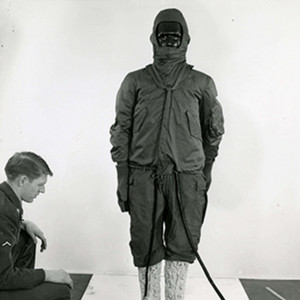
At one point the Quartermaster Corps designs a copper mannequin they can use to test out how cold or wet the soldiers might get when subjected to different kinds of conditions.
They named the mannequin Chauncey.
The model of the mannequin's name was Chauncey.
There were multiple Chaunceys.
They had a team of Chaunceys but they all had like copper skin that could tell how cold they were getting in different jackets.
Yes.
And for what it's worth, Chauncey is terrifying looking.
He's got these like wires sticking out of his body.
You can find these old pictures of like Chauncey in the cold lab being like observed by men with clipboards, you know, and like Chauncey's wearing a jacket.
After months of subjecting Chauncey and others to this terrifying testing regimen, the quartermaster engineers realize there may not actually be just one jacket to rule them all.
And so they come up with this incredible thing called layering.
What?
What?
It blows everybody's mind.
Now, people have obviously been layering in some form or another since the Paleolithic era, when somebody threw a woolly mammoth poncho over their saber-toothed tiger skin.
But Avery says this is the first time layering for field performance was turned into a whole system.
A system built around a sort of simple olive green jacket.
This game-changing jacket and jacket system is called the M43.
M stands for model, 43 because it was made in 1943.
And it's just the green army field jacket.
It's got four pockets, two at the chest, two at the hip.
It cinches at the waist.
You've seen it everywhere.
Like every company now makes a version of it.
It is so classic.
I had honestly never thought about it before.
But in 1943 this M43 jacket represented the cutting edge of clothing technology a modular system that could be transformed to fit almost any environment.
There was padding for cold weather, a Porca edition for rain and snow.
And the military now had something that could be easily adapted for battles from the tropics to the Alps.
Almost immediately they got to work mass producing the M43 field jacket, along with literal tons of other outdoor gear, all meant to keep millions of soldiers as fighting fit as possible for years into the future.
Even after the surrender of Nazi Germany in the spring of 1945, the Quartermaster Corps kept producing supplies, because the war was still raging in the Pacific.
In her series, Avery talks to a historian about this very moment, and we're just going to play a little bit here.
We know now how World War II ends, with the droppings of the atomic bombs on Japan, but no one was planning for that.
That's Charles McFarlane, a costume historian and journalist who wrote his master's thesis in part on the development of the field jacket.
And the Manhattan Project was, obviously, a secret.
The vast majority of the United States military didn't know the atomic bomb was being developed, let alone that it was about to be dropped on Hiroshima and Nagasaki in 1945.
So the government was still producing clothing for the idea of a war dragging well into 1946, if not 1947.
There was a huge ramp up of supplies and clothing in preparation for an invasion of Japan, which was expected to suck up a massive amount of lives and supplies.
But the war's end cannot be anticipated while it's still being fought.
The Quartermaster Corps is charged with assuring the successful operation of the Army of the United States by providing food fuel, clothing and equipment at home and abroad.
You have basically 12 million Americans in uniform, and each of them is given clothing for all four seasons, from socks to underwear, to boots, to hats.
Not to mention all the M43 jackets and backpacks and tents and gear.
So great is the extent of the quartermaster operations that over 25 of the cotton textile industry is now producing for the quartermaster corps.
Even before the end of the war, the United States government claimed it had 16 million pounds of surplus clothing.
Not to mention 7 million tubes of toothpaste, 25 million folding chairs, and 17,000 homing pigeons.
But in August of 1945 the war came to a surprisingly abrupt end, after the devastating bombings of Hiroshima and Nagasaki.
All of a sudden, Avery explains, the U.S. military had a huge new problem.
All that frenetic production meant they now had a massive oversupply of clothing and gear just sitting around.
And how did the military decide to solve this problem of all of this surplus stuff on their hands?
They decided to sell it off and like as cheaply and quickly as possible.
A new agency called the War Assets Administration was put in charge of overseeing the sale of all surplus property.
To quote a 1947 article from the Quartermaster Review imagine a warehouse capable of holding a million dollars worth of property.
It would take 34,000 such buildings to accommodate the War Assets Administration's total inventory.
So, you know, what are you going to do with all this mountains of stuff?
Apparently there are warehouses all over the place.
Chalk a block with gear.
This is menswear icon G. Bruce Boyer.
I'm G. Bruce Boyer, a fashion journalist and author of several books on fashion.
We all bought clothes at the Army-Navy store.
Everyone.
It was cheap, you know?
Army surplus stores were rare oddities before World War II.
After World War II, they explode.
They are everywhere because it is so easy to buy up large amounts of cheap inventory.
In just one month, according to a January 1946 Newsweek article, the War Assets Administration sold off four million pairs of cotton and wool socks, 1895000 pairs of work clothes, 10000 khaki shirts, 884000 navy raincoats, 5000 parkas.
I could keep going.
This was all in one month.
It was all for a song.
The War Assets Administration could not get rid of this stuff fast enough.
I knew guys that bought socks and underwear and everything, everything there.
Yeah.
After World War II, I would say there was a generation that just saw it as like the place to get underwear and like a place to get jeans and socks.
So the army surplus store was kind of like the Uniqlo or H&M of the 1950s?
Yeah, exactly.
It was the Uniqlo of the 50s.
You know, you need something, you just go to the surplus store.
And in addition to helping clothe a new generation of American consumers, Avery says this massive surge of Army surplus also served to turbocharge a nascent outdoors industry.
A lot of gear companies that we know and love today got their start by selling surplus or they sort of padded their inventory by selling surplus.
Like REI was a great example.
REI...
You know, they've been around for a long time.
They've been around since the 30s.
But a member of their co-op was a veteran and was able to get like early access to some of the surplus stuff.
And this was a really great way for a young company you know, in addition to making their own stuff to be like, and you can also get surplus here.
You know, it's like, oh, their shelves are suddenly much more full.
And they were sort of making their own gear alongside selling the surplus stuff.
It was a great boon for a lot of companies.
They rode the wave of the surplus.
Yeah, yeah, totally.
Which brings us to the second chapter in the story of the military's influence on everyday style.
By 1965, the United States had entered yet another major war, the Vietnam War.
And Avery says the Quartermaster Corps made a major update to their layered jacket system.
The new model, called the M65, had the same classic olive green color and a similar array of pockets on the front.
But it also had new features, like Velcro sleeve straps and a collar with a stowaway hood.
And many of those updated M65 jackets eventually found their way into the army surplus ecosystem.
Pretty soon, these iconic military jackets were showing up in the counterculture —
People like John Lennon and Jane Fonda were seen wearing things like the M65 jacket.
You'd see anti-war protesters sporting the exact same jackets their contemporaries were wearing on the front lines in Vietnam, just this time with a peace sign on the back.
Avery says that by the 1970s this rebellious, ironic army surplus style started to grow more and more popular.
In the 70s, they're selling berets and military jackets with extra patches on them.
It's like the military look becomes this trend.
Army surplus goes from a way Americans got their basics to this kind of chic subculture.
A new wave of boutiques starts to pop up around the country.
They sell modified, stylized surplus outfits.
And one of these stores would eventually become one of the most recognizable brands in the US.
And to hear about how this happened, I talked to a woman named Patricia Ziegler.
The surplus stores were selling things for the lower prices.
And I figured that we could actually sell the same pieces for a lot more if we added style.
Initially, Patricia wasn't a fan of military surplus herself.
I was such an anti-war person because it was the Vietnam War period and my friends were getting drafted.
So I didn't really have a warm feeling about military surplus.
In the 1970s, Patricia was an artist.
She was working in-house as an illustrator at the San Francisco Chronicle.
And that's where she started dating a reporter named Mel.
I met Mel, and he would buy things at surplus stores.
Mel and Patricia fell in love, and together they quit their 9-to-5 jobs.
We want to see the world.
And so we quit.
But then freelancing, you know, can get a little tough.
They just wanted to make enough money to paint and write and travel.
But then Mel got another freelance assignment in Australia.
And when he came back and he was wearing this British Burma jacket.
Mel had gotten it at a surplus shop down there.
And to Patricia, this jacket had a really different vibe.
And I noticed it right away, not because it looked military.
It looked really safari rugged.
Mel looked really dashing and swashbuckling in this jacket.
Patricia changed the buttons and added suede patches.
And at a certain point, we said, this is our business.
We've got to find more of these jackets.
Okay, they couldn't find those exact jackets that Mel found in Australia, but they did the best they could in California.
Surplus is kind of a secret world.
You have to find the dealer.
And we did, of course, Mel being a journalist, researched a lot.
They found a local dealer who was offloading 500 Spanish military paratrooper shirts.
Which makes sense when you think about it.
Franco had just died in 1975.
Spain was getting rid of surplus from the last regime.
Mel and Patricia bought all 500 shirts.
We had $1,500 left in our bank account between the two of us.
So this was a substantial investment.
And they sold these shirts at the Sausalito flea market.
I put one on Mel with the sleeves rolled up and the collar turned up.
And I put on one with tight jeans and belted it.
And we sold over 100.
It was just little touches of style.
But these flourishes were all Patricia and Mel needed. needed to stand out.
So I went home and took two shirts apart and put them together to make a four-pocket safari dress.
And some other ones, I took off the epaulettes and made a waistband, took off the arms.
I said, doing our part for disarmament here.
And we made a skirt.
And so Mel said, oh, we've got a business and found a store that was 400 square feet.
In 1978, Patricia and Mel set up a tiny shop in Mill Valley.
I started cutting up jackets and sleeping bags, and we started dyeing things.
And also we'd sell like gas mask bags that didn't have any gas masks in them anymore, but they made great purses.
It was just a matter of looking at things in a fresh way.
There were a number of boutiques like this.
There was Commander Salamander in DC, the cockpit in New York, Camp Beverly Hills in LA.
All who stalked recut re-dyed, zhooshed up military surplus.
It was such a phenomenon that it was actually spoofed on Saturday Night Live.
I got Rhodesian fatigues.
I got the Italian camouflage jackets.
The kids are crazy about them.
They're buying them like hotcakes.
At this point, too, we have the yuppification of military clothing.
As Charles McFarlane put it to me, the students who were wearing field jackets in the 1960s grew up.
They cut their hair.
They got jobs.
They became conventional bourgeoisie.
But they kept their Grateful Dead records and their penchant for surplus field jackets.
You have Woody Allen wearing military surplus to go to the art house theater in Annie Hall.
You have Dustin Hoffman in Kramer vs Kramer playing a father going through a divorce living on the Upper West Side, and he's wearing an M65 field jacket.
It's really in the post-hippie, post-Vietnam era when these things start to go mainstream.
And I think the key to that is the brand Banana Republic.
Yes.
Banana Republic.
As soon as we decided to have a store, we said, OK, well, what are we going to call this?
And Mel just intuitively, just said oh, it's Banana Republic, because it's struggling young countries that want to sell bananas, the surplus from the last dictator.
I mean it was very uncool to say this, very unwoke you know, but at that time we were having so much fun with it and we weren't politically correct at all.
We were an artist and a writer.
We weren't business people.
But one of the business problems Patricia and Mel were facing had to do with their supply.
The U.S. had ended the draft in 1973, and militaries in Europe were downsizing.
Smaller military budgets and armies meant less and less army surplus to go around.
So eventually, Patricia and Mel decided to sell their business to The Gap, because The Gap offered to help Banana Republic manufacture their own version of the styles that had made them a success.
Over the next decade.
The Gap turbocharged Banana Republic's growth and that helped popularize this yuppified kind of mutant version of army surplus fashion.
And as Avery explains in her podcast, this moment marks a major turning point.
It was the end of an era, both in how the military made its clothing and in how those styles made their way to the rest of us.
Surplus comes from big, massive militaries with lots of cheap excess sloshing around.
The end of the draft led to a smaller, tighter army that can be accounted for.
There doesn't end up being that much left over.
It's not like a company supplying to the military is going to be like oops, we made a couple extra hundred thousand jackets.
Clothing for the 21st century army is made to order by private companies who stand to make a lot of money.
That's coming up after the break.
This message comes from NPR sponsor Adobe.
Introducing the all-new Adobe Acrobat Studio, now with AI-powered PDF spaces.
Need to turn 100 pages of market research into five insights with a click?
Templates for a sales proposal that'll close that deal?
Or an AI specialist to tailor the tone of your market report?
You can do all that with the all-new Adobe Acrobat Studio.
Learn more at adobe.com slash do that with Acrobat.
Okay, so the end of the draft spelled the end of the era of army surplus.
Many of the classic military designs lived on, of course, in the fashion lines of places like Banana Republic that had remixed army styles for a yuppie audience.
But Avery says this more direct three-way relationship between the US military, the world of fashion and the world of gear is still alive and well.
So many of the brands that you know and love are in fact military contractors.
They make a lot of clothes for the military or for special operations.
They're really, really, really interconnected.
Like Arcteryx does it.
Patagonia says they don't do it, but they used to do it under another company.
Gore-Tex does it.
Vibram does it.
Danner does it.
It's really, really common.
Patagonia, we should say, is a financial supporter of NPR.
Now, in order to understand how this modern web of military partnerships works, Avery actually visited one of the major conventions where military suppliers display their wares.
It's called the Association of the United States Army Trade Show, or AUSA.
If you are a company who's trying to do business with the military, the AUSA conference is the place to be.
It's where all kinds of companies, from gun manufacturers to health startups to cell phone carriers, set up booths and try to impress the generals who are strolling around.
Also present are a number of well-known clothing companies and suppliers.
So Avery is walking around AUSA trying to interview reps at those well-known clothing companies.
Many of them ignored me or shrugged me off a number of times before they would finally do me the kindness of outright refusing to talk to me.
Refuse to talk.
I wasn't that surprised.
I knew this would be hard to report on.
I mean already, if you look at the websites of outdoor companies who contract with the military or make these special ops clothes, those clothes are really hard to find.
Like, they bury it on their website a little bit.
You have to dig around for these clothes and just know they exist.
Like Patagonia, used to put their own name on the uniforms and special ops clothes they made, until they started manufacturing them under a company called Lost Arrow Project.
And now it's a rebranded independent company called ForgeLine Solutions.
And I was trying to find someone who could just talk to me in an in-depth way about this.
Like, at Functional Fabric Fair, I saw Vibram had a booth.
And you know Vibram, they make the shoe soles.
So I went up to them and at first they were like, hey, what's up?
Vibram loves Gorp Court.
It's widely known that Vibram souls are in military boots.
They even had some military souls right there on display in their booth.
And when I asked them about their military work, they suddenly got real jumpy.
Yeah, I just want to be guarded.
Yeah, yeah.
Now we don't know exactly why a number of these companies didn't want to talk to Avery about this part of the business, but you can sort of intuit why.
Like maybe they don't want to broadcast their involvement with the military to customers who might be turned off by that arrangement.
But just when Avery was about to give up on getting an outdoor brand to talk about the business of military contracting, she did meet someone who was willing to talk.
And not only was she willing to talk, she was like come on over to our headquarters and see what we're all about.
Kat Shewey is the vice president of design and innovation at the popular outdoor brand Outdoor Research.
Kat was taking me up the steps of Outdoor Research's office building in downtown Seattle, where she was going to show me openly matter-of-factly, what Outdoor Research manufactures for the United States Army.
You're putting these kids out there into the harshest environments.
You have to protect them.
And we are incredibly transparent about this part of our business and really proud of it.
And the people that come here love that part of who we are.
With outdoor research, it's right there on their homepage.
There's a tab that says tactical and you can just click it and it says same outdoors, different mission.
It's a nice kind of symbiotic relationship between those sides of the business and we can really push and pull innovation that way.
Outdoor Research began as a civilian outdoor gear company.
And pretty early on in the company, Outdoor Research started making equipment for the special operations community.
They started doing this in the 80s.
They've been in that game for a really long time.
And Outdoor Research became especially known for this high-tech glove system.
Started with the special operations community that led us to develop a system, a seven glove system, for the special forces community.
That's Alex Rodero, head of tactical at Outdoor Research.
And then that's cascaded into bigger army projects.
Like gloves for the entire army, which is just...
Now, one big reason that gear companies like Outdoor Research might want to work with the US military is yes, the massive scale of their orders.
But it's also the fact that military clothing must, by law, be made in the United States.
Making military gear offers a means of subsidizing domestic manufacturing, which has become extremely rare in the clothing industry.
Making clothes for the military is one of the only last remaining domestic clothing industries that we have, because it's a matter of national security right.
We don't want our clothes for our military to be made in another country, because if we went to war with that country that would give them a major tactical advantage.
They could, whatever, lace all our clothes with arsenic or not give us clothes.
You know?
So military contracts offer a way for companies like Outdoor Research to diversify their supply chain and their streams of income.
Two completely different business models.
They have their company Outdoor Research, the retail brand, and then they have this military contracting side.
The outdoor side where you've got seasonal forecasts and planning.
And on the military contracting side, it is a goddamn rodeo.
For us, I mean, the government's our best customer, but they're also our worst.
Like they don't plan and they can't give us a forecast.
But then they'll come and they'll say here's a large order out of nowhere.
And wow, that's great.
Thank you so much.
But now I can't fulfill it fast enough.
So why keep doing it?
I think it comes back to you know, we really care about the soldiers and we make gloves to protect soldiers' hands.
And we don't just make for the U.S. military.
So we also have overseas tactical production that we build for NATO troops.
So my parents live in Poland.
Obviously, there is a Ukraine crisis going on.
There are thousands of U.S. troops that are in Warsaw right now.
And on a daily basis I get pictures from my mom of US military and NATO military wearing OR gloves in Poland.
Although, beyond a sense of duty, there are other benefits that make it worthwhile to deal with the military contracting.
People get introduced to the brand through the military.
So like when you're a kid and you're 18 and you're enlisted and you get your bag of your gear and in it is an OR glove.
And that OR glove goes with you through your entire tour of service and is a dependable piece of gear.
That's a great brand introduction.
That's a way for you to fall in love with the brand.
And when a big government contract actually does work out, that's great for business.
We have an 80-20 model where the tactical business is 20 of our business and sometimes that balance shifts.
Sometimes the tactical business is really really good and it helps to support the outdoor business when the outdoor business is in trouble, and oftentimes vice versa.
So it's actually great to be diversified in this way.
And as we learned through the pandemic, having U.S. manufacturing was... a lifesaver for us.
I don't think we laid off a single person in the pandemic.
And even though Kat mostly designs the civilian outdoor wear, still all the tactical stuff, all the army gloves and the special ops clothes, they're all still being designed right here, side by side, in this one building.
So we have things that get developed for the military that then get commercialized in our outdoor space, and then we have vice versa.
Crossover is inevitable.
Outdoor research might literally produce the same jacket in two different colors one for special ops and one for the outdoor industry.
This connection between the outdoor industry and the military is unavoidable.
It's glaring.
It's everywhere.
Hearing all this brought me back to that walk I took with Avery around Soho, when she pointed out that almost every item of clothing I was wearing had links to the US military.
Some of those threads were historical, like specific design features and technology that came straight from the Quartermaster Corps' design labs.
But also many of today's outdoor clothes are still the product of this entwined industrial ecosystem linking, you know, crunchy downjacketed REI shoppers with the soldiers on military bases around the world.
In her series, Avery admits that at the start of this reporting journey she thought of herself as anti-war and basically unconnected from the doings of the US military.
But she said that visiting places like the Association of the United States Army Trade Show and seeing so many familiar brands on the convention floor, it opened her eyes to how deeply interwoven the military and the broader economy actually are.
What did you make of that, seeing these companies that you knew from kind of your civilian life represented at the Army Fair?
Well, initially I was shocked and it really, really weirded me out because literally everybody was there.
Your phone company was there.
Your internet provider was there.
Your workout machine at the gym was there.
Like every company was there.
And so that's the thing.
It's like a lot of companies contract with the military or try to.
Clothing is just the tip of the spear.
And I walked out of it being like, oh my God, I'm so much more connected to the military than I thought.
Avery started this process tugging on a single thread about how clothing had evolved out of military design, but it ended up crystallizing something way bigger.
It gave her a sense that the entire economy is just more deeply intertwined with the military than she'd ever fully understood.
Has doing all this research made you think differently about the clothes that you wear or about the clothes that you see on the street.
Totally, totally.
But totally in the opposite way that I thought.
Like, it makes me kind of into the military style clothes.
And I never was before.
I was like, that's a fetishization of the military.
I'm anti that.
I started wearing camouflage and I started wearing combat boots.
These two things feel, like, a little at odds.
Like one.
This feeling of like oh my God, I'm part of this web.
I didn't realize I was a part of that kind of makes me feel complicit with something that I feel conflicted about, but I'm going to wear more of it.
Yeah, it's sort of like acknowledgement of the water I swim in, you know?
It's like I think I used to feel really like rigid in my role as, like I'm a civilian, I'm anti-war.
I don't do that.
And now I'm like, well, I am civilian and I am against war and...
These institutions also belong to me and I have a say in them, and they are also for me and they're part of like, my long shared history as an American.
I have something to say about them, too.
And these camo sweatpants are pretty sick.
Also, I do love the look.
I have come around to the look.
Avery Truffleman, host of the podcast Articles of Interest.
Thanks for coming to Planet Money.
Thank you so much for having me on Planet Fashion.
Planet Money, but make it fashion.
Planet Money, but make it fashion.
This episode of Planet Money was produced by Luis Gallo, edited by Jess Jang, fact-checked by Yasmeen Al-Sayyad and engineered by Robert Rodriguez.
Alex Goldmark is our executive producer.
Articles of Interest is produced by Avery Truffleman, edited by Allison Barringer, fact-checked by Yasmeen Al-Sayyad and engineered by Jocelyn Gonzalez.
Music by Ray Royal, Lulatone, and Sasami Ashworth.
I'm Alexi Horowitz-Ghazi.
I'm Avery Truffleman.
This is NPR.
Thanks for listening.
Thank you.