We scalloped next.
Yeah.
Thank you, Claude, for telling me the temperature.
Useful for everything from deciding where air defense sites are in Iran to scallops, apparently.
Thank you for having us, Sam.
This is a really cool place.
Do you want to show us around?
Yeah, that sounds good.
What is this?
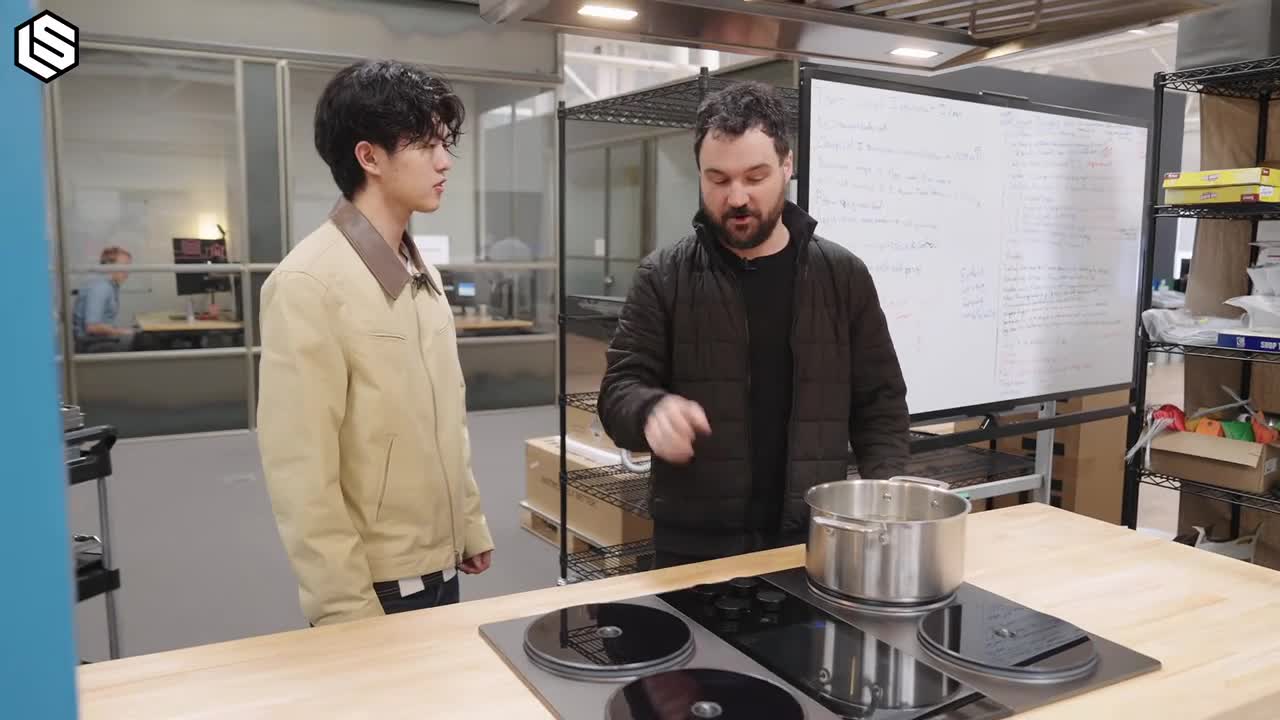
So this is the Impulse Cooktop.
It is, to my knowledge, the highest performance stove in the market.
Wow.
But a couple things here that's interesting.
So one is we've set up the station with a ventilation hood as well, to kind of show you how much power this thing's got available.
Notice that the ventilation hood actually turns on automatically when we start boiling.
But look at how fast this is going.
So we're putting 10,000 watts of power into a medium-sized pan or pot.
And we can boil about a liter of cold water in about 40 seconds.
This is, I think, a little more than a liter.
But you can see it's already starting to boil.
It's already on.
And we actually, one thing to note here is we have a partnership with Zephyr.
So in stores nationwide, starting relatively soon, possibly like at the same time this video is posted, you're gonna be able to buy.
I'm gonna turn it down a little bit.
You'll be able to buy Zephyr branded Powered by Impulse products alongside the ventilation hoods.
And then we're also previewing features we'll have in the future, which is like coordination between the hood and the stove automatically.
So like I do that, it spins up.
Yeah, the speed goes to five to two.
And also, why don't you play with it a little bit just to see how real-time it feels.
And these are magnetic, right?
They're magnetic, so you pull it off, it turns it off, actually.
Oh, wow, it turns off as well.
So you have to click it to do it, and then...
Wow, that is so cool.
And it's so responsive.
We wanted to feel analog, just like how a gas stove feels.
Because most other induction stoves can't do this.
Yeah, it takes a long time.
We had to redo the power electronics and control systems from scratch.
And we control all the firmware and hardware and everything like that to actually make this experience possible.
So everything from the turn of the knob to the bubbles being formed there is under our full control.
Wow.
Yeah, that's amazing.
There's a lot of other things here.
Is this testing?
I see a lot of pots, pans.
Yeah.
So when we get interesting contacts from customers for like, this pan works a little funky or like does it work with X?
We end up just going and buying stuff and testing it.
We also have a bunch of pots here that are actually wired up with thermocouples so we can actually just reliably test our temperature control, power control and power control algorithms, so that we know that there's no regressions when we go and release stuff to customers.
We're in the process of qualifying an update that triples the performance of our temperature control system.
Wow. which means when I say that, it's like, what does that exactly mean?
It means it gets to the temperature you set about three times faster than it currently does.
Wow, that's very impressive.
And I guess for QA do you guys have like a system where you have a lot of people come in and test out stuff before it goes out?
So we have, we're a small team, we're like 30 people total.
We QA every build we send out to customers, obviously.
And then what we also do is many of us have units at home.
And so that's kind of the first wave.
So it's like people are cooking at home and they'll see, you know, they'll see the builds.
But obviously like for like the baseline, like let's test every edge case.
We do it basically here on this station.
Wow, that's like the true definition of dogfooding.
You're like trying it out yourself and making food.
Yeah, but hopefully you're not eating dog food.
That's true, that's true.
Here we have the parts.
Yeah.
So we basically here's like kind of the stove exploded on a table, but basically we went and like the idea here is like we went and effectively reinvented the stove from first principles around the idea of having a lithium ion battery at the center of the system.
What does that exactly mean and how does that work?
So basically we put a three kilowatt hour LFP battery lithium iron, phosphate inside home appliances, starting with stoves.
That gives us an additional 15,000 watts of additional power.
So that's like double what a typical induction cooktop has in terms of aggregate power across all the burners and stuff like that, on top of what the wall supplies through a plug.
And so we're able to actually bring to bear significant performance improvements over other appliances just from having more watts available.
So what we then did is we were like, okay, let's reinvent everything upstream of that.
So we went and built our own custom power electronics and control system.
So like, this is one of our induction driver boards.
We've also got like, this temperature sensor technology, which we'll be using later when we cook.
And then our induction coil, we actually ended up designing all of this from scratch.
Like we did all the magnetic simulation, et cetera, ourselves.
And this allows us to actually, control everything from the turn of the knob to the pan getting hot.
And we control that entire end-to-end flow with kind of our own firmware, embedded systems and high-level software.
That's so cool.
That has allowed us to basically build the highest performance stove in the market.
Now, why do we have all this stuff splayed out?
Well, I also sell this to other major appliance OEMs.
So basically, we built a modular platform.
We call it Impulse Core, and if you use Impulse Core, you will get the highest performance appliances.
You'll be able to build the highest performance appliances yourself as well.
So we've got multiple deals with multiple major appliance manufacturers, some of which have announced, some of which have not announced, and we'll be shipping globally this year through a number of partners.
Wow, that's exciting.
So you have the main product that you guys build entirely yourself, and then you also have the core product that you sell out.
Exactly.
And that gets us channel access to, like every form factor of appliance, every market we may not be into.
And also like it gets us into stores across the United States without us having to have like a big sales team.
So we can basically operate much more like a software and like a software company than like a hardware company that needs a giant logistics footprint and ships large cardboard boxes across the country and has installation services and all this other stuff.
We can really be kind of like, intellectually heavyweight, but a logistics lightweight basically.
Yeah.
How long does it usually take for you to build something?
Cause you even said from the start thinking through first principles.
Kind of reminded of how Elon thought through, I think like SpaceX as well.
I assume there's a lot of inspiration there.
So I guess, in terms of building these things out, iterating through, like what are the timelines looking like?
Yeah, so it took us four years flat from receiving three.
It was it was it was it was 2021.
We started the company in July 2021.
We shipped our first revenueable units.
I believe the first one went to the American Housing Corporation guys in June 2024 or 2025.
So this was three years, and 11 months later was how long it took, end to end to do the entire thing from company formation Like literally I've filled out Stripe Atlas to landing products in people's homes.
I think we could have probably shaved six months off of that for various reasons.
But, like you know, typically building a product where, End to end, you need to basically reinvent core modules.
Every single point.
And there's also a heavy compliance requirement.
So basically getting this through the UL 858 tests, getting this through some of the other UL requirements we had to meet.
And also, you know, there's a bunch of, and we had to build like many many, many units, like 200 plus units, to get, before we even shipped one to a customer and put them through a battery of tests to make sure they were reliable safe, et cetera.
And then we also had to develop all the software that runs on the device too.
So it's not just you build the thing, but you have to build the thing and then make sure that the software on it is good.
Yeah, that works and continues to get updated.
Exactly.
So basically typically the length of time it takes to build a complex hardware device.
I think it's like it's two years if you don't have to really invent like new modules and systems.
It's probably three if you.
You know, if you do um, just based on past experience from, like my backgrounds in consumer electronics worked on everything from Google glass to Oculus.
You know other things like that.
So it worked on mostly face computers before I jumped into this space.
Yeah no, that was one thing as well.
Starting consumer hardware and then pivoting now to it's like a passion as well, because I heard that it was kind of prompted with a pizza trip to Japan.
Yeah, well, so I was actually not, I was not in Japan for pizza.
I was in Japan for the IEEE Haptics World Conference.
So we're working on game controllers at the time.
So if you've used the MetaQuest Pro, I was the controller.
I came up with that controller program back in like 2018 or 2019 or something like that.
I was in 2019, I was at the IEEE haptic conference.
I was like, we went to this really good pizza place called Savoy.
I was like, I got my pizza back in like 30 or 45 seconds.
And I'm like, what is the power density required to like cook a pizza that fast?
And I was like well, that's a lot of watts and you can't get that out of like a tabletop toaster oven or something like that.
How could you build a tabletop device with that level of power?
And it's like the answer is you slam a battery into it.
And if you slam a battery into it, you've decoupled the energy input from the wall with the device's power outputs.
You can decouple the user experience from the grid.
And that level of approach has not been done in kind of the major home appliance space at all.
And that kind of gave me the spark of an idea.
I also realized another thread, which was I was working at Meta at the time or I guess Facebook it was called Facebook back then and realized that if I wanted to build my own hardware company, I was kind of like I think you can look at like Palmer Luckey with Oculus and it was like how did he prototype that and how did he figure out like where was like the like, where could you move things kind of like revolutionarily a step forward?
And it turns out he could do this like while, like I think, living in a trailer in his parents' driveway with, like meager resources, because it was just it turns out that, like the low hanging fruit had not been harvested yet.
And the low hanging fruit was like, oh, phone displays are really good.
You can make a VR headset with a phone display or a tablet display.
And the optics for this were the optics for it were achievable by someone who again, was basically a college-age individual without crazy resources.
That said, you had to build a real company and do all this other stuff, which you then did.
But the big part of this was you did not have to be a large technology company to move the needle forward on the capabilities.
Like typically to design something like oh, I built like face ID at Apple.
It's like a multi hundred million dollar program where they had to acquire, like an Israeli computer vision company that had the hardware.
Like like one of my friends worked on that and it's like these are like big industrial efforts to kind of move the ball on, like making the iPhone better, for instance.
And that's even, that was true 10 years ago.
It's even more true now.
And so I'm kind of like, well, where can I do this?
Like, obviously, VR got harvested.
Yeah.
And I was seeing, even in VR.
It's like, let's imagine I left Oculus and I went to start my own VR company, which I could have done.
Yeah.
Well, the first thing is well, you need to spend a lot of money on component engineering and developing new components and stuff like that.
And it's like it's not a reasonable ask for a VC to be like yeah, give me a hundred million dollars to make custom displays, like custom displays, custom chips, custom cameras.
Like, all of this stuff has to be custom custom, custom because well, you're up against the vision pro and they're spending a lot, a lot as well.
There's no like.
There's no like architectural insight that makes that you can be more.
You can outmaneuver them by being being more clever.
And so and so the second thing was well, friends with a lot of folks who kind of gave me this feedback on the consumer electronic side, which is like I want to build a company that doesn't have to get acquired.
Like, the big goal here is like if you need to have an app store to make the thing work well, you need to subsidize all these developers to basically come to your platform.
And you don't need an app store for home appliances.
Now maybe some people think that that would be a good idea but like ultimately, I do not believe you need an app store for home appliances.
And so like you can ship them a stove and as long as it cooks, you are good.
Meanwhile, if I ship someone a game console well, unless I'm paying game developers hundreds of millions of dollars, you know aggregate probably billions in some sense.
If you look at how much like Meta Reality Lab spends on content for the Quest headsets and stuff like that, it's like it's an expensive proposition to actually maintain that two-sided marketplace, especially before the user base is mature.
I didn't want to have to run into problems like that, basically.
So I was like okay, Two things.
Let's pick on a low hanging fruit space where none of the big tech companies are playing right now.
And two, let's make sure there's no app store or ecosystem requirement.
Make sure I could literally ship one of these and it's good.
Yeah, the value is direct.
Yeah, the value is direct.
And so those were kind of two key guiding principles.
Obviously realized that home appliances were an awesome space to get into because well, there's a secret to getting better performance out of it.
And then it was like, okay, well, what do you do first?
And so the pizza oven thing was kind of a cool idea, but I'm like, well, everyone's got a stove.
Not everyone has a pizza oven.
And I'm using my gas stove at home and I like my gas stove at home.
And I had tried a bunch of electric stoves.
I tried, I had an induction hot plate.
I had all these things and I'm like these things are all like no one really got the UX right or any of these other things.
And so I went and basically studied the space pretty deeply and realized that like yeah, this is probably the right entry point, because it turns out the stove is if you look at someone's home and you put an electric stove in someone's house, it's like 60 amps of their like.
100 to 200 amp panel capacity is like just an induction stove, which is crazy.
Yeah, so if you can make a better one because you've got even more power available and you can reduce the requirement that it needs to like run on the home yeah, you can then install induction stoves in every house in america and you can install better stoves in every house in America.
Yeah, much better stuff.
Much better stuff.
Yeah.
And then the last piece is like, well, now I've got a battery in everyone's house.
And if I have a battery in everyone's house, there's no energy storage all over the grid.
And we all know like there's kind of a there's both a power generation concern but also a congestion concern on the grid where like, we're adding all this new load growth it's everything from ai to people getting evs, to also people's homes electrifying as well, like they're getting heat pumps and air conditioning and stuff like that and so if we can basically put energy storage on the grid, kind of like invisibly in these like middle, mid-sized machines, we're going to be in a very you know much better spot than if we didn't do that.
So that's been kind of my like thinking.
And then there's one last piece which is I think worth raising, which is we build this thing like it's a phone.
And it's not like we view this as a consumer electronics device.
We don't really build it like it's a home appliance.
And there's a philosophical difference between what I would call kind of like electricity 10 and like what i would say is like the modern electric technology stack.
So it's like batteries, power electronics, embedded compute, electromagnetics etc.
Like everything is getting built around a very relatively narrow set of technologies.
So like okay, we've got a lithium-ion battery yeah, you've got like embedded computer stuff, you've got motors or induction coils or whatever, and then you've got power electronics.
And the real advantage of this is this allows you to build software defined hardware products.
And so, if you think of like the big innovation of like Tesla versus other car companies, like Tesla did a couple key things.
One is they made the electric car work.
But then the second thing they did is they built it like a phone where they controlled, like in the Model S was actually like I would argue.
The Roadster wasn't exactly this, but the Model S really was this.
It's like this was a car designed end to end like a consumer electronics program, where everything, including all the modules that go into it, were coherent with the original vision, versus oh, we have to go use this component from this vendor or whatever.
And because they did it that way, it's just a better car than everything else.
And obviously our friends across the Pacific and China figured out exactly the same strategy, and they're really good at consumer electronics.
So now they've got some of the best cars in the world with like Xiaomi and all this other stuff.
And I think that's a bigger lesson than say, like Elon talking about vertical integration or anything like that, there's a consumer electronics mindset of like you need to own the end to end product all the way through.
And, like my view is like everything from this knob turning to this coil, heating up the pan, we control, and making sure that we do that allows us, we and we have full software control which allows us to then, you know, do more things beyond what we're shipping on day zero as well.
Yeah.
And it'll be significantly better than anything.
And it's and it ends up being a platform for like and you can see with like Tesla, with FSD, you can see Tesla like literally going, and they had a video where they basically went and said like they were sunsetting the Model S and Model X and they basically will go and show that all of those technologies are going into Optimus.
And so getting good at the technology stack is transferable beyond that, basically.
It's very evident that you put a lot of care and quality into even just every tiny piece of the hardware.
One kind of question that I assume a lot of audience members have as well is do you have any plans to release a single cooktop?
Oh, everyone asked for the single burner.
Everyone asked for the single burner.
I think we're going to have we're working on what what tabletop devices we're gonna ship in the near future.
I think if you're interested in that, or a two burner, we're definitely thinking of you guys and I think that that's something that we're gonna try to have a solution for in the coming year or two or three.
Great, thank you for showing us the tour and the space, and i hear this is your dev unit that you have pulled up for us to show some cool tricks.
Yeah, usually we have like an actual production unit, but this is like a dev unit that i've been working with behind my desk, but we put it in the studio for uh, today to show you some new stuff.
So awesome.
Yeah, we could cook some scallops and some pasta, so do you want to get us started?
Yeah, so i'm going an idiot and i don't actually know how to use a stove, so let me let's see if this, let's see if i can ask the stove what to do set the front right burner to the right temperature to sear scallops at.
This is agi right here, we got it.
We got it.
Yeah, we'll see if it works.
Oh wow, cool.
So it'll set to.
So it's going to set some high temperature to sear scallops.
Wow.
I don't know.
I trust Claude.
I don't know.
We'll see what happens.
Wait, so Claude is the model that's running behind it?
Yeah, it's running Claude.
I probably should run some super fast Cerebras thing, but we'll get to that later.
This was also part of an experience for me to teach myself on how to build agents end-to-end.
So basically, I was like, well, the world's different.
I need to actually learn how to do this stuff.
Even though I'm a hardware guy, I do have a software background.
I did take software classes in college.
I've deployed software in production facilities and stuff like that, mostly for servicing hardware companies.
Let's try to build some AI stuff.
So I went and put Claude on the stove.
Yeah, no, that's very cool.
I've never seen a use case of Claude in the kitchen in some sense.
I guess how has AI also helped in development or has it also accelerated, whether it be RD or testing things or trying out new Yeah?
So I started.
So I've been using the AI dev tools since they basically came, or I've been using AI for software development since it basically started being acceptable at it.
So, like I was I when Sonic 35 came out, I was like okay, this is like we're actually.
This is good enough to start.
Like you could vibe, you can actually can vibe code.
But basically, I was playing around with Cursor.
I was actually also just using the web UIs and just being like, give me a website I can download.
And I was pretty reasonably impressed this stuff could actually work, which is cool.
When cloud code came out, it was like was like when i had access to cloud codes like april or something like that april or may this past year, i was like okay, this is actually, this is actually going for real right yeah, and what i started doing is i was like i noticed a gap in what we had for the company, which was we didn't have like fleet telemetry that was like under our own control.
So I was like, okay, really important to actually know what's going on.
If you're about to ship a product, it's really important to know what's going on with your products and make sure that, like you know, make sure customers are happy.
But also like if something goes wrong, like you can go look it up by like seeing oh, there's a bunch of error flags in this unit, or whatever.
So I started using I think this was Sonnet 4.
I started using Sonnet 4 with Cloud Code and I basically went and built an end-to-end fleet telemetry system from like Terraform, like infrastructure in Terraform, deployed on AWS.
I've never done any of that stuff before.
And it was kind of this, like you know, hardware guy learns enterprise, SaaS sort of adventure, but it was also a like how to use the agentic tools to like, you know really, really build something durable.
So that's that's how that was like and you can look at, like my github commits and all this other stuff, and it just basically took off at that point.
Yeah, that's amazing.
So, by the way, the temperature control on this thing is like it's already yeah, it's already ready to go.
It's not like smoking or costing, it's not smoking, anything like that, but yeah, it's raw dog, these scallops well, not raw, but yeah, you get the idea.
Right now we do like four, four scallops or maybe five.
I feel like the temperature, because that's one thing too right, so this will probably retain the heat of the pan um, even as well, that doesn't matter.
So that the thing is the way this product works.
Yeah, We control the temperature.
So this thing is holding 446.
Yeah.
And you notice, when I added that scalp, it starts dipping but it's going to put more power in to kind of keep it under control.
So you have like complete control.
Complete closed loop temperature control end to end.
So this thing like doesn't smoke, doesn't burn.
And you'll see, like, you can start seeing the crust on the bottom of the scallops right there.
I don't know when we're supposed to flip these things.
Yeah, we could probably flip it, I mean, in, like, 10 more seconds.
Like, get the color.
But, yeah, that's great.
And I assume you can wow and it also shows, like the temperature, the temperature of, like you know, like there yeah, that burner status, great.
Yeah, so i can go.
Look at that.
That was pretty good.
Yeah, that's looking really good.
Yeah, so i can go.
I kind of seared that one on a weird angle, but you know you get the idea.
Yeah, but these look really good.
And I love how it shows the real-time burger status to be able to understand like where it, Because it also just dipped down like 10 degrees-ish or so.
And also you can, like, lift the pan up and it resumes, no problem.
Yeah.
So like pretty straightforward.
Yeah, no, that's amazing.
And then I guess we can start with the water, right?
Because it also boils water at an insane pace.
Yeah, so we can put up to 10,000 watts of power into any burner on this thing.
Yeah.
So that's like three times what most induction stoves are.
And like it's like five times what they are when they're not in that like boost mode in a bunch of cases, which is often time restricted because they don't have the temperature sensor to know that it's like under control, basically.
So i just put 10 000 watts into this thing wow, and you can see the bubbles are already forming on that thing.
That's pretty insane and it's like okay, it's already.
You know, it's already 150 degrees at the bottom.
It's like it's climbing really rapidly, Great.
And we could get the pasta over there.
Do you want to grab that?
Yeah.
You can start moving.
You can probably just dump it in because honestly.
Yeah.
Should we?
It's already.
How much do we want to put in?
We could do three of them or.
Yeah.
We did pasta max.
Yeah.
Let's do it.
Yeah.
Honestly.
Yeah.
Let's just do all of it.
Great.
Oh, yeah.
I didn't realize there were four.
Are these probably good?
Yeah, I think these are good.
Yeah, they probably look good.
Do you want to put them on this plate?
Yeah.
Wow, these look amazing.
Wow, the color and everything.
We scalloped maxed.
Yeah.
Thank you, Claude, for telling me the temperature.
It's great.
Wow.
Useful for everything from deciding where air defense sites are in Iran, to scallops, apparently.
Yeah, the whole spectrum.
Great.
Yeah.
So, are we going to use this pan for anything else, or are we good?
Yeah, so I think we're good.
We'll just boil the pasta, and then we'll use this other pan to kind of assemble the final dish.
Okay, sounds good.
So I'll go put this guy over there.
Yeah, so that's great.
And then, yeah, we could put this over here for now.
And then how long of a time, how, how much time do we need to wait for this thing?
Um, this one, I think, is only five minutes, but yeah, we can.
So this thing is gonna boil over pretty fast, but we can, we'll.
We'll turn it down in a second.
Yeah.
So you see how, look at how crazy this is.
Yeah.
It's and look at the control authority.
It's like, oh, basically nothing.
Oop.
Yeah, it's instant.
It's like.
So let's set it to like two.
This is what high is on, you know, for mere mortals.
We'll just leave it like that.
And then set timer for five minutes from now.
See if it works.
I don't know.
Yeah, wait, this test unit, I mean, it's already put in a lot of work.
Yes, we got a timer over there.
It's for five minutes.
Wow.
Yeah, you can see the tenth, the time, everything.
Yeah.
Wow, that's amazing.
I guess when you go through iterating, through ideas, is it just a lot of dogfooding.
And then Yeah, and also it's the fact that if you can use AI now to prototype stuff, it's just so much faster.
This UI is a concept UI that our product manager worked with her design firm on.
And she's already two steps beyond this.
But basically what we did is I was like OK uh, just give me the latest figma.
And i took the latest figma using the figma mcp and managed to get this running on here wow, and this ui was enough to basically give us the starting point to be able to build some of these ai features so you can see stuff.
So like, i'll give, while this is going, you got, you know, you got four more minutes so i can show you some other stuff over here.
Yeah, so i can be like see it, pull up a recipe for Kenji Lopez-Alt's Korean fried chicken.
And this is going to the internet, so it's gonna.
You know, it takes like 30 seconds or something like that.
Because again, I'm like, I'm not, I'm not, you know, I'm not like LLM tool, call optimizer, I'm like a hardware guy, but basically, but basically goes.
Does a web search, gets the URLs, goes to various sites, figures out a good recipe that works, and then it.
And then in the agent harness, it basically converts it to a defined schema, which then shows up on the screen.
So it goes into recipe steps and stuff like that.
And then you can use the knob you actually had to go do it.
So by the way, it has its own timers.
So it'll be like, coat the wings with whatever.
And then it says, wait 30 minutes and it'll go do that.
And then when you get to preheat the oil, it actually sends a command to the burner.
So it'll actually say like, okay, It'll say, there's a command to confirm, so I can click that.
It's gonna set that to 351, 177C.
There's some bugs in terms of unit use and stuff like that, but bear with me.
And then it's like, make the batter, go do it.
Wait for it so they can see it.
And then you know, fry the wings and it'll actually have a timer while you do it.
So it's like okay, we'll set it to.
You know, set it to the preheated temperature, do that, and then you know, serve or whatever.
Yeah, and so this ux is very nice, where it even shows the image, let's.
Yeah, it shows all the stuff yeah, and it's super flexible.
It's super flexible too, so like i'll um, i can go pull up something else.
I'll be like, Let me find another thing.
Pull up a recipe for egg fried rice, but modify it to include char siu pork.
We'll see if this works.
So char siu pork, egg fried rice.
So it's giving you a bunch of instructions.
So it says like, we don't have day old rice, unfortunately, so we can't cook it right now.
But it goes to scramble the eggs, sets the temperature to the scrambled eggs.
Wow.
And then it's like, get the char siu pork, apparently pre-marinated, assumes I have char siu pork on, but you can get that on wheat actually.
And then it actually raises the temperature up, raises it to 200.
And then it lowers it for the aromatics.
And then it's like stir fry the rice. and then finish and serve.
And so you can go.
What's fun is even going backwards.
It makes me do that, but that's just my own limitations and my own agent harness.
But you can see that this actually works, right?
So also this was actually commanding this one to this temperature to do it, so it can do multi-burner stuff.
So it was basically saying like, this is a wok, Keep the wok over here.
I forgot to mention that.
It was doing this for all of the prep stuff.
Then it was basically saying, assuming there's me a wok here that would be going and doing it.
That set that to 350.
Wow, that's very smart.
For the tossing.
It'll do multiple burners and it knows the capabilities of the stove.
Wow.
And do you want to start the burner?
Yeah, what are we doing on this one?
So we just need to turn it on medium-high-ish.
I don't really know the... We're just melting some butter, rather.
Oh, you just want to melt some butter.
Okay, yeah.
So you know we can melt butter.
You want to brown the butter or no?
No.
Okay, so you don't want to brown the butter.
Cool.
So I'll set it to 250 or 260, which will not brown the butter.
Great.
And then, so why don't you just get some butter?
We have some butter here.
How much butter do I actually need?
We could cut it.
Do you want to cut like a third?
You could put it down the table.
Yeah, yeah, yeah.
That sounds like a patriotic amount of butter. and then we can yeah let the butter go yeah so by the way this will like this will just melt and it won't burn because of the temperature control okay just dump or like how much we want so we could do like half of that but if you want to make it more cheesy and um rich we can just do everything okay i mean i don't think we need to do everything yeah i think cheese maxing is you know good to a certain point Also, if you cheese max, you're not looks maxing.
Indeed, that's true.
This cheese and butter are going to mog, as we say.
Shout out to our brain rot overlords.
Yeah.
So this is, by the way, this is just gonna melt.
It's gonna be awesome.
So I don't know what the melting point of Parmesan is, but you know, we're probably above it.
And also you'll notice that nothing's burning yeah, nothing's brown very, and it's also not sticking as well like the cheese.
Yeah, because this is basically enabled by this active temperature control technology.
Yeah no, it's going wrong.
Do we want to add a little more butter and then we can?
How much more?
I probably like that much more yeah, probably.
Yeah, like another perfect cool great, Wow.
Everything is moving just very in a controlled manner, which is very nice.
It's very chill.
Yeah, very, very chill.
And that's the idea here.
It's like you can...
This takes a lot of.
I mean you can make, you can overcook things, but you can't, you won't be able to burn things because of the temperature control.
Yeah, that makes sense.
Great.
Okay.
And then we could probably, I think we want more cheese.
Yeah, I would agree.
Yeah.
We can add a little more cheese.
Yeah.
I think we want to, you know, yeah.
Good to offset those Chinese peptides in our systems, you know, given we're in San Francisco.
Indeed, yeah.
I guess while we're going, do you also have call-outs that you want to make?
Hiring, you know, new launches?
I mean, I think we're just really excited.
We're just really excited to, you know, get the product out.
We're launching in showrooms nationwide with Zephyr, like probably about the time this video is out.
I think they're like showroom getting their units right now.
So basically, we're really excited to be in hundreds of stores, like literally hundreds of stores, nationwide.
And I honestly think that there's this like story here of like, what are we actually building?
We realized that home appliances we stopped calling robots robots when they work and we figured out how to automate some of the hardest problems in the kitchen, like holding temperature consistently, like the fact that like this just works yeah, and the fact that, like i can, i don't have to uh, like there's no browning burning, anything like that, minimal sticking maybe a little bit, but yeah, you know, we can do something like that.
Yeah yeah, add the pasta to that.
But basically we figured out a lot of the key automations we can actually, and then we built the software to find hardware product that allows us to layer intelligence on.
But then the question is like, well, how are you gonna get these things to people's homes for real?
And I made a realization a while back that's basically like well, you're not going to alter human behavior of like how they get machines in their kitchen, like you need to show up where they're actually going and buying these things.
And so the realization was like we've got this deal with zephyr who makes you know they're one of the top, they're the top ventilation hood brand in the united states.
Well, beneath every hood there's a stove.
And if we now are in all of these countless stores across America, this is gonna be a lot of Americans' first contact with like products like this.
And we can then deliver experiences, you know, empowered by AI, like as the stove is, like an embodied intelligent thing.
And it's a logical first step into a broader spectrum of like bringing like actual smarts to the home for the first time, like i think the first era of smart home was like we can actually put phone chips in products, yeah.
The next era is like no, these things are intelligent and useful and they do things that are like not a party trick, but actually like hey, we looked up the temperature to sear those scallops yeah, and it just works true Yeah no, that's great.
I love the mission.
I think, you know, having it in households worldwide eventually.
Yeah, so we're also launching globally this year as well.
We've got a really exciting set of announcements queued up for that as well, but more to come on that side.
Great.
This is looking fire.
Yeah.
Should we add the scallops in and we can then like a final mix around and we should be good.
We could try it out.
But yeah, thank you again for showing us the test unit and just the amazing Yeah.
So this is.
By the way, this unit is just a slightly earlier manufactured unit, but it happens to be unlocked.
I have an unlocked bootloader, so I've actually been realizing that I need to step up my game.
I mean, I think I heard like Sergey Brin's coding now, you know, it's like sort of like that.
So like if you're a 30 person hardware startup, like the CEO better be coding, right?
So that's true.
That's true.
So that's that's been mode.
Yeah.
And you know, as long as I don't get one shot about GPT or you know their stuff I avoided the whole, for you know thing.
But yeah, that's fair.
That's fair no, but it seems like you're doing pretty cool things and i guess, for the audience, will these ai tools as well be out when the stoves are?
Yeah, so the goal is that with if you buy an impulse cooktop today these, these features are.
This is a preview of features we can do um, so no guarantees that features are exactly parity, But I want to have these features out this year in homes across America.
Great.
It'll probably be similar to how Tesla does software updates.
You'll constantly do software updates.
We've done over 10 OTA updates so far for customers.
We've got one coming up, probably by the time this video is out that dramatically improves temperature control.
Great.
So you didn't notice it before, but basically it takes about 40 seconds to get a pan up to temperature.
On the public release right now, it's about a minute 50.
But we're really excited to get the performance that you see right here out to customers very soon actually.
Great.
Yeah, that's exciting.
It's going through final QA right now.
Great.
We can try the pasta now.
Also notice the butter is still not burned.
Yeah, don't see any brown butter.
There's a bunch of, like, little bit of little Parmesan.
I love some Parmesan crisp, though.
It's probably going to taste pretty good, honestly.
Yeah, that's fire.
We can try a little, and then we can have some also.
We'll have some judges as well trying it.
Seems very cheesy.
We didn't really try it for salt, but I don't know.
I think it's okay.
I think you put enough salt in the water.
Yeah.
I'm a very big Parmesan fan, so I think this is good.
Yeah, I'm going to have some off this plate because it's...
Just jumping in here, that was amazing.
You guys really cooked.
Thanks, Sam.
And Sam, you've been cooking, which I think restores some faith in American dynamism.
We have three very special guests, including one person that you know particularly well.
Come on in, guys.
Amazing.
Okay.
And I guess Sam is the one who kind of tinkered with this.
You can also eat as a talk, but yeah, this is the unit.
So he kind of has like a cloud code for a stove and yeah, he's been working on it.
So he's the mastermind behind everything.
Great.
Good job guys.
Okay.
Scallops.
And you guys can all just, like, come in.
They told me the temperature to cook for it.
So if you get food poisoning, it's Claude's fault.
Okay.
Nice.
So you guys cooked it on the impulse day?
Yes.
Wow.
For the induction stove.
Wow.
Really good.
78 out of 10, dude.
It's amazing.
I feel like, did you guys use butter on this?
Yeah, we used a good amount of butter.
You see that stick?
That was a full stick at the beginning.
It was half a stick of butter.
I love it.
I love it.
I love it.
I'd eat this all day.
Great.
Yeah, so an approval of Impulse Stove.
Claude and Impulse together.
Man.
Yeah.
I do have some XAI credits, so we'll try grok next time.
Okay.
Yeah, maybe a voice feature as well to talk back to you while you're cooking.
That would be great.
Definitely get a different judge.
Unhinged mode, unhinged mode.
Yeah, unhinged mode.
I got to do it.
I got to do it.
Great.
Well, thank you again, Sam.
This is amazing.
Like, amazing place, amazing demo.
Thanks for coming through.
Yeah.
But best of luck with the launch and everything.
And everyone can find it where?
If you buy Direct to Consumer, we're shipping now.
People have had them for like a year.
ImpulseLabs.com.
But we're also launching nationwide in Zephyr, in showrooms that have Zephyr products.
And we'll be in a couple hundred showrooms basically by the time this video drops.
So you might be able to see us in your neighborhood.
Yes, go check those out.
Awesome.
Thank you.