This message comes from Greenlight.
Parents rank financial literacy as the number one most difficult life skill to teach. With Greenlight, the debit card and money app for families, kids learn to earn, save and spend wisely.
Get started risk -free at Greenlight .com slash NPR.
You're listening to Short Wave from NPR.
Hey, Short Waivers, Emily Kuang here with health correspondent, Ping Huang and NPR producer, Megan Lim, hi you both.
Hey hey. Hey hey. And you're here to tell us some good news.
Yes, Meghan and I are here to tell you a public health success story.
It's got puppies, and it's got tics, and winning.
And they're winning against Rocky Mountain spotted fever, which is one of the deadliest tick -borne diseases in the U .S. Oh, are we going to Colorado?
Are we going to the Rocky Mountains?
Not quite, not quite.
So, for this story, we're actually going to take you out to a corner of southeast Arizona to the San Carlos Apache Tribal Lands.
It's remote, it's beautiful, you know, purple mountains and mesas and they're covered in these creosote bushes and these spiky saguaro cactuses, a bit east of Phoenix.
And the people in these tribal lands in Arizona have been battling Rocky Mountain Spotted Fever for about 20 years.
Yeah, at one point they had rates that were 150 times that of the national average, but by the time that Megan and I visited, they were reaching a huge milestone.
no deaths from the disease in five years.
That's amazing. All right, well, I want to hear about how they did it today on the show, the long battle against Rocky Mountain spotted fever on Arizona tribal lands.
Ping and Megan are going to take us around the San Carlos Apache Reservation and show you how the tribe is winning against the ticks.
I'm Emily Kwong and you're listening to The Science Podcast from NPR.
This message comes from Charles Schwab.
When it comes to managing your wealth, Schwab gives you more choices, like full -service wealth management and advice, when you need it.
You can also invest on your own and trade on Thinkorswim.
Visit Schwab .com to learn more.
Support for NPR and the following message come from Edward Jones.
What does it mean to live a rich life?
It means brave first leaps, tearful goodbyes, and everything in between.
With over 100 years of experience, navigating the ups and downs of the market, and of life, your Edward Jones Financial Advisor will be there to help you move ahead with confidence.
Because with all you've done to find your rich, they'll do all they can to help you keep enjoying it.
Edward Jones, member, SIPC.
This message comes from Charles Schwab.
When it comes to managing your wealth, Schwab gives you more choices, like full -service wealth management and advice when you need it.
You can also invest on your own and trade on Thinkorswim.
Visit Schwab .com to learn more.
Okay. So, to be totally honest, I am unfamiliar with Rocky Mountain spotted fever.
What does that disease involve, Ping?
Yeah. I didn't know a whole lot about this disease before I started digging into this myself.
It's caused by a bacteria called Rickettsia rickettsii, carried around by ticks, spread to people and other mammals like dogs and cows through tick bites, and in the U .S., it was first seen in the late 1800s in the area called the Bitterroot Valley in western Montana.
Yeah. People called it the Black Measles then and it was very deadly.
Four out of five people who caught it died.
Wow. That sounds really bad.
And did they call it black measles because it caused like dark splotches or something?
Yeah. Classics, body rash, and in the early 1900s, a young doctor named Howard Ricketts discovered it was spread by ticks.
But by the way, this has nothing to do with the medical condition called Ricketts, which is a bone disease related to not enough nutrition.
Even back then, there were some early attempts to get rid of ticks.
One of these involved creating these giant vats of arsenic solution, getting cattle to swim through them.
But the solution burned the cattle skin and udders, caused a lot of resentment from the ranchers.
Yeah, no kidding. And then in the 1920s, government researchers built a research lab to better study this disease.
The Rocky Mountain Laboratories is now part of the National Institutes of Health.
But since those early days, Rocky Mountain spotted fever has been found all over the us in most of the continental states.
Okay, so that's kind of the history of the disease, how it got to have such a big range.
Meghan, what does it do to those who get bitten?
It's pretty brutal.
The bacteria targets the lining of your blood vessels, what's called the endothelial cells, and it gets in those cells and makes a bunch of copies and then it bursts the cells open to keep spreading.
Johanna Salzer is a veterinarian and epidemiologist at CDC, and she was one of our guides when were out there.
She explained this all to us and says that's when the signature rash we mentioned earlier, that spotted fever, becomes visible.
Do you think about, uh, spotted fever because it can cause a rash when people become severely ill?
It's all of the busting of those blood vessels as the organisms are coming out.
Oh, yeah. The rash is what's visible outside the body but Johanna says that's happening everywhere inside the body, too.
So once internal bleeding begins it can be hard to pull back and it is treatable if you catch it early, but if left untreated people can die within 8 days of showing symptoms. Yeah.
Okay. This sounds like a very serious disease and it's one of the reasons you two went to report this story in Arizona.
Before we get into how the tribe turned the disease around, why has the infection rate been so high?
Well, this is a story that goes back to when the first known cases of this were found.
So that happened in this area about 20 years ago where a child from an Arizona reservation died from it, and it was a real mystery at the time.
Everybody thought that didn't exist in Arizona because the typical tick that normally transmitted in the rest of the United States does not reside in Arizona.
This is Dr. Mark Traeger.
he's a family medicine doctor based in Arizona and he spent much of his career working for the Indian Health Service.
He says that, you know, after that first case, more cases showed up and they launched this whole investigation with tribal health and the state of Arizona and the CDC and what they discovered was a new tick vector for this disease in the US.
I am from Connecticut where there's lots of ticks.
So, I know a vector is just like fancy science word for a creature that carries a disease.
It can be a mosquito, it can be a in this case, it's a tick.
Like, roughly speaking, the disease is spread by the American dog tick in the eastern part of the U .S. and the Rocky Mountain wood tick to the west. So, American dog tick, Rocky Mountain wood tick.
But here on Arizona tribal lands, they discovered that it was actually spread by a different tick, the Brown dog tick, which is from a different genus altogether.
Oh, so it's like a third tick we gotta worry about now.
Yeah. Now, this was a tick that was known to be spreading the disease in Mexico, but this was the first time it was implicated in Rocky Mountain Spotted Fever in the US and it was clinging to the reservation dogs and spreading to kids who played with them.
These dogs are everywhere on the reservation.
I mean, there's the dogs that people own, some of which are indoors and some of which are outdoors.
Yeah. And then there's thousands of other dogs that are considered community dogs that are basically stray and roaming.
And it's upon these dogs that this new tick vector is being carried, spreading Rocky Mountain spotted fever to children and it's also sounds like a bad combination of things.
Yeah you know we met with Maureen Brophy who was also the CDC down on the reservation.
And she says it all kind of stacks up.
So here and in the areas where brown dog ticks are transmitting there's like this perfect storm that happens where you have a lot of free -roaming dogs, you have infected ticks, you have access to care that's limited either you know by finances or geography or whatever.
Okay, so given this perfect storm, who then has been turning this disease around, and how?
So it's taken a whole team, primarily it's the work of the San Carlos Apache tribe, specifically their Department of Health and Human Services.
Nice. Okay. And they've worked together for many years with the CDC, because one part of the strategy is early treatment with a common antibiotic, doxycycline.
But it only works if someone gets it very soon after a tick bite.
And remember, people can and do die within eight days of showing symptoms. So the other part of the team's strategy is to stop tick bites altogether, which is just as hard as it sounds.
This is why we love public health, though.
They're all about prevention, they're all about partnerships.
Okay, so how is the tribe and the CDC doing this?
So the tribes largely succeeded by taking a one health approach, which means basically that the health of animals and people and plants are all intertwined and that you have to intervene at the right place to keep everyone healthy.
And I want to preface this by saying they've done a lot of work on all fronts.
There's early diagnosis, early treatment, public awareness.
We saw posters all over the rez telling people about the symptoms and dangers of Rocky Mountain Spotted Fever.
And they have this whole protocol that gets triggered at the hospital whenever a case is suspected.
They confirm it obviously, and then they follow up and check and see if anyone else in the house either person or pet has it.
This reminds me of what was it during the pandemic we all did contact tracing?
Contact tracing, yeah.
Exactly. Is that kind of like it?
Public health strategy, exactly.
What else are they doing?
Yeah. So a big part of their efforts are these campaigns that they run where they go door to door and they work with homeowners to get rid of ticks.
These tend to happen around three to four times a year.
In the warmer months, which is busy season for ticks.
But Megan and I actually went down for a campaign that they were piloting in the winter season.
let's go, to see if it might actually keep the population down in the spring.
That's pretty cool.
What did it look like in action?
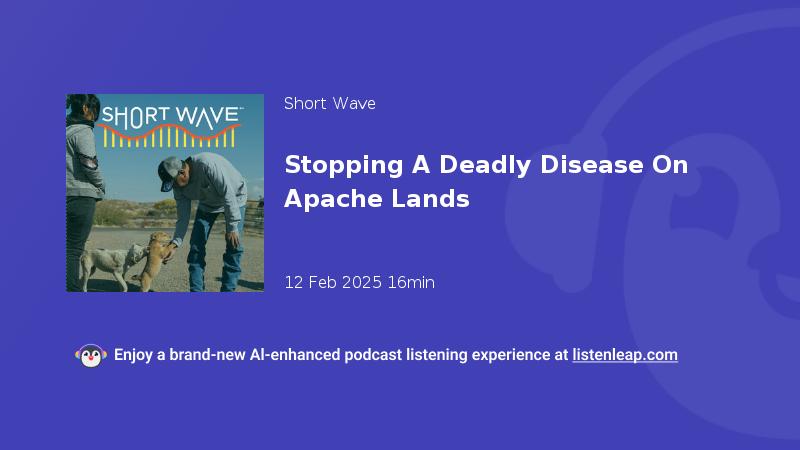
So there's a few different parts of this that we saw, members of the health department, and some folks from the CDC that were there when we were there, they roll up to people's homes, they set tick traps to count the ticks and they put collars on the dogs to prevent the ticks there.
Okay, so go ahead and put it over his head.
And these have been super effective.
they told us. And this is good for eight months.
Okay. They also go around and spray a caricide.
It's this pesticide that kills ticks and mites, and Animal Control will go and spray it all around the base of the house about three feet up.
It's supposed to be harmless to people once it's dried, but it kills ticks.
Fascinating. Right.
I mean, at this one house we went to where Maureen had gone a bunch of times over the past few years, she says there were so many ticks the first few times she went and now there wasn't a tick to be found.
Not on the dogs, not on the tick trap that she set, which she had baited with dry ice since the carbon dioxide attracts the ticks, just not a single tick to be found.
This is so impressive and it's so – this One Health approach is so multi -pronged.
It is making a difference but it does sound really labor -intensive.
How does the tribe keep all this going?
With a lot of work and good relations in the community, a lot of the groundwork's being led by Hardy Bendel, who's a tribal member and head of animal control.
This area has been one of our target areas.
Most of the cases that we see come from here.
He took us around and introduced us to a lot of people, and he even took us to an Apache cattle ranch, where we met up with a cowboy who had just recovered from Rocky Mountain Spotted Fever.
he said he had a rash that was still fading on his foot.
It's kind of still there, but it's not as bad as it was.
It was just like a little spot on my foot, you know.
That was Houston Tyhinton, who's a stockman at the cattle ranch. And he had just gotten Rocky Mountain spotted fever in November of last year, which proves to Hardy's point that even though a high season for these takes us in the spring and summer, they do bite year -round.
And just to paint the picture a little more, I mean, Hardee's got this tiny field team.
It's two people, Timothy Nosy and Josiah May, and they're out there most weeks just visiting people, talking to them about Rocky Mountain Spotted Fever, spraying their homes.
They do get some temporary help in the high season, but otherwise, it's just the three of them holding the line across all 2 ,000 -plus households and 1 .8 million acres of the reservation.
Wow. I've heard in other public health interventions, individuals like that are called like super communicators or nerd nodes of trust. They're just like people who are really good at spreading awareness because people already trust them.
You're totally right.
Josiah, Jonah, as he goes by, was a really integral part of the community and was clearly taking care of a lot of people in the reservation.
And that's what they've got, because there's no vaccine available yet for people or for dogs.
And less people think that this is easy and solved.
It is not. I want to contrast what's happened here, this great success story that we've been talking about, No Deaths in Five Years, with what's been happening recently with the same disease in northern Mexico.
They have a surging epidemic there.
And I spoke with a doctor and epidemiologist in Mexico, Gerardo Alvarez -Hernandez, at the Universidad de Sonora, who has seen many deaths from the disease.
This disease in Mexico affects people and population that are very vulnerable, not only biologically like children and adolescents or elder people, but people that is living in poverty.
It's also been found in travelers who are returning to the US.
Back in 2023, the CDC sent out a warning for severe and fatal cases after three people who had recently traveled to Northwest Mexico died from the disease in California.
This disease is very serious.
it requires constant vigilance.
So it's something they expect to keep working on for many years on the San Carlos Apache tribal lands and the others around it.
Well, we will take and celebrate any win we have right now.
Five years, no deaths from Rocky Mountain Spotted Fever in this community.
Ping. Megan, thank you so much for bringing us this story.
You're welcome. Thanks for having us.
If you liked this episode, make sure you never miss a new one by following us on whichever podcasting platform you're listening to.
And hey, if you have a science question, send us an email at shortwave at NPR .org.
This episode was produced by Burleigh McCoy.
It was edited by our showrunner Rebecca Ramirez and fact checked by Tyler Jones.
The audio engineer was Koyce Lee.
Beth Donovan is our senior director and Colin Campbell is our senior vice president of podcasting strategy.
I'm Emily Kwong. I'm Ping Kwong.
And I'm Megan Lim. Thank you for listening to shortwave from NPR.
This message comes from Greenlight.
Adults with financial literacy skills have 82 % more wealth than those who don't.
From swimming lessons to piano classes, parents invest in so many things to enrich kids' lives.
But are you investing in their future financial success?
With Greenlight, you can teach your kids financial literacy skills like earning, saving and investing.
Start prioritizing their financial education and future today with a risk -free trial at greenlight .com slash npr.
This message is from NPR sponsor, Total Wine and More.
This summer season with so many bottles to choose from, it's easy to find your favorite and more.
Find what you love and love what you find only at Total Wine and More.
Drink responsibly, B21.
This message comes from Mint Mobile.
Mint Mobile took what's wrong with wireless and made it right.
They offer premium wireless plans for less, and all plans include high -speed data, unlimited talk and text, and nationwide coverage.
See for yourself at mintmobile .com slash switch.