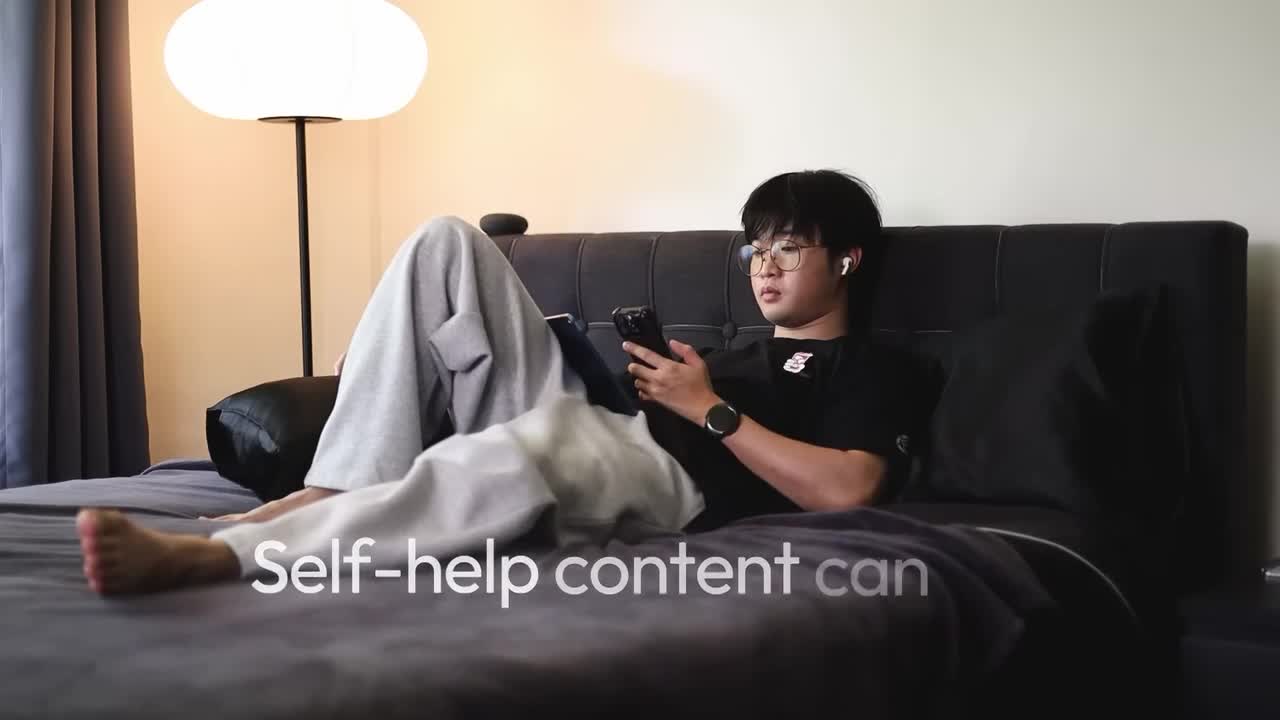
You should stop watching self-help video content on YouTube.
Now, I know that sounds strange and all because I am a self-help YouTuber.
I pretty much make content about self-help and pretty much my income and my revenue comes from making self-help videos.
So you know I'm kind of shooting myself in the foot here, but I still stick to my point, which is that you should stop watching self-help videos blindly.
That is recently, dr k made a video about this, and i kind of wanted to expand on his point there, which is that i pretty much agree that self-help videos to some extent can be very, very bad for you.
Like, people don't realize this, and i can explain that with your reward system, so let me explain.
I just said that Your reward system essentially is a biological mechanism that encourages specific behavior.
And in order for your brain to encourage that specific behavior, your brain has to give yourself some sort of reward.
So there is an action and that results in a reward.
And because of this reward.
This reward will reinforce whatever behavior that caused you to do that action.
And because of that, it will incentivize you to repeat that action again.
So there is an action and it leads to a reward, and that reward reinforces your brain to repeat that action again.
And by reward, I'm talking about dopamine.
Now, in order to get from action to reward, you need what we call effort.
And this is pretty much is the driving force of what human behavior is.
And by effort I mean basically the amount of energy that you put in and the amount of difficulty that you are having to overcome in order for you to complete that specific action.
And your brain actually gives yourself a relative amount of reward based on the effort you're giving and the difficulty that you have to overcome.
So, for example, if you've given a lot of effort, you will get a bigger reward.
And you'll notice that this mechanism happens in pretty much all places.
So, for example, when we talk about going to the gym, if you push yourself forward and you know that you're going to get them fucking gains when you push yourself, your brain rewards you with more dopamine because you've overcome a harder task.
This within itself, this whole reward system is what drives human behavior forward.
Now, let's talk about how self-help is introduced into the system.
Now, the purpose and utility of self-help content is that it is essentially a starting point to progress to the action that you need to do.
So in a sense, self-help videos are in a sense a guide to the action that you need to do.
So pretty much self-help is for those people who don't really know what to do with their life, or they don't know what to do in the first place.
So obviously not everyone can just start doing something, because not everyone has their shit together obviously.
Some people don't have it figured out.
And that's what self-help videos are for.
Self-help videos guide you to a specific action.
So in a sense, self-help is a catalyst of action.
Now the problem is that, within itself, watching self-help content actually does something to your brain and it actually triggers a reward system.
Because your brain is learning something, it is generating dopamine for yourself, because you are actually learning something in your brain and it gives you that click moment.
You notice, whenever you're learning something and just have that aha moment, you feel this rush of dopamine.
That's pretty much self-help.
Your brain gets dopamine just by watching a self-help video and it's already giving a reward.
And I think you guys can already see the problem with that.
You are practically giving yourself a reward without putting... any effort or action.
And that is a problem with most people is that you don't do the action itself.
And the thing is this because your brain is already rewarding you, because you're learning new information, you feel like you're actually productive.
You feel like you've done something when you actually haven't done anything.
You're just there watching self-help videos.
And here lies a problem when it comes to self-help content.
It's way too easy to consume.
It is so easy to consume self-help content that it just ends up giving you this easy access of dopamine and you consider that productive.
It is way too easy for you to access that reward pathway and for you to feel like it's justified.
And because of that, that within itself rewards that behavior of watching self-help content.
And you'll notice that you are not taking any action or even any effort, because you're watching self-help content consistently.
You're binge watching it.
And that's exactly the reason why self-help content becomes very addicting to watch.
It's because it's kind of like a drug within itself.
Because, when you think about it, drugs give you a dopamine reward without actually giving any effort into it.
You just have to take a pill and boom.
Or not pill obviously not pill but, like you know, inject yourself whatever I don't know.
And it's kind of the same thing with self-help you watch it and you're immediately given a reward, a dopamine reward, without having to do any effort at all, and that, to me, is a very concerning thing.
If watching self-help content and taking drugs have a very similar mechanism, that is very alarming.
Now obviously, drugs is a whole different thing, but you get what i mean.
What the fuck?
That's going to be our brain in a few months.
I'm not even kidding.
We're at an age where we just have so much brain melting things and we're just not training ourselves to think critically anymore, which is why I partnered with Brilliant, today's sponsor, to help fight against brain rot.
If you guys don't know what Brilliant is, Brilliant is a learning platform.
And I feel like it's very critical at this point in time to train our critical thinking, because we're just at an age where there's just full of distractions and everything.
And now that we're in an age of AI, everyone's just offloading their effort to AI or letting them write everything.
And we're just not using this.
What Brilliant is is that it's a learning platform where you can learn math, science or computer science in a fun and visual way.
So it's not even boring anymore.
It is visualized and you actively solve problems instead of just learning the content itself.
Currently I'm doing their scientific course, which teaches you how to think scientifically and it just gives you visual problems which it's just so fun to do.
And it's just so quick.
I can do them every day.
And by doing that, I also train my brain to not offload my thinking to AI or whatever.
You can head down in the link in description to get a three day free trial, or you can even scan the QR code right now on this screen.
Anyway, that's Brilliant, down below in the description.
Go check them out, I find them really cool.
Anyway, back to the video and please, for the love of God, start using your brains.
Don't offload everything to AI.
Yeah, that's all I have to say.
Now, luckily for you, there is a way to get out of it.
And, luckily for you, you can keep watching self-help content, because number one.
Please keep watching me.
I'm just kidding.
But there is actual utility to self-help content because it actually serves as a great foundation and guide for people who don't really know what they're doing.
The only thing you have to do is what I call the one to one ratio.
So what exactly is the one to one ratio?
So the one to one ratio is my idea of how to properly consume self content, which is to make your consumption equal to the output and action.
This could be with any self-help YouTubers, so like me Jay Spark or Matthew Smith, Amy Wang, PCFG Studies and whatnot.
You need to equalize your ratio of consumption and action.
Basically, your amount of effort when watching self-help content must be equal, or must be the same, to the amount of effort applying the said content that you've just watched, because you are basically reinforcing the action that is guided from the self-help rather than watching the self-help content itself and instead of using that reward that you get from watching self-help content.
So when you watch self-help, self-help content, self-help you get a boost of dopamine.
I want you to use this boost of dopamine as a starting motivator motivator rather than the reward itself.
So you not only do you have starting dopamine to make yourself feel good about doing the action, but you can actually reinforce yourself to do the action, which leads to the ultimate reward within itself of dopamine.
And because of that, you will reinforce this action rather than watching self-help instead.
So let's take a very practical approach here.
So I want you to use this literal video as an example.
So we're near the end of the video.
And my entire point is for you to apply these self-help videos the same rate you were watching them.
So what does that mean for this video specifically?
So, for example, that would be you literally closing this video right now after watching and just stop and reflect.
And to just reflect about what you just learned from this video, i would highly highly recommend just sitting in silence or just taking the time off to just think about it, rather than watching and binging the next video or, you know, just sitting there and thinking about it.
You know what?
Let me help you.
Let's think about it right now.
So we just learned about how we should have an equal ratio of effort to amount of watching self-help videos.
So let's spend a minute of time just in silence for you to process that information.
Have you internalized it?
Boom.
Hello.
Are you still here?
I don't even know if that was one minute, but anyway, that wasn't that hard.
And hopefully, by internalizing that and just taking the time to think about it, you can actually start applying this once you close this video.
Anyway, I hope you guys enjoyed this video.
It's a little bit of a different video and it's a little bit something that I really want to talk about, because I recently seen Dr K's video and I wanted to expand on it.
I think we've come to a point where we just have so much self-help content out there and I think people are just getting the point of self-help content wrong, because the point of self-help content is really to guide you, not really to make you feel accomplished just by watching it.
You know you, you could be watching this, but literally you haven't done anything aside from watching this video.
And there's this quote that i always follow, which is that knowledge without action is just ignorance, right?
So what's the point of learning everything if nothing's going to be done?
There's no output, you know made and you know.
Even then, i still think it's useful that you're watching self-help content, thank you, but then again, 80 of the results and if you really want to succeed is really from the action.
But yeah, um.
That being said, again thank you guys for watching.
Um, i've been vlogging a lot more, so hopefully my vlogs on my second channel, you know, will be, you know we'll be back on track.
So uh, stay tuned for that.
But yeah, for now, thank you guys.
So much for watching.
I'll see you in the next one.
Don't forget to drink your water.
I'll see you in the next one, bye.