You're listening to Roundtable.
I'm Niu Honglin, joined by Steve and Yuxuan.
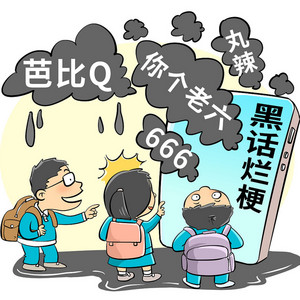
Over the past few years, a quiet linguistic drift has been underway.
Viral memes and online catchphrases some humorous, some crude.
Many ambiguous have slipped from screens into classrooms and office chats.
Educators are sounding alarm about disrupted lessons.
Parents worry about declining language skills, and linguists point to a deeper concern the erosion of nuance in everyday communication.
Today on Roundtable, we examine the rise of modern day slans and ask a fundamental question.
What happens when shortcut expressions start replacing real language?
And before we wrap up the week, let's take a moment to appreciate the good stuff.
We're happy to present Roundtable's Happy Place, where we each share something that made us feel lighter, happier or just a little more grateful this week.
But before that...
Language is supposed to stretch our minds, giving shape to feelings we can't yet name.
But in the age of memes, words contract instead of expand.
Complex emotions shrink into punchlines, serious issues get wrapped in irony and a world already saturated with noise becomes even harder to navigate with clarity.
So I was wondering, have you used any of the memes or internet slams in your daily conversation?
Or let me rephrase myself, how often do you do that, Yusheng?
Yeah, I absolutely did that.
And I think that is some kind of a common behavior that a lot of Art like gen Z would do.
That would be like perceived as cool.
Or we use Internet, we we know that kind of Internet slant or memes and
That at sometimes I wouldn't say, of course, this whole topic is, is is gonna be about.
How should we understand these means how, how should we realize that we've been bombarded by these memes in our lives?
But the thing is that nowadays it's been quite convenient and it's been very, very easy to use when maybe only one word or one phrase can just express the whole feeling of your idea.
I doubt that, but we can talk about it later.
I don't think it's Gen Z. I think it's Gen Alpha.
It's the next one.
It's the youngest group, right, that's using these the most.
Oh.
These days.
I was about to say it's all the generations.
Everybody's using it.
You think so?
Yes, even my parents sometimes use the kind of language.
Yeah.
Really?
They use the previous well, not previous generation, like the kind of slang that's popular 10 years ago, but they use it.
Yeah, but that's what I mean, though.
Each generation has their own period of being annoying.
Your parents had it, their parents had it, their parents, parents parents had it.
Okay, and it's gonna happen again after gen alpha.
It's just, it's just.
For me it's just kind of like um, something that young people go through because And we'll get into the reasons a little bit later but one of the reasons is because it's out there and everybody's talking about it.
It's like social currency.
You want to fit in, right?
You want to be able to communicate, so therefore you use it yourself.
I think it's just amplified these days.
Because of the internet, because of social media and because of the meme culture that people are more exposed to it and therefore use it more often, perhaps.
But the news story here definitely is making headlines and it's about younger generation, young students at school, even some of the youngest ones.
Certain internet slang expressions have become very, very popular among even primary school students in China.
And one example is this video is showing that students are keeping saying these memes like 包的.
This is a Chinese phrase that used to mean like sure or definitely.
It's like when you ask, can you handle this?
And the other person just replies, totes.
Okay.
You bet.
Yeah, that kind of thing.
How do you say that?
Totes.
No, not the English.
I already speak that language.
Yeah so, but the thing is that to encourage students to learn more like expressive and elegant language.
Instead of replying too much on internet slang, one Chinese teacher suggested several traditional idioms that can convey a similar meaning.
I think it's really hard to directly translate into English, but I can list some, like...
Let's say it's about almost certain to succeed, or I am fully confident and well prepared.
When you're replying that,
You bet.
Those are memes?
No, those are Chinese idioms.
Oh, okay.
Those are the good, elegant words.
Oh, I was going to say, those sound like well-formed and thought-out sentences to me.
Yes, and that's my point.
What Yu Shun said, ooh, a simple meme or internet slang can express my feelings so perfectly.
I know what you mean and also I get the feeling that ah, there's something that I do not know how to express perfectly and it is being delivered and expressed by someone, and that is a really good moment.
But that moment. is so rare in the past and also so precious.
I find those moments in, for example, Chinese poems or in beautifully written novels.
Specific moment we're feeling.
A very intricate, delicate feeling is being described by someone and they feel like ooh, our soul just clicked at that moment.
Yet nowadays, Hold on.
Okay.
That's a good pronunciation.
Yes, yes, you're good.
What did I just say?
It's good.
And that is related to when you're playing video games.
Usually you would have a buff or a shield, like a defense shield.
And when that system got broken because of certain things your opponent figure is doing, then the hurt you got would be much higher or much extensive.
And that is showing that oh, my defense just got lowered or my defense just got removed because of certain thing.
And now I'm so vulnerable and it's really easy to hurt me.
Okay, so that is the origin of this word.
Okay, ask me if I understand.
Do you understand what I talked about?
You just... I was making... So good.
But I was making the point.
My point was that is just a word describing that currently...
Something has touched me in a bad way really, really heavily, but it didn't say what has hurt my emotion.
Is it because you said something that was right about me, but I don't like?
Is it because you're accusing me of doing something that I didn't do?
Is it because that your way of speaking is so rude and hurt my feelings?
None of this information is included in that one simple phrase.
And people use that phrase and it simplifies their feelings.
Yeah, but every generation has its own linguistic code, though.
And this transcends culture.
This is true in China.
It's true in America.
It's true in Australia and England.
Pick a country.
And this is also a way of communication.
It might not be the most elegant or articulate form of communication, but it still is a way of letting people know how you feel in a particular moment.
The thing is old people don't like it.
And that's why it becomes a thing.
But it's not that big a deal.
Yes, if it's vulgar, you're crossing a line there.
OK, if it's defamatory, you're crossing a line there.
But if you're just figuring out, as a young person, how to communicate, get along with other people, I don't see a problem with this.
Before choosing side, before I personally choose a side, Yixuan, you choose a side.
Do you think it's a big deal or not?
I kind of think it is becoming a big deal right now.
And the thing is that when a lot of like adults are saying these kind of things, they are expressing the ways in a simplified way, as you said.
But that's under the circumstance of they have already learned a lot of stuff and you have the knowledge of the whole scenario and maybe the history of that.
Right.
But when, when these like primary school students, they are using these words, they just got a shortcut of these words, slants and memes.
They didn't get to the like, the behind the meaning of that.
They don't know what they're actually saying.
Yes, and they are just actually directly using them in the way that I think it is cool, but they are not actually learning the way that this language or linguistically performed.
And also, you would maybe encounter problems such as you're losing the ability to grammarly form a long sentence sometimes when you're using the short ones all the time.
It affects the ability.
And, of course, another thing would be we are for especially young kids, like Yushun mentioned.
Some of them do not understand the formation of such words and they are mistakenly use a rude word as something that is just a catchphrase.
There's no... negative side or connotation related to it and that is also a problem.
Yeah, it's a problem, and that's when parents and teachers step in and say no, you don't use it like that.
But again, young people are still figuring out language themselves.
So they're going to make mistakes like that.
They're going to say inappropriate things or sometimes derogatory things.
And it's a mistake and it shouldn't be allowed.
Don't misunderstand me.
But what I'm saying is it's going to happen.
You just need people in the right positions to say no, that's not correct when they say those types of things.
Is there anything that we can do, though, for the well, maybe for adult?
I can agree with Steve that it's not it is not that big a deal.
We are still able to use the beautiful lines from Chinese poems.
We're still able to use really formal languages, Chinese idioms in official settings.
But for young kids, probably it's a bit more serious than for adults.
But should we do something about it?
Is there anything we can do about it?
That's why a lot of people are praising the teacher that I mentioned before under this video, saying that sometimes our brain has been taken over by these internet slans and memes and sometimes we may even forget that There are more elegant and expressive ways to speak.
And I can totally relate to it is because I think I mentioned this before in previous shows.
Because in primary school, we learn a lot of poems from ancient China.
That's when a lot of these very significant, renowned poets to make that they made it.
When they see something very magnificent, Hold on.
You want everybody to be a Shakespeare when they're walking around.
It's not like that.
Let me finish this.
We want some people to be Shakespeare.
That's true.
It's like, when you are seeing these beautiful and magnificent views, you have more ideas and more expressive ways to express it.
But not like saying some simple words, not like me just saying magnificent.
Magnificent is good.
You can say take my breath away.
But some people say, wow, bro.
Wow.
That's not OK.
That is OK.
If everybody's saying that, I don't think it's OK.
Why is that not OK?
Because it's just too simple.
It's too simple for everybody, right?
If everybody's using that kind of language, then you lose the nuance and you lose the subtle implications and you lose different ways to say it's beautiful.
It can be beautiful in different ways.
Yeah, I mean, I know what you're saying.
You want people to be good speakers.
You want them to be articulate when they use their words, and that's never a bad thing.
But you can be that in the proper context and still be a different kind of perhaps even dumbed down speaker with your other friends.
When I play ice hockey, I would never broadcast half of the words that come out of my mouth.
Okay, that makes sense.
I don't skate around the ice saying, "'Twas a good shot, fine fellow."
Nobody talks like that when you play...
See what I mean?
There's a time and a place and there's context for things.
And that's why I think it might not be so serious.
But there is a flip side to that coin.
Let's talk about this that came out in February of this year.
It was from the Social Survey Center.
This is what they found through their survey.
69 of responders said they were worried about the overuse of vulgar internet memes that could hinder young people's ability to quote speak properly.
Regarding the negative impacts of such memes on adolescents, 53 of respondents said that they may lead to a misuse of vocabulary, meaning not using the words properly.
And 31 almost 32 thought that some memes are vulgar and meaningless and it undermines the development of young people's proper values and worldview.
Those sound really serious.
They are quite serious.
Yes.
How do you evaluate that?
That's a tough thing to do.
How can you tell if someone's worldviews and values are undermined by memes?
That's very hard to measure.
You're right.
And that is why I think schools should step in.
Parents should look after their kids and also watch out when serious issues happen.
But at the same time, as a parent myself, I also... want to agree with Steve a little bit.
That is every generation has their opportunity and their face to be annoying.
And when they do, maybe we can you know cut them some slack.
Give them a moment, because they do still need to communicate and bond with their peers, with their classmates.
They want to make friends.
And it depends on the kind of language they use.
I remember a TV commercial came out in around 1999 or 2000, something like that.
It was a Budweiser beer commercial.
And they played it during the Super Bowl, the American Football Championship game.
And this commercial caught on like wildfire.
In the commercial, when the guy answered the phone, you know, what's up, right?
Like, hey, what's up?
But they answered like this.
What's up?
Oh, yeah.
I think I remember that.
Do you know about this one?
Yes, yes.
Many people try to say that in that way.
Because it's on the telephone, then everybody started answering the phone that way.
My friend calls me.
I say, hello.
And I would hear this on the other end and i would say, and everybody around me was like oh my god, would you shut up please?
But that's my point.
I don't talk like that all the time and i don't talk like that anymore.
I think it's just a generational thing.
Well, for those of you who are listening, let us know what you think.
Do you think it can be a serious problem or do you find it okay for your kids to use that kind of language in your home?
Let us know.
You're listening to Roundtable coming up next.
Happy plays.
Don't go away.
Delivery.
Delivery.
Delivery, delivery.
What is it?
Happy Meals from Round Table.
It's Roundtable with me, Niu Honglin, Steve Hatherly, and Yixuan.
Sometimes all it takes to brighten your day is a fresh perspective.
In Roundtable's Happy Place, we share what's been bringing us joy in hopes.
And that is, it can be inspiring to you to find the little moments of happiness in your own life.
So Yusheng, can you share something that can make me happy too?
Oh, hopefully.
But my happy place this week is from the sci-fi world.
I've been listening to...
The Audiobook of the Three-Body Problem.
Ah, that's a good one.
That is kind of a groundbreaking Chinese sci-fi epic written by Liu Zixin.
And it's one of the most influential science fiction novels in China.
And its impact has gone far, far beyond the country.
Yeah, not just China.
English or Chinese?
You're listening to... To better understand the plot, I think.
But anyway, the story has inspired several, as we said, screen adaptations.
For example, in China, Tencent produced a three-body TV drama and received quite a good comment and review.
And internationally, Netflix actually also created a series based on the three-body story.
Yeah, I watched that.
Oh, really?
Did you like it?
It was a good watch.
Yeah, that got really positive ratings, I think.
And what really draws me in is the story itself and how the book blends bold, imaginative sci-fi ideas with the sense of realism.
You know when you were thinking about I'm not going to spoil it, but anyway the sense of realism that feels almost unsettling.
Even though the story takes us into cosmic civilization and also future technologies.
So many details feel strangely real.
And I find myself completely absorbed and both fascinated and a little bit... scared, to be honest.
Because it is too real.
Yeah, I understand.
It's plausible somehow, right?
I don't know where you are right now in the story, but for the first book it was very real.
Like you said, it feels like something like this could really happen on a star that we do not know, and it's slowly happening and approaching us.
For the second book, it's a bit more philosophical, in my opinion.
And the third book is just.
He is creating a whole new world, a whole new no, it's a whole new concept of how the world can be, or how the universe can be, and it's also quite.
I think all three stories or all three sections in this one book is really good.
Hope you enjoy it.
And for those who haven't been reading Three-Body Problem or listening to it, quite a good time to start.
It makes you happy as it has made you happy.
And allow me to share my happy place.
Recently, I have The pleasure to revisit Guangzhou after almost a decade.
I think the previous time I was there was more than 10 years ago.
Oh, wow.
Yes, and it was a very delightful experience, though my trip was... definitely packed with work.
It was only three days.
I still had a lot of fun.
And Guangzhou has been as beautiful as I remembered, but it's also been very, very international.
Not like I remembered.
When I was walking on the street, I see one out of three person being a foreign expat.
And when I was walking on the street seeing a little vendor well, different vendors selling their products, sometimes a children's toy, sometimes flowers.
They can interact with people in English quite well.
And that's just, you know, vendors on the side of the street.
And also because, when I was there, the city was decorated with the 15th National Games related decoration.
And it's being very warmly celebrated. and hotly celebrated the entire city.
And even when I was visiting some of the souvenir stores, I see local residents and tourists buying the souvenirs, buying a lot of the souvenirs.
And it shows how popular and how...
Enthusiastic, the city is about the national games.
Did you get one of the dolphins?
Yeah, the mascot, right?
Yes, yes, yes, the mascot.
It's Chinese white dolphin, and I got one.
And the reason that it made me particularly happy was that I realized even it's a three-day business trip.
Even I was quite busy during the entire experience.
Still, I was quite pleased because it's my little getaway.
When you are away from the day-in, day-out life that you have had for a really long time, it is the pleasant, the joy you can enjoy.
And I realize that life is not measured by the number of breaths we take, but by the moments that take our breath away.
Hmm.
Well said.
Very poetic.
No meme talk there.
I hope this can inspire those who are, you know, finding it a little dull in their life to take some little gate away.
Even if it's not maybe it's not a long trip just for a weekend or something you can find joy in the little things around you.
So yeah, hopefully that can make you happy.
And also the 15th national game.
It's quite impressive.
Did you catch any events when you were there before the event started?
Yes, one day before.
Oh, only one day before.
I didn't follow the whole process, but I've seen some of these live broadcasting of a badminton match um bra match and the people can actually see.
Do you remember these kind of uh eagle eyes when you can, when you're watching the soccer ball and also tennis ball, when people are trying to identify it is out or not.
You can have that 360-degree camera vision to see that.
Oh, okay.
Now you can see these games live in that angle, like 180-degree angle to see that.
So you can move your device?
Yes, you can move, like in perspective.
You can move yes, move your screen and you can see that the court is moving around your finger and you can control which angle of the court.
You see.
I'm not sure that you are controlling or the broadcaster are controlling, but you can see it is moving.
That's pretty cool.
Yeah, the tech available now used in sports.
Camera technology to determine whether a play was this or that, or in or out, or something like that makes it a lot more accurate.
I guess is the word, but for us who watch it's just kind of a different viewing experience.
Yes.
And the technology that CMG has also allow people to analyze a moment that just has just happened and see the angle of the ball and also see what are some techniques the athletes are using.
And it's quite informative as well.
Well done there.
And that brings us to the end of today's Roundtable.
We'd love to hear your thoughts on today's topics.
Leave us a comment or send us an email to roundtablepodcast at qq.com.
Until next time, keep the conversations going and the ideas flowing.
I'm Niu Honglin with Stephen A. Shun.
Thank you for listening.
Bye-bye.