Hello my friends and welcome back to the Easy English Podcast.
The best place to learn English while listening.
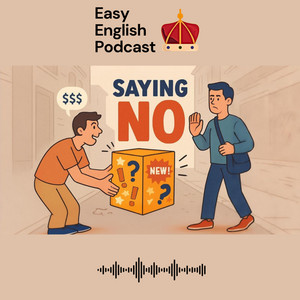
I'm your host Oliver, and today we are looking at a superpower that I like to call the power of saying no.
No may seem like a very simple word in English, but in reality, for many English learners, declining a request might feel uncomfortable.
You might worry about sounding rude in English or maybe unprofessional.
However, setting boundaries and knowing how to say no properly in different ways in English can set you up for success.
So let's get started today and learn some new words.
And we will learn how to soften your refusal, your no, to sound polite but still assertive, confident and more natural in English.
Now for our key vocabulary.
Here are five essential words and phrases for mastering that art of no.
The first that we need to listen for in today's episode is the word assertive.
Assertive.
I've said this word before in the episode.
And this means having or showing a confident and forceful personality.
Being assertive means saying no without feeling guilty.
And we usually use assertive as a positive description, a positive adjective.
The second word is boundary, boundary.
And a boundary is a limit or a line that shows where one area ends and another begins.
So we might set a boundary between our work and our personal life.
So where the work stops and where the personal life begins.
Our third word today is to decline, decline.
And this is a verb.
It essentially means to politely refuse an invitation or a request.
In other words, to say no to an invitation or request, to decline it.
I'm going to decline this meeting because I am busy.
Fourth word today, capacity, capacity.
Capacity is the maximum amount that something like your schedule, for example, can contain.
For example, I don't have the capacity to do any more work this week.
And our final word, bandwidth, bandwidth.
This is the mental energy or time needed to deal with a task.
I'm sorry, I just don't have the bandwidth for a social event tonight.
Okay, listen out for those words in today's episode.
Hopefully you'll hear them.
If not, don't worry, you're going to hear these words as well in context as I read.
So even if you don't recognize them, you can try to understand the overall meaning.
So this week, the Christmas holidays are coming up.
I didn't make a specific Christmas episode this year because I have done two or three Christmas podcast episodes before.
But if you can give me one Christmas gift this Christmas, it would be to make sure that you are following or subscribed to the podcast and that you've left a review, if you enjoy it.
And, as always remember every week on the Patreon, along with each main podcast episode, I post the transcripts as well with each episode.
And starting last week, as part of Patreon membership, every episode comes with a set of flashcards.
So you can join our Quizlet class for free as part of your membership and get access to flip cards every week to help you learn key vocabulary from the episode and extra words that I haven't highlighted in the episode.
And we have a bonus episode every week too.
This week's bonus episode, or I guess last week now, is the art of gift giving.
So talking about gift giving, particularly around Christmas.
So etiquette, we call it, about how to give gifts and how to react a little bit around that topic.
But enough about the Patreon.
If you want to support, the link is always there in the description.
You get access to all that bonus stuff and it really helps the show.
Let's get into our main episode today.
So in English speaking cultures, we rarely say a flat no, just no.
A direct no sounds quite harsh in the culture of English language.
As we've talked about before in English, English is an indirect language.
Most cultures that speak English have indirect cultures or indirect communication styles.
We better to say
And as a result, the language behaves differently.
It doesn't mean that, you know, it's silly that people don't say no.
It's just how the language works.
I've talked about that a lot before, so I'm not going to stay on that point for too long.
And usually you'll see, whenever people say no to something, sometimes they'll use what we can call and I've read this name online it's called a no sandwich strategy.
So when we think of a sandwich, a sandwich has a piece of bread, then it has some meat or something inside, and then another piece of bread, which is why it's called a sandwich.
It's sandwiching something together in the middle.
So when we use a no sandwich and you can also use this for negative feedback we start with the piece of bread.
So the first piece of bread on top, And that is something positive.
So you might say, for example, you know, thank you for inviting me.
Or I appreciate the invitation if someone has asked you to go somewhere.
Then we have the filling, the part inside the sandwich, which is usually the no.
The real part, the part that we want to actually answer.
And this says that you cannot do it.
We usually keep it brief.
So for example, but I'm not able to make it or I can't make it.
And finally, the bottom bun, the bottom piece of bread.
And that is another positive sort of finisher or finishing point, and it's usually a helpful or a friendly tone.
For example, maybe next time, or I'd love to help out in the future.
In a professional setting, for example in work.
Saying no is usually sometimes about managing your capacity.
So your ability to work, your prioritization.
So prioritizing what you need to do.
So usually when you're declining something, it's because you need your attention somewhere else.
That's usually how work goes.
We have a limited amount of attention and time, so we have to choose what we focus on.
And as a result, we say no to some things.
Or at least in theory, we should.
So if you're too busy and someone has asked you to do something, or they've made a request, instead of saying I have too much work, you could also try and say something with that sandwich idea.
You know I'd love to help you with that, but I don't have the capacity right now, or I don't have the bandwidth to give it the attention it deserves right now.
You might also say, my plate is quite full at the moment.
That's a phrase just saying, or another way to phrase it is, I have a lot on my plate right now.
And it just means that you have a lot of tasks and a lot of things going on currently.
If your boss asks for something extra, for example, you can help them to ask you to help or sorry, to help you to prioritize.
So maybe, if it is something they really want you to do, you can say hey yes, I can help you with this, but I'm going to have to prioritize some of my other tasks.
So why do we often struggle to say no?
Well, we do think that when we say no, it will lead to conflict.
So it can lead to problems.
It can lead to a bad reaction or we think that people might think badly about us.
For example, in work, you might be worried that people think that you're not a team player, that you aren't, you know, working hard for the company, for example.
However, usually native speakers actually respect people who set boundaries.
So in the language, you're clear, you're direct, and you talk about your boundary.
And the boundary really is about where you've reached your limit.
So when you say no to something or you say, I'm busy enough, I've had enough, I can't do it.
You're showing that you value your time.
And although you recognize that someone has requested something, you're making a choice based on your position, your time as well, because your time is important, of course.
Another example of setting a boundary might be let's say, a colleague has asked you to join a meeting at 6pm, for example.
Now, this is a very, maybe a basic example, but your boundary is that you don't work after 5pm unless it's something very urgent.
You might exercise, you might use that boundary, exercise the boundary and say you know no, I can't do that.
I will be finished work at 5 p.m.
So you're making your boundary clear about when you finish work.
And these are all important aspects of saying no.
We have to recognize where our boundaries are when we allow ourselves to say no to something.
I don't know about you, but sometimes, whether it's work or whether it's life, it can seem like everything is urgent.
Everything needs to be done now.
Everything needs to be prioritized.
And sometimes we need to just stop for a moment and realize that we have to have our own boundaries too.
Not everything is urgent and some things need to be prioritized over others.
And if we say yes to everything, some things will not be done.
So we do have to decline some requests.
Okay, let's take a break for a moment and look at our listener spotlight.
But first I know Christmas is coming up and that's why my ebook Frizzle Verbs Are Easy is now half price for the winter holidays.
So, if you haven't picked up a copy of Phrasal Verbs Are Easy.
It's an e-book which teaches you English phrasal verbs by using short stories to help you learn these words from context.
The link is in the description below and it's half price for a limited time.
So you can download your copy and get access immediately.
So last week's episode was about technology and talking about technology in English.
Some different topics and varieties.
I did ask about people's opinion of technology, but I didn't get a lot of answers.
There was quite a few listens, but not a lot of answers.
So I'm going to go straight to today's question.
What are some things that you struggle to say no to?
And why?
I will rephrase it.
So what are some things that you find it hard to say no to?
For example, you might find it hard to say no to having some chocolate.
You might find it difficult to say no or to decline if someone invites you to a party.
These are just some examples.
So I want you to answer and to let me know what you think.
And I will choose a few of your answers and read them out in next week's episode.
Okay, so let's go back and learn a couple more phrases that I think are really useful and cool with this topic.
So when we're saying no to friends or family, maybe in a more casual setting, what are some phrases that we can say?
This can be harder sometimes because it can actually be more emotional.
People might think that you don't want to meet them if you're a friend and you say no to meeting them.
But the best way is to be honest and direct about this.
You don't need a good excuse.
Saying no really is just enough when it comes to being honest and direct with friends and family.
I was reading a book recently and it was talking about this, about saying no.
And the main way to do this, I suppose or, as this book had said, the best way to do this with friends or family is to make sure that you're direct and clear from the start.
There's nothing worse than if someone says you know maybe, but we both know they're not going to go.
Or they say, oh, I will try to go, but I'm not sure.
You know, that type of attitude is, it's dishonest and it's not direct.
The best way, and it's better for both people, is if you say, you know, no, I'm afraid I can't go.
Or, you know, I can't go.
And then finish up with something positive, like, but I really hope that you have a good time.
Or, but I appreciate the invite.
So, rather than starting with the positive and ending with the no, it's always better to directly say no and finish on a positive.
Because usually in a sentence when we hear that word but we start to forget about everything else at the start and we focus on those final words.
It's perhaps a psychology trick or something psychological, where you know if I say to you that sounds amazing, but I can't go, the focus is on the fact that I can't go.
But if we say I can't go, but that really sounds amazing, it emphasizes the fact that you think it sounds amazing.
Strange, but it is kind of true.
So that's a tip from a book I recently read.
That I would recommend you is to say no directly at the start and then say something positive and nice at the end.
Okay, so that brings us to the end of today's topic.
Let's recap a few of the words today, because some of them were quite hard.
The first was about being assertive.
I probably didn't use this word as much as I wanted to today, but being assertive is being confident and forceful.
I guess an example there is saying no directly at the start is being assertive, right?
Our second word was boundary.
So looking at our boundaries.
And I know we talked about that in quite a bit of length.
So it's important that you set your boundaries of when you say no or when you know that you need to say no.
We had decline.
So to decline, to decline an invite.
We had capacity.
So talking about, you know, the amount of maximum amount of what we can do.
And bandwidth.
So as well, again, the mental energy that we have.
So finally, what I want to say is I hope that if you're celebrating Christmas, you have a very Merry Christmas.
And if you're not or you have another holiday at this time of year, I hope that you have a wonderful holiday period.
I wish you wonderful times with family and friends and lots of joy during this winter season.
Thank you all very, very much for your support, your nice comments and all the care that you put in towards this podcast during the year.
Without your support, I wouldn't be able to do this, and I would certainly have a lot less motivation to do so as well.
It's very inspiring, a lot of the work that you guys are putting into learning English.
I just want to say, keep it up.
You're doing amazing.
You'll never know how much I really appreciate each and every one of you for listening and supporting.
So I hope you have a very Merry Christmas and Happy New Year.
And I'm very excited to be back making more podcasts now into the new year and to grow this podcast bigger than ever before.
Have a wonderful holiday and I will see you and speak to you very, very soon.
Goodbye.