If you want better conversations, conversations where people actually listen to you, where you stop rambling, where you sound sharp fast decisive, then today's episode is for you.
Because I've realized something.
Communication isn't a soft skill, it's a science.
And scientists can now tell you what makes someone magnetic and what makes someone instantly forgettable.
So I'm going to give you a bunch of research-backed, neuroscience-backed communication tools that I've realized almost all of the top 1 use but nobody else talks about.
This is how you change the way you speak in minutes, not years.
Mindset shift number one, people mirror your micro behaviors in about 200 milliseconds.
Think like less than the blink of an eye.
This is something called the neuro echo effect and it's pretty wild.
So neuroscientists at the University of Parma discovered that your brain has mirror neurons that fire within 200 milliseconds of watching someone else move or emote, which basically means people don't respond to what you say.
They respond to the emotional signal you send before the words even happen.
If you speak in tension, their nervous system tenses.
If you speak more certainty, their nervous system calms.
If you are scattered, they kind of mirror that scattered.
If you speak grounded, they become more grounded.
And this is the real reason that top speakers, or the people that you look up to, or the CEOs you look up to in the world They look pretty calm when they speak because they're actually trying to regulate the room's nervous system without anyone noticing.
You know, I remember when I walked into a room of a bunch of private equity guys.
You can imagine a mahogany table, a bunch of guys in suits sitting around it.
I'm the youngest person by far.
I'm the only female.
I know it's a stereotype, but it's what happened.
At that point, we were coming in to talk about my company and there was no chair for me.
Nobody stood up.
Nobody asked to pull up a chair.
And they were sort of all arguing on top of each other, talking about things, ignoring me.
And there's many ways I could have approached this conversation.
But I walked in and I pulled up a chair and I just sat down quietly and I waited.
I didn't try to speak over them, i didn't try to push through them, i just sat there like i had all the time in the world for them to figure out their small things.
Because here's why i made a promise to myself that i do not make myself small for small men, and i don't think you should do so either.
You know, i've walked into pe meetings where everyone is talking over each other like caffeinated squirrels.
I don't play that game, i sit Quiet.
And within like 30 to 90 seconds, the entire energy shifts back towards you.
Because people mirror these micro behaviors faster than they actually process your words.
They would never listen to me if I started piping in, if I started shouting, if I tried to get their attention and said quietly, let the room come to you.
And then there's this other thing that's fascinating about the brain and the way you communicate, and that is that the brain is addicted to novelty, not logic.
So they call this the orienting response.
So if you want to instantly grab somebody's attention, you need to give them something unexpected, right?
So there's a Russian neuroscientist that discovered this reflex.
But anytime a brain encounters novelty, it diverts a lot of processing power to it.
And so your brain is actually wired to prioritize.
Surprise curiosity pattern breaks over logical information.
That's how we get you on TikTok with these crazy clickbait little videos that happen, right?
So the way you start a conversation matters more than the conversation itself, which is crazy.
If you lead with something that disrupts the brain.
That is surprising fact.
Bold statement, a strange question.
The brain literally has to pay attention and then it has to stick there for a second because it's actually manually processing it, sort of like a car starting up a motor slowly.
So I want you to ask yourself how many times do you worry about all the things that you're going to say to somebody, but not just what the first sentence is?
Three, I think people judge your intelligence by clarity, not complexity.
This took me a long time to realize.
It's called the simplicity anchor.
So a study from the University of Munich found something really fascinating.
When speakers use simple language, listeners rate them as smarter, more competent, more trustworthy.
But when speakers use complicated or overly technical language, listeners assume they're hiding something insecure, not as smart as they look.
And I've seen this firsthand.
When you go into an investment meeting, one of the first things you want to do is you want the other person to think that you're smart.
You're asking for money from them.
But immediately listen to it next time you get your spidey senses up on somebody because they start using words like cogent.
And I find this to be divisive instead of like, that makes sense.
And I'm not sure everybody would agree with that.
So if you want people to think you're smart the crazy part you've got to stop trying to sound smart.
Simplicity actually shows a new IQ signal, shows a higher IQ signal.
The other part about this that's true is that questions actually increase dopamine.
So they call this the curiosity loop.
Carnegie Mellon scientists discovered that when you ask someone a question, especially an open-ended one, their brain releases dopamine.
That's like the happiness drug.
Dopamine makes people more alert, more engaged and more curious.
This is why questions pull people into conversations, not away from them.
How many times have you been in a conversation with somebody and they're just talking about themselves and you want to die until you get a word in or potentially I don't know respond to something.
That's why one of the most famous books of all time, which is How to Win Friends and Influence People, by Dale Carnegie, the entire book.
You can skip it.
The book goes like this.
Shut up.
Listen more.
People care more about what you know about them than what they know about you.
So try opening next time with something like, hey, can I ask you something I never asked before?
Do you want to hear something strange?
Can I test an idea on you?
It's like, ooh, me?
I'm so special.
This is just for you and I. It's something unique.
You know I once closed a deal because I asked the seller what would make this sale feel like a relief instead of a risk.
I could just tell he was like super tight.
He didn't want to sell his business.
Actually, there's so many physical reactions people have.
He had these little hives.
It actually happens a lot on men, I've noticed.
When they're nervous, they'll break out in kind of red splotches on their neck.
And I could just tell he was in a heightened state.
He didn't really want to talk about his business financials.
He was kind of scared that they were too messed up in order for me to want to buy this business.
And so he's getting heightened and heightened and heightened.
And even though I was trying to downregulate, I couldn't break him out of it.
But I said instead, I just kind of leaned in quietly and was like hey, what would make this sale feel like a relief instead of a risk?
And I'm quietly giving it to him, I'm leaning in showing intent, I'm very focused on him and his entire body changed.
Because questions chemically shift conversations, especially if you pair it with the last video that we did.
It's about communication and how to speak like a CEO, because your voice literally changes other people's heart rates.
This is called vocal entrainment.
This one also blew my mind.
University College London found that humans subconsciously sync their heartbeats to the rhythm of a speaker's voice.
Vocal entrainment.
So if you speak rushed, restless, stressed, heart rate is going to increase.
They're going to feel stressed.
If you speak steady, decisive, rhythmic, their heart rate calms.
They feel safer.
So your voice is not just communication.
It's like a remote control for other people's physiology, other people's biology and makeup and how they feel in an instance.
This is probably why I don't know if you guys have ever been to a yoga class where the yoga class is like a super fast, high-pitched voice.
Awful!
Could be the best speaker in the world.
But they have to speak, if you've ever noticed, they speak in kind of this yoga tongue.
Like and downward dog, and then we're going to move into upward dog, and then we're going to.
Why is that?
They're trying to rhythmically control your breathing.
And this rhythmic language sounds more true to people.
The processing fluency effect is actually where a Princeton study found that statements that rhyme or follow rhythm are judged as more truthful.
And what does this mean?
It means if the brain can process a phrase quickly, it assumes it must be correct.
See how these lines feel on you right now.
Move slow to move fast.
What you track grows back.
You repeat what you don't repair.
Kind of like, does it sound like deep wisdom?
It's like you repeat what you don't repair.
You're like, yeah, that is true.
I've noticed that, right?
Like even before the meaning is processed, it sounds like wisdom.
And this rhythmic language in your language can be incredibly persuasive.
And so how would you use this in everyday life?
Well, sometimes we call it talking in tweets.
So for the founders that we teach at contrarian thinking half the time, i'll say when was the last time you actually said those words out loud that you're speaking right now like?
Have you ever read somebody's email?
It's a founder when they're trying to sound smart and they're like to whom it may concern you know.
Please find attached the subject matter of this email, which is uh, in regards to our conversation we had last week, i'd like to follow up on shut up what that's not english.
Instead, think about how you could say more, or what is called high signal, with less words.
So high signal to noise ratio.
And that might be something like quick follow up on the one important thing we talked about last week.
Like how can you just be as concise as possible?
And some of the most impactful people of our generation.
There's a guy by the name of Naval Ravikant, and he's basically known for having banger one-liners.
Banger one-liners.
If you can speak in one-liners, people will repeat your words back to you.
The simpler it is, the more rhythmic it is, the more people will repeat your words back.
If you can get people to repeat your words back to you, what happens?
They follow you.
They listen to you.
They think that you are truthful because you literally put words in their mouth.
If you wanna get hyper-tactical on this, there's something called the 3-2-1 trick.
And I can't remember where I stole this from originally, but it's so good and so I wanna share it with you.
The step one is pause three seconds.
So when you are in a situation where you want to communicate aggressively, you want to be listened to.
You are in one of those difficult conversations.
I want you to pause for three seconds.
This is actually gonna activate part of your brain.
Neuroscientists found that when you pause even briefly, your anterior cingulate cortex activates.
A fancy way of saying the part of your brain responsible for error detection and attention, or lies.
It comes to attention.
And the pause literally kind of clears your mental windshield, allows you to see what is true or not.
So somebody says something you don't like.
You're going to pause one two, three.
Then you're going to do step two.
Give only two points.
This is called dual track working memory, that the brain really can't process too many things at once.
So it can usually process a verbal and a visual track.
So when you limit to two points, both tracks sync.
And then Can you please repeat that point back to me.
So what am I doing?
I'm putting my hand out there, like pointing to a specific point.
My movement is mimicking my communication.
And I'm giving them one thing to act on.
Step three, end with one question.
This is how you interrupt what's called the default mode network.
So your brain has a default mode, like the way that it runs every single day.
It's why, when you drive to the office, for instance you ever get to the office you're like, Oh I forget, like I didn't even remember driving here, right.
That's daydreaming, wondering your default mode network.
And questions shut that down instantly.
It like immediately forces the brain to come into the present moment, whether it wants to or not.
And this is how you pull anyone back into the conversation, even if they were drifting.
So let's say you really want somebody to pay attention to you.
You're gonna go, okay, here's the three, two, one method.
You're going to pause after they speak.
Three, two, one.
That is going to make them pay attention.
They're like, oh, that's uncomfortable.
What's happening here?
Two-step.
I want to talk about this one point, visual plus verbal cue.
Last point.
Do you understand what the goal is for this?
Or can we talk about that one point together?
Pulls them back into the conversation.
Super easy trick for difficult, important conversations.
There are some tactical tools, I think, that we all should just have in our toolbox when it comes to communicating.
And I wish they had taught this in school instead of like whatever we learned in marketing or communication or writing.
You know, one of the things that's most important in speaking in this day and age, where we have the shorter attention span than ever, is speaking in sprints, not streams, or what's called segmented speech processing.
So MIT researchers found the brain processes information in chunks.
Maybe you've heard this before, not like continuous.
So after about 12 seconds of uninterrupted speech, listener attention goes... falls to the ground.
TikTok actually based its entire algorithm on this single idea that humans can only pay attention for five to 10 seconds.
So why do you think the For You page is all built on these five to 10 second video hooks immediately.
Because they read the MIT research about chunking.
So what does that mean for us individually?
Speak in five to 10 second sprints.
This is so uncomfortable, nobody does it, and yet it works every single time.
I want you to pause briefly, then continue after 5 to 10 seconds and you're going to watch clarity skyrocket.
Especially try doing this in a fight.
It's a fascinating thing to do if you are fighting with your husband or wife or friend or partner or whoever.
Do you ever feel like you can't get a word in?
Like they're like going on and on and on, and all you're doing is waiting until they're done talking, so that you can get in there and do the same thing.
I'm gonna come right back and then you go on for as long as possible.
That's like this Mexican standoff between the two of you just like monologuing each other until you shoot yourselves in the face.
Not speaking from experience.
And anyway, the way to get around that is to not do whatever a human wants to do, which is speak for a long time.
It's to go, I really just wish you wouldn't raise your voice when we spoke less than 10 seconds.
Shut up.
Let them go on for 16 years.
I really wish that during our next conversation, we could sit down and maybe have a glass of wine while we're talking about this.
Shut up, let them go on.
At a certain point, the shortness of your responses allows the other person to actually hear you, and it's gonna shorten theirs too.
Try it, comment below, let me know if it works for you.
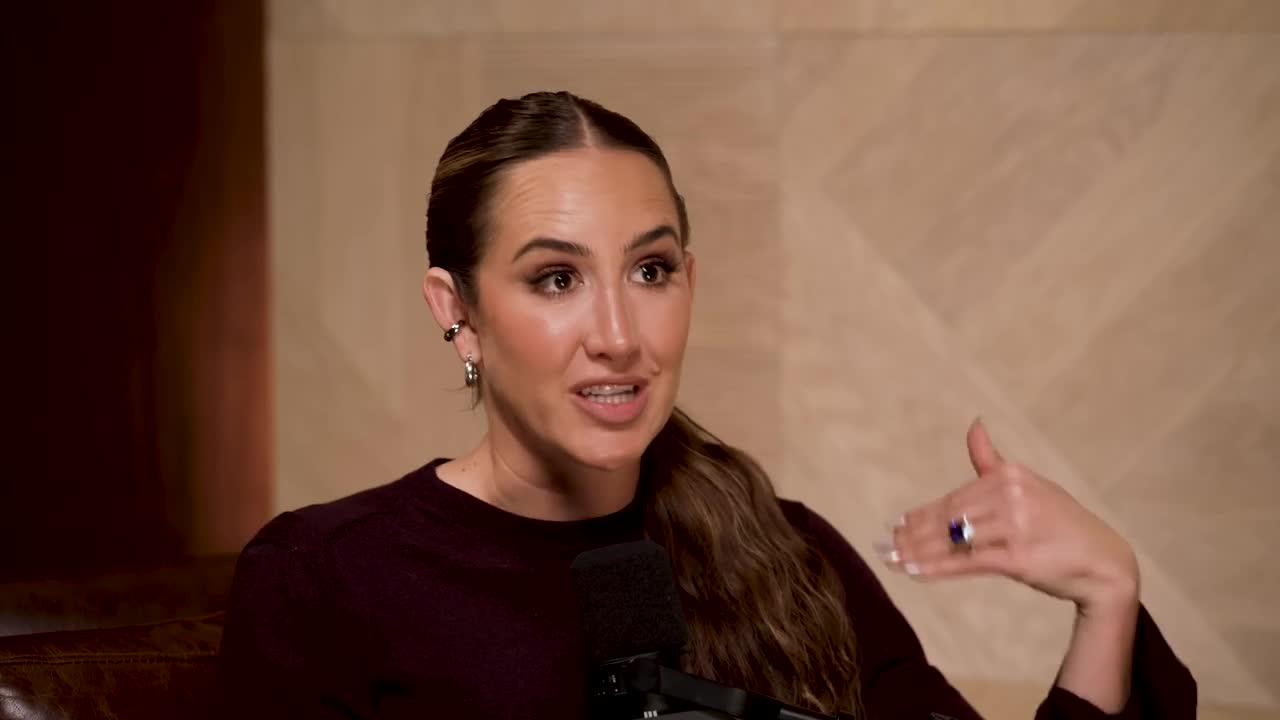
As you can see, I use a lot of hand gestures.
They actually say you should gesture before you speak.
This is called gesture priming.
So lots of studies on this, but the one I like the best is from UC Berkeley that found that gestures actually precede speech in the brain.
What does that mean?
Your hands help your brain form the thoughts.
So if you want to think clearly while you talk, move your hands first, like no dead hands.
One of the most uncomfortable things that you can do actually in having a difficult conversation is to go from this so hands in front of me talking to people to this hands behind of me not being able to see.
Why?
What does this immediately make you feel when my hands are behind me?
Like what is she holding?
What does she got back there?
This my hands are hidden.
Why?
The reason why actually goes back to the caveman days, which is that if our hands are hidden, we could have a weapon in them.
You know, Jan from HR could be like, but that's probably not going to happen.
And yet that is still how our little lion brain works.
And so no more hidden hands, no more dead hands, no more limp hands.
All of that screams that somebody could hurt you.
As opposed to hey, open hands mean I want to communicate with you.
Come here.
Look how, look how harmless I.
You just landed your first major client.
Congrats, this is huge.
But here's the thing big wins come with big exposure.
One mistake, one mishap, one unexpected accident and that dream contract could turn into a nightmare.
Next, insurance helps owners like you protect what you're building, so you get instant online quotes, coverage tailored to your specific business and an instant certificate of insurance so you can start work immediately.
No complicated forms, no waiting around for someone in a cubicle to approve your livelihood.
So, whether you're a contractor creator consultant, cleaning crew Next, makes it painless to get protected, so you can focus on growth, not what could go wrong.
Winning is great, but getting covered is what keeps those wins.
Check out nextinsurance.com slash Cody and protect your first major contract today.
The other thing that I want you to ponder is like maybe you've noticed this in this little podcast rant that I'm doing today for you too is that stories stick 22 times more than facts, which is fascinating.
The Stanford researcher found that people remember stories 22 percent more than statistics alone.
Why?
Because stories activate our sensory cortex, our motor cortex, and our limbic system.
This is kind of like if all neurons were firing at the same time.
It's this neural coupling that lets the listener live your point rather than hear it.
Do you know what I'm talking about?
Like if I'm just like, people remember stories 22 times more.
You're like, okay, I could remember that number 22%.
Like that's my rational brain, I can process that.
But if I said your toddler will never touch the stove again.
When you tell him the story about the first time you touched the stove, how much it hurt, the pain that you had in your hand, and the toddler then goes to touch it and you mimic the feeling of how much it hurt and you lick it and you're like ah, this feels awful.
Like, you're going to remember that story.
So remember, if you want to persuade somebody, even a toddler, tell them a story.
Don't use a spreadsheet.
Don't use numbers alone.
And that goes to this idea of perceptual language, which is based on Cornell research.
So what does perceptual language mean?
Cornell studies show that people trust speakers more when they use language based on perception.
Let me give you a bad example first.
We must improve operational efficiency.
What?
What does that even mean?
I don't fully understand.
We need to see fewer steps.
We need smoother handoffs.
We need cleaner workflows.
Your brain likes it when they can visualize it.
You're like, okay, 10 steps, two steps, I can see.
This is why often I like to be on a whiteboard when I'm explaining complex topics.
Why, if you were to explain a topic to me, I will say I am a visual learner.
And really that saying, I am a visual learner, you're not.
Everybody's a visual learner.
Everybody learns more and retains more when they both see it and when they're actually able to visualize it, as opposed to conceptualize it.
So you know, I remember one of the times that in our business, more than any other, we were stuck on a problem.
And the problem in this particular instance was we couldn't figure out how we were going to buy the second company and integrate it, which is called mergers and acquisition, post MA integration.
And the reason is because we had all of these people.
So you could kind of imagine like two org charts.
They've got people everywhere on them.
There's dozens of them.
I'm like, does Dan go here?
Does Bob go there?
It's so overwhelming.
And so we were talking through it.
And I realized the only difference we needed to do is we needed to color code on a whiteboard the roles that people had at the varying companies and see which one were duplicative.
So a lesson that was taking us I don't know 45 minutes to talk through visually.
We figured out in 10 minutes when we were talking through it verbally.
When we did it visually, we did it in less than 10 minutes.
And so any time that you can, do what we call it contrarian thinking.
Show, don't tell.
Next, I want you to think about replacing these words that I almost never want to hear from you again with two different ones.
I want you to replace I think with I've observed.
So Columbia University said, statements framed as observations are seen as 40 percent more credible than statements framed as opinions.
I think is actually this like it's a low confidence signal.
I think we should do that.
Why?
Just because you feel like it.
I've observed.
Well, that seems to tell me that there's data backed behind it.
So anywhere you can, you should do two things as a CEO and a strong communicator.
One would be you should ask why someone thinks that we should do X, Y or Z, And if you instead want to be the one influencing and say, I've observed, that's going to lend yourself more credibility.
You can also use these things called temporal landmarks, because behavioral economists found that time anchors drive action.
So you know how, when you go to a checkout like Black Friday, they'll say like right now today, in the past 10 minutes, Barb from Iowa just bought this new shirt.
So did Jan.
Like time creates this momentum for some reason.
When we see somebody putting a limiter on it, a time limiter on it, we'll move faster.
You can also use the cognitive snap.
So this is my favorite thing to do ever at restaurants.
Try it in New York City.
I don't know why most people don't do this.
It's so simple.
I want you to use your server's name and one detail about them.
Oh, Tori, is that your name?
That's amazing.
I love your haircut.
I want to order XYZ.
Hey, Tori, is that your name?
That's great.
Where are you from?
It sounds like, are you from Australia?
One specific detail.
You can also do this in meetings.
Hey, John, earlier you mentioned your team was stuck.
Let me show you something.
I'd love to get your opinion on this.
This is called self-referencing.
So it's like you're being referential to them first, which makes their brain think I'm getting a compliment.
I'm back in.
Let's say you're talking to your husband and he's not paying attention to you at all.
And he's watching the game and he's really wishing you weren't talking to him about whatever.
You're talking to him at that moment.
I want you to try this.
I want you to just say his name.
Hey, John.
Hey, yesterday you mentioned you wanted me to do this and see if he then draws back in.
This is incredible in meetings as a pullback for attention.
You can also do something really, which in this day and age is not that normal, which is open your rib cage.
This is called postural neuroendocrinology.
There's a mouthful for you.
But most of us this day and age have what's called a closed and a flared rib cage.
It's from like typing like this too much and short breathing.
So we kind of only breathe in our stomach.
So when your rib cage is closed like this, it's going to actually increase your cortisol, so that's your stress, and it's going to decrease your testosterone, which is like the aggressive energy that flows through us.
So when you open your rib cage and you raise your arms, that basically allows you to have what's called a calm, dominance posture.
And this is like real physiology.
This isn't like a Superman woman posing or anything like that.
When you roll your shoulders back and you open up the ribs one, you can have a stronger voice because your rib cage is opening, but also it signals to the other person that you're in a dominance position.
And so you can try that next time you want to communicate more fully.
I certainly believe in this more than the power posing.
And these small things are not meant to manipulate somebody.
This is meant for you to become a better communicator, because I think that if we communicate better, then our lives get better, we transfer more trust and we get the things we want.
And often we help other people get the things they want too.
And so this shouldn't be something sneaky you're doing.
We're gonna actually talk about taking turns and why that builds trust faster than agreement.
And so Harvard research shows you don't actually have to agree with somebody to build trust.
You just have to share roughly equal speaking time, literally.
You can disagree with somebody intensely, but just give them the floor and watch what happens.
If you allow somebody balance or equality, they feel it is just as good as agreement.
And that is why often when you're sitting on a panel like I've had to do a panel before on a news station where we were on different sides of a belief about capitalism and the economy
I tended to think it was good.
The person next to me tended to think that socialism was better and that capitalism was not good.
I could not have disagreed with this person more.
Let me get that straight.
From the bottom marrow of my bones, I disagreed with this human.
I think they were wrong about almost everything they said on set.
But I made a promise to myself in the beginning that I would make this unemotional.
And I wanted to give my argument.
I wanted them to give theirs.
And so all I did was speak and then allow them to speak just as long as I did.
Now they piped in a few times to interrupt me.
And what did I do?
I actually allowed it.
I allowed it calmly.
And then I just said, you know what?
I just gave you the full two minutes.
I think it's reasonable for you to give it back to me.
Would that be unreasonable?
I also love using that.
Would that be unreasonable?
Because it's basically, what are they going to say?
Fine, no, that would be, it's like you can't almost argue with it.
It's such a good trick question.
And lo and behold, at the very end, the guy comes up to me, he goes, that was incredible.
I think we agreed about a lot.
I was like I literally don't think we could have agreed about less, but he felt good because I allowed this equity in conversation.
And after you do that, I want you to end with something called a cognitive close, not a question.
So what does this mean?
People follow a recommendation 60% more often than an open-ended question.
So I don't want you to end with, let me know what you think.
I want you to end with, here's what I recommend we do next.
Here's what we should do next.
Here's the next steps.
That's even tighter.
Here's the next steps.
You're just asserting dominance that that is going to be what happens next.
This is all leadership.
And as you can tell, it's actually not that complex.
There's a series of little trials we've done as humans over time to realize that communication is not a soft skill.
It's not something that you were born with.
It's not something that only some people have.
When people say he's an excellent communicator, that just means he has more data, more reps and maybe more of this research than you do.
But now you're equally backed.
Take three or five of these lessons, apply them to your life and learn what it feels like to have other people lean in on every word that you say, because the game of business and of money is really just a game of communication.