I'm David Marchese.
And I'm Lulu Garcia -Navarro.
And we're the hosts of The Interview from The New York Times.
David and I have spent our careers interviewing some of the most interesting and influential people in the world.
Which means we know when to ask tough questions and when to just sit back and listen.
And now we've teamed up to have these conversations every week.
We'll try to reveal something about the people shaping our world.
And we'll get some great stories from them too.
It's The Interview from The New York Times.
Listen wherever you get your podcasts.
From The New York Times, I'm Michael Barbaro.
This is The Daily. From the outside, the political movement created by Donald Trump has never seemed more empowered or invulnerable than it does right now.
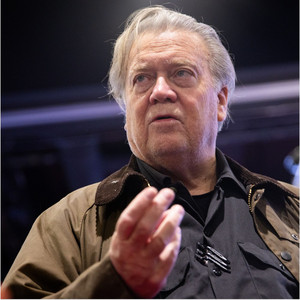
Except to the man who helped get Trump elected in the first place, Steve Bannon, who sees threats to the movement and betrayals of it at almost every turn, whether it's bombing Iran or allowing tech billionaires to advise the president.
Today, my colleague Jeremy Peters talks to Bannon about the nature of those threats and why, in Bannon's mind, the future of the MAGA movement depends on defeating them.
It's Tuesday, July 1st. of movement, the rise of Donald Trump within it.
You have reported on that world for years.
You even wrote a book about it a few years back.
Can you describe what has been happening within that world over the past couple of weeks?
Really, it's been kind of a civil war over the prospect of an actual war in the Middle East. It begins with Israel's bombing of Iran a couple of weeks weeks ago.
There's two ways to stop Iran from having a nuclear weapon.
One is diplomacy. The other is force.
And this leads to calls from the Israeli right and from many Americans on our political right over here for the United States to get more actively involved.
This is why we elected Trump.
Sometimes you've got to make hard decisions.
We're warheads and they're going to hit us with them.
If this is not a reason to defend ourselves, then give me one.
So, immediately you start to see pushback from President Trump's MAGA base.
So you've come out for regime change in Iran.
Tucker Carlson, the former Fox News host, invites one of the Republican Party's biggest hawks and pro -Israel politicians, Ted Cruz, on his show.
So... Okay, so you topple the regime and by whatever means.
What happens then? How many people live in Iran, by the way?
I don't know the population.
At all? No, I don't know the population.
You don't know the population of the country you seek to topple?
Where he basically belittles and mocks Ted Cruz in front of his audience.
No, it's not even...
You don't know anything about Iran.
Okay, I am not the Tucker Carlson expert on Iran who says...
You're a senator who's calling for the overthrow of the government and you don't know anything about the country.
And of course, as we know, Trump decides to bomb Iran anyway.
MAGA is not for foreign wars.
We are not for regime change.
Then you have folks like Marjorie Taylor Greene.
Here we are, turning back on the campaign promises, and we bombed Iran on behalf of Israel.
The congressman from Georgia, who is really, I think, at the vanguard of what the very hardcore Trump loyalist thinks.
There are a lot of MAGA that's not happy about this.
I'll just be blunt.
And what are the most important voices in Republican politics giving voice to this non -interventionist sentiment?
This is incrementalism.
If they hit back at American troops, do we go back in and hit again?
Next thing you know, brother, you're in a forever war.
It's Steve Bannon. Right, Steve Bannon, who helped propel Trump into office in 2016.
He was Trump's campaign chief.
Famously fell out of Trump's good graces during that first term in the White House, but remained fiercely loyal, supported Trump's false claim that the 2020 election was stolen, and in fact, serves time in prison because he won't comply with a congressional subpoena to talk about the January 6th riots.
And, Jeremy, Bannon is someone you've covered really closely.
Why, in your mind, is he such an important voice in this particular debate?
Right. Well, I've known Bannon for about 15 years at this point.
And Bannon is important in this particular political moment because he is the host of a very influential podcast. It's called War Room.
We know that many staffers in the West Wing listen to it.
Before Trump was elected the second time, Bannon would have people on it who went on to become members of the Trump cabinet.
But it's not just those MAGA elites who make up kind of a core following here.
It's the average voter.
It's a very large audience.
So it really does reflect the sentiments of where Trump's hardcore, most loyal supporters are.
And Bannon is quite candid when he sees the White House or Republicans in Congress straying from the MAGA principles, from what they promised voters.
He calls balls and strikes as he sees them.
So when the debate about military intervention in Iran erupted, I went to go visit Steve at his house and home studio in D .C.
with my colleagues from The Daily.
Welcome. Glad you guys are here.
And I wanted to find out just how deep he thought the fissures in MAGA World were.
If he thought that the fight that was breaking out Republican on Republican over military action could really threaten Trump's political coalition.
You know, when I was in the New York Times when we first did this, how many years ago?
That was 2017. It was a long time ago.
Yeah, that was when, remember, somebody yelled, fuck you, Bannon, outside.
I'm excited. That's where you know you're having an impact.
So we sat down for what turned out to be two long conversations.
I met you in? 2010.
Was it nine or 10? It was nine or 10.
And what became clear is that the answer to that question starts with what drew Bannon and the Americans who would form the MAGA movement to Trump in the first place.
Bossy introduced me when he was thinking about, I guess, running for Obama.
And Bannon tells a story about the first time that he met Trump back in 2010.
This is a really tempestuous time in American politics.
It's the aftermath of the 2008 financial crisis.
It is the birth of the Tea Party and the anger that many Americans have toward Barack Obama and what they see as his policies of bailing out big banks and large corporate interests while they're still on the hook for mortgages they can't afford. At the time, Bannon was a former finance guy turned documentary filmmaker and conservative activist. Andrew Breitbart was one of his best pals.
He was active in Tea Party circles.
You know, coming from finance and Goldman Sachs, we really didn't know much about Trump.
He was a media, you know, he was in things Goldman Sachs didn't finance, like casinos and things like that.
So he wasn't, I didn't know him, but I knew him as a huge personality in New York.
And Donald Trump is flirting with getting involved in presidential politics.
And through a friend, a longtime conservative activist by the name of David Bossie, Bannon gets invited to Trump Tower one afternoon.
afternoon to help explain to Trump what it would be like to run for political office in the current climate.
We sat there for five hours doing that presentation where Dave Bossie was walking through how you win a Republican nomination.
And I was so impressed with two things.
Number one, his knowledge of China at the time.
And I told Bossie on the way back, I said, look, I can't have that conversation with anybody in D .C.
Nobody understands China at all.
I said, But Trump has a pretty good feel for it, much more sophisticated.
The other was I was up there as the Tea Party guy, right, about crony capitalism, populism.
And so Bannon explains to Trump in this meeting how America is going through an eruption of populism.
So I'm explaining populism, you know, it's for the people and it's, you know, this is a blue collar and it's a whole, you know, there's been waves of populism before and you had Buchanan and Ross Brown doing it, he's not, and he goes...
And Trump kind of perks up at this point and says, well, that's what I am.
Oh, yeah. I go, that's me.
A populist. And he goes, a popularist. I'm a popularist. And I go, no, no, populist. And he goes, yeah, popularist. And I go, no, no, no, it's populist. And he goes, yeah, popularist. He's kind of adding a syllable.
Exactly, and making up a word. And so finally I just drop it.
Bossy's like kicking me on the table.
Shut the fuck up. The guy's what he wants to be, right?
So afterwards, I'm on the train and it's bugging me.
And I'm sitting there and I turn to bossy and I go, you know, I think he might be right because he comes at this with a bigger media personality.
And he's already has an impression on the American people's and he clearly knows how to communicate to the average person.
So after that first meeting, Bannon begins to see Trump as somebody with this almost preternatural ability to understand public opinion.
And to tell Americans what they want to hear.
Of course, Trump doesn't end up running against Obama in 2012, but his interest in politics doesn't go away.
And a couple of years later, he attends this event in New Hampshire where a number of Republican presidential hopefuls are speaking about the future of the country and the Republican Party.
The rest of the speeches are all kind of the same.
Right. Different. You know, Rand Paul's a libertarian and Mike Lee's a libertarian.
You had Ted Cruz and he had Newt Gingrich. So you had the limited government conservatives.
But it all kind of sounded the same.
Trump's was totally different.
He's actually given the speech that's amazing.
Kind of off the top of his head.
And the audience is leaning into it.
Right. And this is one of the reasons we're following Trump.
What was he saying, though, that people were leaning into?
Trade, China's ripping us off, immigration.
Stupid wars. Stupid wars.
The three pillars today, the forever war, stupid wars.
And you see people nodding about it and leaning into it.
And at this event, Trump spoke to what, in Bannon's view, ends up becoming the three pillars of the MAGA movement.
And those are restricting free trade, restricting immigration, and ending forever wars.
And on that third pillar.
Forever wars. Forever wars.
There's this particularly striking moment at a debate in 2016 in South Carolina where Trump is on stage with all his opponents, including Jeb Bush, who is former President George W.
Bush's younger brother.
Obviously the war in Iraq was a big fat mistake.
All right? And Trump looks at Jeb Bush and says, They lied.
Okay. Your brother lied.
There was weapons of mass destruction.
There were no weapons of mass — Okay.
All right. Governor Bush — He took us into Iraq under false pretenses, looking for these weapons of mass destruction that he knew didn't exist. While Donald Trump was building a reality TV show, Joe, my brother was building a security apparatus to keep us safe, and I'm proud of what he did.
And... He's had the gall to go after my mother.
The World Trade Center came down during your brother's reign.
Remember that. Hold on.
Your brother didn't keep us safe.
I think it's safe to say that until that moment, people didn't say things like that in American politics.
People did not. And they certainly didn't do that in a state like South Carolina, a Republican stronghold that is very military heavy.
The audience at the debate at the time was kind of aghast. People booed Trump and the political pundits who were used to conventional GOP politics, where these traditional conservative hawks dominated foreign policy, said, he's done.
This is another example when Trump is thumbing his nose at the Republican voter, they'll see right through this.
But what those pundits really missed was that Trump was speaking directly to voters who really wanted to hear a candidate take on a Republican Party whose policies were no longer helping them.
And Trump ends up winning that primary in South Carolina by a huge margin.
Bushes. This this was not about politics.
This was almost about culture and a suppressed voice of working class people whose sons and daughters had had to remember the agony of people.
When you go to these veterans, they see this.
It's what did my son die for?
Why is why is my daughter not have a leg?
What gets the most anger out of people I see is when they talk about Iraq It's the broken lives, the broken families, and what was the purpose People forget this, but Trump's promise to get us out of what he called stupid wars Was really important to his ability to forge a bond with working class Americans Americans who felt like nothing was breaking their way anymore, like they were getting screwed left and right.
They were bearing the burden for all of these mistakes made well, well above their heads and pay grade.
And Trump said, I'm not going to do that.
If I get elected, we are not going to get into these wars anymore.
Right. And we tend to focus most on immigration and trade.
But what you're saying, what Bannon is saying, is that it's the combination of those two and Trump's deep suspicion of war that ends up bringing him so much working class support.
First in 2016, then again in 2024.
They believe in his promise that he's going to deliver on all three of those issues.
Yes, that's right. And Bannon sees momentum building.
He sees a political alignment that Republicans have long sought occurring before his very eyes.
Trump is winning over more Black and Hispanic voters.
We have African -American men at 39 percent and they're not going anywhere else if we don't turn them off with invading another third world country.
And Star County, Texas, down in the Rio Grande, is the most Hispanic county in the country.
We lost it by 60 points to Hillary Clinton, 60.
We won it by 16 this time.
That technotic plate shift of us trying to have a realignment is before us if we deliver.
And in Bannon's mind, that growth, the health of the coalition, is dependent on sticking to those three pillars and on Trump doing what he said he was going to do.
But very early in Trump's second term, Bannon is seeing threats to the MAGA agenda everywhere, including from people Trump brought inside the tent himself, like Elon Musk.
And this is why I'm so anti -oligarch and anti -Elon and all these guys.
I fucking hate them.
although they are part of our coalition.
And why exactly? Because Musk has given Trump hundreds of millions of dollars.
It's hard to see him as somebody who's trying to undermine Trump.
Why do I detest these guys so much?
Bannon would say, Because they're not MAGA, they're not conservatives.
That Elon Musk doesn't care about the working class voter.
He doesn't care about Trump's campaign promises to those people.
He just cares about his own share price and net worth.
Elon got the math earliest, right, about how we were building a coalition.
So he jumped in after he bought Twitter.
The other guys became believers at 10 p .m. Eastern Standard Time on the 4th of November.
After we won Pennsylvania, all of a sudden Zuckerberg and all these guys, oh, yeah, this MAGA thing's good.
And that is really a kind of a betrayal in Bannon's mind of what Trump promised to be for his voters.
Especially because these technology companies have made no secret about the fact that they're creating something in artificial intelligence that is going to not create jobs for Americans but eliminate them altogether.
together right in bannon's mind it sounds like if you're bringing in the billionaires who are going to be creating the trucks that need no drivers and the factories that need no workers then they are using trump and maga ism to hurt trump and maga's most important working class constituency all to enrich themselves but bannon's battle with these people he calls the oligarchs Or the broligarks.
Broligarks. Is part of a bigger fight that MAGA loyalists feel like they're needing to wage against powerful forces in business and politics that are trying to push Trump back into the realm of a more traditional Republican president, right?
Consider immigration.
OK. Yesterday, I think one person came across the border, right?
He's essentially sealed the border.
And I'm very happy with the deportations, although they have to pick up one.
Trump has delivered on a lot of his promises.
And Bannon would praise Trump for that.
I don't give a shit whether the upper middle class in Beverly Hills, in Bel Air, have got to pay actual American citizens to do their lawn or, you know, clean their gutters.
And people say, oh, we'll never get American citizens to do it.
But, well, hey, if you have to pay a decent wage in a competitive market because you don't have millions of illegal aliens that are prepared to work for slave, look, we can't have a country that's based upon servitude.
That's what this is.
But he also pointed to the big industries that rely on undocumented labor and how they were recently lobbying Trump to scale back these deportations because it was hurting their bottom line.
The most important blowback you're going to face is big agriculture, the hotel industry, the restaurant industry, and you're going to get it even more going forward. And that's what we if you don't turn it around, we're going to lose everything.
And Bannon sees it as his role to intervene and say, no, no, no, no, don't let this fail before we really even get off the ground.
Right. Stiffen the spine of the president, those around him.
Exactly. And so Bannon has been fighting on all these fronts.
When Israel comes out, bombs Iran, Republicans are pushing for deeper U .S. involvement in the conflict.
Trump makes his decision to bomb Iran.
But it seems important to say that immediately after the president made that decision, he pushes for and secures a ceasefire.
So as of now, the U .S. is not in a forever war, Not in the situation that Bannon most feared.
Right. And that's no doubt a relief to Bannon.
But the fact that this bombing even occurred, the fact that Trump ordered American pilots into enemy airspace and had them bomb these nuclear sites, illustrates just how entrenched, how influential the war machine in Washington is.
And how, in Bannon's view, the fact that we got so close to a situation that really could have escalated and still might, we don't know, that all that shows how easily a major pillar of MAGA, this non -interventionist pillar, could be toppled.
The fact that the bombing happened at all to him is proof of how deep the threat is.
And how vulnerable the coalition really is.
We'll be right back.
I'm Diana Nguyen. I'm a producer on The Daily, and I worked on an episode about how these really complicated global forces impact this one ranching family.
I'm just going to, I'm recording now.
I'm just going to record everything.
I've lived in one of the most rural pockets of Texas, and I always heard ranchers say it's super hard to make a living, but I didn't really get the economics of it at all.
What kind of cows are these?
In making this episode, I started to understand how decades of consolidation in this industry has made it tough for the people who produce our food.
It's important to me that we were able to tell this story about rural America.
On The Daily, we have this amazing group of producers from all over the map who are bringing their own life experiences to the stories that we tell every day.
But it takes a lot of resources, and we need your support to keep doing that work.
You can help us make the daily by subscribing to the New York Times.
Thank you. Jeremy, given that Bannon and people like Bannon are waging all these battles to protect Trumpism, how does he think about why the president would take the risk of doing what he ultimately did in Iran and what Bannon explicitly didn't want him to do, Which was bomb these three nuclear sites.
Why would Trump, in Bannon's mind, take that risk and act against this core tenant of his own movement?
Because Bannon sees the same set of powerful forces that have been arrayed against Trump all along as pushing him toward war with Iran.
Forces like what in the case of Iran?
Chief among them would be Israeli Prime Minister Benjamin Netanyahu.
We've been lighting up Netanyahu every day.
Who Bannon would say is leading Trump into war by exaggerating the threat of a nuclear Iran.
You started a war, you started a conflict where you don't have the military capability to end it.
You have to depend upon us.
And Bannon has said, look, President Trump shouldn't have to come in and play cleanup.
for the Israelis. American forces shouldn't have to finish the job that the Israeli military couldn't finish itself.
However, I think more.
It's not simply President Trump's decisions.
I think if you really look at it and what I'm seeing and hearing from people, it is the over the top cheerleading and look like pushing by Murdoch's Fox News that remind people they're having PTSD.
It reminds people of the worst elements of the Iraq war.
I mean, literally, and beyond Netanyahu, you have some of the more traditionally hawkish elements in the Republican establishment like Fox News.
Do not listen to the voices on Fox News that I think are beyond irresponsible.
I think you're playing into the worst of the neocon wheelhouse.
Bannon sees echoes of the Iraq war in this push for American intervention in Iran.
I mean, this is all the hunt for let's go hunt for yellow cake.
Remember, after they march up country, they couldn't find weapons of mass destruction.
Why? They didn't have weapons of mass destruction.
And we went on that whole charade.
And Fox was, you know, the pom poms were out every day.
You have a variety of commentators in right -wing Republican circles appearing on the shows that President Trump watches saying, don't listen to your base here.
You need to do what's right for the country, for the world.
This is my point about the deep state and about the apparatus.
The gravitational force of the Middle East, but also institutionally, the three most powerful institutions are the CIA, the Federal Reserve, and CENTCOM.
CENTCOM has a massive gravitational force.
You also have the generals of the U .S. Central Command, who in Bannon's eyes, by their very nature, are just going to be more hawkish about military action.
Right. The way Bannon sees it, it's the old, if you're a hammer, everything looks like a nail.
Bang away. We have changed the electorate of the Republican Party.
We have not changed the political class.
To ban Trump bombing Iran was the triumph of the establishment.
The old order wins.
You can replace the president.
You can replace the cabinet and even tens of thousands of federal workers in very senior positions.
Which Trump has, which Trump has.
But there's still an element that is going to stop Trump from fully executing what he promised to deliver on.
And I think that's at the heart of it for a lot of Trump supporters like Bannon, because they would say we won.
We won decisively. The American people voted for this.
They knew that Trump wasn't going to get us into foreign conflicts.
And yet there are people in Washington who are still somehow persuading Trump that he should at least somewhat renege on one of those promises.
One of those pillar promises.
And it might look to outsiders like MAGA is at the height of its power, but to purists and ideologues and intellectual godfathers like Bannon, it's still a movement under constant threat.
banon feels this every day but he told me he's determined to keep the movement intact by staying focused on those three pillars of mega the progressives and the rhinos and all that that think they're going to break apart maga because of this this is one of the things that we're going to guarantee does not happen we're not going to allow the mega movement will not shatter it is It's too valuable to this country, it's too valuable to the citizens of this country, particularly in our expansion mode.
Jeremy, I'm hearing you talk about all the forces that Bannon is fighting and sees as pressuring Trump to do what he doesn't want him to do.
The deep state, the commentators on Fox, the generals, Prime Minister Netanyahu of Israel.
And I'm noticing who Bannon is not blaming, and that's Trump himself.
which is a little odd because Trump made this decision about Iran as only he can as commander in chief.
And obviously, the president's weighing a lot.
But why isn't Bannon ultimately holding him responsible for the decision that he doesn't like?
To survive in Trump's world and to remain relevant in his eyes, you have to be very sparing with your criticism of his decisions, very gentle.
So there's that Bannon recognizes.
I think there's also the fact that Trump's voters have said we trust this guy.
We elected him because we have faith in his judgment.
And even though it wouldn't have been Steve Bannon's first choice to drop bombs on Iran.
If we're able to achieve this and everything comes together and President Trump just did the one military thing that was glorious in its complexity and that's it, that's, I think, the discipline that we need.
He's holding out the possibility that maybe Trump did make the right move here and this won't escalate.
So let's give him the benefit of the doubt and see how this turns out.
And Bannon understands what a singular political figure Trump is.
That this movement doesn't exist without him as the charismatic leader.
Listen, Jeremy, he's not just the leader of the MAGA movement.
He created this movement.
If Trump had not come along at the time he came along, coming down that escalator 10 years ago, we would be 20 or 30 years behind.
Now, look how he's changed everything politically.
against all odds and against the established order, both the Republicans and the Democrats saying he's a fool.
He's an idiot. That's never going to happen.
And now I think most people realize we live in the age of Trump.
It is a seminal moment in American politics defined by one man in the movement that he helped build.
And I think we're at the very beginning of this movement.
And I think President Trump's going to be with us a long time.
Bannon has described Trump to me before as a guided missile.
An interesting metaphor given the subject here.
Exactly. Didn't use that metaphor in this current context, but point being, he's powerful, lethal, but he needs a little direction from time to time.
As somebody who has a very clear set of political beliefs, you know, an ideology he can articulate, late, Bannon helps somebody who is fairly unideological like Trump stay on script.
And even Trump, whose intuition for what his voters want is quite remarkable, he needs a reminder, Bannon thinks.
And that reminder is even though he's president, he is still in the minds of of his most loyal supporters, Trump, this revolutionary political figure.
And he will face pressure time and time again, as we're seeing now, pressure from his generals, pressure from American allies, to abandon those revolutionary promises he made.
Right, and to do what the establishment wants.
That's right. But he can't.
And that's what people like Bannon are there to say.
Don't. Don't forget how you got here.
because if you do, then the whole movement could unravel and you would be just like another ordinary Republican president.
Thanks, Jeremy. Thank you, Michael.
We'll be right back.
Here's what else you need to know today.
Now, Republicans are about to make a mistake on health care and betraying a promise.
It is inescapable that this bill in its current form will betray the very promise that Donald J.
Trump made. The fate of President Trump's giant domestic policy bill has become uncertain after two Republican senators, including Tom Tillis of North Carolina, vowed to vote against it.
And half a dozen other Republicans remained undecided.
In a fiery speech from the Senate floor, Tillis said that he could not support the bill because it risked kicking his constituents off of Medicaid.
So what do I tell 663 ,000 people in two years or three years when President Trump breaks his promise by pushing them off of Medicaid because...
Trump can only afford to have three Republican senators oppose the legislation, which would extend his 2017 tax cuts and pay for part of them by cutting Medicaid and food benefits for the poor.
The president has set a deadline of Friday for the bill to be passed.
And the Trump administration has determined that Harvard University violated federal civil rights law by failing to protect its Jewish and Israeli students from harassment during protests on campus over the war in Gaza.
That conclusion could increase pressure on Harvard to reach a legal settlement with Trump, who has already cut Harvard's funding by billions of dollars and sought to prevent international students from attending the university.
Both sides are currently engaged in negotiations over a potential settlement.
Today's episode was produced by Caitlin O 'Keefe, Aastha Chaturvedi, and Stella Tan.
It was edited by Lisa Chow and Larissa Anderson, with help from Paige Cowan.
It was fact -checked by Susan Lee, contains original music by Marion Lozano and Alicia Baetube, and was engineered by Alyssa Moxley and Chris Wood.
Our theme music is by Jim Brunberg and by Lansberg of Winderlei.
Special thanks to Nick Pittman and Maddy Macielo.
that's it for the daily i'm michael babar see you tomorrow