You're listening to Roundtable.
I'm Steve Hatherly today with Njonglin and Yushan.
Coming up, what happens when a subway system needs to pay its bills?
In China, the answer is a radical makeover.
Stations are being transformed from transit points into bustling commercial hubs, merging your commute with your grocery run.
Subway stations are getting a facelift.
After that, third hand smoke.
Have you even heard of it?
It hides in our buildings in ways that are not obvious, but that does not mean that it's not incredibly dangerous.
Roundtable podcast at QQ.com.
Once again, roundtable podcast at QQ.com.
And now.
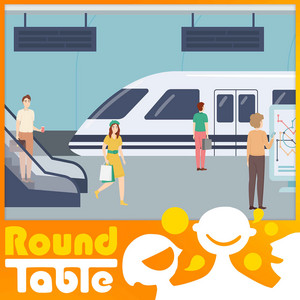
Not long ago, subway stations in China were purely functional spaces crowded, utilitarian and designed solely for moving commuters from point A to point B.
Today, that's no longer the case.
Step into a station in Guangzhou or Wuhan or Shenzhen and you might find yourself browsing some fresh fruit, grabbing a pre-ordered breakfast, picking up some farm produce or maybe a brief game of tennis.
This transformation has turned subway stations into something akin to a mall's basement level the B1 level, which is a one-stop hub for daily needs, leisure and, of course, some consumption.
What was once a place to rush through has become a place to linger shop, hang out, maybe even relax a little bit.
So what is going on with the upgrades at China subway stations?
What is going on is that people are getting demanding.
Previously, when I'm walking into a subway station, I'm eyes on the subway train.
You go into the subway and you get your destination.
And on the way, you're a little bit thirsty.
You get a bottle of water from the convenience store.
You're very, very hungry because it's your morning and you are hurrying to your workplace.
You get a sandwich from the same small, dingy, not dingy, maybe dim kind of convenience store.
But that is no longer the case here in China in a lot of cities.
For example, we're looking at Guangzhou.
Guangzhou has launched its in-house supermarket chain, UU Select, in September.
2025, with locations in different stations, subway stations, and the stores stock seasonal fruits.
Seasonal fruits, not regular apples and bananas.
You can get your durian there if it's the right time.
And also local specialties from underdeveloped regions.
We are talking about agricultural product.
You can get honey, you can get bamboo fungus.
And also there's the zero, well, there's the kind of bread that are almost freshly made.
And can be preserved for long.
Yes, preserved.
And they also offer luggage storage and cultural and creative products, like rulers printed with the subway's 10 no safety guidelines.
You know, fun little souvenir can take away, and that is the case in Guangzhou, but in other places they're getting very, very creative with these, with these spaces that they used to just be space underground.
Yeah, they're doing it in Wuhan.
They transform nearly 4000 square meters of underground space at one particular station into a bustling market.
That was the city's first in-subway fresh produce market.
In Shenzhen, they have, this is cool, the country's first in-subway sports facility.
They have badminton, table tennis, pickleball courts.
That's fun.
And it's really popular.
They have an over 80% daily booking rate, which is really kind of cool.
And when you're really ambitious, you can also integrate the subway area with your other facilities in the city.
For example, in Suzhou, they've integrated the Suzhou the Shishan Plaza area urban public, cultural complex area with one of their subway stations.
And the station would be able to connect via different types of very spacious underground passages to cultural venues such as the West Wing of Suzhou Museum and Science and Technology Museum, as well as the Theater of Suzhou, and that would also give a makeover to the station's decoration.
You would imagine a station being bright at most, but they can make some of the space even having glasses.
I think it's not entirely underground.
Some part of it is upground.
And another thing is here in Beijing one thing the weirdest thing I've ever seen in a subway station is that the Wukong Station, because it's linked with a commercial area and there is a venue for.
I think a lot of different performances can happen in those venues.
And what you can do in the station is that you can get your concert makeup in the subway station.
So you're all dressed up for your concert.
Ready to go.
You said before, the reason this is happening is because people are demanding more, which is probably true.
But I think another, and this is kind of obvious.
I think another reason this is happening is because it's not cheap to operate and maintain a subway station.
Yeah, that's true, because the financial pressure of operating a subway is relatively high and metro ticketing, metro fare setting, generally follow the principle of public welfare, which keeps the prices relatively low too.
So from Beijing... Very low.
Very low?
Well...
Very low.
Trust me, very low.
Depends on how far you go.
Low is relative, I know, but compared to other big cities, it's cheap.
Yeah, but here in China, from major cities such as Beijing, Shanghai and Shenzhen to smaller ones such as Suzhou, Wuhan and Kunming, the base metro fare is typically around 2 to 3 yuan, while the maximum end-to-end fare usually ranges from 5 to 15 yuan.
So for many people of subway stations building a station, building a subway it costs 500 million to 1 billion yuan per kilometer, and that's about almost 70 million to 137 million us dollars.
So in cities which with a complex geology or high demolition costs, this figure rises even higher.
So we see just how expensive To build one in the first place.
I think 10 years ago, when I was living in Hong Kong, we had the conversation about the metro in Hong Kong.
They make money.
They make money.
I saw articles from CNN and The Guardian and all these international outlets talking about how much money the Hong Kong subway system makes.
And the background info to that story is that none of the subway company in other parts of China make money.
You know why I was having this doubting tone when I said the price is low or maybe not that low?
That's because, about over a decade ago, you traveling in the Beijing subway will only cost you fixed price like two to three yuan.
But It was around less than a decade ago.
I don't remember which year it was.
It started to calculate the mileage you travel and based on that, give you a varied price.
And yeah, that's usually between 5 to 15 yuan.
So we had that period before and then we enter a new phase.
But even that didn't really cover all the costs because, according to 2024 financial reports, among 28 major city subway operators, only Shanghai and Fuzhou turned profit after deducting government subsidies.
So we see how hard it is for them to self-supply.
Yeah, and other big cities around the world, too.
I think the New York City subway system.
I'm not sure, pardon me, in 2026 if this is still true, but famously I think it operated at a loss.
Here in China, stations have tried to take measures to cut their costs a little bit.
In Hangzhou, they reduced the operating hours of its escalators.
Some stations ran them only during weekday mornings.
And evening peak hours.
In Foshan excuse me, Metro they close 30 minutes earlier and they implement energy saving measures, including optimized lighting and blah blah, blah and things like that.
Now, the point here of all of this is that you can't.
Even though there's millions and millions of people using these subways daily, it's not enough to make money.
And because the purpose of building these subways is not precisely to make money.
It's more of a public welfare within the public welfare system.
It's for the convenience of the consumers and consumers.
Would find it also beneficial to having these places spaces, being redesigned into the area of, with some commercial use, so that they can get the service they want or they enjoy elsewhere.
Well, I think it's just a win-win and it completely makes sense because I'm...
I'm at least a little bit familiar with the subway lines.
There's a lot of subway lines in Beijing.
I'm not sure how many.
Line one, the one that cuts directly through the city, that's the oldest one.
Now, I haven't visited a station on line one where I've seen any of the space really put into use.
When you come off the train and go upstairs on the platform, before you get to the exit, before you go up the stairs or the escalator to the exit.
There's a tremendous amount of space there, but it's not being used.
And even in some of the newer lines, I think line two is one of the newer ones in Beijing.
I could be wrong anyway.
One of the other ones I was on is brand new.
And even still, a lot of space that wasn't being put to use from what I saw.
It only makes sense to put shops and restaurants and whatever in there because those places will pay rent to the subway stations and and it's another source of a lot of revenue.
Yes, but that kind of redesign and the use up of space also needs careful, careful calculation and redesign and you need to make sure that building some more stores and using the space is safe in the sense that it's safe for the construction, for the structure, but also for people when they really need to evacuate, when there are too many people, too crowded.
We want to make sure that safety factor is also being included.
So that's one of the worries then, I guess, is that these places are supposed to be and they are transport hubs.
Therefore, safety is the number one priority, and efficiency, number one priority and concern.
The worry is then what you're saying is that if these turn into shopping zones, they may become overcrowded and safety might be an issue.
Yes.
So yes, these are something that can be mutually beneficial to the shop owners, to the subway, as well as the consumers.
But it needs to be done in a clever way.
And those...
Clever ways include the examples we explained earlier in the beginning of the conversation.
I think one other reason for Beijing city management to not put or design subway stations into a mall-like area is because it's already overly crowded.
You know, occupying any of those lanes for people to walk would be hard for people to accept.
And people are moving quickly.
Yes.
Yeah.
And, you know, for morning commuters and evening commuters...
You know, maybe picking up a durian isn't priority number one.
And another kind of lovely thing that designers are thinking about is that they're not really content with the current stores that are thinking about getting into their subway spaces.
They're thinking probably in the future there can be more services like pharmacies, laundries or parent-child play areas, to turn stations into places, full lifestyle complexes.
So they are thinking about better ways to use the space.
They cannot really just introduce a bunch of stores only because currently they're not making enough money.
The plan is to be long-term.
Well anyway, we're going to be seeing upgrades.
Then, I guess, slowly but surely these will be rolled out.
And, by the way, my logic can't be correct if line one is the oldest, How can line two be modern and new?
If I'm remembering correctly, that's the second notice.
Yeah, must have been another line I was thinking of.
We'll take a break, and when we come back, the dangers of third-hand smoke.
Looking for passion?
How about fiery debate?
Want to hear about current events in China from different perspectives?
Then tune in to Roundtable. where East meets West, and understanding is the goal.
This is Roundtable.
I'm Steve today with Yushan and Yeohong Lin.
When we think about smoking, we think about our lungs, our safety.
Ashtrays, dirty smells, things like that.
We know about first-hand smoke.
That's the smokers themselves.
Second-hand smoke, that's the people nearby smoking.
But we're going to talk about third-hand smoke today and how that is incredibly dangerous and also how new rules are taking that danger into account.
Let's start with the definition, though.
I mean, I think for a lot of people, the term third-hand smoke might be a new one.
Never heard of it.
Yeah well, have you ever walked into a room that seems to have been emptied for a while, but you can still tell immediately after you enter that somebody in there previously have been smoking?
That's because you're inhaling the third-hand smoke, so that refers to the toxic chemical residue left behind after tobacco smoke settles on indoor surfaces like walls furniture carpets curtains, clothing and household dust.
Even so, what is what?
Doesn't it go away?
Well, nicotine is highly adhesive.
That's the main thing you smoke out.
Yeah, Once it sticks to surfaces, it doesn't just sit around.
It reacts with other indoor pollutants like nitrous acid from gas stoves or outdoor pollutants.
That's going indoor from the windows.
So these reactions form new compounds over time, and many of which are more toxic than just the original first or secondhand smoke.
So when I say to someone, you are polluting the air around me, I am not right.
They're polluting the entire room.
You're right, but you're only partially right.
And this is how the exposure happens.
So when you are in that environment, it can enter your body in a few different ways.
So one is through the inhalation of these gases that get re-emitted and also the particles too.
Because it's in the furniture, it's in the carpets, it's in the curtains, it gets mixed in with the dust.
So even when you vacuum, that dust can get pushed around and blown into the air and therefore you're inhaling it that way too.
And another thing you said when you walk into a room about the smell of The smell might be an indicator, but it doesn't have to be.
Even if you don't smell anything, if there's no indication that anyone has ever smoked in that room, that doesn't matter at all, because those chemicals will still exist.
Not just for weeks, not just for months, not just for years.
It could be for decades.
Can I just laundry wash everything?
You can.
You want to put the wall in the laundry machine?
I mean, curtains, clothes.
Might be hard to put back up.
Yes.
And we would see that.
Well, when we can actually absorb it through our skin.
Also, it makes infants and toddlers particularly vulnerable, since they crawl, they touch everything and they frequently put their hands in their mouth.
And if you put your hands that have touched the areas no matter it's floor or wall that have been pollutant by cigarette users.
Yeah, it's really, really dangerous.
Now, Why are we talking about this now?
Because this term is not new.
The term itself was introduced in the early 2000s and scientists actually suspected for years that tobacco residue did linger.
But early research tools, or the early research that was done, they couldn't fully measure what exactly was the chemical evolution or the biological impact of that third-hand smoke.
So What has changed is advances in indoor air monitoring and molecular analysis and toxicology all of those sciency terms.
Now they are allowing researchers to track how these residues transform and change over time, and also, more importantly, how they interact with our human cells.
So recent research was done.
It was done here in China from the Chinese Academy of Science.
What did they find?
Well, they found that thirdhand smoke doesn't fade into harmlessness.
And as it ages, it becomes more genotoxic, meaning that it causes increasing damage to DNA when human cells are exposed to it.
So indoor spaces essentially become slow motion chemical reactors for nicotine trapped in the materials to keep reacting with indoor air compounds.
And I learned about this And I found it really scary too, because researchers also observed that exposure to aged third-hand smoke triggers oxidative stress in human cells, meaning that it damages your DNA.
It disrupts normal cell repair mechanism and interferes with metabolic processes.
They call this biological rust.
Yeah, the rust.
Yeah, like metal rusting over time.
The damage inside our body is gradual and cumulative.
The cells in our body lose resilience.
Inflammation increases.
The body becomes less sufficient at repairing itself.
And there are long-term implications as well.
Yeah, so the bad news here is that it has been affecting us for years.
We didn't know about.
The good news is we know about it now, and the better news is that, even before we can put fingers on the real evidence and trace all these, we have already started.
By saying we, I mean here in China, as well as around the world, have started different types of regulations making sure that indoor smoking is prohibited in public facilities.
Or at home.
I mean, if you're listening right now and a member of your family... or maybe it's you you smoke inside your house and you have I don't know maybe you have young kids in the house or something like that stop doing it yeah because I mean now we know it's not just the secondhand smoke you think oh it's okay you know I'm blowing the smoke out the window now it's it's really bad and it's really bad over the long term so bad in fact and this is a really cool thing that happened in in California this just went into effect on the 1st of January this year What they're doing now in that state is they require sellers of single family homes to disclose known third hand smoke contamination to buyers.
Now what that means is the sellers of the homes.
They have to inform the buyers if they know a home has a history of indoor smoking or vaping as well, or if any action was required to address contamination.
That's a really cool law change.
Yes.
And here in Shenzhen, for example, not only are you not allowed to smoke in public indoor areas, you're also not allowed to smoke in certain outdoor or semi-outdoor, semi-indoor area, like the entrance of a subway station or a bus station, the entrance of certain kind of tourism destinations.
That's also included in the no smoking area.
I guess that makes sense because It can also pollute the walls in that entrance area.
And now what I do is just I hold my breath and I ran very fast to escape.
We shouldn't be asking people in society to have to go that far.
Just quickly, Yushan, you asked, oh, can you just clean it and that'll make things better?
Yeah.
Here's the answer to that.
Standard deep cleaning or repainting.
It often acts as a cosmetic fix in that study that they did.
It showed that smoke residues can penetrate drywall insulation, carpets and other systems in the house.
And that means if you want to get rid of it, you have to remove the carpets.
You have to seal the walls with smoke blocking primers.
You have to replace duct work where residue has accumulated.
And that will cost you a tremendous amount of money.
So the answer is you can clean it, but it's like stripping your house down to the bare bones and then putting stuff back.
Really important topic.
I'm glad that we covered this one today so people can be more aware of it.
That's it for today's roundtable.
Thanks very much for sharing your time with us today.
I'm Steve for Nyo Hong Lin and Yushan.
We all say thank you.
Have a good one and join us again next time.