Did you know that comprehensible input is four times more effective than traditional learning methods?
In this slow English comprehensible input vlog for beginners, you will learn new English words, pronunciation and how to speak naturally in English.
This video is part of my 3000 most common English word series, designed to help you understand up to 95 of spoken English.
Short.
Truck.
Still.
Botanical gardens.
Monkeys over there.
Colorless.
Wildlife.
Cooled stroll.
Overgrown.
Unusual.
Chirping.
Let's get started.
What is this right here?
What is this?
This is grass.
How would you describe this grass?
It's green.
Yes.
So three words you can use to describe this grass is the grass is green.
That's one sentence.
The grass is very short.
It's very short.
The grass is not very tall.
The grass is very short.
That's the second sentence.
And the third sentence, the grass looks very healthy.
It looks very healthy.
Looks very healthy.
Now I want you guys to make one sentence and put it in the comments to describe the grass.
If you wanna get my 3000 most common English words PDF to help you understand up to 95 of spoken English with real, clear definitions and examples organized by CEFR level and topic, then check out the link in my description to get it.
What do you see here that you can describe?
Let's continue.
What is this right here?
What is this? is a tree.
Correct.
This is a tree.
A tree.
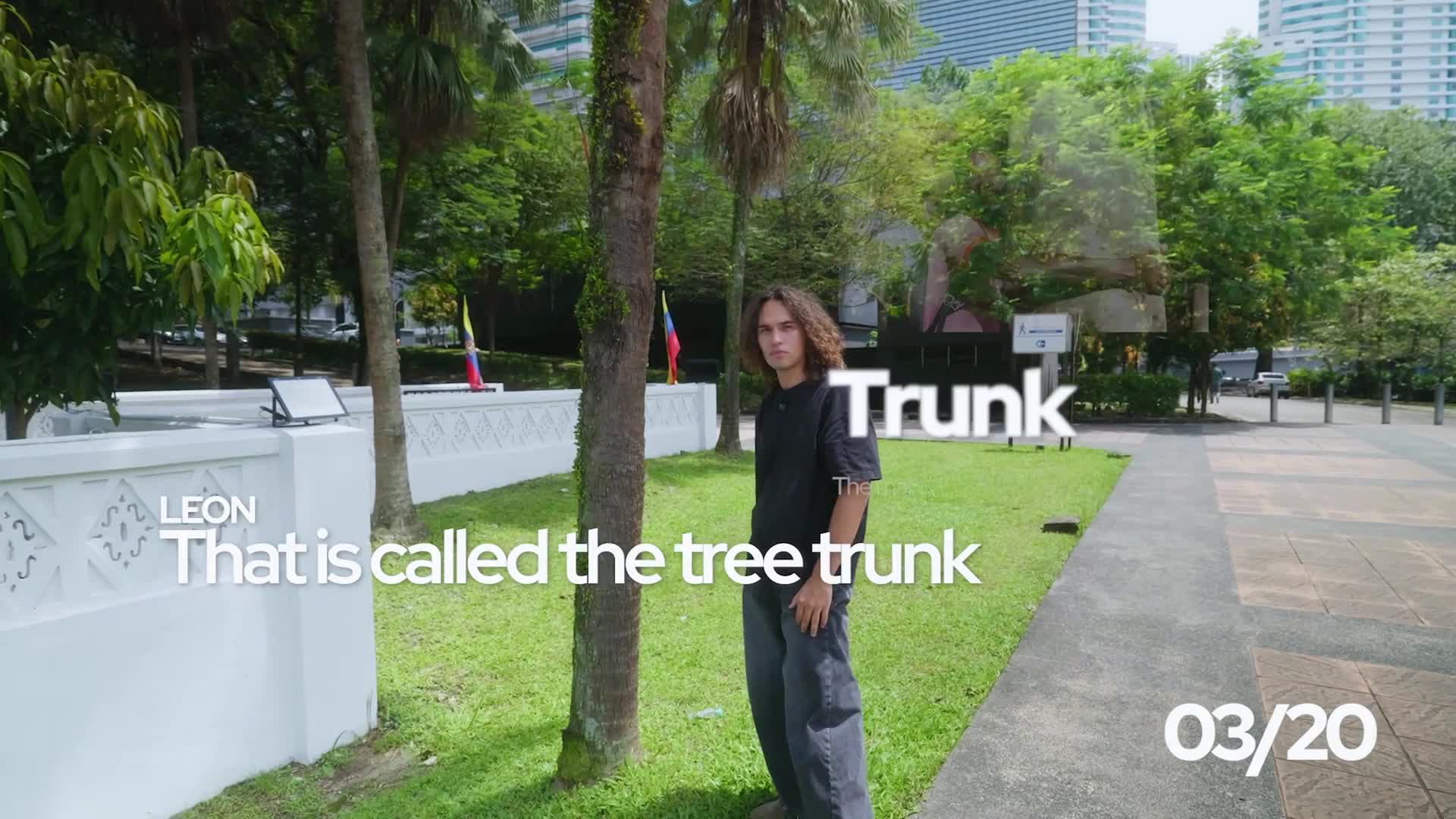
What is this part of the tree called?
What is the main part of the tree called?
That is called the tree trunk.
Correct.
This is the tree trunk.
And this tree is different.
This looks like a palm tree or a coconut tree.
I'm not a tree expert, as you can tell, but most trees have roots that go in the ground.
The roots go in the ground and they're spread throughout the ground.
The roots.
Usually you cannot see the roots.
You cannot see the roots because they are under ground, they are underground.
A tree has roots that are underground and then it has the tree trunk.
That's above ground and from the tree trunk there are branches and at the end of the branches there are usually leaves leaves, there are leaves.
If there is just one leaf, you would say there is a leaf leaves leaf, that right there, that is a white wall.
There's also some sort of pattern on the upper part of the wall in the shape of a diamond, but that is a wall.
What am i doing right now?
Standing.
Correct.
I am standing still.
I am standing.
You can say he is standing, she is standing, they are standing, or I am standing.
I'm standing still.
Now we're going to walk into a park that has many trees, lakes and other animals, and we are going to describe them in slow English using comprehensible input.
Let's go right now.
We are walking on this path.
We are walking on this nice path.
The path is easy to walk on because it is paved.
It's paved.
This to the right of me is a building.
This is a building, a big white building, and right here this is an underpass.
So now we are going to walk under.
You can see in here, on the ceiling, there are LED lights.
LED lights.
These are these very bright, almost blue lights.
These are these very, very bright white lights, LED lights.
And it is dark inside this underpass. but it is also cool.
On the outside it's very hot because the sun is beating on your skin and it's very humid, so it's hot.
So it feels refreshing to go underground in the underpass and be protected from the elements.
This right here looks like the main gate, doesn't it?
Or maybe not the main gate, but a gate.
Yep, we're going into the botanical gardens.
And you can actually see right on the path there, there are monkeys.
I did not know there were monkeys here, did you?
I had no idea.
They look mischievous, do they not?
I don't want to get close to them because they will try to steal my backpack.
Yeah, these ones look worse than the ones we saw at Monkey Beach.
Yeah, these ones definitely have more human contact.
Yeah, but this is where we are.
We are at the Botanical Gardens.
This right here is a map.
A map.
On the side here, we call this a legend.
A legend.
Legend has multiple meanings in English, but in this case it is just a place that has all the items on the map listed.
So you can see number 22 and number 22, Edible Garden, a legend.
You can see the monkeys over there.
The monkey just climbed up that tree.
You got to hold onto that camera tight.
Oh, I know.
Oh, that one there is eyeing you up.
Oh, look at the monkey.
Look at him.
Look at all of them.
Look at the one up there.
Oh, look at that guy.
I'm gonna take out my phone, open up my camera, and I'm gonna take a video of the monkeys.
Can you see them?
I'm also gonna take a video of the monkey.
They look kind of chill now that we're closer to them.
But look at this tree.
Those look like roots, but I'm pretty sure that's just the way the tree is.
But those all look like roots.
That's a cool tree, actually.
Now a question for you.
What is the difference between that green part and this paved part?
What is the difference?
Can you give me three differences?
And you guys, too, in the comments, give me three differences. a three differences.
The first and most obvious, in my opinion, is this is organic and this is inorganic.
What is another way to say that?
This is natural.
This forms naturally.
So grass just grows without you needing to do anything.
Grass is natural.
This, however, is not natural.
This is unnatural.
It is not naturally formed in nature, especially in a perfect path like this.
Second.
This grass is colorful.
This this just looks gray and dead.
And the last one.
This is a living organism.
It's alive.
This is not alive.
There is no life in this.
Yep.
So grass is alive.
That's why it can grow.
Even if you cut it, it'll grow.
However, pavement and cement is not alive.
This right here is a gazebo.
A gazebo is an open air structure like this usually, where you can eat and have barbecues or just sit and relax, like this one.
It is a lot cooler in the shade of this gazebo.
It is a lot cooler.
And up top there, you can see an LED light.
Tell me, guys, is the light on or off?
The light is off.
Over there in the lake, what do you guys see?
What is that?
That is a fountain, a fountain.
How many fountains are in this shot?
There appears to be one, two, three, four, five, six fountains.
I am not sure if you can see them all on your screen.
So if there is more than one of something, whether it's an object, a person or anything, you say there are fountains.
If there was just one fountain, you would say there is a fountain.
So plural, there are fountains.
Singular, there is a fountain.
Time for a quick quiz.
What do you call this part of the tree?
The tree trunk.
What do you call the part of the tree that is underground?
The roots.
What do you call the part of the tree that grows out of the tree and usually has these small green things on them?
What do you call that?
The branches and the leaves.
This lake looks to be naturally formed.
The color of the lake is green.
The lake is green.
It is not blue.
It is green.
There is a lot of wildlife in this park.
When we were walking here, we saw about four or five monkeys, right?
Yes, they were kind of big too.
Yeah, they were running across the path, the monkeys, but they seemed pretty calm and I think they might be scared of people.
And another thing, right on the ground here, you guys, you can see all these rocks.
All these rocks, these rocks are very smooth.
You can see the rocks are very smooth and shiny, but this is uneven.
It's uneven.
So if you're walking, it doesn't feel that comfortable to walk on since it is uneven.
These benches are made of very tiny rocks and cement.
The floor is made of bigger sized rocks and also cement, but it is not smooth.
So you can really see the difference.
These rocks are tiny.
These rocks are tiny.
Those rocks are about normal size.
They're not very big, but they're also not tiny.
And as you guys can see, the ceiling of the gazebo is broken.
It's broken or it is damaged.
The gazebo ceiling is damaged.
The inside part here is the ceiling and the outside you would call the roof.
The roof and the ceiling.
What material does it look like this ceiling is made out of?
I will give you a hint.
It's made out of the same material as this pillar wood.
It is made out of wood, the ceiling is made out of wood, the roof is made out of clay tiles.
As you guys can see, there there are a lot of pigeons just chilling, like another one flew down.
Pigeons, in my opinion, are kind of like a dirty animal.
A lot of people refer to pigeons as rats that can fly or rats of the sky, because they are kind of like a dirty animal a dirty animal.
I agree with that.
They are always digging through garbage and there are a lot of them, so it makes sense why people call them rats of the sky.
But there is a nice breeze where we're standing, so I could just feel the nice, cool breeze just hit me and it's very relaxing because is hot.
I'm sure you guys have heard me say that about a million times.
That right, there is an exaggeration, an exaggeration.
I was exaggerating.
I didn't actually say it a million times, but it's an exaggeration.
It's very normal in any language, i believe, to exaggerate a fact or to exaggerate what you're saying.
But that breeze feels very nice, just hit me.
We are currently at the very beginning of the park, so you could walk around this whole lake and if you go further that way you will find more lakes.
So there are more lakes in that direction as well.
So what do you guys call this?
What do you call this?
You can call that dirt or soil, or you can call it the earth, but people mostly call it dirt or soil.
Here i would just call it soil, since it's beneath the tree, but you can also call it dirt.
They pretty much mean the exact same thing dirt and soil.
Or, if you want to get fancy earth, when you walk through a park, you can either say you're going for a walk or it sounds a little bit better if you say you're going for a stroll.
A stroll is similar to walking, but it's just like a relaxed form of walking.
You're not really walking anywhere particular, you're just going for a stroll.
You're just walking around the park.
Oh, i'm going to go for a stroll in the park.
It's more for pleasure rather than specifically going somewhere.
So you can see this small little ditch here, ditch for water.
So when it rains, the ditch will fill up and the water will flow into the lake instead of flowing onto the path where people are walking.
And right now i want you guys to guess what i'm doing.
Tell me what action this is.
There are a couple correct answers, but i just want you guys to give me one.
What did i just do?
You can say I jumped, because I did.
I jumped or I hopped.
I just hopped over this ditch hopped.
So instead of saying oh, he jumped, you could say he hopped which uh, is like either just small hops like this or what i just did there, a jump.
You can refer to that as a jump as well, but also you can use jump when you jump higher.
So if i jumped really high, like if i ran and then jumped, then you would say jumped, because that's not really a hop.
A hop is not as high as a jump.
So Let's continue.
How would you describe this right here?
The path is blocked.
So yeah, you could say the path is blocked or you could say the path is overgrown.
So this bush is overgrown.
So now it's blocking the path.
So we have to go around.
And this path, I don't think it's used very much.
What do you think?
Maybe just by the monkeys.
Maybe just by the monkeys.
But yeah, it looks like some people put sticks there.
It doesn't look like that's naturally there.
Why do you think that?
Maybe to defend themselves or clean up.
From what?
The monkeys.
Maybe.
Now on this side, I don't even see the paved path anymore.
I just see like a dirt trail now.
Yeah, I think it ended over there.
This is part of the trail, but it looks like it continues up over there.
Yeah, the initial stretch was like nice and paved, but then it went overgrown.
And now it looks like the sand from the top of this small hill has come down and completely covered the paved trail.
So we're kind of like Bear Grylls out here in the wild.
Yeah, this looks a little wet, so i think when it rains because it just rained yesterday it brings this all down and covers it.
Is it normal for it to be raining this much this time of the year?
In kl, like the past week or two, it's been raining every day at night usually, but uh yeah, is that normal?
Well, from what I understand, monsoon season is right away.
I think it starts in March.
So this is the beginning of the monsoon season.
And then when it's monsoon season, it's going to rain every day.
From my understanding, it starts in April.
And from what I've heard from people.
They said it is very unusual for it to be raining this time of the year.
This time of the year is supposed to be dry and hot.
When does the rainy season start in Kuala Lumpur?
The wettest months are October, November and April.
We're currently, according to this, in monsoon season, November to March.
I thought it was dry season.
I might be tripping.
Let's keep going and walking down this big, heavy, overgrown path.
I'm not sure if you guys can hear that.
If not, insert some bird audio.
But the birds are chirping.
The birds are chirping or you can say the birds are singing.
Birds are singing or they are chirping, which is very beautiful.
If you guys liked this slow English podcast and you want to see more videos like these, let me know in the comments.
Also, let me know how long you want these type of vlogs to be, the slow English vlogs.
Do you want them around 10 minutes, 15 minutes or 20 minutes plus?
If you're serious about becoming fluent in English, I've built a full speaking shadowing and pronunciation course you can follow step by step.
You get instant access to over 60 video lessons right away.
And I add three to five brand new lessons every week to keep the content fresh.
And you're not just getting videos.
You also get an exclusive ChatGPT prompt to help you master the pronunciation of any word, plus a step-by-step structure to follow so you know exactly how to practice and get the most out of every lesson.
Inside we train pronunciation Accent, rhythm and natural speaking so you stop hesitating and start speaking with real confidence.
Now here's a sneak peek at what you get the moment you join.
So I wouldn't take legal, I'm down to he already so cranky jeans and one hoodie Which I click the link in my description to join this.
The grass is very short.
It's very short very healthy It looks very healthy.
That is called the tree trunk.
Correct.
The roots go in the ground.
I am standing still.
I am standing still.
We are walking on this path.
We are walking on this nice path.
We're going into the botanical gardens.
On the side here, we call this a legend.
A legend.
You can see the monkeys over there.
The monkey just climbed up that tree.
This is organic and this is inorganic.
And this concrete is gray and colorless.
Yes.
The light is off.
There is a lot of wildlife in this park.
These rocks are tiny.
These rocks are tiny.
Feel the nice cool breeze just hit me.
You're going for a stroll.
A stroll is similar to walking.
The path is overgrown.
So this bush is overgrown.
It is very unusual for it to be raining this time of the year.
The birds are chirping.
You will become fluent in English.