Welcome to Spotlight.
I'm Patrick Woodward.
And I'm Megan Nolet.
Spotlight uses a special English method of broadcasting.
It is easier for people to understand, no matter where in the world they live.
It is difficult to imagine a time when no one in the world had heard of the film Star Wars.
No one recognised the names Luke Skywalker, Han Solo or Darth Vader.
No one had heard the term Jedi.
No one had heard the expression May the force be with you.
But all that changed nearly half a century ago.
The world has never been the same.
On today's Spotlight, we look at the impact Star Wars made on the world.
We discuss how it changed the film industry.
We look at how it expanded opportunities for films to make money.
We examine why the Star Wars series has remained popular for so long.
A long time ago, in a galaxy far, far away, These words introduce every Star Wars film.
The first Star Wars film was made in 1977.
It is a science fiction film.
This is a kind of story that involves futuristic technology.
It is about a group of fighters battling for freedom.
They are called the Rebel Alliance.
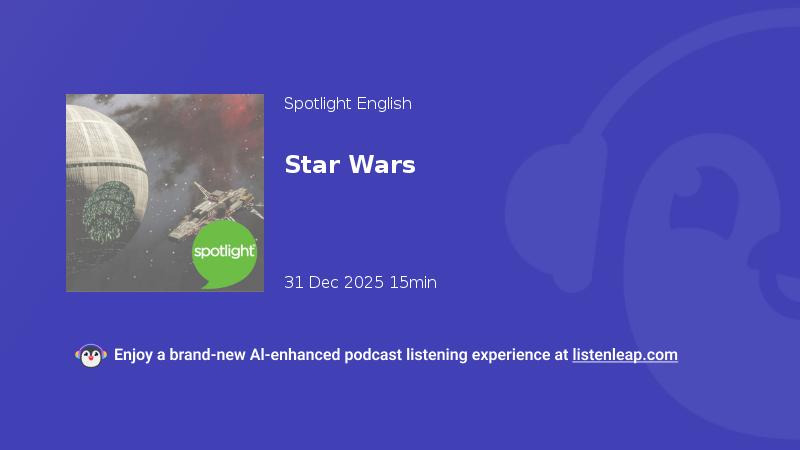
They want to stop the evil Galactic Empire's new weapon, the Death Star.
It can destroy an entire planet.
Luke Skywalker and the Rebel Alliance steal design plans of the Death Star.
Princess Leia, leader of the Rebel Alliance, is captured by the Galactic Empire.
They try to rescue Princess Leia while destroying the Death Star.
George Lucas wrote and directed the film.
Lucas knew that he needed the best special effects to create a believable film about in space.
He started his own company to create new camera and lighting techniques.
Lucas hired talented artists and engineers.
These artists made detailed models of spaceships, fighter planes, planets, and alien creatures.
They used special equipment to control the movement of the spaceship models during filming.
This special equipment made the ships look more realistic.
They did similar things for places in the galaxy.
They filmed small versions of locations in ways that made them look bigger.
Lucas was still worried people would not like Star Wars, despite all the new techniques.
He said, I did not think the film was going to be successful.
The film studio did not have any faith in it.
Lucas flew to Hawaii when the film was released.
He did not want to be near the film studio when Star Wars failed.
But after the first weekend, he saw a news story on television.
It said everyone loved Star Wars.
Lines of people waited outside theaters to see the film.
It was very successful.
Lucas finally believed people liked his film.
They did not just like Star Wars, they loved it.
The film made $775 million in ticket sales.
It was the most money a film had ever made up to that time.
Lucas was a great filmmaker.
But he was also a smart businessman.
He made a deal with the film studio before Star Wars was released.
He agreed to get a smaller salary.
In exchange, he received all merchandising rights.
This meant he would earn all the money from sales of toys, clothing, video games, posters, and more.
Fellow directors did not think this was wise.
They believed that merchandise connected to films did not sell well.
But Lucas thought But even if the film did not sell many tickets, children might want to buy Star Wars toys.
Lucas was right.
He made much more money from merchandise sales.
Children who saw the film wanted to own toy figures of characters like Luke Skywalker, Han Solo Chewbacca, R2-D2 and Darth Vader.
Children were able to buy these toys.
They could recreate the film in their homes.
Lucas and the film studio wanted to make another Star Wars film after their great success.
Lucas continued writing the story. of the Rebel Alliance fighting the Galactic Empire.
The new film was another big success.
The Star Wars films quickly turned into a franchise.
A franchise is a collection of creative works that all relate to the same story.
Many Star Wars movies and television series were made.
People also wrote Star Wars books, comic books and sticker books.
They created hundreds of Star Wars video games.
Star Wars toy sales have earned billions of dollars.
The Star Wars franchise has made more than $46 billion.
It is one of the most successful film franchises in history.
But why?
Why has the Star Wars franchise remained so popular for so long?
Many Star Wars followers today were not even born when the first film came out.
How did Lucas do it?
How did he interest people for so many years?
Lucas filled the world of Star Wars with interesting characters and stories.
The Rebel Alliance struggle against the Galactic Empire was exciting.
New character and filming techniques were added to later films.
Lucas took his time telling the entire story.
He spread it out over many films.
He was excellent at creating something people could look forward to.
He decided to call his second Star Wars film, Star Wars Episode 5.
The third film was called Star Wars Episode 6.
He also changed the name of the first film to Star Wars Episode 4.
This way of numbering the films told followers that they were part of a larger series.
It kept the followers interested while waiting for the next film.
It also meant Lucas would have to write the series beginning.
He would have to make the first three episodes because He started with the fourth.
This was a unique idea that worked perfectly.
Writer Nathaniel Rourke said Lucas wanted Star Wars to feel like a story people were coming into the middle of.
Lucas made episodes four, five and six in the Star Wars series.
He directed the first three films many years later.
People were incredibly excited to see these films, sometimes called the prequel trilogy.
Lucas wisely waited 22 years before making these episodes.
This made people even more interested in what stories he would tell.
It gave followers the chance to re-watch episodes 4, 5 and 6 many times.
Young followers grew up.
They started families.
They showed episodes 4, 5 and 6 to their children.
They passed down their love of the Star Wars franchise.
Other filmmakers released episodes 7, 8, and 9, 10 years after episode 3.
These were the final episodes of the story.
These films introduced a new generation to the Star Wars franchise.
These new followers could then go back and watch the first six films.
One of the central storylines in Star Wars films is the relationship between fathers and their children.
In the first few Star Wars films, viewers learn that Darth Vader, one of the leaders of the Galactic Empire, is actually the father of Luke Skywalker and Princess Leia.
In later films, viewers discover that Han Solo's son now fights against him and the Rebel Alliance.
Cass Sunstein wrote a book about people's fascination with Star Wars.
He said, The Star Wars films are all about fathers and how much their children need them.
Any struggling father can be saved so long as his child loves him.
Star Wars films have brought parents and children together for many years.
A father sits with his son.
They watch Luke Skywalker swing his glowing blue light sword at Darth Vader.
Vader blocks him with his red light sword.
The father wraps his arm around his son.
He smiles seeing his son so excited.
The father reacted the same way his son was reacting.
He had reacted this way when he first watched the film at a younger age with his own father.
Have you ever seen any of the Star Wars films?
Which is your favorite?
Do you have a favorite character?
You can leave a comment on our website at www.spotlightenglish.com.
You can also find us on YouTube Facebook TikTok, Instagram and X.
You can also get our programs delivered directly to your Android or Apple device through our free official Spotlight English app.
The writer of this program was Peter Anderson.
The producer was Michio Ozaki.
The voices you heard were from the United Kingdom and the United States.
All quotes were adapted for this programme and voiced by Spotlight.
No AI or artificial intelligence was used in this programme.
Spotlight programmes are written, voiced and produced by real people for real people, no matter where in the world they live.
This programme is called Star Wars.
We hope you can join us again for the next Spotlight program.
Goodbye!