Squiz Kids acknowledges the traditional owners of the lands on which we podcast, the Turrbal and Gadigal people.
Squiz Kids! It's your daily news fix.
Fun, free, fresh. Hello and welcome to this very special Squiz Kids Q &A, the podcast where you, the kids of Australia, get to ask the questions.
I'm Bryce Corbett and today we're coming to you from Gadigal land and we pay our respects to elders past and present.
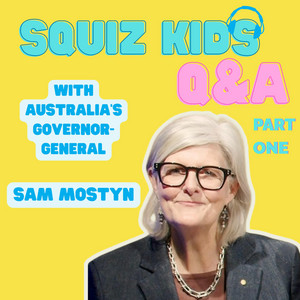
I'm excited to say that today we have a very special guest. Joining me in the Q &A hot seat today is none other than the Australian Governor -General, Her Excellency, the Honourable Sam Mostyn.
Your Excellency, welcome to Squeeze Kids.
It's wonderful to be here, Bryce.
Now, Your Excellency, first things first, that's quite a title that you have there, Her Excellency the Honourable Sam Mostyn.
Two things. One, how do I get a title like that?
And two, for the purposes of this podcast, how would you like me to refer to you?
Well, how do you get a title like that?
I suspect that you might have to get your skates on and start to think about whether you would like a vice regal role like Governor General, because they're titles that are I maintain for people in high public office.
And mine, because I have a certain representation role, which we'll talk about, means that those words are part of how I'm described.
Very well. But today, I'd be much more comfortable if you could just call me Gigi Sam.
Gigi Sam. I learnt that from all the students who come through Government House, who found all of that other bit a bit of a mouthful.
Sure. And I'm Governor General Sam, Gigi Sam.
I think that works better.
And I feel more comfortable when I'm talking to young people as Gigi Sam.
Sam. Excellent. Then GG, Sam, it is.
Now, this is a very special week for our special guest. Today marks one year to the very day today that the Governor General has been in her role.
So we thought it was an excellent opportunity to plonk her into the Q &A hot seat and subject her to a grilling from the kids of Australia.
You reckon you're up for it, Your Excellency?
I'm strapped in already.
It's a tough test, let me tell you.
Now, as you know, Your Excellency, or rather GG, ggsam we asked our listeners to send in any questions that they had for you about your job about what a governor general does about what it has to do with our system of government what it has to do with the king and we were flooded with amazing questions from some very smart children all over Australia and a huge thanks to all of the kids who sent questions in but because ggsam is a very busy woman with all of that governing generally that she has to do we had to whittle down the questions.
Before we dive in, may I say first of all, a very happy first birthday.
How has it been being the Governor -General for a whole year now?
Well, thank you. It's a birthday I didn't ever expect to be having.
It has gone so, so quickly.
It feels a lot shorter, but we have packed a lot of things into the job.
And I've learnt, just as you do with this show and talking to Australian kids, why it's so important for me to do my role in a very visible, modern and optimistic way.
So we've been doing that for for the last year and getting really good feedback that to see me out and about, see me visiting parts of Australia, talking to kids, talking to communities, listening to what matters has really hit the spot that I hoped it would.
And so it's set, this first year has set, I think, the groundwork for how I'll do the rest of my term.
I have five years in total.
And so I'm hoping that this year sets us up to do this job in a way that can add some value to the country, but also brings to life what it is to be a Governor -General and why our democracy matters matters so much. Indeed.
And on the subject of bringing it to life, you're doing that so expertly, may I say, with your Instagram account.
Now, what is the Instagram handle so we can get our people to follow?
I would love everyone to follow this.
The more we get, the better, and the more feedback we get.
So, it's just at GG underscore Australia.
And for people who haven't yet seen that Instagram account, it is a wonderful example of how you are, I feel, opening up the office of Governor General.
I mean, you welcome us via video into your home at Government House House in Canberra or home here in Sydney, Admiralty House.
What's the object behind all of the Instagram accessibility, if you like?
Well, when the Prime Minister asked me to serve and then appointed me into the role, he said he wanted a Governor -General that reflected our time and that in particular, he wanted a modern, optimistic and visible Governor -General.
Now, the Governors General before me have all been quite visible, but through the lens of, I think, things that a lot of Australians haven't really understood or haven't been curious enough to ask the deeper questions.
So it's a lot to ask people in the midst of their normal days to try to work out what the governor general does or how our constitution operates and how democracy works.
So I was a fairly, fairly avid user of Instagram and social media before I took on this role.
And I know that it provides a direct connection and visuals matter, storytelling matters.
So our Instagram and Facebook in particular opens up to the world and to Australians in particular what actually happens once you get behind the gates of Admiralty House.
government house what are all these things that are words are thrown around like swearing in or constitutional duties or um return of the writs after an election they're all quite technical words they're thrown around a lot and for many australians really no sense of what that really means yes so i've i've um with a lot of help from a great team that i have at government house and then listening to the students that come through government house we decided we would just fling open the doors and each time I do something that has a constitutional ceremonial component we film it we tell the story
and show exactly what's happening and hopefully get people engaged in a way that's not about the the old -fashioned view of the job but the modern Governor -General in a modern Australian democracy that's easy to understand and engage with and today's part of that yeah have this conversation well look we're so delighted that you took time to have the conversation with us now are you ready to dive in and take your first question I think I'm ready I I know they are very good questions.
They are very good questions.
We have a very clever bunch of listeners at Squiz Kids, I must say.
And this is a good one to kick off on because I have a feeling lots of Squiz Kids will be keen to understand exactly what it is that a Governor -General does.
Take it away, Avie from Beaconsfield in Western Australia.
Hi, my name is Avie and I am 11 years old.
I live in Perth, Western Australia.
And my question is, I am new to Australia.
What is the Governor -General?
Ailey, that is such a great question.
And I've travelled quite a bit to West Australia, so it's great to get a question from the West. I tell anyone who wants to listen about my job that it's easy to think about me through four Cs, and the four Cs are constitutional, ceremonial, community and commander -in -chief of the Australian Defence Force.
And within those four Cs, I do all of my work.
And a good example of constitutional and ceremonial together would be recently I swore in the prime minister after we had a federal election.
So at government house I was able to swear him in and then with him swear in his cabinet.
Very ceremonial, but all under the constitution of who is our government after the Australian people have voted.
That's a very strong constitutional manner.
Constitutionally too, I am in my role because I actually represent the king.
So King Charles III is the king of Australia and he is the person for whom I take my constitutional responsibilities.
So I am chosen by the Australian Prime Minister.
This job is always chosen by an Australian Prime Minister, but the confirmation of it is done via the palace and via the king.
Amazing. So it's an important representational role.
I'm as close as you can get to an Australian head of state, but the head of state himself is the king.
So I perform all the duties of the head of state in Australia.
On behalf of the king.
On behalf of the King, but there's a very important constitutional matter that everyone should know and be very proud of.
I would never ask the King for advice on how I do my job.
I would never pose a question about something we're doing in Australia to him, for him to give me advice.
And he would never contact me or my office to offer me advice or opinions or tell me how to do my job.
He does not direct me.
He doesn't offer an opinion on how I do my job.
I take all of my advice and counsel from the Australian Prime Minister, the senior ministers, is the government and the parliament of Australia.
And so for all intents and purposes, this is an Australian job with an Australian at the helm in a constitutional arrangement where I represent the crown.
I also, I do many ceremonies, beautiful ceremonies for all sorts of organizations of which I'm patron.
So I'm patron of over 200 organizations.
And their organizations, I think, speak to the character and focus of Australia.
And as a patron, we do many ceremonies for them.
Then community. It's probably my favorite part of the job.
Tell us about that.
We're kind of doing it now, engaging with the community, engaging with young people.
We have 25 ,000 students that come through Government House every year on the bus tours of civics education in Canberra.
Amazing. Yeah, so 25 ,000.
I don't see them all.
Do you have to cater for them all?
That's a lot of cordial.
We do a little bit of catering, but we have a team, household staff and aide de comps who work for me who show those young people for a couple of hours around Government House.
And then if I'm in the house and in Canberra, I race out and try to spend 10 or 15 minutes with students.
We take a selfie. We have a bit of a chat about where they're from.
And I ask them the things that I should be focused on a bit like we're doing today.
And that's a form of community.
I also travel all over the country.
Lots of travel. To regional towns, to outer suburban areas, to rural and remote communities, to go where Governors -General go to reflect the light and shade of Australia.
And what do you mean by that?
So a former Governor -General, Sir Zelman Cowan, once said that the job of the the Governor -General is to visit places, see what's good and bad, and reflect that.
So that's the light and shade.
And then tell those stories, reflect those back to the people who should hear about it, or share it generally with the Australian community.
So we get a wonderful, diverse, broad picture of how Australia is going.
So an example of a tough time, I've been recently in northern New South Wales, visiting people who are affected by the floods.
And so I spend that time understanding what they need, the stories they would like told to the national audience of Australians.
And we think about that very carefully and tell that story to say stick with people who are in recovery when really tough things have happened.
Some of the kids listening to this podcast might be in places that have had fires, cyclones, floods, hail.
It's tough. And so we visit.
On the other hand, we do visit places that are celebrating the very best of what they do and we tell those great stories back to the country where we see the very best of things, innovation, young people doing amazing things, farmers doing amazing things with their soils, food producers, people working in community to help people through tough times with social enterprises, all kinds of stuff.
Commander -in -Chief of the Australian Defence Force.
Commander -in -Chief, that's an important one.
It's an important one.
There's a little bit of a misnomer or a sort of funny thing.
So you're not ordering people to march around squares or?
I do not order any.
I couldn't command anyone in the Defence Force to go and serve.
What I do is I'm a ceremonial head of the Defence Force for the purpose of celebrating what our Defence Force personnel do, to pay tribute to what people who've served have always done.
So you'll often see me at very, very important ceremonial duties for the Defence Force.
I recently gave the Anzac Day dawn service address from Gallipoli in Turkey for all Australians, which celebrated 110 years since the first Anzacs landed at Anzac Cove.
So I'll do that. commemoration days like Remembrance Day, the Vietnam War commemoration events.
And I grew up in an army family.
So my dad was in the army.
He served Australia for 40 years.
I was then called an army brat.
I'm not sure, that was the official term growing up.
And so army families and Air Force family, Navy families kind of grew up knowing what that work was.
So that's my commander in chief role.
And I would take all my advice and counsel from the Prime Minister, the Australian chief of defence and the defence minister.
So I could not command anyone to do anything.
But I very much enjoy all my interactions.
It must be very tempting.
I'd be very tempted too.
Our next question comes from Patrick in Perth.
And he's got a question that lots of children asked.
Take it away, Patrick.
Hi, my name is Patrick, and I'm 10 years old.
I live in Perth in WA.
And my question is, why should children care if they can't vote until Until they are 18 years old.
Patrick, that is one of the most important questions, so thank you for asking it of me.
And whenever I meet young Australians, I go straight to this point about what we celebrate in our democracy.
And I know on Squiz Kids you really care about facts and being curious.
We do. I talk about democracy being one of the great strengths of our mighty country that we must choose to pay attention to and care about a lot more than perhaps we do.
I know you do here at Squiz Kids.
That's what you're involved in.
Absolutely. I think we've got to be really focused on this.
So the question is very important.
Don't wait until you're 18 to work out why you vote or why you would care about having a vote.
Right now, kids around the country, I think, could be thinking very deeply.
Maybe it's through Squizzy and looking a bit deeper at how elections are held.
But think about what makes us unique in the world and why we are such a strong democracy where we have people who feel safe here, who can fulfil their lives however they want and know that the people they elect are the people that make decisions and if we don't like what they do, our democracy means that through voting and our elections, we can change governments at all levels.
So we are one of the only countries still that has a fundamental belief in it's the people who vote the people who govern us.
I met a lady just recently who came to Australia.
She was a refugee from Afghanistan.
She came through a refugee camp in Iran.
She came into Australia with her daughter.
her. Two weeks before the last federal election, she became an Australian citizen.
Took citizenship and she told me that the most exciting, important thing she then did was two weeks later, after she'd registered as a voter, voted in the federal election.
When I asked her why, she said, because where I'm from, we don't get to vote.
We don't have that.
The people do not determine how we are governed.
Here, I'm so proud to now be an Australian citizen who can vote.
So I think young young people are going to be the future of our great democracy.
And turning up to vote and knowing why you're voting, the power of the vote, and why being curious and fact -based when voting makes us great.
Absolutely, absolutely.
And I couldn't agree more.
Now, understanding how Australia's system of government works is, as you said, something that we spend quite a bit of time here at Squiz Kids talking about, because we know it's very important and that civics education, as it's called, is a very important part of everybody's education.
We partnered actually with the Museum of Australian Democracy to create a four -part podcast series called The Sensational World of Civics which is available on the Squiz Kids website for any parents or teachers who are listening and it's why these two next questions from Charles in Ipswich and from eight -year -old Arav in Plumpton New South Wales are both such good ones.
Hi my name's Charles I'm nine years old and I live in Ipswich in Queensland.
My question is do you have to make a lot of decisions for the Australian government?
Hi, my name's Olive.
I am eight years old and I live in Plumpton in New South Wales.
My question is, are you able to change the laws?
Thank you. They're really great questions and they go to the heart of what I do.
I don't make decisions on behalf of the Australian government and the civics program, I'm sure, explores all of this.
I think that civics is pretty sensational too.
It is pretty sensational.
I know. We're going We're going to make all Australian kids think the same thing.
Absolutely. Don't you worry, Gigi Sam.
I think the coolest kids will be those that love – The coolest kids will be the civics kids.
That's it. I love it.
A new strap line. So in my role, I take all my guidance from the Prime Minister and the Cabinet.
When matters come up to me, though, from the Parliament, so regularly I have bills that come up to me after they've been through the House of Representatives and the Senate.
We should point out, Bill is not a person.
No, Bill is not a person.
It's a document. A document.
It's the beginnings of the law.
And so the law, we are generally prescribed by legislation and laws that tell us and prescribe how we do things, what… How the country works.
How the country works, where the money comes from.
What we can and cannot do, where the money comes from.
That's right. What are the rules that tell us about how we live in this country and the relationship with our governments?
And this is the Commonwealth legislation that comes.
And so they are called bills as they are making their way through the House of Representatives and the Review House, the Senate.
So that's the green one.
The green one. And then the red one.
It goes to the green house first and then to the red one.
And sometimes in between those or from those houses, the bills can go off for debate.
And so once that process is complete and the matters have all been dealt with and there is a bill, a document ready to get what is called the Crown's assent.
This is where you come in.
That's right. As the King's representative here in Australia, you have to give each bill or each law or the royal assent.
That's correct. And so up will come very beautiful -looking documents.
They've already been signed by those who represent the parliament, and then there's a space for me to sign and to give the Crown's approval to the legislation.
That's a massive responsibility.
It's a big responsibility.
Every time I have a bill before me, I have to sign two copies for the record. I look at the space where I'll sign my name, and I think in doing this, the moment I finish signing my name, this becomes the law of the country.
So it is a very important moment and this is why our system of government is so stable and so reliable.
Now, Gigi, Sam, here's a question that, if answered correctly, and I want you to think long and hard about your answer to this one, this could make you not just the king's representative here in Australia, but it could in fact make you the actual queen of kids in Australia.
Connor from Coorparoo, take it away.
Hi, my name is Connor.
I'm 10 years old. I live in Coorparoo, Queensland.
My question for the Governor -General is can the Governor -General please ban homework as kids do way too much in school?
Thank you for considering about my question.
That is a fantastic question, Connor.
Goodness me, I wish I could have asked someone to ban homework when I was your age.
I'm going to really disappoint Connor.
No. With all that power, you're the Commander -in -Chief.
You can't tell teachers or principals.
No, I can't. I can't tell them to ban homework.
No, I'm so, so sorry.
Sorry, kids of Australia.
I do say to every group that comes through the school, though, that I do love teachers.
I think teachers are doing an incredible job.
Teachers are the best. They're the best. Teachers are very cool and I think if you're getting homework, it's because your teachers want you to be your best self.
There you are. I do know I get lots of homework too.
I'll bet you do. So I do a lot of homework most nights.
I do lots of research. So that's exciting to hear.
Homework doesn't finish when you finish school.
It doesn't and it gets more.
Maybe it gets a bit more interesting because you get to choose the things that are interesting, but it teaches you.
Homework teaches you how to be curious and go deeper into things and in your own private time work out how you want to engage with a subject.
And so, Connor, maybe think of homework as a chance to think about your future and know that the Governor -General is also doing homework most nights.
There you go. You're not alone, Connor.
Let's head back down to the south now and hop across the Bass Strait to take a question from our youngest Inquisitor today, Five -year -old Luke from Kingston Beach in Tasmania.
Hi, my name is Luke.
I am five years old.
I live in Tasmania, Kingston Beach. And my question is, have you met the king and what's he like?
And that's where we'll press pause, just for now.
That's the halfway point in our special Squiz Kids Q &A with Australia's Governor -General Sam Mostyn.
But there's heaps more to come.
Don't miss part two tomorrow, same time, same place, where we find out whether she's met King Charles and been to his palace and discover what she's learned since becoming Governor -General.
And if you want to see the GG me and all of these amazing kids asking all of these burning questions in person, head on over to the Squiz Kids YouTube channel to check out some shorts right now.
The full interview will be their first thing on Thursday morning.
For now, this is Bryce Corbett signing off and reminding you, as ever, to get out there and have a most excellent day.
Over and out.