This is the TED Radio Hour.
Each week, groundbreaking TED Talks.
Our job now is to dream big.
Delivered at Ted conferences.
To bring about the future we want to see.
Around the world. To understand who we are.
From those talks, we bring you speakers and ideas that will surprise you.
You just don't know what you're going to find.
Challenge you. We truly have to ask ourselves, like, why is it noteworthy?
And even change you.
I literally feel like I'm a different person.
Yes. Do you feel that way?
Ideas worth spreading.
From TED and NPR, I'm Manoosh Zamorody.
On the show today, the psychology of winning.
Have you ever wondered what is going on in the mind of a professional athlete?
Part of my personality, from the time that I can remember, is that when the lights were shining.
When the moment of the game came down to the last second, to the last play, when the attention and the focus turned toward me, there was something greater in my spirit that came alive.
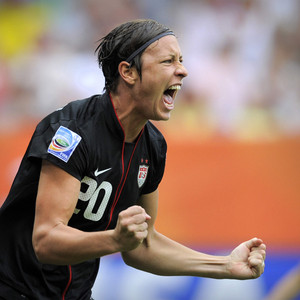
This is Olympic gold medalist and World Cup champion Abby Wambach. She played for the U .S. women's national soccer team from 2001 to 2015 and is widely regarded as one of the greatest soccer players of all time.
And now in my retirement, I am an author, a podcaster, and an avid U .S. women's national team fan.
But on July 11, 2011, she had a lot to prove.
It was the quarterfinals of the Women's World Cup in Dresden, Germany.
Team USA versus Brazil.
and Brazil's legendary striker, Marta Vieira da Silva.
There is a healthy rivalry between USA and Brazil in 2011.
Marta's at the top of her game.
I am at the top of my game, and if Marta just had the game of her life, which was always possible when Marta stepped on the field, then you just had to figure out how to deal with that as best as you can.
We scored an early goal and what people don't know about what was going on inside the stadium is when we scored that early goal, we were like, listen, let's keep possession because it was early.
I mean, we still had a lot of soccer left. So we were keeping possession and I remember the crowd, they want to see excitement.
They want to see soccer and football really happening.
Team USA was sitting on the ball, taking their time, trying to keep the score at 1 -0, which really annoyed the fans.
So the crowd kind of started to turn against us in a way and start to back the Brazilian side.
They wanted a game, a game they ended up getting.
I think about the 60th minute, one of our defenders, Rachel Buhler, ends up getting into a collision with Marta, ends up drawing a straight red card inside the penalty box.
So, not only is Brazil awarded a penalty, but we now lose a player.
We are now playing with 10 women.
And oh, God, that was such, I'm experiencing like stress as if I'm right back there.
So we get ready for the penalty shot.
Brazil takes the shot against USA's goalie, Hope Solo.
Hope saves it and we're freaking out.
We're all like, oh my gosh, this is great, you know.
Well, the referee says, no, no, no. Hope moved early and so they got to retake the penalty and then Brazil scores the penalty.
One -one, 60th minute, Team USA is down a player and I'm just thinking oh this is not good this is not good we play for the next 30 minutes and it's it's an intense game you know there's not many chances from either team really regulation ends and it goes into extra time and Marta God I'll never forget it where I was standing they get corner kick and somehow she scores this goal.
And I just remember screaming from that point on, we just need one good chance.
We just need one good chance.
We are fighting for our lives.
We They're fighting to stay in this tournament.
This would be, I think at the time the earliest exit the U .S. would ever exit a world championship being the quarterfinals.
What is going through your mind at this point?
Are you like angry?
Is there a point where you like, I just have to stay in the zone or otherwise this is all gonna fall apart?
What is happening? I am everything all at once.
Okay. I am angry. I am terrified.
I am excited. I am at the edge of myself.
I am praying. I am talking to myself.
I am pleading. I am willing.
I am all things. I'm everything all at once.
Because the clock is ticking at this point, right?
Yeah, the clock is ticking, the ball is basically, I think on our own goal line where Hope Solo is standing, the end of the field, and I'm screaming like just kick it north like direct we need to get to the goal we've got.
I felt like we only had a few seconds which we did we only had a few seconds left until the referee was gonna call the game.
Teammate Megan Rapinoe gets the ball.
Megan takes a couple of touches and you have to understand the relationships that we all have. Like these are plays is that we have done a thousand times with each other.
But the problem is Megan is now basically on the half mark.
So she's probably like 40 yards away from the end line.
And I'm at the top of the box, and so this delivery and this angle and the trajectory has probably never been attempted.
But because it was such late game heroics, Pino was like, I know Abby's in there.
I'm just gonna take a couple touches.
I'm gonna look up, and then I'm gonna look down.
And as soon as Meghan looked up, and as soon as she put her head down, I knew the ball was coming toward me.
And as soon as the ball came off of her foot, for whatever reason, I knew that that ball was coming to my head.
I knew it. The only thing in my mind was don't screw this up.
I knew I was going to head the ball.
Would the keeper save it or not?
Well, as the ball is approaching my head, I see a pair of gloves come into my vision and come out of my vision.
As the ball is striking my head, I realize the goalkeeper has come out and missed the ball.
Nobody is in the goal.
I have a wide open net.
Now I'm thinking, if I miss this, this would be the biggest embarrassment in the whole wide world.
My head connects with the ball.
You know, your eyes have to shut when the ball hits your head, and then when the ball comes off your head, your eyes open back up.
But I heard the roar of the crowd before I could see the ball, And the roar of the crowd was so loud that I black out.
Like, I don't have a recollection of the ball hitting the back of the net.
Moments like this are what athletes and their fans live for.
And whether it's on the field during a crucial exam or while giving the biggest presentation of your life, Going for the win can be exhilarating and terrifying.
So what are the best ways to set ourselves up for success?
On the show today, the psychology of winning.
Why we love watching people compete at the top of their game, and how we can manage our own anxieties in high pressure situations.
Which brings us back to Abby Wambach. Her header in the 2011 World Cup quarterfinals is legendary.
And over the years, Abby has replayed that moment over and over again in her mind.
Because I've wondered, how the heck did that happen?
What about me? What about my brain, my body, my spirit is different than somebody else to be able to do that?
Is it just like, right place, right time?
Or is it the sincere openness to utter annihilation had that gone the opposite way, right?
Like I try to tell my kid, the more open you can be to be completely devastated by something, the more possibility opens up to you.
And I think that that's true in life, I think that's true in love, I know that that's true in sport, the more you open yourself up to devastation, the more possibility will be open to you.
And that's what this moment was.
And I believe deeply in all of my being that some of the best athletes we watch and some of the biggest moments we've been able to watch, we gather the energy of everybody watching and we are somehow able to tap into that will, to tap into that desperation and to give it what it wants.
And so I think that that's what happened.
And P .S., folks, this only tied the game.
We go into the Panalika kick shootout.
Ali Krieger finishes it off for us to win.
I hope Solo also saved one.
That was the reason why we were able to win in five.
Yeah, my God, like I feel exhausted just explaining all of it because it was - this feeling?
Yep, you know there's really not much that you can compare that kind of thing with.
Winning the game in that fashion in that way, it was just so unbelievable.
It made me famous. It brought the popularity and fandom back to women's soccer the way that it kind of was when Mia Hamm was present and starting the women's soccer sports revolution in this country.
That moment was everything.
When you have a moment like that, is there a sense that you can, oof, take a deep breath?
Maybe rest on your laurels a little bit?
I remember the next day Pia, our coach, She sat us in a circle.
She wanted everybody to go one by one and tell their story.
How they experienced it.
She knew that this was, this moment was bigger than this one specific team.
What she was trying to give us was the space to be able to be like, that just happened.
Be proud and be amazed and be awed And at the end of that meeting she said, okay, we have to move on to France.
We still haven't won anything here.
That we will be able to celebrate for the rest of our lives.
But today is a new day and we need to move forward. That's Abby Wambach. Her podcast is called We Can Do Hard Things.
And by the way, the U .S. team ended up losing in the final of that World Cup, but came back four years later in 2015, and with Abby won the championship.
On the show today, the psychology of winning.
I'm Manoush Zamaroudi, and you're listening to the TED Radio Hour from NPR.
Stay with us. Support for this podcast and the following message come from Sierra Nevada Brewing Company.
Raise a glass today and you'll taste more than just beer.
You'll taste a trailblazing spirit.
You'll taste pure ingredients, sustainable brewing, and a commitment to community.
And you'll taste a world of flavor, from the legendary Pale Ale to the citrusy and smooth hazy little thing.
It's flavor that takes time so you can make the most of yours.
See for yourself where fine beer is sold.
Sierra Nevada. Taste what matters.
Please drink responsibly.
This message comes from Smalls.
Smalls cat food is protein -packed recipes made with preservative free ingredients you'd find in your fridge.
And it's delivered right to your door.
That's why Cats .com named Smalls their best overall cat food.
Give your cat the food they deserve.
To get 35 % off plus an additional 50 % off your first order and free shipping, head to Smalls .com and use promo code TRH for a limited time only.
It's the TED Radio Hour from NPR.
I'm Minouche Zomorodi.
On the show today, the psychology of winning.
We just heard how soccer great, Abby Wambach, was able to turn a crucial moment into a clutch goal, but what if she'd whiffed, totally missed the ball.
For every win, there's an example of someone at the worst possible time, choking.
Did you perform worse than you expected, given what you could do?
To me, that's a choke.
This is the president of Dartmouth College.
My name is Sian Bylock.
Sian is also a cognitive scientist who spent most of her career studying what happens in our brains when we crack under pressure.
For Sian, there was one particular day in high school when this happened to her, And she will never forget it.
I was playing soccer, I was the goalkeeper, which is a pressure -filled position.
All eyes are on you.
And I was playing as part of the California state team, which is part of the Olympic development program.
So it was a big deal.
And I remember turning around and realizing that the national coach, the coach that would select somebody to come up and play on the national team with standing behind me.
And I first just shook it off, but I remember really all of a sudden becoming really self -aware of everything I was doing, from breathing to moving.
And soon after that the ball came towards me.
Someone was dribbling down the field, and I essentially was in slow motion, almost thinking about how he was playing like the coach was watching me.
And I missed such an easy shot.
And shortly after that it happened again.
And really blew my chances to play it at the next level and shook me to my core about whether I could perform well when it mattered.
Okay, so is that why you became a cognitive scientist?
I definitely do me search. So trying to understand how I can perform better under pressure.
And then when I got to university, I found this amazing major called cognitive science where you could actually ask questions about how you were performing, what happened in the brain and body as people learn and perform at their best. And one of the things I realized was that there was a lot of research focused on how people learn, whether it's how you learn as a young child, how you learn to become an expert in everything from chess to athletics to music.
But there was less research focused on what happened when someone was pretty highly skilled and all of a sudden they didn't perform well.
And I wanted to ask that question.
How do you even go about studying what happens in the brain?
Can you take me through the process that you went through to try and pinpoint where things, I guess go wrong?
Yeah, I mean, so I'm interested in performance at all kinds of different levels and in different tasks.
And one of the first things that we actually did when I was in graduate school and first studying this is we set up a lab with a putting green and we invited professional golfers in.
And we put them under pressure and look to see what happened if they got worse in terms of how they putted.
Oh it's called the yips, right?
When you like just completely whiff the ball but you're actually a very good golfer.
Yeah, I mean, the yips is one way that it's been described or just choking under pressure.
and golf is a great sport to study this because people certainly can play differently depending on what's on the line and who's around them.
What did those golfers tell you?
It was really interesting.
So, we had pretty high -level golfers, whether it was Division I golf team or some professional golfers.
And one thing that they told us is that when they puttered well, they actually couldn't really remember what they were doing.
They were sort of in a zone.
And when we asked them for their memory, they couldn't tell us much. It's you know, why I always think professional athletes after a really good game, either thank their moms, or they thank God, like when people ask them questions, I can't tell you what they did because they were playing in a sense out of their mind, they weren't focusing on what they were doing.
But when they performed poorly, they actually were paying a lot of attention to every step of what they were doing.
And this gave us insight that may be counter -intuitively one of the reasons people flub under pressure, especially in athletics as they start paying too much attention to their performance, things that should just run on autopilot.
SONIA DARA... Do we know how good someone has to be as an athlete or I guess any skill that they have, public speaking or anything where they're under pressure?
Is there a level of achievement that they reach when they can do this autopilot thing and don't have to talk themselves through every step while they're actually doing it?
It's a really good question and I don't think there's a one -size -fits -all answer.
And we're all really expert at certain things.
Like you shuffle down the stairs all the time and if I asked you what you were doing with your knee, you'd probably fall on your face.
So we're all experts in certain things.
So this actually happened to me, not under pressure, just I was carrying a laundry basket down the stairs.
And I was like, be careful, be careful.
And I like looked and I felt very nervous about falling so I guess that is high pressure and I was thinking so much that I flubbed it and fell and actually broke my foot.
So, yeah. So I have actually experienced that.
It turns out it would have been better if you just hummed a song or thought of a keyword and just kept on going down the stairs.
Yeah, I mean, there's something actually very reassuring about this idea of our brain being able to take over without us having to pay attention.
Yeah, I mean, it's how we do all sorts of things in our lives.
I mean, we're getting bombarded with all sorts of information that we don't pay attention to at particular moments.
And sometimes like, you're probably not thinking about your foot right now, but now you are, because I told you about it.
We do a lot of things outside of conscious control.
And a lot of what my research has shown is actually, you have to trust yourself and be able to perform that way, because that's how you're going to have the best outcome.
Sian Beilock picks up from the TED stage.
My research team and I have studied this phenomenon of over -attention, and we call it paralysis by analysis.
In one study, we asked college soccer players to dribble a soccer ball and to pay attention to an aspect of their performance that they would not otherwise attend to.
We asked them to pay attention to what side of the foot was contacting the ball.
We showed that performance was slower and more error -prone when we drew their attention to the step -by -step details of what they were doing.
When the pressure is on, we're often concerned with performing at our best. And as a result, we try and control what we're doing to force the best performance.
A lot of it comes down to the prefrontal cortex, that front part of our brain, that sits over our eyes and usually helps us focus in positive ways, it often gets hooked on the wrong things.
The end result is that we actually screw up.
It feels important to mention gymnastics.
Simone Biles is, of course, the most famous example of being at the absolute top of her field and then dropping out after experiencing what people in gymnastics called a twisties, this sense of not knowing where your body is in space.
Is that different than what you were talking about, paralysis by analysis?
No, I mean I actually think it's really similar in terms of this idea that all of a sudden what had gone on autopilot what she knew how to do didn't feel right.
And then when she needs to focus on where she's going to land for example, she isn't able to.
And so it's a form of your performance changing because of what's happening mentally.
What she didn't say, I've injured my foot, right?
She injured her ability to attend to what she wanted and to not attend to what she didn't.
And do you think stress, anxiety, the pressure of the moment makes that out of synchness happen between the brain and the body or could that have happened at any point?
Well I think the yips which sometimes just creep up out of nowhere in golf and other sports and you know in baseball it's happened sometimes it happens out of nowhere but there is a body of research that suggests that when you are really stressed, when all eyes are on you that actually can be an avenue that changes how how you think about how you're going to perform and can induce some of whether it's the twisties or the yips or performing poorly under pressure.
So talk us through what you think are some easy hacks I guess to not let our prefrontal cortex get hooked on the wrong things.
Well first I think practice is key.
Not just practicing a toast you have to give at a wedding or a speech without anyone watching you, you gotta practice under the conditions you're going to perform under, so if you're giving that toast and you want to practice to perfection, you've got to practice in front of your friends.
You've got to make yourself a little nervous.
Even practicing in front of a mirror, it increases self -consciousness so that you're ready to go when you're on the big stage or it's that big day.
I've read that the golfer, Jack Nicklaus, used to think about his pinky toes?
Yeah, that's another idea.
It's sort of a crutch to not overthink the step by step details.
So either thinking about your pinky toe or having a keyword or mantra or a swing thought anything that sort of takes you from spending too much time dwelling on the details of what you're doing.
So when I was playing soccer and then lacrosse, I started the game with a song like I always had, Take It Easy by the Eagles in my head and now when I go into an important talk or It pops up in my head, I start singing it.
That's your soundtrack for doing well without stressing out?
That is my soundtrack.
So, I do have to ask you have a very stressful job but when you were first learning about all of these things about what was going on in our brains did it change the way that you approached your work?
Yeah, it's a great question.
And I think for me, the most exciting part of my work is showing that you can get better at things with practice and you can learn how to perform and lead in different situations.
And so for me, the idea that you're not born a choker or thriver, that everyone has to practice and that's how you are able to show what you know when it matters most, I think, gives me hope.
And Hello, Class of 2024.
This is so exciting.
—At Dartmouth, we had Roger Federer gave this commencement speech, which was absolutely amazing.
—Today, I want to share a few lessons I've relied on.
—And he talked about this whole idea that even though oftentimes people would say he was effortless in what he did, it was the farthest thing from the truth.
—Effortless is a myth.
I mean it. I say to someone who has heard that word a lot—effortless.
people would say my play was effortless and most of the time they meant it as a compliment.
But it used to frustrate me when they would say he barely broke a sweat or is even trying.
I mean I want to make clear to people who maybe aren't tennis fans that you know he is one of the greatest players of all time and one of the key things he's known for is being cool as a cucumber under the pressure.
he had to train himself to be consistent.
The truth is I had to work very hard to make it look easy.
I spent years whining, swearing, throwing my racket before I learned to keep my cool.
And then he spent a lot of time practicing how not to pay attention to what he was doing in those moments, how to trust himself and what he knew.
I didn't get where I got the pure talent alone.
I got there by trying to outwork my opponents.
I believe in myself, but belief in yourself has to be earned.
Trusting yourself is a talent, embracing the process, loving the process is a talent.
I mean, what a life lesson for those students to hear, right at a pivotal moment when they are about to embark on a very uncertain journey.
It was a life lesson for me, right?
It's never too late to go back to those basics and to be in a situation where you really, you feel you can trust yourself in that most important situation.
Still to this day whenever I give talks where I'm a little nervous, I remind myself that I know my material, my research better than anyone else in the room, which is true.
And so even if I mess up or don't get everything exactly right, I'm probably the harshest critic of myself relative to anyone else, and that's pressure -relieving in a way.
That's cognitive scientist and Dartmouth College President Sian Bailock.
Her book is called Choke, What the Secrets of the Brain Reveal About Getting it Right When You Have To.
You can see her full talk at ted .com.
On the show today, the psychology of winning.
So we've been talking about how each of us, whether we are an athlete or not, can put ourselves in the right mindset to score.
But what is it about competition that we find so compelling to watch?
Why do we spend millions of hours and dollars gaping at people kicking or throwing around a ball?
We want to see some form of transformation, You want to watch your protagonist grow, that's really what it is.
This is sports journalist Kate Fagen.
Kate has thought a lot about why some sports captivate viewers.
While others, particularly women's sports, don't.
And that's something women's sports has suffered from too.
This idea that like collectively as a culture, we haven't decided it matters.
So when it comes to people tuning in, you start to get that, well, if this thing doesn't matter culturally, then I'm doing it almost as a form of charity.
Like do it for our young girls, as opposed to, no, these are the best in the world.
And if we actually treated women's sports with the respect, like you wouldn't need to think of it as a charity.
Kate began questioning why it was such a challenge to get people to pay more attention to women's sports years ago, when she started out as a sports commentator at ESPN.
When I worked at ESPN and I would do a TV show, I was in the production room and I was always pitching women's sports stories.
Here's Kate Fagen on the TED stage.
It almost never worked.
Every once in a while, it would work.
But this thing would happen when we would do a women's sports segment.
Many of the other men on the segment didn't really do their homework.
So they were kind of blah.
Then the segment would be kind of blah.
There's actually a term for this.
It's called gender bland.
And then the segment would end, and the producer would be like, see, this is why we never do women's sports, because they're boring.
When a men's segment fell flat, the problem was us.
We would redo it. All right, come on, do your homework, pick it up, we're doing that again.
When a segment on women's sports fell flat, the problem was women's sports.
The reality is that just existing in our culture you will know a dozen men's storylines.
I mean these things are literally push notified to your phone, or you're at a bar, or a doctor's office, and the talking heads are giving you the latest NBA drama.
In America osmosis will have you knowing men's sports storylines.
So, who tells the storylines of women's sports today?
If we're willing to inspect what actually spikes our heart rate and pushes us to the edge of our seats, instead of just assuming we know, we can all collectively make the sports world a more equitable place.
I started to notice that it's not as if people just don't care about women's sports.
there are environments and there are circumstances in which people are caring about women's sports.
So I started to think along with a lot of my female colleagues at ESPN, what are the common denominators when this does happen, when people care about women's sports because it felt to me like that could also answer the broader question of why we watch sports.
In a minute, the key ingredients Kate believes every athletic event needs to make it impossible for us to turn away.
Today on the show, the psychology of winning.
I'm Manoush Zamorodi and you're listening to the TED Radio Hour from NPR.
We'll be right back.
It's the TED Radio Hour from NPR, I'm Manoush Zamorody.
On the show today, the psychology of winning.
And we were just talking to sports journalist Kate Fagan, about why women's sports have struggled to get equal footing.
Kate says to understand what the problem is, we need to go back to basics, and why people People love watching sports to begin with.
You know, the billions of dollars that are poured into it, we've gotten so far away from understanding what actually drives our investment in it.
If you strip that all away at its base, what are you left with?
Like what are the common denominators?
For many, she says, sports start out as a family affair.
The noise is terrific here.
The race goes as Rexham look to start off a new era at the club.
Take the recent FX show Welcome To Rexham.
It's a documentary series about a failing Welsh soccer team that then gets bought by two Hollywood actors, Ryan Reynolds and Rob McElheny.
I don't think I really understood the weight of it until we stepped into that stadium.
The saga goes well beyond the scoreboard. It's about how the citizens of this depressed post -industrial town intertwined their identity with their team.
This is a place where many people have Rexham tattoos, and are buried in coffins draped in Rexham flags.
People say it's only a game, but it's not, it's more than that, you know.
This football club means everything to people in this town.
Kate calls this kind of fandom, generational inheritance.
and many women's sports, she says, just don't have it yet.
There's so many veins of generational inheritance in sports.
There's the one that does take time and literal family generations where you can actually say, well, why am I a New York Met fan?
Well, because my grandpa was a Brooklyn Dodgers fan, and then they left for LA, and then the next team that we got It was the New York Mets, and there's something bigger than yourself about that.
I think why we love sports at its core is for the culture and community of it.
And whether it's your literal community, it's like your city team, or you live out of state and it's your grandmother's favorite team or your grandfather's favorite team, that's all part of community as well.
And then pair that, and they often go hand in hand, with cultural value.
Like we wanna be in on what culture is talking about.
And you've seen that happen with women's sports over the last few years.
It's cultural value has risen dramatically, meaning that the community is bigger.
Meaning that now you're a part of something outside of a small group, but that you feel like the culture is telling you has value.
And then more people come into that circle and then it grows.
Okay. So that's why we love watching an established sports team.
But what does it take to get people to watch a new sport or an athlete that we've never heard of or for that matter, a women's sports team that hasn't been around that long?
Well, I think sports blossom in our minds when they have two things, when they have stakes to them, and when we understand the storylines within them.
Here's Kate Fagan again on the TED stage.
This is what burns at the center of sports.
In the Olympics, we have all agreed to gold medal matters.
Same with the World Cup.
And now, paired with this agreed upon stakes, we also have, at the Olympics in the World Cup, very obvious storyline.
One person has a USA jersey on, someone else has a different country's jersey on.
Alright, we've got agreed -upon stakes, we've got very obvious storylines, of course now we're gonna have a commitment to even deeper storytelling, which is how we end up teary -eyed after a three and a half minute NBC vignette about a Romanian gymnast. Yeah?
You have everything you need now for the next two hours of competition.
An Olympic gold medal is on the line, and you've got your storyline.
Romanian gymnast desperately overcoming the odds.
Boom. Storylines drive up the stakes.
Higher stakes, more storylines.
And on and up we go.
You see it played out so much in the Olympics because you're dealing with these very random sports often that aren't in the limelight.
You're dealing with all different countries whose athletes we probably have no name recognition for.
And so NBC spends, you know, whatever their budget is every Olympics to build these little vignettes so that when we're watching an obscure sporting event all of a sudden we're invested.
I mean to me, English major, I'm like of course it's Joseph Campbell, the hero's journey, right?
It's like those old methodologies of sending someone on a quest and then they have to overcome.
Like there's the miracle on ice, there's the cubs winning the World Series in 2016 or Muhammad Ali who built himself into a mythology.
that's always been the case, would you say?
Yeah. For the same reason we watch a movie or we read a book, obviously we wanna watch something where we fully believe everyone on the field or court is pursuing the championship with as much passion as they possibly can.
But, like, let's say Kaitlin Clark for example.
That's the college player who turned pro and got women's basketball a lot of attention.
I think we could have a decade long storyline of her...
I live in Charleston and I was walking to the local coffee shop and there were two guys both of them older than 60 shooting around and I was just walking past and they were talking about Kaitlin Clarke.
And one of them was like, her game still needs to develop right but those are the storylines.
You're watching because you know the and what happens matters, and because it matters, you have a vested interest in if they win or not, but that doesn't mean that if they don't win, you're not watching the following year.
So I do want to ask you, we have talked about why people love watching sports.
But what about talking sports or sports language?
I feel like whether people love sports or not, we all use sports terminology and metaphors all the time like, aww, he struck out, or keep your head in the game.
Kate, do you have a favorite metaphor?
Something that you think about often?
Well, this is a little selfish one, but like my dad, he passed away from ALS but he taught me basketball and he always used to say and he was just talking about basketball, always make your last dribble the hardest. And he just meant that when you're going for a pull -up jumper, like you really got to pound the basketball into the floor on that last dribble because like you want it bouncing up into your shooting motion and you know, You don't leave it behind you, but, like, he would always say it to me in high school, and I'd always be like, make your last dribble the hardest. Make your last dribble
the hardest. It was very helpful on the basketball court, but it was really helpful off the basketball court, because it was like, all right, if I'm gonna do something different, like, leave a job, you know, you gotta make your last dribble the hardest. You gotta propel yourself into the next motion, whatever that is, and maybe sometimes you don't know exactly where it's taking you, but you want some sort of forward energy off of the thing before.
And I think about that one a lot.
It's not like a common sporting phrase.
The other one I loved was, growing up, was you miss 100 % of the shots you don't take, and that's like a standard basketball one, but my wife and I all say it to each other all the time when we want to do something, we're not sure if we should, it's like, well you miss 100 % of the shots you don't take.
That was writer and sports journalist Kate Fagan.
She's the author of Hoop Muses, an insider's guide to pop culture and the women's game.
You can see her full talk at TED .com.
So all this hour, we've been talking about the psychology of winning.
But even if we do win the proverbial gold medal, how do we keep up the stamina to go for it again and again?
Writer Sarah Lewis believes most of us underestimate the power of the near win.
Here she is on the TED stage in 2014.
Sarah Lewis -What gets us to convert success into mastery?
This is a question I have long asked myself.
I think it comes when we start to value the gift of a near win.
I started to understand this when I went on one cold May day to watch a set of varsity archers, all women as fate would have it, at the northern tip of Manhattan at Columbia's Baker Athletic Complex. I wanted to see what's called archer's paradox, the idea that in order to actually hit your target, you have to aim at something slightly skewed from it.
I stood and watched as the coach drove up these women in this gray van, and they exited with this kind of relaxed focus.
I stood behind one archer as her coach stood in between us to maybe assess who might need support, and watched her, and I didn't understand how even one was going to hit the ten ring.
The ten ring from the standard 75 -yard distance, it looks as small as a match stick tip held out at arm's length, And this is while holding 50 pounds of drawer weight on each shot.
She first hit a seven, I remember, and then a nine, and then two tens, and the next arrow didn't even hit the target.
I saw that gave her more tenacity, and she went after it again and again.
For three hours, this went on.
At the end of the practice, one of the archers was so taxed that she laid out on the ground just starfished, her head looking up at the sky, trying to find what T .S.
Eliot might call that still point of the turning world.
It's so rare in American culture, there's so little that's vocational about it anymore, to look at what doggedness looks like with this level of exactitude, what it means to align your body posture for three hours in order to hit a target, pursuing a kind of excellence in obscurity.
But, I stayed because I realized I was witnessing what's so rare to glimpse that difference between success and mastery.
So success is hitting that ten ring, but mastery is knowing that it means nothing if you can't do it again and again.
Mastery is not just the same as excellence, though.
It's not the same as success, which I see as an event, a moment in time, and a label that the world confers upon you.
Mastery is not a commitment to a goal, but to a constant pursuit.
What gets us to do this, what gets us to forward thrust more is to value the near win.
Mastery is in the reaching, not the arriving.
It's in constantly wanting to close that gap between where you are and where you want to be.
Mastery is about sacrificing for your craft and not for the sake of crafting your career.
We thrive when we stay at our own leading edge.
It's a wisdom understood by Duke Ellington, who said that his favorite song out of his repertoire was always the next one, always the one he had yet to compose.
Part of the reason that the near win is inbuilt to mastery is It's because the greater our proficiency, the more clearly we might see that we don't know all that we thought we did.
It's called the Dunning -Kruger effect.
The Paris Review got it out of James Baldwin when they asked him, What do you think increases with knowledge?
And he said, You learn how little you know.
Success motivates us, but a near win can propel us in an ongoing quest. One of the most vivid examples of this comes when we look at the difference between Olympic silver medalists and bronze medalists after a competition.
Thomas Gilovich and his team from Cornell studied this difference and found that the frustrations silver medalists feel, compared to bronze who are typically a bit more happy to have just not received fourth place and not medaled at all, give silver medalists a focus on follow -up competition.
We see it even in the gambling industry that once picked up on this phenomenon of the near wind and created these scratch -off tickets that had a higher than average rate of near winds and so compelled people to buy more tickets that they were called heart stoppers and were set on a gambling industry set of abuses in Britain in the 1970s.
The reason the near wind has a propulsion is because it changes our view of the landscape and puts our goals, which we tend to put at a distance into a more proximate vicinity to where we stand.
It gets us to focus on what right now we plan to do to address that mountain in our sights.
It's Jackie Joyner -Kersee, who in 1984 missed taking the gold in the heptathlon by one third of a second.
And her husband predicted that would give her the tenacity she needed in follow -up competition.
In 1988, she won the Golden Heptathlon, a record of 7 ,291 points, a score that no athlete has come very close to since.
We thrive not when we've done it all, but when we still have more to do.
I stand here thinking and wondering about all the different ways that we might even manufacture a near win in this room.
how your lives may play this out, because I think on some gut level we do know this.
The deliberate incomplete is inbuilt into creation myths.
In Navajo culture, some craftsman and women would deliberately put an imperfection in textiles and ceramics.
It's what's called a spirit line, a deliberate flaw in the pattern to give the weaver or maker a way out, but also a reason to continue making work.
Masters are not experts because they take a subject to its conceptual end.
They're masters because they realize that there isn't one.
Now, it occurred to me as I thought about this why the archery coach told me at the end of that practice, out of earshot of his archers, that he and his colleagues never feel they can do enough for their team, never feel there are enough visualization techniques and posture drills to help them overcome those constant near winds.
It didn't sound like a complaint exactly, but just a way to let me know, kind of tender admission, to remind me that he knew he was giving himself over to a voracious, unfinished path that always required more.
We build out of the unfinished idea, even if that idea is our former self.
This is the dynamic of mastery.
Coming close to what you thought you wanted can help you attain more than you ever dreamed you could.
Even if we created utopias, I believe we would still have the incomplete.
Completion is a goal, but we hope it is never the end.
Thank you. That was writer Sarah Lewis.
Yes. She's the author of The Rise, Creativity, The Gift of Failure, and The Search for Mastery.
Her new book is called The Unseen Truth, When Race Changed Sight in America.
You can see her full talk at ted .com.
Thank you so much for listening to our show this week about the psychology of winning.
This episode was produced by Rachel Faulkner White, Katie Monteleone and Fiona Gieran.
Our production staff at NPR also includes Matthew Cloutier, Harsha Naha -da, Chloe Weiner and James Delahusy.
This episode was edited by Sanas Meshkinpour, Katie Monteleone and me.
Irene Noguchi is our executive producer.
Our audio engineers were James Willits and Josh Newell.
Our theme music was written by Team ARA Bluey.
Our partners at TED are Chris Anderson, Roxanne Hylash, Alejandra Salazar, and Daniella Balerezo.
I'm Manoush Zamorodi and you have been listening to the TED Radio Hour from NPR.
This message comes from NPR sponsor Fixable, a podcast from TED.
Hear unfiltered advice that will help you solve your work issues fast. everything from helping your team manage changes to figuring out what to do about your Office Crush.
Find fixable wherever you listen.