Phrases, English phrases, chunks of speech, commonly spoken words that you can use to speak more like a native.
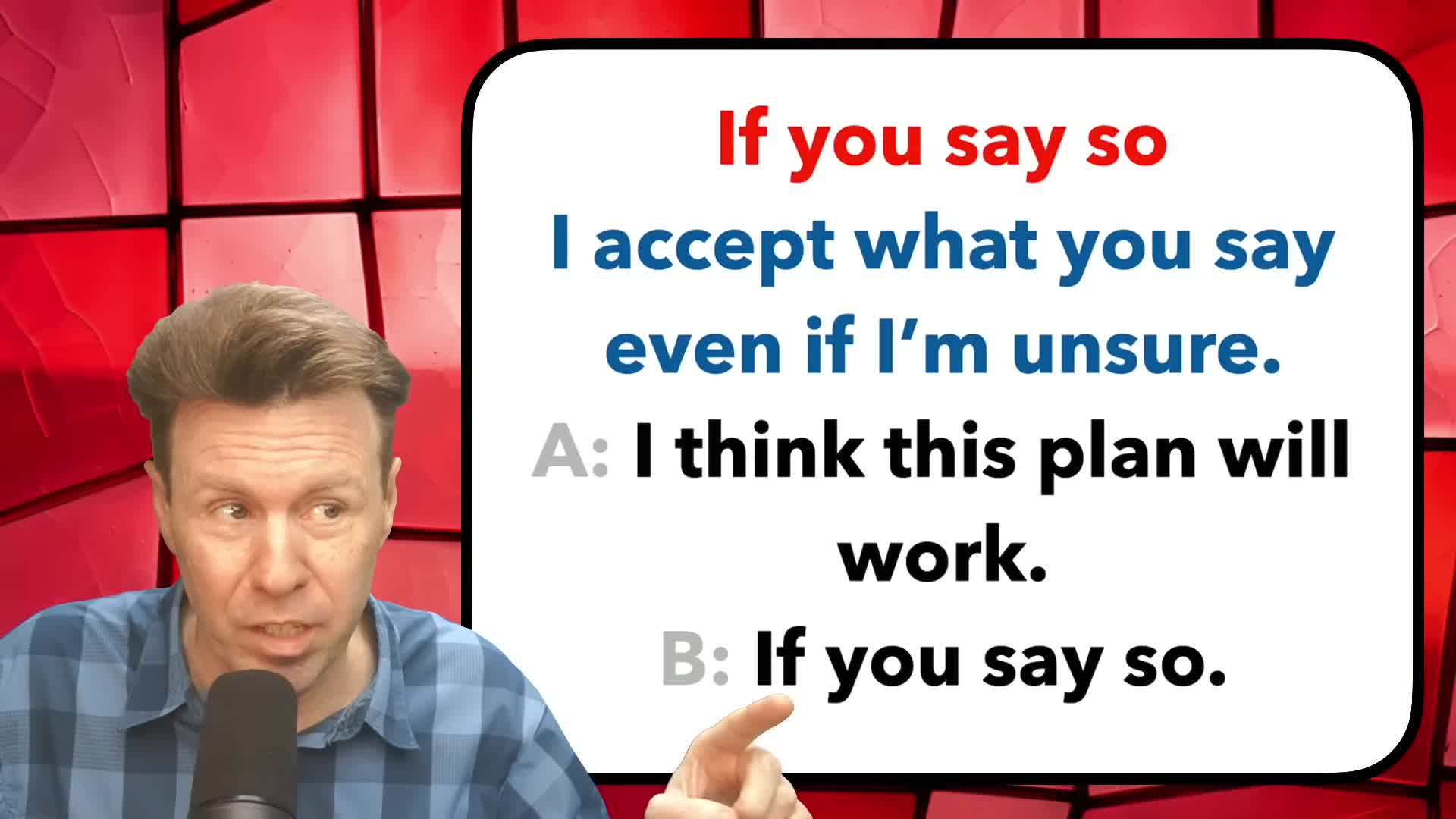
For example, if you say so, if you say so, so that means I accept what you say, even if I'm unsure.
For example, I think this plan will work.
If you say so.
So if this person, if B says, if you say so, they kind of think I don't know if it's going to work or not.
If you say it's going to work, okay, we'll see.
That's the nuance.
If you say so.
Okay, here's the next one.
What I say goes.
What I say goes.
This means I'm in charge.
If I say it, you must do it.
No arguing.
What I say goes.
I'm your father.
What I say goes.
That's how it's used.
I'm the boss.
What I say goes.
All right, touchy, touchy, touchy.
You are easily offended.
I'm sorry you are so touchy.
Be careful what you say.
He's a bit touchy.
Yeah, be careful what you say around him.
He's a bit touchy.
You can go ahead and repeat these example sentences.
And, you know, just keep repeating after me.
Mimic me.
Don't half-ass it.
Don't half-ass it now.
Don't do it carelessly.
If you're going to do it, do it right.
Don't half-ass it.
So if you're half-assing something, you're not doing it fully.
You're not trying your best.
You're not doing your best.
You're just kind of, eh.
You're doing it, but you're not putting your 100% effort into it.
You're half-assing it.
So don't half-ass it.
You can use don't half-ass it or you can say, I was half-assing it.
I wasn't trying my hardest.
Okay, next.
Speak on my behalf.
That means speak for me.
Please don't speak on my behalf again.
Don't speak for me.
I wasn't there and you volunteered me.
Don't speak on my behalf again.
Got it?
Next one.
It takes two to tango.
That means both people are responsible.
Don't blame just him.
It takes two to tango.
It takes two people to do something like that, so it's not just his fault.
Pardon my French, pardon my french.
For americans it means sorry for using bad language.
I'm sorry for using bad language, pardon my french.
So if you said a cuss word, then you would have to say oh, pardon my french.
Like i'm sorry, i said a bad word, pardon my french, but that was a shitty idea.
Shitty is a bad word.
It's a shitty, it's a bad idea.
It's a shitty idea.
I'm sorry about that.
Pardon my French.
And for you French people out there, pardon my English.
Pardon my bad English.
It slipped my mind. slipped my mind.
It means it slipped my mind.
It means I forgot.
Sorry, I meant to call you, but it slipped my mind.
Sorry, I meant to call you.
I was going to call you.
That was my intention, but it slipped my mind.
Okay, good old days.
It's the good old days.
A nostalgic time in the past.
I miss the good old days of childhood.
I miss the good old days when there was no internet.
Do you remember those days?
If you're my age, you remember those days.
To put it in a nutshell, to put it in a nutshell, to summarize it, to put it in a nutshell, I quit.
To summarize everything, I quit.
Well, that puts it in a nutshell to me.
It's like saying to make a long story short.
To make a long story short, I quit to put it in a nutshell.
Yes.
Okay.
As a matter of fact, as a matter of fact, Actually, in fact, I saw her yesterday.
Have you seen her recently?
Well, as a matter of fact, I saw her yesterday.
Have you seen that new movie?
As a matter of fact, I saw it yesterday.
To start off with.
All right, so at the beginning.
To start off with, let's introduce ourselves.
So at the beginning of something, you say, let's begin with.
Let's begin with, to start off with.
All right, that's easy.
From my point of view, in my opinion, from my point of view, it's unfair.
That's easy one too, huh?
You know that one.
To the best of my knowledge, as far as I know, to the best of my knowledge, he's single.
Is he married?
To the best of my knowledge, he's single.
As far as I know.
I could be wrong.
Out of style.
If something is out of, what?
I hit the button.
Out of style.
If something is out of style, it's not fashionable anymore.
That outfit is totally out of style.
So the out of is pronounced out of, out of, out of, out of style, out of style.
The of is contracted out of, out of style, totally out of style.
Okay, never say die.
I think that was a James Bond movie.
It means never give up.
Never say die.
Never give up.
We might have lost this time, but never say die.
Okay, let me do better.
I'm going to pretend I am a coach and I'm in the locker room after a match and my team.
They're all sad and they're like, oh man, we lost.
And then I'm going to say, we might have lost this time, but never say die.
We will win the next one.
How's that?
Say it.
Never say die.
We will win the next one liar liar, pants on fire.
And then the the um all the, the.
I'm still on my on the last one and i'm thinking i'm a coach and i tell my players that never say die.
And then the players say to me liar liar, pants on fire.
It's a childish way to call someone a liar.
He's lying.
Liar, liar, pants on fire.
Liar, liar, pants on fire hanging on the telephone wire.
Children will sing that song.
Okay, next one.
You just say the word.
You just say the word.
And that means I'll do it as soon as you ask.
If you ask me to do it, I'll do it.
You just say the word.
You just ask me and I'll do it.
If you need help moving, just say the word.
If you want me to help you move, just ask me and I will help you.
Just say the word.
You can say that again.
You can say that again.
I completely agree.
This weather is amazing.
You can say that again.
I love it.
All right.
You don't say you don't say this.
You try to say it like, yeah, yeah.
Don't say.
So it means I'm surprised.
Maybe sarcastic.
Okay, this one is often used sarcastically.
Like, she got a promotion.
You can say it like, oh, you don't say.
And that means you're surprised.
Oh, I'm surprised.
Or, I know she got a promotion.
You don't need to tell me.
It's obvious.
You don't say, so it's all in the delivery.
Well, you're stating the obvious.
You don't say next obsessive, obsessive, always thinking about something.
She's obsessive about cleaning the house.
Are you obsessive about anything?
She's obsessive about cleaning the house.
Talkative.
Are you talkative?
Do you like to talk a lot?
My little brother is very talkative.
My older daughter is very talkative.
Very talkative.
She will talk your ear off.
If someone talks too much, they talk your ear off.
Backstabber.
Someone who stabs you in the back with a knife.
Someone who betrays others is a backstabber.
He acted like a friend.
But he's a backstabber.
He will talk behind your back.
He will say things behind your back.
He's not your friend.
He acts like he's your friend, but he's a backstabber.
Okay, next one.
Clumsy.
Drops or breaks things easily.
I broke another glass.
I'm so clumsy.
You are so clumsy.
I'm sorry.
I'm so clumsy.
Believe me.
Believe me.
That means trust what I say.
Trust what I say.
Believe me.
This is the best movie ever.
You've got to see it.
Believe me.
My phone is dying.
That means the battery is very low.
Hurry, my phone is dying.
My phone is dying.
My battery is running very low or my phone is dead.
That means the battery is empty.
It's not working anymore.
Sorry.
I didn't reply.
My phone was dead.
My phone, my phone died.
I couldn't call you.
My battery died.
Oops, I went too far.
There we go.
My phone ran out of juice.
This is the last one I think.
Yeah.
My phone ran out of juice.
That means there's no battery left.
There's no more energy.
You can use this for not just your phone too.
You can say I ran out of juice.
It means I ran out of energy.
So, anyways.
Oh no, my phone ran out of juice.
The battery died.
All right, there you go.
Those were our phrases for the day.
Lots of natural, everyday native speakers use those phrases all the time.
They're very common phrases.
I didn't give you anything weird.
Just commonly used phrases.
All right, keep moving forward one step at a time, and I'll see you in the next step.