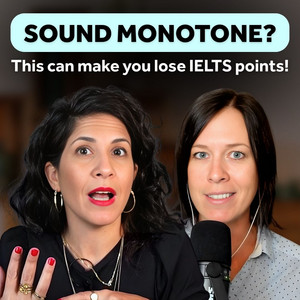
Did you know that speaking in monotone can actually lower your score on the IELTS speaking exam?
And not only that, it can actually impact the way you communicate and perceived by other people.
This is exactly what Aubrey from the podcast All Ears English is going to talk about today.
Aubrey has been an IELTS teacher, a community manager and an English teacher and a podcast host for many years, and she has vast experience supporting students on reaching fluency but also acing the IELTS exam, and today she's going to share a little bit about what she knows about the speaking part in the IELTS exam and how speaking in a more versatile, expressive way can actually boost up your score significantly.
She's going to give you practical tips and share with you some insights that not a lot of people know and whether or not you need to take the IELTS exam.
This conversation is going to be extremely valuable because we're going to talk about monotone, being expressive, feeling confident, feeling fake and all of that good stuff around speaking in English as a second language.
So let's go ahead and listen to the conversation.
Hi, Aubrey.
How are you doing?
I'm great.
How are you?
I'm really good.
Thank you so much for coming here and sharing a little bit of your knowledge and experience with my audience, with our students.
So thank you so much for coming on today.
Absolutely.
Thank you for inviting me.
I am really excited about this conversation.
Me too.
Me too.
So I want my audience to know a little bit more about you.
I have already introduced you, but how would you describe what you do to people who ask you so what do you do?
Right.
And I get this a lot from people who've already asked me, because it is not just I can't just say teacher and feel like that's accurate enough.
Right.
So I'm one of the co-hosts of the Allers English podcast, as well as our other podcast, the Business English podcast, and IELTS Energy.
And I'm also the community manager, so anyone who joins our courses becomes a part of our community.
I host live speaking practice over zoom, which is my favorite part of my job.
It's, you know, a global community, so people from all over the world.
I'm learning about different cultures and languages and i love it so much.
But yeah, I've been with Allers English for about six years now.
It's a small company.
Our goal is connection, not perfection.
So creating those speaking opportunities rather than worrying so much about your English being perfect.
I love it.
Like when I heard it the first time it was after I was thinking of the phrase and I used it in one of my videos communication over perfection.
And then I heard you say that.
I was like, I love this so much because this is really so aligned with what I believe in.
And, of course, your messages and like how you talk about the work is special, like so aligned, and I love that because I think that positivity and, you know, being focused on what really matters is so critical.
But because there is so much out there that focuses on getting it right and don't make mistakes and sound like this and sound like that, that kind of like you forget about What really matters and what really works right.
Because that's what we see and what we have found, right?
I'm a Spanish learner, French learner.
And when I, you know, stop worrying so much about my grammar being perfect and just try to connect with the person I'm talking to.
That's when I really have a great conversation, when I enjoy language learning.
And it motivates me to keep doing the difficult work of language learning, those connections.
So that really, when we see our students embrace that, that's when we see real progress.
I agree.
I love that.
And we'll keep saying it.
We'll keep delivering that message across our platforms.
So you are here today mainly to talk about the speaking part in IELTS exams specifically, how monotone can lower your scores?
And I want to talk about that.
And I think this is such an interesting topic for people who are taking the exam, but also for speakers who want to be better communicators and confident speakers.
So I want to begin by asking you, what is monotone?
Yeah, right?
This is speaking in that flat tone, without changing your pitch, without drawing words out for emphasis, where I might just say you know, if on the IELTS test, for example, I'm asked about a recent movie I saw, and I just respond I went too wicked at the movies.
And I'm just speaking in a very flat tone.
A lot of IELTS students don't realize how that can affect your pronunciation score.
Because right in the scoring system, you're required to vary your tone, vary your intonation.
And like you said, Hadar, just for everyone in a conversation, that monotone is hard to listen to.
It's easy to let your mind wander, because the pitch changes.
Is what's grabbing your attention, what's showing emotion and expressiveness?
So in the same way that you don't want to use that phonetic.
This is so interesting because I didn't know that.
Well, I'm not, you know, deep into exam prep and work and all of that but, like I definitely support my students who are studying for the exam and preparing for it.
And that I know it's not a part like it's not something that they think about when preparing for the speaking part, right?
You think about fluency, you think about your vocabulary, you think about being accurate, but not so much about how varied your pitch is.
So it's really good that you're saying that.
Before we go into how that impacts and maybe what to do about it.
Why do you think people tend to gravitate towards like a more monotone speech or flat intonation?
I think it's the first thing to go when we're focused on what you were saying interesting vocabulary, the grammar we're using.
There's so much that we have to think about when we're having a conversation, trying to use that vocabulary.
We've been learning that sometimes we just don't think about the tone.
Are we using a monotone?
I have too many other things to think about.
Not only that, your first language might have a very different tone and pitch than English.
It might not feel natural to you to change your pitch in this way.
That's totally fine, right?
And in most conversations with loved ones, with friends, they're not really going to mind if you use a monotone.
They know you, they love you, they maybe expect it.
But on a test, or maybe with a new conversation partner, someone you're meeting for the first time.
That's when this is something to think about in addition to vocabulary and grammar.
The tone is what could really create a good first impression, right?
Could build your network if you're working where someone feels like you care more about the conversation because they can hear it in your tone.
Talk to me more about that, because I think it's really important, not just for the task but like in general, in communication.
Why do you think people feel like you care more if you vary your tone?
It's a great question.
So, if you think about it, if you're using a monotone, if you're talking about something you're excited about or sad about, no one would know, unless something about your facial features or your gestures shows that, because that's how we express emotion is with that change of pitch, that change of tone.
We'll sound a little more sad or hurt about something.
We'll sound more excited about something when our pitch is raising, right?
It's all about our tone of voice.
It's actually pretty difficult to stay in a monotone when you're excited about something in your first language.
But in a second language.
There are so many other things you're thinking about that you might not realize that the message, the emotion, isn't being conveyed if you're using a monotone.
Right.
Yeah.
So I want for people who may not still be 100% clear about what that sounds like.
So for example, if Aubrey would were to ask me, Hey, how was your ask me a question?
How was your day yesterday?
How did it go?
Yeah, it was really OK.
Like I went to my friend and I saw her and I haven't seen her in a long time.
So it was really interesting.
And we talked about a lot of important things.
That is a perfect example.
Would you say that was monotone?
Right.
And I have no idea if you hated the experience or loved it, because there's no change of tone or pitch to convey emotion about it.
And it might even sound like I'm angry at you or something, right?
I'm just like, yeah, I don't want to talk to you.
You know, like, do you even want to have this conversation with me?
Am I the problem?
It's just the exact no, but like, for example, I could say yeah, I went to my friend and I saw her.
We talked a lot about a lot of interesting things and it was really great, you know?
I think I also used like a more positive vocabulary when I lifted my pitch automatically because I was already getting excited just by the pitch.
Yes, and that's something I want to get into about the IELTS exam and everyday speech that it's actually really hard to not use a monotone if you're not using any descriptive language, any interesting vocabularies, because then vocabulary, what words do you emphasize?
Yes, you want to emphasize content words, but if you really want to share excitement or that something was terrible, You need some interesting adjectives to emphasize, to draw out, to give space in order to really convey those emotions.
I love this and I didn't think about it, but like, it's really hard to say it was amazing.
You know, like just the word amazing and monotone, you can't, it's like, it was amazing.
You want to lift it, right?
Exactly.
Right.
Or imagine you want, you say it was super amazing.
What?
No.
Right.
We're adding these maybe kind of slang adjectives, especially in part one of the IELTS exam where you need slang.
You need that more informal vocabulary and you want to add these more slangy adjectives like super way, totally.
And that and you want to hit them.
Right.
It was super awesome.
And draw out those vowels.
Let's talk about the exam, because I know a lot of my audience and students.
They need to prepare for it and they need to take it in the future or to retake it.
Tell me about the speaking part in the exam.
What are they looking to see?
Just like that one very good example that you gave.
And also, how do you connect this idea of speaking with versatility and variety?
Yes.
So right in the scoring system.
It's very important that you're familiar with the scoring system of any exam you're taking.
But for speaking exams, this is usually in the scoring system.
And the way IELTS words it is that the IELTS speaking pronunciation score.
So this is about the pronunciation score, right?
There are four different scores pronunciation, fluency.
Fluency and coherence, grammar and vocabulary.
So the pronunciation score, you should be able to get a nine, right?
Some of these other scores might be a little lower.
Most people score a seven on grammar, but if you can get a nine for pronunciation, that's going to pull up your overall score right.
So part of it is the use of stress.
And then they have in parentheses emphatic slash, contrastive stress and intonation to enhance meaning.
And the examiner is listening for that, is looking for that.
And for your band eight or nine, you must have flexible of all of that.
Flexible use of stress and intonation.
You can have occasional lapses.
And then band six, some effective use of intonation and stress.
And then seven.
I also like to do this where one band will say displays features of you know, because the band six has several things.
It's not just about intonation, of course.
It's also about your phonemes being correct.
You know, it'll say a range of phonological features.
So there are several things they're looking for.
But if you don't have varied intonation, you cannot score even a six for the pronunciation score.
Wow.
Can you give an example of that idea of stress using intonation to stress words?
Yes.
So it's a lot about what we were saying, right?
If your stress, your intonation should match what you're saying.
So sometimes you will tend a little more toward monotone.
If you're talking about a funeral or something that was very sad, your voice might lower a little more to emphasize those more serious emotions.
Or part three of the exam where you're talking about societal issues.
If you're talking about crime rates in your city, you should not sound excited.
Right, your tone should be appropriate to match that answer.
But especially on part one and part two, where you're describing or talking about interesting, exciting things, what you do with your friends and what types of foods you like your intonation should not be flat and monotone, because in a daily conversation it would not be.
And the IELTS examiner is looking for your tone to match that.
What you're saying, the words you're saying, right?
So your syllable stress and your word stress needs to be appropriate, but also the words that you emphasize, which content words, which adjectives, or are you emphasizing them at all, is vital.
It needs to be natural as they say, but it needs to fit your answer.
It needs to fit what you're saying.
I can totally see that.
And that is what I expect.
I would support my students even without the exam.
This is what good communication is.
So I can see why that's what they're looking for.
That's the thing because the examiner is looking for good communication.
So this is definitely not just for IELTS students, anyone learning a language.
You want, you know, that good communication, interesting conversations.
You want people to want to speak to you.
And a lot of that is varying your intonation, allowing emotion to show, slowing down when needed to emphasize certain words, because that's a big mistake IELTS students make.
You're nervous when you're taking a speaking test.
You might speak very quickly and run all of the words together, and words that you're going to emphasize or raise your pitch need a little more space.
You need to slow down a little bit to give yourself that chance to emphasize interesting adjectives and content words.
I think in general, I agree with you.
And I think in general, when people feel nervous, not only that they speed up and then they don't kind of like land on the words that they want to emphasize.
Right.
Or they don't take breaks.
I think it's also like a pitch killer.
Like your pitch immediately drops because you feel so scared and you don't want to feel vulnerable.
And pitch is kind of like exposing you in a way and changing your voice, especially if you're not used to doing it in your first language.
Right.
So I think the mindset part is, plays a huge part in people's ability to sound more expressive.
Absolutely.
This has to be practiced, right?
This is vital.
It's Yes.
It's one thing to know how important it is to understand the scoring system and know that you have to vary your intonation, raise your pitch, show emotion.
But if you haven't practiced it and you go in on test day and you're a little nervous...
It's impossible, almost impossible.
It would be so difficult.
So this is something you want to be very proactive about practicing it, both in conversations with speaking partners.
Just if you're summarizing a podcast out loud just to practice speaking it, you've got to do it then, right.
When you're answering practice IELTS speaking answers, you have to do it then because you need to get used to thinking of this interesting band nine high-scoring vocabulary using the grammar that you've been learning and also all of the pronunciation features. you know how is my word stress am i stressing the correct syllable am i this you can't have to think those things on test day you have to have practiced it so that you can go in and confidently raise your pitch when you need it emphasize the words you know should be emphasized emphasize the correct syllable that's got to be second nature by the time you take the exam or it'd be really difficult to do it when you're nervous and really just trying to think you know what is my opinion about some of the difficult questions you're asked.
So you're saying basically that when you get to the text you should have practiced it by then, because otherwise it would be really hard to perform well on the day of the exam?
Absolutely.
And just like for a conversation, right?
When you, let's say, you meet someone for the first time in English at like a conference, a work conference.
And so the stakes are a little higher.
This is maybe an important person for you to network with.
You know that it could be a valuable relationship.
In the same way you'll that nerves are going to kick in a little bit potentially.
If you've never practiced having a conversation with You know having that small talk conversation.
In the same way, you might struggle to come up with the vocabulary and use the grammar that you have learned and also vary your intonation.
This has to be practiced ahead of time, whether it's for regular conversations or for an exam.
And do you have any tips on how to practice it?
Yeah, great question.
So yes, when you're answering IELTS speaking answers, record yourself.
So when you're trying these yeah, the raising the pitch and all of the things you know you should be doing then listen to it back and really pay attention.
Almost diagram your sentences, which were the adjectives, which were the content words.
Did my pitch change?
Can I hear emotion?
Get feedback on those recordings from a speaking partner or a teacher, because you might not always be able to hear it yourself.
If you're like, yeah, maybe I can hear some changes, get a second opinion from someone else.
And if they say no, this is monotone and you're just not realizing it.
The other thing you can do is compare it to if you find someone who speaks in an interesting way.
Hadar is a great example.
Any of your YouTube videos.
Compare your recording to Hadar's recordings or Oller's English or a TED Talk where someone speaks in a really interesting, engaging way.
Does it sound different?
What words are they emphasizing?
How is their pitch changing?
Are they right?
Then you're going to start recognizing it in your own answers.
So that's the first step, is to be aware of if your intonation is varied, if it's correct, as you would say, if you can hear emotion.
And then, once you have done that, once you can recognize it in your own language, then it's just a matter of repeating that, doing that again for the next answer, right?
And you can isolate skills.
It's really smart when you are aware of everything that the examiner is listening for in your pronunciation score.
Listen to it and just look at syllable stress, right?
And compare that to what it should be.
Am I emphasizing the wrong syllable, right?
Is my word stress correct?
Then listen to it again.
Can I hear emotion?
Is my pitch?
Changing and isolate these skills.
Listen for specific things, practice specific skills in isolation, then put it all together.
And you'll be confident about those individual skills because you know you've mastered like that one part of the pronunciation score.
So two things I love about what you said.
One is, first of all, recording yourself.
People try to avoid it as much as humanly possible, but I think it's such an effective tool.
So important to use it.
And it's important that you know how you sound and to be able to give yourself feedback.
So yes.
But also practicing different skills in isolation.
That's huge because I noticed that when people try to focus on everything, they focus on nothing.
And when you are able to focus on one thing, you're very intentional about it.
That's how you start making changes.
Whereas when you try to think about everything, then it's a little bit of this, a little bit of that, but not a lot of impact.
I teach my students to do that when shadowing as well, because they focus on their intonation, their rhythm, vocabulary and all these different things, but not everything at once.
So practicing for the exam or in general, you know like, if you want to be more expressive, Such a great, Exactly.
And shadowing is so useful for exam prep as well, but also regular conversations.
That conversation you're going to have at a convention.
If you've done quite a bit of shadowing, you're going to be so much more confident, whether you're taking an exam or speaking to someone for the first time.
And especially in those high stakes situations where we just have to admit there likely will be nerves involved.
That's when it's tough, like it's pretty easy with a speaking partner you're super confident with, or if you're alone in your room just practicing.
But in those high stakes conversations or a test that you've paid money to take maybe you've taken it multiple times, you have to recognize i probably will be a little bit nervous.
I need to have practiced this ahead of time to the point that i'm really confident.
Confidence is really what helps you overcome those nerves.
Yeah for sure.
So, speaking of you know, confidence and in the context of intonation and porosity, work.
So I feel like I don't feel.
I know that a lot of my students feel fake and when they try to expand their intonation.
So they tell me, like, I want to be more expressive.
I want to vary my pitch, especially if it's not something that is common in their first language.
Maybe their first language is, you know, it's like a little bit more monotone.
So there is no right and wrong.
Different languages have different behaviors, different sounds, different intonation patterns, right.
But what you're saying is relevant for American English.
And you know, like, this is what we're focusing on in English in general.
So what would you say to students who feel fake when trying to speak in a more expressive way?
Well, first of all, it's okay to feel fake, right?
Or to feel unnatural.
Because when you're first doing this, especially if you're taking the test for the first time, this is very new right.
You have to put in effort.
And in your first language, you don't have to put in effort when you're having a conversation.
It just comes.
Everything is just natural.
It's easy.
You've been doing it your whole life.
Anytime when you're putting in a lot of effort, you've kind of it feels a little forced, it feels a little fake.
So of course you know, allow yourself to feel that and recognize it's very natural, you're not alone.
But then the more you practice every time you practice answering an IELTS speaking question the less it will feel fake, the less it will feel unnatural, because now you're starting to be comfortable with the rhythm, with changing your pitch.
It starts to feel less and less fake because you've done it more, you've practiced.
You're having this sort of voice in English that is different from your voice in your first language.
It will be different.
You sort of have to create this new persona.
And maybe especially for the IELTS exam, where you're required to vary your pitch, you may have to almost be feeling like an actor, right?
Right.
I'm doing this because I know the score requires it.
It's not really me.
That's OK.
The examiner doesn't care.
It doesn't affect your score, how you you are.
Right.
So you may need to.
Yes, exactly.
Step out of your comfort zone and have this new voice, this new persona.
Or, as the same actors probably feel so fake at first, but then they do it a lot and it starts feeling very natural to act.
Yeah.
And I think that's the thing.
Like, everything that is different from what you've been used to is going to feel fake and it's going to be feel artificial.
And I think what you're saying really is essentially it's not bad.
Like feeling fake is not bad.
It's just a sign that you're doing something a little different.
And if you don't let that hold you back or make you feel like you're doing something wrong, there's a lot of opportunity in that experience, right?
And I love the fact.
You know, when I studied linguistics, my teacher said that people who are bilingual have two facets of their personality in those two languages.
So it's almost like things that you can express in one language.
You can't express in another language because of you know, like the cultural aspect or the experience that you've had in that language.
And and I think that if you allow yourself to think, OK, I'm going to tap into my more expressive self, I'm going to tap into my person that is outgoing, let's say extroverted part of my identity.
Right.
Like I think that could happen.
That could be exciting to discover it like that.
And it's interesting.
I'm thinking about that situation at that conference again.
It is so tricky because you do want to be your authentic self, but you also want to create a good first impression.
Grab attention, give them a reason to want to speak to you.
So there is sort of this tightrope you're walking between all of those things you're trying to do and going too far, being like over the top and feeling not authentic, right?
So this is something that would need to be practiced.
Luckily for the exam, that's not the case.
You're not trying to create this first impression and be your authentic self.
You can focus more on.
I just need to get the score I want so that I can immigrate, so I can start my master's degree.
And so luckily that stress isn't there.
Right.
It's all about just doing what the scoring system is requiring of you.
Then it doesn't matter if the examiner thinks you're your authentic self.
So that's one stress, at least with the test practice that you don't have to worry about.
Yeah.
Yeah.
I love that.
Anything else you'd like to share?
Any other piece of advice or just like something to think about for students who are about to take the exam or who are struggling with being expressive in English?
Yeah, I would say it's really difficult to prepare for an exam like this without some kind of coach or teacher.
And we do have quite a few students who come to us who have been working with like a TOEFL teacher or just like an ESL teacher.
And there are so many things that are specific to each exam, and getting feedback from someone on both speaking and writing like IELTS essays, for example, someone who really knows the test well is really vital.
And it's not enough to like post your essay online and get feedback from maybe other IELTS students.
You need to trust that the feedback you're getting really is accurate and and is preparing you and the confidence that that gives when you have an IELTS expert.
It's sort of like taking the test once and getting feedback, but often you just get a score.
You don't know what exactly gave you that score.
You need specifics on what you could improve, how you can get a higher score the next time.
So this is really vital.
I recommend to everyone out there.
It will cost more for you to take the IELTS exam a second time than to hire someone who knows what they're talking about to give you feedback before you take the exam.
So I highly recommend find a course or a teacher, someone who can give you feedback on your speaking and writing before test day.
It's really, really important.
And that is a good reminder that it's a skill to pass the exam.
And if you fail the exam, it doesn't mean that you're not fluent, that your English sucks.
It's just like you don't know how to pass the exam.
And you need to learn specifically to do that, which is why I agree.
Like if I were to take an exam let's say, if I were to take a Spanish speaking exam I would take someone who knows exactly how to pass an exam and not just like a general teacher, because that is my goal.
I want to get it done for sure.
And of course, boosting your fluency in general is essential because it's a life skill.
And that is also essential for the exam.
But I agree.
I think this is something important to remember, especially in the aspect of failing just means that you need to learn how to answer and what to answer, and all of that.
That's such a good point.
I'm glad you brought this up because I do feel like a lot of students take IELTS once and then are really discouraged.
And they do feel like it's a sign about their fluency.
And often that's not the case.
We'll start working with someone and realize it's more not understanding the scoring system, not having received feedback on speaking and writing, so you don't know what to change.
There are specific things that examiners are looking for.
And if it's missing, as much as they want to give you the seven or eight you're looking for, they just can't because they have to follow this very specific scoring system.
Exactly.
So yeah, it's really important.
You know, we of course have a course, but IELTS energy is a great podcast.
We share tips.
You know two new episodes every week.
You know.
Find an IELTS specific podcast, for sure, but also a course that has strategies so that you can get the score you need.
Yeah.
But like you said, Hadar, it's not just about the test, right?
Anytime.
If you feel like you're not as fluent as you would like to be often, just don't get discouraged.
Don't feel like you know your plateau.
There could be something very specific that's missing, that you could do to change things, whether it's to get a score or to be building the connections you want in English.
So there's a lot you can do.
Don't get discouraged.
Don't feel like I've tried everything and plateaued.
There's definitely new things you can try, new skills, new strategies.
Switch it up so that you can stay motivated.
Yeah, for sure.
And that is the most important thing like to stay motivated, to keep enjoying this work, because otherwise it's so easy to quit.
And we don't want that.
That's not going to help your fluency.
Especially test prep, but any language learning.
It's so easy to, and not even quit.
It's like soft quitting where you're like, I'll do it tomorrow.
And suddenly six months go by and you haven't done anything to work on your language, right?
Yeah.
Yeah.
We're going to link everything to the show notes and description, but if you don't mind, sharing again all the places where people can find you and the podcasts and all the courses.
So let us know.
Absolutely.
So the All Ears English podcast for general fluency.
We have five episodes a week and they're short.
They're very digestible, 15 minute episodes.
And Hadar will be on one very soon.
It was an amazing conversation.
So don't miss that.
And then the Business English podcast, if you work in English, we just had our 500th episode.
And IELTS Energy, if you're preparing for the IELTS exam.
You guys are so prolific.
I'm like always blown away by it.
I love it.
I love the work that you do and you put out there.
We do a lot of podcast recordings during the week, but it's so fun.
We love it.
So I look forward to it every week.
Oh, that's so cool.
All right.
So Aubrey, thank you so, so much.
It's been a pleasure talking to you and thank you for all the valuable tips and the advice.
And I have no doubt that this has helped so many of the people watching.
So thank you.
Thank you.
Thank you so much.
Yes, I hope so.
Thank you, Hadar.
Thanks for inviting me.
This was really fun.
Thank you.