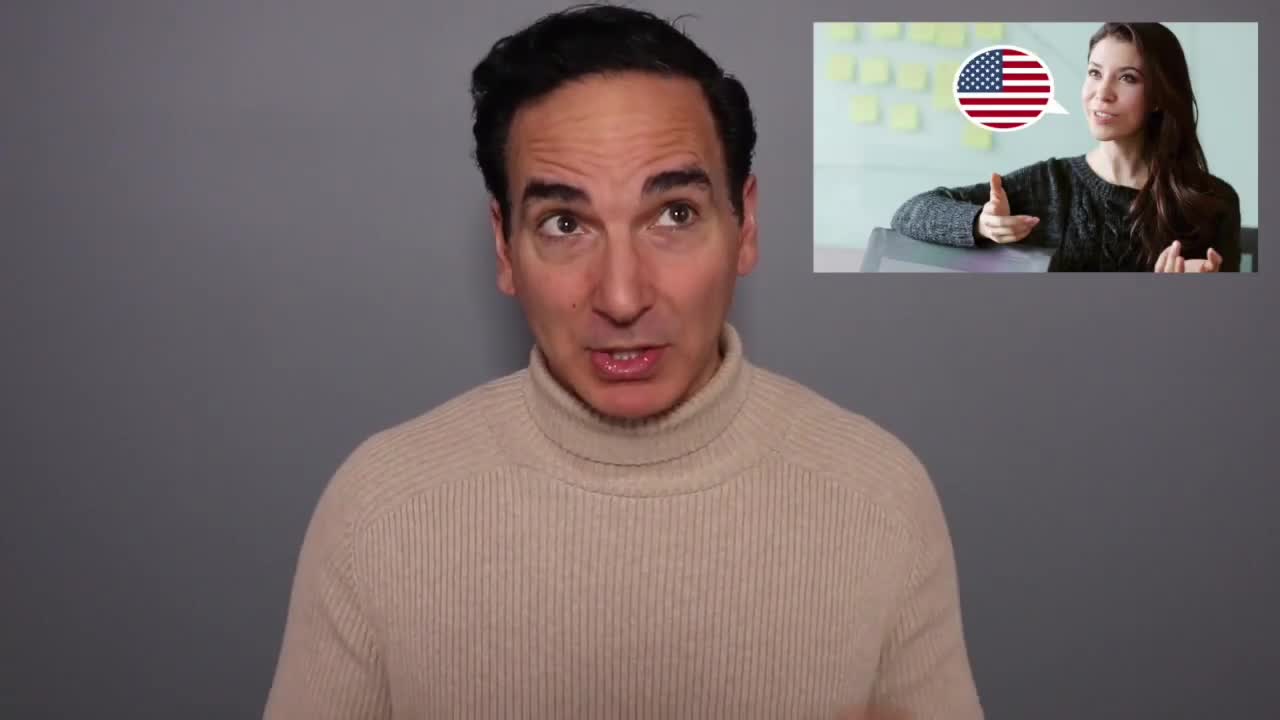
I don't understand.
I work on my American accent.
I feel like I got a good grasp of it.
But then when I go out and I talk to my American friends, they're talking super fast.
How am I possibly able to keep up with that speed?
On this video, I'm going to teach you the secret of speaking faster American English.
Hi there, I'm Gabriel Barofato from GB Voice Academy.
If you haven't yet, subscribe to my YouTube channel so you can get access to all of these videos that I put out on a regular basis.
I've also left a link to my five-star best-selling action production course down below, as well as links to my other five-star rated communication courses that will help elevate your communication skills to the next level.
Let's not get seduced by this idea of speaking fast American English.
I'm going to refer to a musical term called legato.
This is a term used when singing a phrase, it's like a string of words connected to each other.
Well, it's the same situation when we're talking American English.
What you notice is, when these words are connected together, a lot of sounds are eliminated, making it easy to transition from one sound to the next.
And it's that flow of sound that we're gonna be working on in this video.
Let's start with this one.
What are you, what are you?
Yes, that's how it's spelled, but if we were to add that into a sentence hey, what are you doing tomorrow sounds a little too proper.
You could obviously tell that i'm not that familiar with american english.
If i were to say it that way, instead of what are you, that phrase is reduced to what do you, What are you?
What are you doing tomorrow?
You hear that?
Versus, what are you doing tomorrow?
Let's break that down.
What are you?
Now let's put the emphasis on the what.
What are you?
What are you doing tomorrow?
You hear that?
If we were to try to speed up the way it's properly said, what are you doing?
It kind of sounds like we're doing a funny play.
Good, let's look at some other examples.
Stick with me because at the end of this video we're going to be doing a fun quiz to put together all of these reduced American sayings.
That's going to help you retain the information I'm teaching you.
Many youtubers out there that like to chit chat and talk that stuff can go right over your head if you don't implement it into practical exercises, which we're going to do at the end of this video.
I'm going to i'm going to go to the store.
Now try saying that fast.
I'm going to go to the store.
So let's find the reduction to that.
I'm gonna.
I'm gonna.
I'm gonna go to the store.
See how easier it is to say that fast?
I'm gonna go to the store.
Versus I'm going to go to the store.
Good.
Let me.
Let me.
Let me see what I can do.
Does it sound like a relaxed American talking?
Let me see what I can do.
Let me.
Let me.
So we notice that T is gone.
Let me see what I can do.
Easier, isn't it?
And we can very easily speed that up.
Let me see what I can do.
Versus let me see what I can do.
So you notice that the T's tend to get eliminated.
The T's seem to be that sound that trips up when you're trying to speak fast.
Let me lemme.
To create that t sound takes a lot of effort and it's sort of like a big bump in the road that's stopping us from trying to smooth out that sound.
You're starting to see that pattern right, you're moving on.
Want to want to come check it out.
Try saying that fast.
Want you to come check it out?
Again, it's that T. It sort of trips us up, doesn't it?
Well, let's reduce that to wanna.
Say that a little faster.
Wanna.
Implement that.
Wanna come check it out?
Again, T, gone.
Reduction.
Easier.
Next one.
What is up?
What is up, John?
Now, that obviously sounds like we're not native speakers when we say that.
What is up?
Sounds like a robot.
What is up versus what's up?
What's up?
So you notice the T is not eliminated in this particular example.
In this case, we add that T to the S. So it's .
Try that with me.
It's kind of like when a bus is opening up a door.
What's up?
Again.
What's up?
You hear that?
Now try picking up the speed on that.
What's up?
Pretty simple, right?
Hey, what's up, John?
A lot smoother.
A lot more legato.
Remember that word.
Here's another one.
What is that?
What is that?
Hey, what is that you are looking at?
You can hear those T's, right?
You've seen enough American television to know that when you hear those T's, it's a dead giveaway that we're not native speakers.
Again, let's get rid of those T's and reduce it to this.
What's that?
There's that thing we were talking about earlier, right?
What's that?
What's that?
It doesn't feel right or sound right when you say it on its own, doesn't it?
It feels really weird.
You're like, are you serious?
This is what they say.
But in reality, this is what it comes down to, what they reduce it to.
Try it in a sentence.
What's that you're looking at?
Speed that up.
What's that you're looking at?
What's that you're looking at?
See, when you put it into context with the sentence, you're like oh yeah, this is something I've heard in American television and movies.
What's that you're doing?
What's that you're looking at?
What's that name again?
You hear that?
What's that?
What's that?
Trying to.
There are those tedious T's, right?
Trying to.
I'm trying to get this done by tomorrow.
It does sound articulate, but you would only emphasize T's if you're doing a play.
You're on a stage trying to articulate these words to an audience of over a thousand people.
Then you have to land those T's.
But in everyday conversation, it just wouldn't sound natural.
Trina.
Tryna.
Feels weird, right?
It's like we're saying China.
But if you put it into a sentence, I'm trying to get this done by tomorrow.
I'm trying to... trying to... I'm trying to get this done by tomorrow.
Good.
Stick around because at the end we're going to do a fun quiz.
We can see if you could identify which one of these reduced phrases to use.
Next one.
Come here.
Come here.
So what would be the thing that gets in the way of speeding that up?
Hey, come here.
Hey, come here.
It's that H.
That H is sort of like a big bump on the road, making this a difficult thing to legato through.
Come here, come here.
Versus come ear.
Come here.
Come here.
Come here.
Come here.
Check this out.
You hear that?
Once we realize the ongoing pattern of getting rid of those sounds that stump us, stop the legato flow of these phrases.
Once your body, once your muscles start getting used to that, then you're automatically going to be able to find these patterns on your own when you're speaking and it makes it easier to try to catch up to their speed.
Now, I'm going to give you a few sentences.
Your job is to see which one of these reduced phrases to use.
Pay close attention.
Let me ask you, what are you up to this weekend?
Doesn't sound very natural.
Let's see if you can reduce that first one.
Let me ask you.
That's right.
Let me ask you.
Remember that from earlier?
Let me ask you.
How about the next one?
What are you?
That's right.
What are you?
What are you up to this weekend?
So now let's put it together slow and then we're going to speed it up gradually.
Let me ask you, what are you up to this weekend?
Let's see if we could speed that up.
Let me ask you, what are you up to this weekend?
Now let's match the speed of these American speakers.
Let me ask you, what are you up to this weekend?
It's a lot easier, isn't it?
There's no stops along the way.
It's all about legato sound flow.
You just learned a fun Italian term.
Next one.
Can you come here for a second?
I'm trying to figure out this schedule.
What's that first one?
Come here.
There's that big barrier.
Come here.
That's right.
Come here.
Come here.
Can you come here for a second?
Good.
How about this next one?
I'm trying to figure out That's right.
I'm trying to.
Remember that one, that weird one?
I'm trying to.
I'm trying to figure out this schedule.
All right, let's do it again with these reductions.
Slow and then eventually speed it up.
Can you come here for a second?
I'm trying to figure out the schedule.
Good.
A little faster.
Can you come here for a second?
I'm trying to figure out the schedule.
Awesome.
Let's do it in real time.
Can you come here for a second?
I'm trying to figure out the schedule.
Sounds just like the things we've seen on American TV and on television shows.
Next one.
What is up?
I'm going to head over to the bar for a drink.
Wants to come?
It's pretty obvious what's in the way there, right?
What's that first one?
That's right.
What's up?
There's that from earlier.
What's up?
What's the next one?
That's right.
I'm gonna, I'm gonna, I'm gonna head over to the bar for a drink.
How about the last one?
That's right.
Wanna come?
Tea?
Gone.
No tea.
Let's try it again with all these reductions.
Slower, then speed it up.
What's up?
I'm gonna head over to the bar for a drink.
Wanna come?
A little faster.
What's up?
I'm gonna head over to the bar for a drink.
Wanna come?
Let's do it in real time.
What's up?
I'm gonna head over to the bar for a drink.
Wanna come?
Now, even though we're starting to identify these reduction patterns, to get to that fast speed, we still have to practice, like I teach you in all of my videos.
But identifying these reductions makes it easy to attain that level of speed.
Last one, here we go.
What's that first one?
That's right.
What's that?
What's that girl's name?
What's the next one?
I want to.
I wanna.
Let's do it again with those reductions.
Slow first.
What's that girl's name?
I wanna ask her on a date.
A little faster.
What's that girl's name?
I wanna ask her on a date.
Let's do it in real time.
What's that girl's name?
I wanna ask her out on a date.
When you get to that level, it's pretty fast.
But there's no way we could achieve that speed if we have those T's and those H's in between to stop that legato flow.
So once your muscles get used to that, eventually you'll get to the speed of your fellow American speakers.
Fantastic work.
Follow me on my social media platforms so I have other ways to get my information to you.