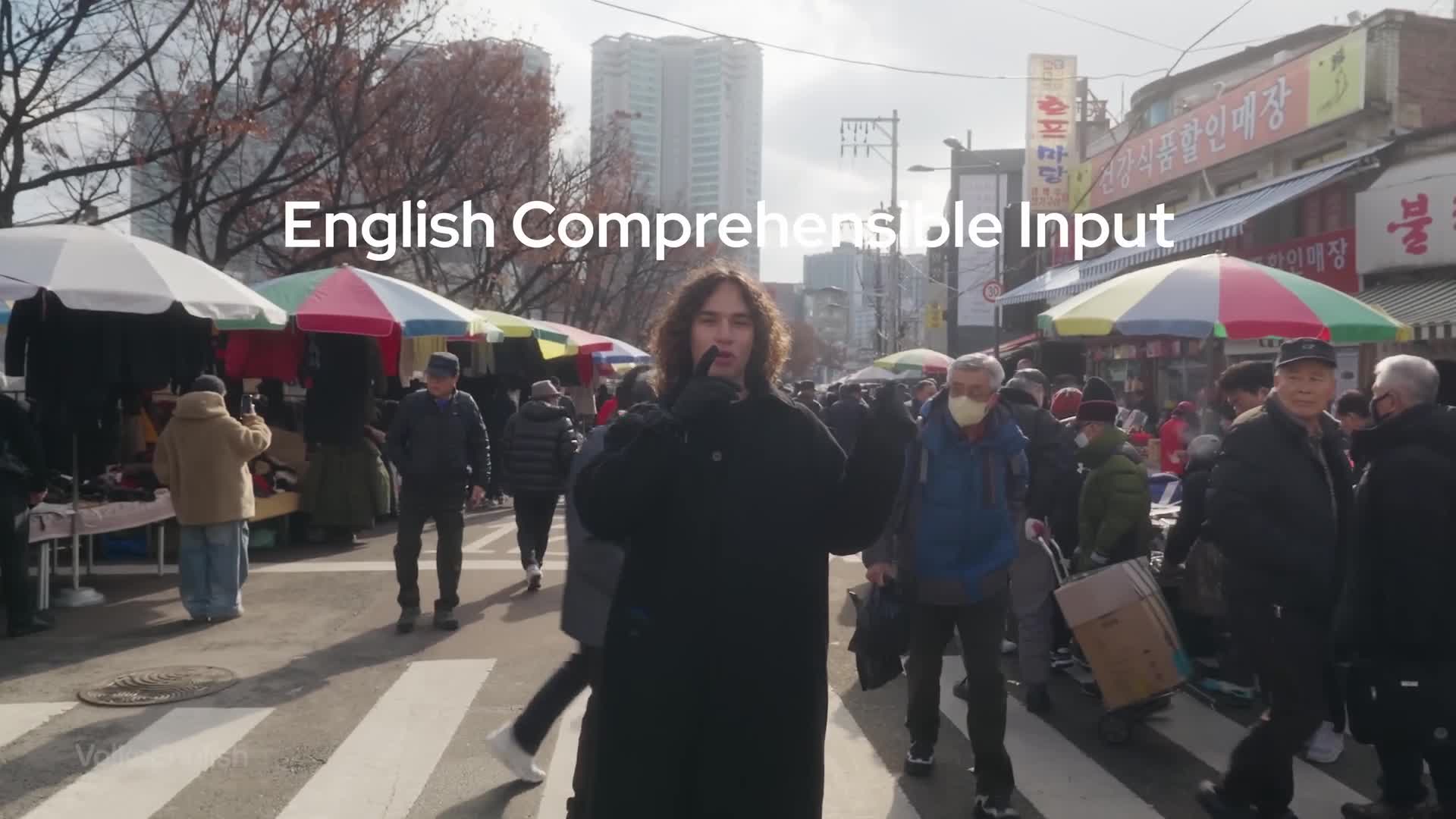
Welcome back to a new video, guys.
Today, we're learning English while shopping at a flea market.
You can think of cameras, deals here, your turtleneck, a bomber jacket, a jewelry store, a vest, a cardigan, big shrinks fleece, coveralls.
Dig in.
The star of the show.
Start the word count and let's go.
We're going to try to find five different items.
A trench coat, a cardigan, a turtleneck overalls, and the last thing we're looking for is a bomber jacket.
We'll try to find that today.
Here they have a lot of belts.
What about some genuine Oakleys?
So a flea market is just a market where you can buy really cheap items or cheaper items.
They're not necessarily lower quality, but they are cheaper.
And they also sell like all different kinds of items like electronics, clothes, bikes, parts.
They sell pretty much anything you could think of, pots and pans.
Let's try to look for those five items.
You'll only know what those items look like when I find them.
So if I don't find them, this guy just sells socks, lots and lots and lots of socks.
We're not actually looking for these, but this is a fedora hatch.
I used to have one when i was younger, but it's not really my style.
Are you sure who even wears fedora hats?
You did when you were younger.
Italians who historically, where it came from?
Fedora hat?
I think it was like italians, like the mob and stuff.
Yeah, i don't know, i feel like that's like an italian thing.
I'm not sure, though.
Oh, look at these cameras.
Oh camera, that's better than what we're running.
These are like film cameras.
Eh yeah, oh no, they're digital cameras, are they?
Yeah, got a little gopro session there.
Look at this little samsung camera.
Oh, and they have, like what, a dvd player so you can put a dvd in here and watch it from right there.
Yep wow, i've never seen that.
Oh, and a psp.
That's crazy.
Why would you want to actually play games?
Or just as, like a souvenir, you never even played psp when you were younger.
Did we ever have one?
No, never.
We had a Wii.
A Wii is just like a gaming console, and a PSP is also a gaming console, but it's like portable.
Okay, here they have the piles of clothes.
I wanted to see this.
I think you get good deals here.
You just like have to search through it and grab something.
Find your size.
Let me check out this.
Maybe we'll find the bomber jacket here.
Oh, they got my rain jacket?
No.
Yeah, you could wear that in the rain.
Ooh, almost a cardigan.
They have like piles and piles of clothes, and these are a lot cheaper.
But you could also go to like stores that are more organized and those are a little bit more expensive.
Well, there's piles everywhere, but most of them are on hangers.
Like, you see these, you can get a North Face jacket.
I wonder where all this clothes even comes from.
Do people like donate this stuff?
Dude, people in Korea get new clothes every season, so it's gotta go somewhere.
I wonder if I could find a rain jacket.
I don't know if it'll be real though.
There are a lot of fakes here.
Oh, there's the turtleneck.
That one right there.
The neck is folded, yeah, with the heart.
The neck is folded up right now, but usually with a turtleneck, the neck is folded down.
And it comes up high and it folds down, but that's a turtleneck.
Okay, one down.
They got the Carhartt hoodies and leave.
That's kind of like a bomber jacket.
Yeah, i'd say so.
Oh no, that's a bomber jacket.
Oh yeah, those are all.
Actually, this is kind of a sick jacket.
That is a bomber jacket, like literally exactly what a bomber jacket is.
This is similar to a bomber jacket but that's a bomber jacket.
But i like this.
It's a little small, though.
Oh dude, look at these bags.
That's like kind of nice.
Yeah, it looks like they recycled it.
Oh, that patagonia fleece, dude.
Stone islands is wait.
And they got a montclair jacket, dude.
And they got the prada back there bro, they got everything, dude.
They got all the jackets.
They've got Gore-Tex there.
Is that what you need?
Yeah, I keep on seeing videos of people on TikTok that bought Gore-Tex jackets from Vietnam.
They test it out if it's waterproof.
It's like waterproof for like the first three wears.
And then after that, completely normal jacket.
Okay, so we found two items.
The bomber jacket and the turtleneck.
What's left then?
The trench coat.
You have a trench coat on right now.
No, trench coat has a belt usually.
Oh, i mean, you can consider this a trench coat too, but we're looking for the trench coat, the overalls and the cardigan.
I want to find like a maybe a t-shirt here.
We've explored like one percent of it so far.
Place is massive, it just keeps going.
T-shirt would be cool or like a sweatshirt.
I think you should do that in one of the enclosed stores, because i found some cool stuff here last time.
Yeah, that's not bad.
Spa thoughts.
Oh, there's a big stain on it.
There is a big stain.
Hoodies, jackets.
Oh, there's Pikachu.
You can dig through this maybe find like some really cool stuff, but I feel like it's just a lot of stuff to go through.
This looks familiar.
I think there are some stores down here.
I've stopped by last time.
Yeah, let's go down here.
Then oh, look at this uh, Jersey store.
Well, those are, I think that's rugby.
Oh, is it?
Yeah, and maybe racing, because I see four.
Those are racing jackets.
Oh, here's a jewelry store.
Real gold chains.
Bling.
Oh, this is where you'd find your bomber jacket.
At the military store.
Yeah.
Oh, there's a bomber jacket.
Have you ever seen that photo guy on Instagram named Bleg?
Bleg?
Yeah.
I don't know.
He's like a million followers.
He just takes... What does he do?
He took a picture of the guy at that stall because he had his photo up there.
Oh, did he?
Yeah, with that balloon thing.
And then he gives it to them after.
Yeah.
I've never seen that.
He learns the language and tries to speak with them in their language.
But he's not fluent?
No, he's American.
While I was editing this video, I noticed how much cleaner my pacing has gotten compared to my older videos.
I've been using Skillshare again and this time I took the in-depth CapCut video editing masterclass.
One thing I learned was how to tighten every cut to the beat instead of leaving small pauses, and it instantly made my edits feel smoother.
What I like about Skillshare is that the classes are taught by real working creatives like filmmakers, designers and photographers, who actually use these techniques every day.
I usually watch a short lesson, then apply it right away.
And you can already see the difference in this video.
They have classes on everything, including English, from pronunciation practice to advanced communication, so you can improve your speaking while building creative skills.
The first 500 people to use my link in the description or scan my QR code will receive a one month free trial of Skillshare.
So get started today.
Thank you Skillshare for sponsoring today's video.
Now let's get back into the video.
That thing looks sick.
Definitely won't fit me, but look at that leather.
What is that like?
A snake skin?
No, that's crocodile.
That looks really cool.
Oh, maybe we could get a snack.
I think this is just coffee, but they probably have food here.
Yeah, they got the OGs.
They have the vests.
This is a vest.
There's a blue Canada goose vest there.
And here's another vest.
A vest.
Oh, we got the cardigan.
I think you could count this as a cardigan.
But I want to find a better looking cardigan.
This is like a cropped cardigan.
Cropped means it's cut short.
So you can see your stomach usually.
Oh yeah.
Here's another cardigan.
This cardigan is longer.
It's longer.
So it's not cropped.
It's not normal.
It's longer.
Yeah, this is what a cardigan is.
It kind of has that v-neck and then in the middle it's open.
Usually there are no buttons.
These ones have buttons, but uh, that's what a cardigan is.
I don't know if you heard the audio from last time, but this is a trench coat.
A trench coat has a belt.
This is similar to trench coat, but there's no belt.
But a trench coat has a belt and also it's more made for rain and wind, whereas this is meant to keep you warm.
Trench coat, oh oh oh, with the matching sweatshirt.
Is this drip?
And i do.
Actually, i do like buying secondhand clothes, because when you buy brand new clothes, it always shrinks not always depending on what kind of quality you get, but usually the clothes shrink.
When you buy secondhand clothes, it's already been washed many, many times, so it doesn't shrink.
So i like buying, you know, used clothes.
All these are so long.
Oh, they have the CCTV cameras in operation.
Yeah, they're watching you.
Everything is so long.
Is it just me or all of this stuff is like so long?
Ladies.
Let's bounce.
We just have the overalls to look for.
Those are going to be really hard.
Those are going to be the hardest to find.
But this is another part of the flea market where they're not necessarily selling clothes but more like really random items like a suitcase, but also with pots, with a golf club set, with an antique phone, with kimchi.
Bro, where do they find this stuff dude, that is, that is funny.
I love that.
Like so, so random.
Let's walk down this way because that wind is really cold.
My guy is pushing an office chair.
It's his shopping cart.
Yeah, i guess it is his shopping cart.
Maybe he just bought it.
Let's see what she's selling here some wallets, Some gloves, some toques belts watches, a magnifying glass, electric toothbrushes, some bike helmets back there, phone cases and then a bunch of other random stuff.
I think, yeah, some charging bricks.
Some portable power banks.
Okay, so these right here are fleece.
These are all fleece.
That's just the material and the type of jacket.
This is fleece.
These are all fleece jackets.
So we just found a whole bunch of trench coats.
Like all these are trench coats.
The belt, the material all of these are trench coats.
Green trench coats, black trench coats, beige trench coats, gray trench coats, leather trench coats.
This is the trench coat corner.
All of these are trench coats, but we still have not found the overalls.
Those are going to be really hard.
I don't know if we can do that.
So they do have these, but these are coveralls.
Coveralls, because your whole body is covered.
Coveralls.
We're looking for overalls.
Very similar to this, but it's not the same.
And here there are a bunch of leather jackets.
80,001.
How much is this one?
100,001.
We have found the overalls right here.
Well, this is like a skirt overall, but these I believe are the normal overalls.
Yep, so they were similar to those coveralls, but it's pretty much pants, but then it has shoulder straps that come up and you wear it like that overalls, and we found a bunch of overalls.
Here's another pair.
Here's another pair.
These are like overall skirts, but we found we found all five items.
You know what that means?
That means we can go and eat lunch.
So come with us to eat lunch.
We're going to have a very special meal.
So let's go there after we're done looking around.
I still am looking for a hoodie or a sweater, either one.
So let's keep on looking for that.
Those are silkworms and I think that's pigskin.
She said kimchi because that's like cheese.
That's how you say cheese in... Oh, is it?
Like when you know how people say cheese for the camera.
Yeah, they say kimchi here.
They also have pig skin over there and then the rice drink.
But it tastes good.
It's super like soft, delicate.
We're gonna go eat some korean beef soup.
That rib soup is also good, but i'm gonna have the korean beef soup.
Let's go in here.
Yeah, i want a soup, so this is the place to be.
We just decided to come for lunch here.
This restaurant is really popular and really famous for their meat and their beef.
So we've decided to get two Korean beef soups.
Beef soup or beef stew?
What was it?
Beef soup.
Yeah, 10,000 won each.
So that's about a little bit less than 10 Canadian dollars and probably about like 6 to 7 USD.
But yeah, we're going to have that for lunch.
It's about 1 p.m. right now.
1 p.m. or 1 in the afternoon, you can say.
And I just poured myself and Leon some water.
So that's his cup.
And I really like the cups in Korea.
Honestly, they're like these metal cups.
They are pretty small, yeah, but they also give you this jug of water, this container of water.
So you can easily just refill your cup.
Very very, very refreshing.
But this restaurant is super busy.
There are a lot of people.
We didn't end up actually buying anything from dongmyo market.
We just uh, we just walked around and we found those five items.
So can you guys remember it?
What is this item?
What is this item?
What is this item?
What is this item and what is this item?
Did you guys get them all right?
Let me know.
Turtleneck, cardigan, bomber jacket, trench coat.
Those are all the items that we found and that you learned specifically.
Now we'll wait for our food and we'll show you guys, what we're eating.
Okay guys, so we just got our food.
It was boiling earlier, but it's not boiling anymore, but it was boiling like it was really really hot, because this bowl is made of stone and it's super hot and that's why they give it to you in this plate, so that you don't burn yourself.
We got a bowl of rice there.
Here we have the sides kimchi, radish kimchi and a salad.
And then here is the star of the show.
Here's the Korean beef soup.
Looks super good.
Korean beef soup.
It's just steaming.
It's so hot.
Let's give this a try.
Let's dig in.
So I'm going to get some soup, my spoon, and I'm going to blow it because it's very, very hot.
Yeah, very good.
I really like soup.
And right now it's like the best time to eat soups because it's so cold outside.
Like we were freezing, eh?
Yeah, it was chilly.
Yeah, especially that wind, man.
That wind just like, it just cuts you.
Like my ears get frozen.
I don't know about you, but my ears get frozen.
Let's try the kimchi.
Last but not least, the star of the show.
The star of the show.
The beef looks very tender.
It looks very tender, very soft.
Oh yeah, i like that a lot.
This is the perfect thing to get when it's cold out and we're gonna dig right into this, finish it all, eat it and we'll see you.
Guys after, the most important part of learning a language, and the reason why everyone learns a language, is to be able to speak the language.
These videos help you with your listening, but how can you practice your speaking even more?
You need to practice by shadowing.
Shadowing is just repeating after a native English speaker to practice your pronunciation, your accent and your confidence.
And I've started making videos specifically just to practice those three things.
So if you guys want to become more confident in English and become truly fluent, check out my Patreon in the description, where I give you guys three new videos every week to practice your pronunciation, your accent and, most importantly, your confidence.
I'll see you guys there.
We are going to be learning English as I clean up my pronunciation, your accent, your rhythm and your confidence.
It was just a roundabout way of her politely trying to spare my feelings.
The a-hole for giving all of my coworkers a different reason for why I have missing fingers.
So I wouldn't take legal action.
Came down to he company-wide training on his behavior.
He chooses not, but I was already so cranky.
I did so much shopping in Mushima.
The jeans and one hoodie shadow.
So a flea market is just a market.
Anything you could think of oh, look at these cameras.
I think you get good deals here, you just like have to search through it.
There's the turtleneck, that one right there.
That is a bomber jacket.
Like literally, place is massive.
It just keeps going.
Here's a jewelry store real gold chains.
Here's another vest, a vest.
Here's another cardigan.
This cardigan is longer.
This is a trench coat.
A trench coat has a belt.
Brand new clothes.
It always shrinks, Not always.
These right here are fleece.
These are all fleece.
But these are coveralls.
Coveralls.
We have found the overalls right here.
Korean beef soup.
Beef soup or beef stew?
Five items.
Let's dig in.
The star of the show.
The star of the show.
And remember, guys, you will become fluent in English.
Bye, guys.