Enquanto você toma seu café e se atualiza com as notícias do dia, tem novidade chegando por aqui também.
O Geely EX2 100% elétrico, o carro mais vendido da China, já está disponível no Brasil.
Compacto, ágil e com autonomia para a sua rotina.
Ele chega com um diferencial curioso um fronta-malas de 70 litros, perfeito para quem precisa de mais espaço e praticidade para o dia a dia.
E além do design moderno, o Geely EX2 também é o elétrico mais econômico do país.
Quer conhecer melhor?
Clique no banner e mude para o futuro agora.
Dirija com segurança, seu bem maior é a vida.
Hello and welcome back to the Easy English Podcast, where we explore real world topics to help you improve your English naturally and confidently.
I'm Oliver and today we are going on a journey to space.
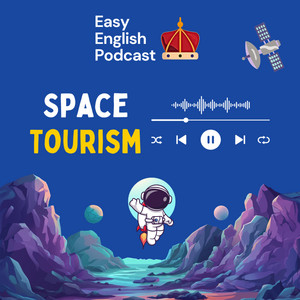
Today's topic is all about space tourism.
The idea of travelling to space for fun, for adventure, or maybe even for business in the future.
Would you travel to space if you had the chance?
That's a question that I hope you will be able to answer after today's podcast.
This is going to be a really fun episode with lots of interesting new vocabulary related to science fiction, space travel and the future.
So get ready to learn while we dream big about the future.
And remember, the vocabulary list is going to be in the description below.
But as always, we're going to start with new vocabulary.
Some words that I think that you should learn and listen out for in this episode.
Let's get started.
Okay, our first word for this episode is orbit.
Orbit.
Orbit.
Have you heard that one before?
Well, it means the curved path of a spacecraft like a spaceship or a rocket around.
Sorry, I have a little cough around a planet or a moon.
For example, the space hotel in the future will remain in orbit around the Earth.
It will have its path of moving around the Earth.
We can also say that satellites are in orbit around the Earth.
They are moving around the Earth in their path.
The next phrase or word I would like you to learn is weightless.
We can also say zero gravity as being weightless.
And this is a state where there is no feeling of weight.
And it's something we would experience in space.
Weightlessness.
That feeling of being able to float and move around is weightlessness.
Our next word is launch.
Launch.
And this is when a spacecraft takes off from the Earth.
So we can talk about a rocket launch or a spacecraft launch.
The next one is commercial space travel.
And this is important because it is our topic today, space tourism, commercial space travel.
And this is when space travel, travel to space, is offered by private companies as a service to the public.
Number five, our fifth word is a spacecraft or a capsule.
And this is the vehicle that we use to travel to space.
Number six is hopefully an easy one that you might know already.
And that is astronaut.
An astronaut is a person trained to travel in space.
Okay, those are our new vocabulary list for today.
And we're going to now get into the episode.
So get ready, buckle up your seat, put on your space helmet and your suit, and get ready to travel into space.
But first, there's going to be a very short ad break.
And just a reminder if you want ad-free bonus episodes and these episodes without ads on Spotify or other platforms, check out the Patreon link below.
It helps to support this podcast and you get a lot of benefits and extra content.
Okay, I'll be right back.
So what is space tourism?
Space tourism is no longer just science fiction.
There's so many companies out there, like blue origin, which i think is the one owned by jeff bezos, the ceo or the head of amazon.
There's Virgin Galactic, which is owned by Richard Branston.
And there is SpaceX, which is, of course, is probably the most famous space company at the moment, owned by Elon Musk.
Elon Musk never seems to be out of the news at the moment.
I am always hearing about him.
But what do these companies mean for the average person?
They've already started taking paid trips beyond the Earth, into space, into orbit around the Earth's atmosphere.
Because so far, when we look at these companies, space tourism is very expensive.
You know we're talking hundreds of thousands of pounds or dollars per ticket, and sometimes millions.
The idea for this podcast episode came from some recent publicity, some recent news about space travel.
I saw on the news the last couple of weeks Some articles and videos about the Blue Origin flight, Jeff Bezos' company flying into space with an all-woman crew, so an all-female crew, including the singer Katy Perry.
And I had a read onto the website and I could see that it was.
So it's such an expensive trip and a very short trip.
It lasts for about 11 minutes in space.
So you're in space for about 11 minutes where you are weightless, being able to float around without gravity or weight.
But I'm not sure how much exactly the Blue Origin trip costs, but on the website they talk about having a 150000 deposit.
And that's just the deposit.
That is a lot of money.
So it's quite clear to me that this type of tourism, this type of travel, is exclusively so, it's limited to the very, very rich, the ultra wealthy, the ultra rich, to celebrities and maybe, in some cases, people who are lucky to win a competition to travel to space.
So, in general, a typical space tourism experience right now, in 2025, might involve being launched into space in a capsule or a spacecraft and then experiencing weightlessness, being able to look out of the window or the glass in place and see the earth from above, and then finally coming back down to earth and this short trip.
For many, they say that it is life-changing.
Many people say that seeing like who have went there say that seeing the earth from space gives them a new perspective and they call it the overview effect.
But the question is, and the question I want to ask today is will space tourism ever become more common and affordable?
What do you think?
Because in the past, so in the past, when we think of modern tourism, so traveling to other countries, traveling all around the world by plane, even in the past by nice high speed trains.
This used to be unaffordable.
It used to be very expensive for the average person.
And over time, the technology and the cost and the price of this became cheaper and cheaper.
Even if we think 100 years ago, even 60 years ago, maybe even less, like 40 years ago, traveling abroad for a holiday was considered very unrealistic for most average people.
It was something that was almost exclusive or done more regularly by rich people, by people with a lot of money.
Because the cost of a plane ticket, the cost of these tours or excursions and hotels were just too much and they were almost designed for very wealthy people, very rich people.
But over time we have seen more budget options, cheaper options, cheaper plane tickets, cheaper hotels and options for the average person, and something that would have been considered very expensive and luxurious and unrealistic maybe 100 years ago is now the normal today.
So will this happen with space tourism?
I'm not too sure, but I hope so.
I hope with time it will become more affordable and cheaper for the average person.
But currently, with a deposit of 150000, I don't think that you or I are going to be travelling to space any time soon.
But maybe with time, we will.
Okay, so let's have a look at the pros and cons, the positives and the negatives of space tourism and of, I guess, wherever you should go if you had the option.
So if you could go to space, would you?
I guess one of the main benefits of going to space would be, in most cases, that it's a once in a lifetime experience.
And it would give you that incredible view of the earth and that change in perspective which I mentioned earlier, is called the overview effect.
The overview effect.
And I think personally, this overview effect is probably very true.
And it's something that most people do experience when they go to space.
The way I think about it is if you imagine or even think about the times that you have been in an aeroplane and you've looked down at the earth, you've looked out your window and you've looked down and seen what things look like, and you see your town or the city that you're from, and it looks so tiny and so small.
It gives you that feeling of realisation, I guess, that the little things don't matter so much.
That homework, that you're stressed about that task for your job.
It's so small in comparison to the size of the earth and the size of the universe.
And often the things that we are arguing about, the things that we think are so important, really aren't so important.
Okay, another real benefit to me, i think, of traveling to space and it would be super cool is experiencing weightlessness, floating in zero gravity.
That sounds amazing.
I don't know about you, but i think it would be super cool.
The closest experience that I've had to this was doing indoor skydiving.
So going to that chamber and they put you in the suit and you float up into the air like this, if you're watching on video,
And it was a lot of fun.
My wife got me this experience of indoor skydiving for my birthday a couple of years ago.
And it was a really cool unique experience.
And I imagine floating in space would be even cooler.
It would be crazy.
Such a cool unique experience.
And I guess also one of the biggest benefits or coolest things about traveling to space right now in 2025, would be that you are one of the first people in history to do it.
Imagine telling your children or your grandchildren, yes, I traveled to space.
I was one of the first people to do it.
I think that's very cool.
But I guess there are a lot of negatives at this stage.
The first being so obvious the cost, the cost of space travel and potentially, the impact that this is having on the environment.
Rocket launches in general produce lots of emissions into the environment.
And I know that certain types of launches, certain types of rockets and capsules are not as bad as they used to be.
But into every launch there is so much production, so much transport, so much in the infrastructure around the launches.
That contributes to pollution, contributes to a negative effect on the environment.
For a very short flight into space.
So it's something to consider as we do this for our pleasure, really to just look at the earth and to float and feel good.
This is not great for the planet.
It's not great for our climate, for the atmosphere.
And perhaps it's not the best use of our resources.
I do agree that pushing forward space travel and the technology is important.
It is very very important for the future of humans.
Is tourism really the most important thing and point to use to do it?
Maybe it is a side effect of this increase in technology, but should it be the goal to make profit off of tourism and off of damaging the environment for a very short trip?
Another potential negative, I think, about this is the risk factor.
Because it's very new technology, they are fairly new companies, of course it could be dangerous.
There is the potential for accidents to happen as well.
Every launch, every rocket launch at the moment is a learning experience.
It's something fairly new.
It's early and you're taking that risk on.
So I guess for many people the idea of floating above the Earth is very exciting, but also scary, quite terrifying really.
And it brings up the question, are we really ready for this kind of tourism?
We have so many problems on Earth right now, so many issues.
Are we ready for taking this next step out of the planet before we've even fixed and sorted our problems here on Earth?
Well, let's look to the future.
Let's imagine the future.
What if space tourism, like modern tourism, so package holidays travelling to warm countries around the world, let's say space tourism becomes cheaper and more common, like normal tourism?
Some companies are now even planning for this future world that we are imagining, space hotels.
And in these space hotels, people can stay in orbit.
So traveling around the Earth. outside in space for several days.
And others imagine trips to hotels on the moon or even Mars in the distant faraway future.
Some, I guess, future space enthusiasts.
People that are really excited about this believe that in 50 years only 50 years People could choose between a holiday on the beach somewhere sunny or a weekend in space.
Maybe students will go on school trips to the moon or couples might take their honeymoon on Mars.
It sounds crazy, and I guess even a hundred years ago, this idea of air travel, so traveling by planes, also sounded crazy.
So it could possibly happen.
What could take us to this stage, this next stage of tourism?
What would have to happen to make this future a reality?
First, more advanced technology.
So a lot of development, a lot of money, a lot of investment into this technology.
And that would also require lower prices.
When any new technology is released, whether it's a phone, a TV, for example, cars when they first came out they're very expensive very, very expensive.
And with time they find ways to make them cheaper, to produce them faster, to produce more of them and to produce with perhaps cheaper materials or cheaper ways of doing things.
And over time the price becomes more affordable until it reaches a price where the general public you and I can afford to pay for them.
Like to buy a car, to buy a TV, to buy a phone.
All things that in the past, only a very small percentage of people could afford and could buy.
So this would have to happen as well for space travel.
The next point I think is better safety.
I'm not saying that the safety isn't good right now, but I guess a lot more experience, a lot more testing and a lot more proven safety records.
So many, many flights before the general public, most people would feel safe and want to go on these flights.
And looking to the future, they would also need a lot more regulation laws in space, international space laws.
Because, when we think about it, every country has laws.
There are international laws on Earth, but there is not a lot of politics in relation to space laws.
Most of it is very minor stuff or speculative.
It's stuff that we've talked about, but isn't really a reality yet.
Okay, another thing that they would require is space infrastructure.
You would need spaceports.
These are like airports, but for rockets or spacecrafts.
You would need places for spaceships or spacecrafts to refuel to get more fuel to continue their journey.
So there's a lot of aspects, a lot of things to consider.
But space tourism in general raises deeper questions than just the cost and the experience that comes from it.
I mentioned this earlier.
Should we really be spending billions of dollars on space travel when we have so many problems on Earth?
Who owns space as well?
If a company builds a hotel on the moon, who's responsible if something goes wrong?
Who polices the hotel?
Is there a military?
Is there a local fire service?
Is all of this run by the company?
And finally, how does this change our identity as humans?
Are we prioritizing leaving the planet, leaving Earth and spreading out into the stars instead of fixing our planet, instead of improving it and making life better for everyone here, rather than just a very small percentage that can afford it?
These are really big questions and there are no easy answers.
But to me, this shows how powerful space tourism could be.
It's not just about fun.
It's about the future of humanity.
And I guess for me, one of the big issues that I have with this is I think it is pushing attention away from very real problems that we experience here.
It's nice to dream and it's nice to look at this future, but do I think that in reality...
As more money is spent on this technology do, I think that the average person will be able to afford this.
Unfortunately, no, I don't.
Even in 100 years, I would be very surprised.
I think that this is something that is almost exclusively from rich people and to me it seems like it is almost running away from the problems that we have on earth.
And, as i mentioned in even other videos, as we go into the future, we have some serious problems ahead of us, From climate change to a declining population in many countries.
We are heading for a lot of crisis, a lot of issues that we need the world's smartest, the world's brightest, the world's wealthiest and richest to put money, time and attention into.
So I'm not against space travel, I'm not against this idea, but I think focusing on luxury space tourism is missing the point.
And it's just another way for companies to make profit and money off of new technology and a unique experience.
So i'm going to leave you with those thoughts today and i'm going to ask you would you go to space on one of these trips if you could?
I would personally, if i was given the option for free, despite everything i've said.
Of course it would be very cool, but if i was having to pay for it, if i was a millionaire, I'm not sure that I would actually pay for it myself at this stage, with the cost around such a short trip or experience.
I think there's a lot more I could do with that type of money.
That would give me a great experience and be better for the earth as well.
So let me know what you think about this topic, about space tourism and about some of these difficult questions.
No matter what your answer is, this is an exciting time to be alive.
We're living in an age where technology is changing all the time, and space tourism might just be the beginning of a lot of that.
So thank you so much for joining me today.
I hope you enjoyed learning English through this fun and futuristic topic.
If you're watching the video podcast on Spotify or YouTube, let me know as well.
Do you like it with video so you can see me speak?
You can see my mouth move the way I say words.
How is that?
Do you enjoy this format more?
I'm very curious to see and hear your thoughts.
So if you would like to keep learning, don't forget that there is a vocab list in the link below and the Patreon where you can get access to bonus episodes and ad-free episodes of the main podcast as well.
We also have additional series which are only on Patreon.
And of course I also post life updates and some personal stuff on there to stay connected with you guys.
I appreciate all of the support.
And, as always, if you enjoyed the episode, follow the podcast, leave a five-star review and share it with someone who loves learning English.
Until next time, keep learning and keep dreaming big.
I'll see you all soon.
Goodbye.