This message comes from Charles Schwab with their original podcast, Choiceology.
Choiceology is a show about the psychology and economics behind people's decisions.
Download the latest episode and subscribe at schwab.com slash podcast.
You're listening to Life Kit from NPR.
Hey, everybody.
It's Marielle.
Do y'all remember the story Stone Soup?
It's a European folk tale that starts with some hungry people and an empty pot.
They put a stone at the bottom and decide to make a soup out of it.
Then, little by little, other villagers walk by and add ingredients.
You know, this one's got some carrots.
Another one has chicken.
This one's got salt.
Next thing you know, they've got a soup.
Now, as far as folktales go, this is actually a pretty realistic one.
You don't have to really follow a strict formula when it comes to soup.
That's why it's like one of those really fun things to start cooking with.
And it's all about like tasting all along the way and adjusting.
Sola El-Weili is a chef and the author of Start Here, Instructions for Becoming a Better Cook.
And she says you kind of can make a soup out of anything.
You might be like, oh, is this is this broccoli going to work with this wilted parsley?
And then somehow you let it simmer for 20 minutes and it's like it was meant to be.
Sol is a new mother and she's been making a lot of soups lately because it's an easy thing to make.
One handed with whatever you've got.
Also, she says soup is the perfect communal dish, especially on a chilly day.
You know, like a big bubbling cauldron on fire and everyone's gathered around it.
And soup kind of gives you that vibe.
There's something about it that's just like cozy and comfy.
And it feels so primal like just eating out of one pot, especially because food gets so complicated these days.
You know, soup isn't like glamorous.
It's not pretty, but it gets the job done.
On today's episode of Life Kit, how to make a great soup.
We'll talk about broth, texture, key ingredients, how to blend a soup without scalding yourself.
And we'll share a couple recipe ideas.
This message comes from the Michael J. Fox Foundation.
Did you know that every six minutes, someone in the US is diagnosed with Parkinson's?
It's the fastest growing brain disease in the world.
Chances are you or someone you know is impacted by Parkinson's.
The Michael J. Fox Foundation is on a mission to find a cure.
Now is a critical time for Parkinson's research, and your support will help drive progress toward a cure.
Get involved today.
Visit michaeljfox.org slash get involved.
This message comes from Carvana.
Explore Carvana's quick and easy financing and browse thousands of car options, all within your budget and timeline.
Get pre-qualified now at Carvana.com.
Financing subject to credit approval.
Additional terms and conditions may apply.
This message comes from ServiceNow.
People should do the creative work they actually want to do, not boring, busy work.
Now, with AI agents built into the ServiceNow platform, you can automate millions of repetitive tasks in every corner of your business IT, HR and more.
So your people can focus on the work that they want to do.
That's putting AI agents to work for people.
It's your turn.
Get started at servicenow.com slash AI dash agents.
This message comes from Carvana.
Selling doesn't need to be stressful.
With Carvana, it's quick, easy and all online.
Enter your license plate, get a real offer and get paid.
Visit Carvana.com to sell your car today.
What can make a good soup?
What elements or qualities should it have?
Well, I think that the most important part of a soup is the broth.
That's going to provide the backbone of flavor.
I mean, if you want to make a good soup, right?
We're trying to make a good soup here.
So you want to start with a really flavorful broth.
I always keep... chicken bone broth in my freezer so I can make soup at any time.
But it doesn't have to be chicken.
I like to think about broth in three major categories.
You've got your broths, slash stocks and you can make it with meaty bones, such as a chicken broth made with wings or chicken backs or feet, or a beef broth made with knuckles and bones, or a fish broth made with the carcasses of lean white fish.
Then you got your veggie broth that you make with all of your simmered bits and ends, and carrots celery, that kind of thing.
And then you have your steeped broths, kind of like dashi, made with kombu or bonito flakes or dried shiitakes.
And then, once you have one of those very flavorful, intensely savory broths, you really can't go wrong from there.
On the broth front...
Should you have a broth ready to go in your fridge or freezer in liquid form?
Or can you make a broth on the spot just with water and some sort of like powder from the supermarket?
You totally can make a broth on the spot.
I love chicken bouillon.
I think it's an amazing ingredient and it's like a lifesaver in a pinch.
But when I'm organized I do like to have some broth in the freezer all the time, because it's just like it can make any meal extra delicious and you don't even have to try very hard.
Okay, so how do you actually start cooking the soup?
You want to start by sweating some stuff.
The term sweat just means you're going to cut up your veggies or your aromatics or whatever and let it kind of get tired in the hot fat.
Everything's going to get a little translucent.
You're going to stir it around just in this pot with a little bit of fat and it's going to pull out all the aroma.
So in a recipe that usually starts with like garlic and onion, where it tells you to cook until like wilted and translucent, that pulls out all those fat soluble flavors?
And the fat, when you say in the hot fat, is that a olive oil or something else?
It can be whatever fat you want it to be.
It's another place to layer in some flavor.
So use whatever you've got.
If all you have is olive oil or like a neutral oil, go for it.
But yeah, you have some bacon fat around or I don't know.
Maybe you like rendered some chorizo and you have chorizo fat.
You just need a little bit like a couple tablespoons, enough to coat all those veggies to really get them melted down.
But any fat will work.
And if you're cooking like – like my favorite soup has crumbled sausage in it.
So I think they say put in the garlic and then put in – cut open the sausage and let it come out of the casing and like, crumble it into the pan.
And I guess that provides the fat that the veggies cook in.
Yeah, yeah.
Like if you're using – short rib or chicken thighs, they can really handle being simmered forever.
So you can just put your chicken thighs in there, render it and then add everything and let it all cook together.
But like with sausage, I would like get it nicely browned first and then pull it out and then cook everything in that sausage fat and then throw the sausage in at the end so it doesn't overcook.
Every soup recipe is going to be a little different depending on the ingredients you're using.
So it's really just thinking about like the core steps you need.
And then you can like level it up.
If you're going to blend it, you can add a little cream, a little butter for some richness.
Or if you want to layer in some spice flavors, you can sizzle some spices in oil.
Drizzle that on top.
You really can't go wrong because there's always a way to fix it.
If it's a little too salty, add some more broth.
If it's a little too thick, add some water.
You can constantly find your way back to delicious soup.
Yeah.
When do you boil the soup?
Should you boil the soup?
So it depends on what part of the world you're in.
So with a lot of Western cooking, French in particular, you never boil.
It's like a gentle simmer.
The goal is to go for like a clear broth, a clear soup, delicate flavors.
But when we're talking Eastern, particularly with like a ramen broth or a lot of Chinese cuisine, even South Asian cuisine, you boil vigorously.
And what that boiling does is emulsify everything together.
So you end up with more of like a creamy, rich soup.
So if you want something lighter and more clear, go for the really gentle simmer.
But if you really want something rich, then go for a boil.
There's no right or wrong answer.
It's just like, what vibe are you feeling?
So I imagine the answer to the next question might be similar.
But How long should you be cooking your soups?
It really just depends on what's in your soup.
So if you're working with like quick cooking ingredients like spinach shrimp, already cooked beans, then you know it'll be fast.
Keep it light, keep it fresh.
A faster cooked soup is going to have like a lighter, fresher taste.
But sometimes quick cooking ingredients like a lot of tender herbs like parsley and dill.
You can simmer for a long time to go for more of like an earthy flavor.
You see that a lot with traditional Persian soups.
There's this really delicious celery soup and it's like celery and celery leaves with a lot of dill that's simmered forever.
And it takes it from this like really fresh, light, crisp thing into like this earthy, vegetal vibe.
So it's like, what kind of a soup are you feeling?
What are you craving?
Yeah.
Do you think there are categories of soup?
How would you define them?
I just think about it as smooth and chunky, like peanut butter.
If you do want a creamy style soup...
What can you use to get there, both dairy and non-dairy ingredients?
Depending on the vegetable, sometimes you don't need any dairy.
You can make a really creamy tomato soup with just tomatoes that are simmered in a broth or roasted even and then blended.
If you really want to level it up and make it unctuous, then finish it with a little bit of cream or a little bit of coconut milk, a little bit of extra fat or yogurt, something like that.
The key with the creamy soup is using a good blender.
When you go to like a restaurant and you have something like really smooth and velvety, you're like oh, how do they do this?
It's a good blender.
So I know it can feel like a hassle to pour your soup into a blender, but a stick blender, like you know, the immersion one that you put right in the pot I feel like it never quite gets you there.
Yeah.
When your soup is larger than the size of the blender, how do you make sure that you blend it all?
And then also, how do you make sure that it doesn't splash back in your face and just scald you?
Because that has happened.
When you're blending hot liquids, there is a little danger involved.
So you're going to have to set yourself up.
You're going to have your pot of soup, your blender and then another vessel where you're going to land your final blended soup and then ladle in some of your soup into the blender.
You never want to go more than halfway, especially when you're blending hot things.
Once it gets blended properly, It really wants to expand and it can explode.
So it's important.
Never fill your blender up more than halfway.
And you know how, there's like a little top, like a little little thing at the top of the blender that you can pull off.
Yeah.
You want to remove that so the steam has somewhere to go.
Otherwise, your lid can blow off and cover it with a towel instead.
Make sure you start on low, go to high.
So you're going to have to work in batches.
You're going to have to get another pot dirty.
It is like a really big commitment, but it will be so much better.
More Life Kit after the break.
Military commanders, intelligence officials, diplomatic power players.
They know things you may not about where the world is headed.
And we will pull back the curtain on what they're thinking on Sources and Methods NPR's new national security podcast.
Our team will help you understand America's shifting role in the world.
Listen to Sources and Methods from NPR.
Sources and Methods, the crown jewels of the intelligence community.
Shorthand for how do we know what's real?
Who told us?
If you have those answers, you're on the inside.
And NPR wants to bring you there.
From the Pentagon to the State Department, to spy agencies.
Listen to understand what's really happening and what it means for you.
Sources and Methods, the new national security podcast from NPR.
The Trump administration has moved fast to change US policy, but much of the country is still trying to catch up.
Business likes a stable environment, so uncertainty does cause a little bit of pain.
On the Sunday Story from Up First a road trip across the country to hear how Trump's policies are impacting everyday Americans.
Listen now to the Sunday Story on the Up First podcast from NPR.
Are there any key ingredients that you think go well in basically any soup?
Something about starting with a base of alliums.
Allium is like a broad family of vegetables that includes onions, leeks, shallots, garlic.
And something about when you cook any allium in fat.
It just adds this incredible savoriness and depth.
And there's like a wide range of flavors you can pull out of it.
So if you keep it kind of blonde, you get more of like the sharp oniony flavor.
And then you can go as far as you want from there and take it like to deep caramel and get it very, very sweet flavor.
Um, but it's this like really rich base to pretty much everything, but especially a soup, and it's particularly helpful to develop a base with alliums.
If you're not using like the best quality broth, like you know, if you're going with a bouillon, starting with some cooked down onions or shallots will really get you far.
Any other sort of like secret superhero ingredients for a soup.
Like our editor, Megan was saying that putting a Parmesan rind in for certain soups can make it really rich.
Yeah, that is a really good move.
And I was going to say a pinch of MSG to add a little bit of savory depth.
But the Parmesan rind, like that's also what it's doing.
Parmesan is a natural source of like a ton of MSG.
So, just like, adding a little bit rounds it all out, gives you this like savory umami thing that makes you want to keep eating more.
What do you think about toppings?
I feel like we've been seeing a lot of that in recipes lately.
I love toppings, especially if you're making a big batch of soup and having it over a couple of days.
It can get a little boring.
So you can jazz it up with a different topping.
If you want to go for something fresh, you can make like a little quick kind of salsa vibe with thinly shaved onion and a bunch of herbs and lemon and maybe like sumac for maybe a little bit of richness.
You could try browning some butter with some spices and drizzle that on top a little bit of creaminess.
You could do a dollop of sour cream or something like that.
Or you know my favorite move, because leftover soup is something I eat when I'm really rushed for time and tired just go into the pantry and grab a handful of Fritos and throw them on top.
Fritos on top of everything works.
How much soup do you make at once?
Soup is something that keeps really well, and it actually tastes better the next day.
So I would like to make soup for like at least three days.
So I would say for us a quart is good for one night.
So I would make like three or four quarts at a time, so we have some leftovers.
Soup is great in the fridge for five days, or you can portion it, pop it in the freezer and it's good for three months.
And, you know, it reheats beautifully.
And once you take it out of the freezer, do you put it back in a saucepan or the microwave?
Yeah, either one, whatever works best for you.
You could do like the defrost mode in the microwave, or I usually just dip it in a little hot water so I can pop it out of the container, throw it into the pot with like a little splash of water, just to like get a little steam going at the bottom.
Go for like a low heat. heat at first just to get everything melted.
And then once it's melted, bring it up to a boil.
And then, whenever you reheat soup, give it a taste and see if you need to re-season it with a bit of salt.
And oftentimes it can fall a little flat and you might need a little squeeze of lemon just to brighten everything up.
Okay.
An adjacent question.
How do you transport soups like to the office for lunch?
Because I have had soup spill in my tote bag and It's a disaster.
I mean, I think the best thing is to get a big thermos.
It'll stay hot and it's like going to seal really tightly for you.
I have this big thermos that like holds about a quart.
I don't believe it was designed for soup, but I do use it for soup.
What's a good like fall spooky season soup?
Well, I love honey nut squash.
They are super concentrated and sweet in flavor.
It's like they took a butternut and shrunk it down, but it still has the same amount of flavor of the big guy.
I love roasting that.
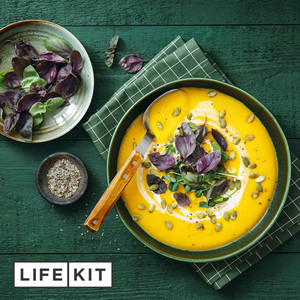
All you got to do is cut it in half lengthwise, scoop out the seeds, slather it with some oil and salt and put it cut down on a sheet tray, pop it in the oven, let it roast at like 375 until it's totally tender and the skin kind of shrivels.
And then, you know, you get your base going.
You got to get your flavor base going.
So I like to do a little onion apple.
Maybe some, like Fresno chilies, get that all wilted down in a little bit of olive oil.
And then, once it's nice and fragrant, scoop out the flesh from the honey nut, throw that in there, top it off with a bunch of bone broth, let it simmer until everybody gets to know each other.
Then blend it, strain it, warm it back up.
And then like for a little crunchy topping, I love just doing some pepitas.
Oh, hell yeah.
Sizzle some pepitas in a little bit of like brown butter, with a little maple and chili, and pour that on top.
And it is a very tasty soup.
And if someone is, you know, fairly competent at soup they've been around the block once or twice what would you challenge them to make?
Whether it's like try out this ingredient or try out this technique.
A soup challenge?
Yes.
Why not try making a pho?
The broth is really nuanced and it can be hard to get the balance of flavor right.
Like it needs just like a tiny bit of star anise.
So I think focusing on getting that broth really nicely made.
And then after that, it's really just about thinly shaving the beef and bringing it together.
But the flavor is really complex.
So I think a pho is a good way to go.
All right, Zola, thank you so much.
This was great.
And I'm excited to make soups now.
Awesome.
Thank you for having me.
All right, it's recap time.
Good soup starts with good broth.
This is your flavor backbone.
If you can keep some kind of broth in your freezer, but also bouillon powder or cubes can work in a pinch.
When you're making a soup, sweat some stuff in fat, like veggies or garlic.
Now the fat might be drippings from sausage or olive oil or whatever cooking fat you have on hand.
If you're browning meat for the soup, you might scoop it out once it's brown and then put it back in towards the end so it doesn't get dry or overcooked.
Some soups you're going to boil, others you won't.
It depends on the type.
If you're blending a soup to make it smooth, a standing blender works better than a hand blender.
And just remember to take out that little plastic piece on the lid, because if you don't, the steam builds up and the lid flies off, and then there's hot soup everywhere.
Soup is great for leftovers.
Make it in a big pot and freeze some.
And if you want to bring it to work or somewhere outside your house, try a thermos.
Keeps it hot and keeps it from spilling.
For more Life Kit, check out our other episodes.
We've got one about how to think through ingredient substitutions when you're cooking and another about meal prep.
You can find those at npr.org slash Life Kit.
And if you love Life Kit and want even more, subscribe to our newsletter at nprorg slash Life Kit newsletter.
Also, we love hearing from you, so if you have episode ideas or feedback you want to share...
Email us at lifekit at npr.org.
This episode of Life Kit was produced by the super Sylvie Douglas.
Our visuals editor is Beck Harlan and our digital editor is Malika Gareeb.
Megan Cain is the supervising editor.
Beth Donovan is our executive producer.
Our production team also includes Andy Tegel, Claire Marie Schneider, and Margaret Serino.
Engineering support comes from Philip Edfors.
I'm Mariel Segarra.
Thanks for listening.
This message comes from NPR sponsor Shopify.
Shopify is the commerce platform behind millions of businesses around the world and 10 of all e-commerce in the US, from household names like Mattel and Gymshark.
Get started with your own design studio with hundreds of ready-to-use templates.
Shopify helps you build a beautiful online store to match your brand's style.
If you're ready to sell, you're ready for Shopify.
Sign up for your $1 per month trial and start selling today at shopify.com.
This message comes from Capital One Commercial Bank.
Access comprehensive solutions from a top commercial bank that prioritizes your needs today and goals for tomorrow.
Learn more at capitalone.com slash commercial.
Member FDIC.