Grownups, Wondery Plus subscribers can listen to Wow in the World early and ad-free right now.
Join Wondery Plus in the Wondery app or Wondery Kids Plus on Apple Podcasts.
Hey, Wowzer fans, Mindy here.
And before we start the show, I gotta let you know that this November, with a special new episode featuring our friends at Circle Round and Terrestrials on Radiolab for Kids,
And don't miss when Elmo from Sesame Street stops by Wow in the World to make us all belly laugh on November 24th.
Oh, but that's not all, Reg.
On December 1st, we are sharing our 250th episode of Wow in the World with all of you.
We think this one is going to be music to your ears.
Literally.
Did I mention it's a musical?
And if you're a member of the World Organization of Wowzers...
Oh boy, do I have a surprise for you.
You can listen to our 250th episode early with me and other members from around the world on Saturday, November 22nd, at 7 pm.
Eastern.
That's right, we are throwing another listening party.
Join us as we dance along to our new songs.
React to the episode with other members in the chat and more.
Grownups.
If you want your wowzer to join this members-only listening party, you can sign up to become a member today at Tinkercastcom.
Slash wow.
Already a member?
Well, you can find the link and password to join the event when you sign in at Tinkercastcom.
Slash wow.
That's it.
It's going to be a November to remember.
But for now, let's get on with the show.
Woo!
Mail's here.
I'll get it, Reg.
Run, run, run, run, run, run, run, run, run, run.
Special delivery.
Ah!
Oh.
Oh, looks like I overshot the door.
Backtrack, moonwalk, backtrack, moonwalk.
Ma'am, please stop moonwalking away from me in shame.
Good afternoon, mail carrier.
And how are we doing on this fine day?
Ah.
Last week, there was a trap door under your doormat.
Two weeks ago, a giant pigeon ordered 14 tons of gourmet bird seed to be delivered by mail.
Ah, Reggie!
Three weeks ago, you mailed yourself an ice cream cone which ended up melting all over my delivery bag.
Ugh, sorry.
Next time I'll spring for same-day shipping on the ice cream.
So...
What do you have for me today?
Okay, well, let's see.
Looks like a new edition of Gingerbread Architecture Magazine.
Ooh la la!
Several invitations to a croquet and multi-level marketing party from your neighbor Dennis.
You can keep those.
And this huge box.
What's inside it?
I don't know.
Well then, could you shake it?
No.
Yeah, just shake the box and I'll guess what's inside.
No, it's gotta be cat litter.
Oh no, it's one of those plant-your-own-herb-garnets.
Maybe it's a ham.
Guy, Ross?
Of course, it's a human being.
Okay, have a good day, ma'am.
I will be going on a long vacation.
Surprise?
Guy, Ross!
Did I do this to you?
No, you did not do this to me, Mindy.
Yeah, you want to say that a little louder for the people in the back?
Ahem.
Mindy had nothing to do with this.
I mailed myself myself.
Hi, Guy.
Could you keep it down, please?
But, Guy Raz, you live next door.
I mean, if you wanted to come to my house, all you'd have to do is call Reggie to fly you over, or take the wow machine, or borrow my motor pickle or snack Dennis' roller blades.
Hey!
No!
The truth is Mindy, I've been trying to make an effort to be more I don't know spontaneous, to think outside the box a little.
Oh, so you literally climbed into a box and mailed yourself to my house and...
Next door.
Well, yeah, but for good reason, Mindy.
You see, I've got a surprise for you.
A surprise?
Is it in the box?
No.
So many packing peanuts.
You think I can eat these?
No, no, Mindy, don't eat them.
The surprise is not in the box.
It's inside of me.
Oh, so are you going to barf it up?
Barf it up?
What?
I mean, you just said it was Mindy.
Mindy, I got three tickets to the America's Squeak Hearts, Hide and Squeak concert tour.
Happy... When is your birthday?
Mindy's birthday is March-tember umpteenth.
Wait, that can't be real.
There aren't umpteenth days in March-tember.
Mindy, are you trying to get extra birthday presents from me again?
Kairos, you know that America's Squeak Hearts is my favorite of the week.
Yeah yeah, I was just thinking you were so kind to indulge me that time.
I wanted to go listen to my favorite elevator music band in that office building, elevator downtown.
Yeah, Guy Raz, I pretty much just complained the entire time.
Well, that's what friends are for, wow.
So when is the concert?
Well, looking at my watch huh what, that's weird.
What's weird.
All of the numbers on my watch are out of order because I scrambled them all up for you.
You what?
So a while ago, I got mad about daylight savings time, and I took it out on your watch.
But hey, I got you that hour back.
Mindy?
You're welcome.
Reggie!
Reggie, we've got a surprise for you.
Wait for it.
Wait for it.
Wait for Reggie.
The three of us are going to see America's Squeak Hearts live and in concert on their Hide and Squeak Tour, and it's a surprise.
I just spoiled it.
Whoa, whoa, whoa, whoa, whoa.
Slow down there, Reggie.
I'm not exactly picking up what you're saying.
Mostly because I don't speak pidgin, but also because you're talking faster than Mindy.
I got this.
Say what, Reg?
Yeah.
Uh-huh.
Oh.
Really?
Voila!
What's he saying, Mindy?
He's saying that America's squeakarts are at the center of a brand new scientific breakthrough.
A scientific breakthrough?
And their performance is basically going to take us through a whole reenactment of the experiments that led to the breakthrough.
What in the wow? gonna be even better than I thought.
They're gonna do an experiment on stage?
What are they, a singing duo of lab rats?
Actually, they're lab mice, Skyroz, but not your typical lab mice.
Wait, did you say America's squeak hearts are mice?
Well, yeah, they're my favorite band.
What'd you think they were gonna be, singing humans?
Well, uh...
Come on, Guy Raz.
Saddle up on Reggie's back.
You'll see for yourself once we get there.
Okay, but I'm not sure this is what I signed up for.
Singing mice?
What are they going to come up with next?
A band of singing chipmunks?
A musical starring cats?
Okay, Reg, prepare for takeoff, because here we go!
Our surprise landing is scaring all the mice away.
Come back here, you little mice.
I think all the mice are scaring Guy Raz away.
Guy Raz, stop.
They're not going to bite you.
They're here for the concert, just like us.
Oh, right, the concert.
We're here to see Mindy's favorite band, America's Squeak Arts, live in concert.
They're just like any other band, only they're lab mice.
Tickets, please.
I have nothing to be freaked out about.
We're all mammals.
Um, Guy Raz, tickets?
Oh, right, $3.
Tiny tickets?
Thank you.
I should have known, by the size of these microscopic tickets, that this concert would be performed by mice.
Here's your program.
It explains the scientific breakthrough connected to the band.
And on the back, there's a coupon for America's Squeak Arts merch booth.
Merch booth?
Rent!
Rent!
Rent!
Rent!
Rent!
Rent!
Rent!
Rent!
Um, we'll take three matching sets of mouse ears.
Okay.
Three matching America's Squeak Hearts Hide and Squeak Tour t-shirts.
Uh-huh.
Three matching sets of mousetrap clip-on earrings.
Mindy, Mindy, Reggie doesn't have earlobes.
Okay, make that two.
Mindy.
And three big wheels of cheese.
Please.
Here you go.
Thank you.
Oh, Mindy, they're about to start.
Come on.
So Mindy, I read you were saying something earlier about this being a concert that reenacts a scientific breakthrough.
Oh, yeah.
It's pretty amazing.
So it all starts off with this neuroscientist.
And a neuroscientist is a scientist who studies the nervous system or the way our brains and spinal cords and nerve cells work together in our bodies.
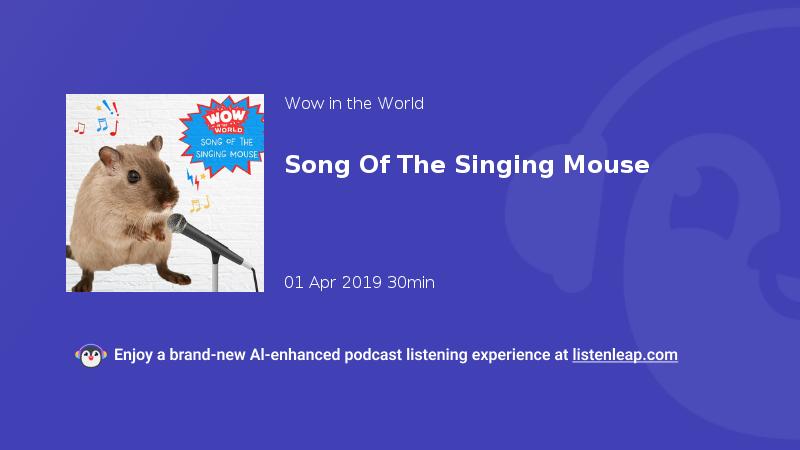
Yeah, and so this neuroscientist named Michael Long and his team of researchers from New York University's School of Medicine noticed something very unusual about a particular species of mouse that lives in the tropical cloud forests of Central America.
A species of mouse called the America's Squeakarts?
What?
No, that's just their band name.
The mice in the band have a completely different name, and that name is...
Go to Nomis Taquina.
Mindy, Mindy, I told you I don't speak pigeon.
That's not pigeon talk, Guy Raz.
That's their name.
Ha.
They also have a nickname, which is much easier to say, Alston's Singing Mouse.
Aha, and let me guess that unusual observation made by Dr Long and his team was that these mice could sing.
Yes, but there's more.
Go on.
These scientists discovered that these mice can sing over 100 different musical notes, and Thank you.
Thank you.
Gracias.
We are America's Squeakers.
Actualmente, our name is Central America's Squeakers.
But it's confusing.
This one goes out to all dear ladies.
No, really.
What you're about to see are the two lead singers of the band engage in a little rap battle to win the hearts of the lady mice in the audience.
Or at least one in particular, though she could be any one of these mice for all we know.
A rap battle?
You mean like a singing duel to win the affection of a mate?
Well, yeah, basically.
And while there are other mice that will sing for love, or whatever you call it in the rodent world.
Most of the time human ears can't hear them, but these singing mice well, they come in loud and clear.
What just happened?
That back-and-forth call-and-response vocal turn-taking.
It was like a fast-paced musical conversation.
You know, Mindy, now that I think about it, I guess that is pretty amazing.
Thank you, thank you, gracias.
I mean all the different vocal muscles and parts of their little mouse brains that had to work together to create that snappy back-and-forth sing-off.
I mean, that's just not something you see very often in the animal kingdom.
Well, unless you count us humans.
Well, that's just the thing, Guy Raz.
See.
Dr Long and his team noticed this in the wild cloud forests of Costa Rica and decided to invite these singing mice back to their lab at NYU.
And just like that, they came?
Well, they did promise them some pretty cush digs.
You know like workout equipment in their cages, organic mealworms, dry cat food three times a day, fresh fruit.
A lucrative record deal, a national tour.
It took all of that to get these mice to visit their lab at NYU?
Yeah.
I mean, Dr Long has actually been quoted as saying that they're kind of divas, especially when you compare them to their lab mice cousins.
So Mindy, once Dr Long and his team got the singing mice settled into their plush laboratory apartment, What did they do?
Well, they began rehearsal.
And by rehearsal you mean I mean they let the singing mice sing their brains out, while researchers studied their brains over a few different experiments.
So let me just make sure I've got this straight.
The researchers knew that these mice could sing, but they wanted to know what was happening in their brains that allowed them to sing duets or musical conversations.
Well, basically, yeah.
So humans have the unique ability to take turns while talking in a conversation.
You know, so immediately starting a new sentence when the person you're talking to ends theirs.
Ha!
And, in fact, that pause between when one person starts talking and the next person picks up is only about a fraction of a second.
And I guess that means that our vocal muscles and our brains have to work together extremely quickly and send signals back and forth to make that happen at such a fast speed.
Right, but why and how and what part of our brains controls this complicated operation?
That must be where the experiments with the singing mice divas come in.
Well, they prefer to be called America's squeak hearts, but yeah.
See, these researchers were hoping that by studying the pretty simple brains of these mice they might better understand how back and forth conversation works in our much more complicated human brains.
So what was the first experiment?
Oh, hang on, I'll tell you in a sec.
We'd like to welcome a special guest up to the stage.
Let's give it up for the Bottlenose Dolphins!
What a fan name!
What?
That's just their name.
Woo!
Bottlenose Dolphins!
Yeah!
Wait, are they...
Flapping onto the stage?
Shouldn't they be in the water?
Hey, shouldn't those dolphins be in the water?
See, bottlenose dolphins are one of the only other mammals besides humans and singing mice that sing in that vocal turn-taking style.
Watch this.
Maybe they can sound a little better underwater?
So back to these brain experiments, Skyroz.
Oh yeah, where were we?
The first thing they did was take the two mice and put them in separate cages where they could hear each other but not see each other.
And then the researchers just sat back and listened.
And what did they hear?
Well, they heard the mice having a musical conversation.
In fact, they learned that they sing differently together than they do when they're alone or solo.
That's interesting.
But what's really interesting is that they learned that these mice have certain unspoken rules to their musical back and forth, just like we humans do when we're having a conversation.
Rules, huh.
Well, I did notice when the mice were on stage having their singing duel that they seemed to be very polite with each other.
I mean, they never sang over each other and they seemed to pay attention to when the other mouse was finished before picking up the next verse, and then also, And they never interrupted.
Ahem.
Huh?
Not like some humans do.
Oh, Anyhoo.
Once these researchers figured out the way these mice communicate through song, they wanted to figure out what part of their brains were responsible for telling them when to sing and when to wait their turn.
And how did they do that?
Okay.
So they used these tiny electric sensors or tools to help them read the signals that the mice's brains were sending to their vocal muscles.
And by seeing what part of the brain was lit up or active while they were singing, they could determine what part of the brain was responsible for telling the mice when to sing exactoritos Guy Raz.
And they discovered that it was the part of the brain known as the orophacial motor cortex, or the OMC for short.
All right, let's hear it again for the bottlenose dolphins.
All right, all right.
For this next song, we are going to speed things up a bit.
Rapido, no?
They're singing so fast that they're all out of tune.
Oh, wow.
This is just like in the experiment.
Huh?
So, using those same electronic sensors, Dr Long and his team sped up the signals that the mice's brains were sending to their vocal muscles.
And before they knew it, the mice were going all bonker balls and singing all the wrong notes and completely out of tune.
And I'm guessing that if they sped up the signals, Then they also experimented with slowing them down.
You know it.
Thank you, thank you, gracias.
And now, let's slow things down.
Lento, si?
Are they singing in slow motion?
Ugh, almost seems that way.
See, after experimenting with, what would happen if they sped up those brain signals, they decided to experiment with slowing them down.
And what happened?
Well, it turns out that these mice could still sing the right notes.
There were just longer spaces in between, and it took them a lot longer to finish.
Amazing!
Thank you, thank you.
And thank you all for coming to the show.
We've got one more song.
Oh, yes, I know, I know.
The band is going to sit this one out.
It's called Who Turned Out the Lights? this must be the last part of the experiment.
They turned out the lights?
Well, metaphorically speaking, yeah, kinda.
See, after speeding up and then slowing down that OMC section of the mice's brains, they decided to turn that OMC section off completely.
They just turned out the lights.
They shut off the mice brains?
No, no, no, no, no.
Not the whole brain, just that One little tiny part, the OMC, and only temporarily.
And what did they find?
Well, they found that the mice could still sing.
Yeah?
But only to themselves.
In other words, they could no longer sing back and forth to each other.
No more musical conversations.
They became solo artists?
Only temporarily.
Before the mice even knew it, they turned that OMC part of their brains back on and that was the end of the experiment.
Incredible.
Mindy, this must mean that the OMC part of the singing mouse's brain isn't what gives them the power to sing, but it is what gives them the power to sing in a back-and-forth way, just like we humans and bottlenose dolphins.
Winner, winner, mousetrap dinner.
Thank you.
Gracias.
You have been an amazing audience.
Our new album is called Hide and Squeak.
Please check it out.
Peace, love, and being nice to one another.
Wow, what an amazing concert.
Yeah, thanks for surprising Reggie and me with the tickets, Skyroz.
That was our first time seeing them perform live since the experiment.
Yeah, and about those experiments.
You know Mindy, I'm wondering if these researchers are planning to take what they've learned and use this new information to help solve other problems with human communication.
Well, it just so happens that they are.
See now that we understand how the OMC part of the singing mouse's brain controls its ability to have singing conversations with other singing mice.
Dr Long and his team are planning future studies to see if they can find the human version of the OMC in our brains.
With the thought that it might hold clues as to how we humans are able to have such conversations, back and forth conversations.
Right.
But not only that.
They're hoping that they can take what they learn from these experiments and come up with new ways to help people whose brains don't let them have these quick back and forth conversations.
So like some people with autism whose brains work differently.
Or maybe people who have had strokes where parts of their brains stop working altogether.
Or people like me who sing all the wrong notes at all the wrong times and can't stop interrupting.
I think that might be something worth experimenting on your own, Mindy.
Speaking of experimenting, is that Reggie backstage trying to communicate with a bottlenose dolphin?
And I thought a mouse-rat battle was going to be the weirdest thing I saw today.
What in the wow?
Wow in the World will be right back.
Grown-ups, this message is for you. grown-ups it's mindy and guy ross here from wow in the world mindy and i have some brand new wow in the world toys out in the world just in time for the holidays made for the kids who love science and for the ones who don't yet from our 100 experiments that wow kit to the telescope and astronomy kit our wow in the world toys help your wowser learn about their world through play plus You can hear exclusive audio content from me and Guy Raz to help your wowzer discover even more wows.
Grownups.
Give the gift of wow and wonder this holiday season with our latest Wow in the World toys designed with your curious wowzer in mind.
You can shop our Wow in the World toys at Tinkercast.com slash toys.
That's Tinkercast.com slash toys.
Hi, thanks for calling Wow in the World.
After the beep, get ready to record.
Hi, Mindy and Guy Love.
My name is Nora, and I'm from Toronto.
And my Wow in the World is that more people have been to space than than in the deepest part of the ocean.
My name's Luke and I'm from Australia.
I'm Indian.
I was 175 million years ago.
All the countries were joined together.
It was a super continent called Pangea.
Love your show.
They had a wedgie for me.
Woo-hoo!
My wow in the world is you can grow a plant in water without soil.
Bye.
Love your show.
P.S.
Say hi to Grandma G for smoothie.
Aloha, Mindy and Guy Raz.
My name is Anastasia.
I'm from the big island of Hawaii.
My wow in the world is that sound you hear in the background.
They're coqui frogs.
They're native to Puerto Rico but came to Hawaii by hiding in potted plants.
Now they're everywhere.
Goodbye.
Love your show.
Hi, my name is Maisie.
I'm nine years old, and I live in Anchorage, Alaska.
And my wow in the world is that when dogs drink water, their tongues move backwards like a spoon to get more water.
Bye.
Say hi to Reggie for me.
Hi, my name is Aiden, and I live in West Lebanon, New Hampshire.
My wow in the world. is that butterflies smell with their feet.
Say hi to Reggie for me.
Hi, my name is Stella and I live in Atlanta Georgia, and my wow in the world is horses can't grow up.
Bye, Mindy and Guy Raz and Reggie.
I listen to your show every night.
Bye.
Hi, Mindy and Guy Raz.
My name is Blue, and I'm from Las Vegas, Nevada.
Pigeons can do math at the same level as some monkeys.
Reggie, can you do math?
Bye, Mindy and Guy Raz.
Love your show.
Hey, everyone.
Thank you so much for hanging out with us this week on Wow in the World.
And to keep the wow rolling, check out this week's scientific podcast.
And grown-ups.
There you can find more info on how your kids can become members of the World Organization of Wowzers shop, our Wow Shop.
Upload photos and videos to us and check dates for our upcoming live events.
That's wowintheworld.com.
Our show is produced by Jed Anderson.
Who provides the bells, whistles, and silly characters.
Say hello, Jed.
Hello.
Our show is written by me, Guy Raz, and Thomas Van Kalken, who also provides silly characters.
Tom?
Hello there.
Thanks also to Jessica Bode, Casey Koffer, Rebecca Caban, Kit Ballinger, and Alex Curley.
Meredith Halpern-Ranzer powers the wow at Tinkercast.
Our theme song was composed and performed by The Pop-Ups.
For more info on their two-time Grammy-nominated all-ages music, find them at thepopups.com.
And grown-ups, you can follow Wow in the World on Facebook, Instagram, and Twitter at wowintheworld.
And our email address is hello at wowintheworld.com.
And if you're a kid with a big wow to share with us...
Call us at 1-888-7-WOW-WOW for a chance to be featured at the end of the show.
Also, if you haven't already done so, please subscribe to Wow in the World on Apple Podcasts or wherever you get your podcasts.
Yeah, leave us a few stars, a review, or just tell a friend about the show.
Thanks again for listening, and until next time, keep on wowing.
Jinx!
And before you go, tell us about yourself by filling out a short survey at wondery.com slash survey.