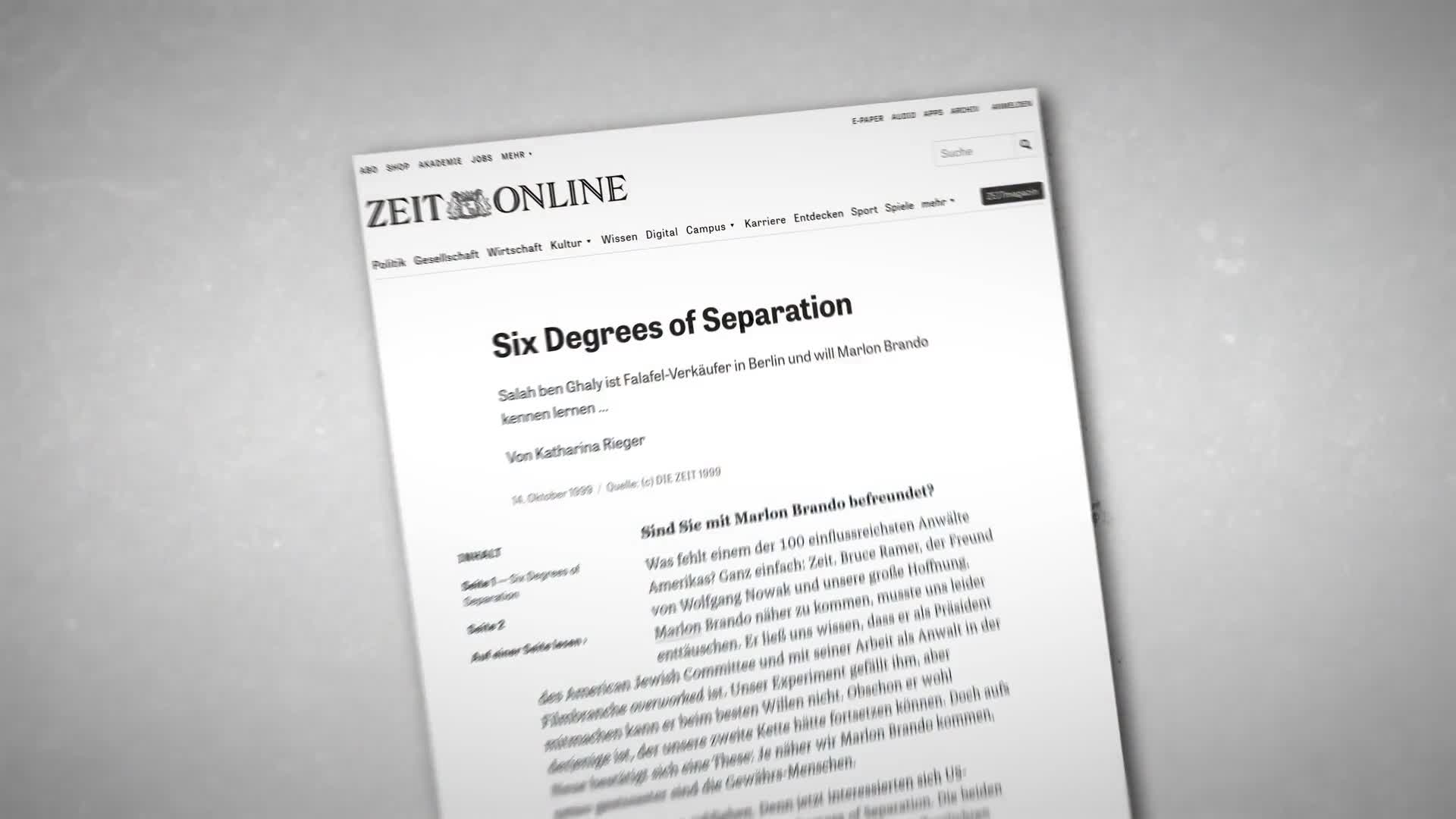
In 1999, the German newspaper Die Zeit ran an experiment.
They asked a falafel salesman and former theater director, Salah Bengali, who in the world he would most like to be connected to.
He chose his favorite actor, Marlon Brando.
So the reporters then searched for a chain of friends, family or acquaintances, people who knew each other on a first name basis, who could connect Bengali to Brando.
As it happens, Bengali had a friend in California.
This friend worked alongside the boyfriend of a woman who was the sorority sister of the daughter of the producer of the film Don Juan DeMarco, starring Marlon Brando.
So in total, it took just six steps, six degrees of separation.
And the idea is that this is not a unique example that you could connect any two people on the planet in six steps or less.
But is it really true?
And if it is, how does it affect our lives?
How is this possible in a world of now, 8 billion people, that we could be that close just six hops or less?
Does that affect how diseases spread, how information travels?
Our math showed the question is not why is the world small?
It's really how could it be otherwise?
But then I got a call from the FBI.
We are making the world smaller all the time.
Like it's supposed to be good, and yet it does expose you to toxicity and malevolence that you might have been shielded from.
You look at the net effect of it, and it's actually been pretty negative by a lot of measures.
People have suffered.
It's not only dangerous in terms of disease propagation, but anything malevolent now has conduits that it didn't used to have.
If we were all connected to everyone else on the planet completely at random, then it would be almost a mathematical certainty that any two of us would be connected through fewer than six steps.
Let's suppose I have my hundred friends out of eight billion people.
Each of them knows a hundred people.
So two steps away from me, is gonna encompass a hundred times a hundred people.
That's already 10.
To the fourth people.
And so if you do 100 to the fifth power, that's 10 to the 10th.
And that's more people than there are on earth.
So that notice that number is five.
I said to the fifth power, that's the ballpark reason why six degrees of separation is true.
But the shocking thing about this is the calculation you've just outlined is about having a hundred friends at random out of 10 billion, and they're all over the world.
But we know that in the real world, that's nowhere near what the distribution of friends are like.
Absolutely true.
So this really crude calculation I did is absurd for the reason that you said.
The world is very far from random.
The truth is, people naturally cluster geographically.
Most of the people you know live close to you and they also have a higher probability of knowing each other.
If you calculate the fraction of people you know who also know each other, that is a measure of the clustering in the network.
So let's try a model with a high degree of clustering.
Imagine all 8 billion people on Earth are arranged into a circle and say each person knows the 100 people closest to them.
So 50 to the left and 50 to the right.
Well, in this case, the furthest person you can connect to is just 50 people away.
So if you wanted to connect to someone on the other side of the planet through a chain of people who know each other well, it would take 80 million steps, and to connect any two people would take, on average, 40 million steps.
Even just getting 10 to the way there would take 8 million steps, and six steps would get you well here.
This is the paradox of six degrees of separation.
We know that we live in these local clusters of friends and acquaintances, but we also seem to be able to connect anyone anywhere in just six steps.
10 years ago I did my own experiment on this and I found that the average Veritasium viewer was only 27 degrees of separation from me.
In social science this is known as the small world problem, named after the phenomenon where you're say, on holiday somewhere and you bump into a stranger who somehow knows your best friend and you say wow, it's such a small world.
In the mid-1990s, two mathematicians, Duncan Watts and Steve Strogatz, set out to solve this small world problem.
Duncan really sort of had very far-seeing imagination at that point.
We had computers that allowed us to simulate environments that were too complicated for math to work.
Up until then, physicists had studied networks that were ordered and regular, like crystal lattices.
And mathematicians like Paul Erdos had done lots of work on totally random networks.
But no one had studied what happens in between.
There must be some enormous middle ground.
And that's what Duncan and I felt like we're starting to explore.
To study this middle ground, Watts and Strogatz imagined a simple, regular network of people or nodes dotted around a circle, each connected to a few of their nearest neighbors.
And so we had this idea.
We're going to start with the physicist end of regular.
Now we're going to turn the randomness knob to make it more and more random through these random shortcuts.
We all have some experience with shortcuts.
I belong to this club called the Internet Chess Club.
I got to be very friendly with a guy in Holland.
That connection makes the world small, because now, even though my friends don't realize it, they're only one step away from a guy in Holland.
And so that kind of connection, where you sort of connect to someone outside your normal circle, is what we came to call a shortcut.
So they went round the circle, disconnecting some of the links and reconnecting them at random to a different node in the network.
And as they did that, they watched what happened to the average number of steps it took to get from any one node in the network to another, hopping between connected nodes.
In other words, the degree of separation.
This is now the moment for the big reveal.
As Duncan turned the knob in his computer simulations.
As soon as he introduced a few shortcuts, the world immediately gets as small as a random graph.
When they had rewired just 1 of the links to shortcuts, the average degree of separation dropped from 50 in the original fully ordered network to 10.
But Watson-Strogatz also tracked how clustered the network was.
That's the fraction of a node's connections that are also connected to each other.
Or in other words, the fraction of my friends who are also friends with each other.
What they found is that clustering remained high for much longer.
The world immediately gets as small as a random graph.
But it stays as clustered as if it were still regular.
So you could simultaneously have the clustering that we know is real and the small world that we know is real.
Now, in Watts and Strogatz's model, they looked at a thousand nodes.
But if you apply their model to the eight billion people on Earth, well then, you would only need three out of every 10000 friendships to be a shortcut.
And the average degrees of separation drops to six.
Our math showed The question is not why is the world small?
It's really how could it be otherwise?
Duncan started saying to me this is about discovering a whole new universe and its properties and laws.
I recognized that he was right.
I just wanted to sort of reflect on what you said about these sort of shortcuts.
I think I've had this phenomenon happen to me sometimes in my life where I'm sort of invited to an event and it seems like a very random event.
Often I kind of feel like, I don't really want to go, you know, none of my friends are going.
But then maybe at the last minute I just say like, well, let's just roll the dice.
And I find that almost invariably those are productive meetings.
I'm kind of wondering if there's a takeaway for people here, which is that they should put themselves in situations where the probability of forming these shortcut links would.
It sort of increase the luck in your life?
You have just put your finger on a very famous phenomenon in sociology that is called the strength of weak ties.
You ask people how they got their job, and people would say oh yeah, I heard about it from you know, Randy.
And then he'd say, oh, is Randy a friend of yours?
And people invariably would say, no, he's an acquaintance.
I wouldn't call him a friend.
He's an acquaintance.
That's a weak tie.
The strong tie is your best friend or your circle of friends.
Excited about their breakthrough, Watts and Strogatz wanted to test their small world model on some real world data.
But this was 1996.
We had to think, well, where are we going to get data on big networks where we could test this?
And it was not so easy.
The internet was not mapped out.
Google didn't exist.
So they turned to an unusual source.
There was only one nervous system that had been mapped at that time, which was the worm C. elegans.
Tiny worm, like a millimeter that you can find in the dirt, a favorite of neurobiologists.
They knew every cell in the body of C elegans, from the time it's a single cell till it becomes a whole organism.
So they had the total wiring diagram of that organism.
Watson-Strogatz tested their model on the worm's neural network.
The worm has precisely 282 neurons, and on average, they're connected to 14 others.
If you lay that all out in a line along the worm's body, the neurons at the ends would be separated by around 40 steps and the average degree of separation would be around 14.
But when Watts and Strogatz ran the calculations they found the average degrees of separation between any two neurons was just 265.
To put that in context, if they were connected totally at random, it would be 2.25.
And yes, OK, so bingo, that was a small world.
Then we were popping the champagne.
I mean, that was really exciting that nature had done that.
So then we thought well OK, but this should be true of lots of networks, because nature can't resist this mechanism.
So they looked at Hollywood actors and power grids across the U.S.
Sure enough, they were both small world networks.
For example, in the database of over 200000 Hollywood actors, the average degree of separation was less than four.
Dangerfield was in Caddyshack with Bill Murray and Bill Murray was in She's Having a Baby with Kevin Bacon.
Then the real payoff for us as people interested in dynamical systems more than graph theory was okay, so what?
So what if the world is small?
Does that affect how things get in sync?
Does it affect how diseases spread?
Does it affect how information travels?
Whatever.
And so we did a number of experiments, again, in the computer like that.
Take disease.
I wanted to know how a few shortcuts would affect how disease spreads through a network.
So I asked Kasper and the team to make a simulation.
And then the question to you is do you want to start with a completely regular world where it's completely clustered, or do you want to start with completely random?
I would start with the regular world.
OK.
There it goes.
This is the spread of infections.
Yeah.
So it takes over the world completely.
Well, if every step was a day, it would take 73 days for the infection to take over this entire world.
Let's introduce a few shortcuts and see.
Okay.
Let's make a small world, like 10%.
Let's go.
Boom.
Wow, that's really dramatic.
Right?
That's really dramatic and very fast.
Yeah, so fast.
Yeah, after 26 days, the whole world.
And that ramp up does look exponential at the beginning.
Right?
It kind of looks linear there as well, but it's almost like you can't go any faster.
Yeah.
Okay, so now let's make it a completely random network.
Boom.
Boom.
Crazy.
How many days now for a fully random network?
25.
Basically identical.
Which is crazy because in the random case, all your links are random.
You know, in the small world case, it's just 10%.
It's like if one out of your 10 friends are a shortcut which you know.
For some people might be a bit much, but I reckon for you it's probably about right.
Yeah, I got lots of shortcuts.
But the crazy thing is that in this simulation, we only used 100 nodes.
And if you use the same model to the 8 billion people on Earth, then you would actually need less than 1 of all your links to be shortcuts.
In 1998, Watts and Strogatz published their findings in a three-page article in Nature.
And the paper took off.
Within a few years, the paper already had hundreds of citations.
By 2014, it was ranked the 63rd most cited paper of all time.
And today, it's got around 58,000 citations.
That's higher than Peter Higgs' paper on the Higgs boson and almost three times as many as Watson and Crick's Nobel Prize-winning paper on DNA.
So it's probably worth making that distinction that citations are one measure of impact.
We're cited a lot more than Einstein, and I think you know who's more important.
It's not us, but it does mean people thought it was worth citing.
We had many tens of thousands of citations from people in far-flung fields, from neuroscience to sociology, to graph theory, to computer science.
Even, you know, English literature.
People would do things like draw networks between words.
Is there any irony in the fact that this paper on small word networks goes viral itself?
Yes, I think so.
Maybe so.
But then things got a little weird.
That's when I started getting some strange phone calls.
I got a call from somebody at the FBI.
I was a little scared.
What's the FBI calling me about?
And so I called back and the person who picks up says hair and fiber.
I was calling the hair and fiber network at the FBI, the people who do you know criminology based on what telltale hairs or fibers are left on the victim's clothes after they've been murdered?
There was a guy who said what happens when the police have a suspect and they say you have fibers on your sweater that match the hair of the victim.
And then the defense lawyer says well, you know, maybe the victim was on a bus and left her fibers on the bus.
And then my client sat on a secondary transfer, they would call it, of these fibers.
That doesn't prove anything.
So the FBI wanted to know what's the probability of secondary transfers, compared to primary transfers, from actually killing the person.
And like, I don't, what do I know?
Now, that's a Steve Strogatz problem.
For most of us, a random caller telling you they're an FBI agent is probably a scam.
Chances are they got your number from a data leak or a data broker.
Anytime you provide your name, phone number, even your social security number, that personal information can be scraped, packaged and sold to anyone who will pay.
And if criminals get hold of it well, they can open credit card accounts in your name or even use it to stalk or harass you.
Fortunately, today's video sponsor, Incogni, can help.
With your permission, they'll send out a letter to each broker using the correct legal terms and keep insisting until your data comes down.
And remember, even one unremoved profile can be enough for criminals to target you.
If you sign up to Incogni's unlimited plans, you can even flag public websites where your information appears with their custom removals tool.
Their data agents will take care of the rest.
Since I started using Incogni 18 months ago, they've filed almost 700 requests for me, and over 600 of those have been completed.
With their unlimited family plan, you can protect your whole family too.
So, to keep your information safe, head over to incognicom.
Slash veritasium by clicking the link in the description, or just use this QR code.
And when you do, be sure to use the code veritasium for 60% off your annual subscription.
So I want to thank Incogni for sponsoring this video.
And now back to networks.
In 1998, Albert Laszlo Barbasi was studying the internet.
At that time, there were around 800 million web pages.
But despite the web's enormous size, Barbasi found that on average, you could connect any two sites with just 19 clicks.
Apparently, the web was a small world too.
But the strange thing was, it didn't look anything like the small world network in Watson Strogatz's model.
We ended up mapping out a region of the world wide web and we had a very clear expectation of how that network should look like.
Barabasi thought the distribution of pages and links would resemble a bell curve, similar to what you'd get for people's height across a population.
Most sites would have some average number of links and there would be very few outliers either side.
But that is not what he saw.
And so we measured the distribution and it didn't look anything like what we expected.
The curve started out steep.
Loads of websites had not many links.
Then there was this really long tail.
And here we saw web pages that had not only a little more, but sometimes 100 times more links than the average degree or the average node on the website.
These were websites like Yahoo, super connectors that linked to thousands of other sites.
Barabasi called them hubs because when he mapped out the network, they resembled the hub of a wheel with spokes going out to hundreds of other pages.
And it was these hubs that made the web a small world, not shortcuts.
So Barabasi wondered, how could this apply to other networks too?
Most field networks or virtually all large networks follow two very fundamental principles.
First, any large network out there never pops out as a large network, but it grows, right?
You have a tiny World Wide Web in 1991, and now we have trillions of nodes on the World Wide Web.
How did we get one to a trillion?
One node at a time, one website at a time.
All the networks out there, no matter how old, how fast they emerged.
They always emerged through some kind of growth process.
So if you think about networks, you must build in that growth process.
Number two, when a new node comes in, you join Facebook.
Who are you going to connect to, right?
And it is somewhat unpredictable, but it's biased.
Your connections are always biased towards the more connected nodes, simply because you are more likely to know a more connected node than a less connected node.
He named this process preferential attachment.
Varabashi reasoned that these two principles could explain how hubs naturally emerge when a network grows.
So together with his colleague, Reka Albert, he ran a simulation.
We've also got a simulation for this.
They started with a simple network of just a few connected nodes.
Then they began adding new nodes to the network one at a time.
With just one condition, they'd be more likely to connect to nodes that already had more links.
That's so cool.
Looks very biological, very organic.
Also, I like how the nodes come out and they don't just sort of stop in one spot.
They kind of like wiggle around and like find.
So when Barabasi and Albert let these networks evolve, hubs emerged.
And we showed that growth and preferential attachment together naturally to the Burgess of the Hops.
With this simulation, Barabasi and Albert showed how hubs could emerge in virtually any complex network.
Take airports, for example.
In 1955, Chicago O'Hare opened to commercial flights.
Unlike neighboring Airport Midway, it had long runways and plenty of space for new jet aircraft.
Airlines began shifting service there.
As more airlines connected flights to O'Hare, passengers had more options to connect, making it increasingly attractive.
After deregulation in the 1970s, more airlines were free to add routes and the feedback loop accelerated.
Each new route made the airport more useful to passengers and more appealing to other airlines.
Today, O'Hare is the most connected airport in the United States, with direct flights to well over 200 destinations.
But we don't just see hubs in man-made networks.
In food webs you have a few keystone species like Atlantic cod that connect hundreds of predators and prey.
And in the metabolic networks in our cells you have a few molecules like ATP that govern hundreds of chemical reactions.
In the neural networks.
In our brain you have a few regions, like the prefrontal cortex, that link hundreds of different functions.
Now, as each of these networks evolved and grew over time, you had new species, new reactions and new circuits that latched on to what was already well connected.
And so you get this sort of natural growth.
Now, preferential attachment isn't the only mechanism that can create hubs.
There are plenty of other factors at play, particularly in these more complex biological systems.
But what Barabasi's and Albert's simulations showed is that all it takes is a tiny bias when growing a network and hubs end up being inevitable.
Once hubs are there, they fundamentally change the way the system behaves and the way we understand that system.
Hubs like O'Hare mean you can get pretty much anywhere in the world in just a few flights.
But that connectivity also has consequences.
In August 2025, thunderstorms shut down Chicago O'Hare and 280 flights were canceled and 80 were diverted.
Overflow hit at least six other US airports, while some planes stuck in Chicago never left for Europe or Asia.
Bad weather in Chicago totally changes not only the travel pattern in Chicago, but within 24 hours the whole country is being affected by that.
And we see the same phenomenon in natural networks.
Knocking out one keystone species, like Atlantic cod, can destabilize an entire ecosystem.
So this is what we call the Achilles heel of networks.
And this could be good news or it could be bad news, right?
Good news if you want to create drugs to kill bacteria, then you're going to go for the hub.
This idea has created a whole new field of network medicine, where researchers develop drugs to target crucial parts of a disease's metabolic network.
But understanding the role of hubs doesn't just help develop cures for a disease.
It can help us control its spread.
In 1990, Thailand was facing one of the fastest growing HIV epidemics in the world.
The government tried broad campaigns like posters, TV ads and school talks telling everyone to use condoms.
But the infection kept spreading.
So in 1991, the government tried something different.
They started targeting hubs.
They told brothels around the country that every client must use a condom or else they'd be shut down.
And the impact was huge.
For example, HIV infections among young men joining the military dropped by more than 50%.
And by 2013, Thailand's Ministry of Public Health estimated the policy had prevented over 5 million infections.
All because they realized the importance of hubs.
Hubs and shortcuts make any complex network more connected than it seems.
That means things spread quickly, whether that's airport delays, information, or disease.
But could that impact run even deeper?
I mean, could the structure of our social network influence our very behavior and beliefs, without us even being aware of it?
Back in 1997, Watson Strogatz investigated just that, using a game called The Prisoner's Dilemma.
It's probably the most famous problem in game theory and it's used to represent a ton of different conflicts we see in the real world.
We've actually done a full video on it before, but here's a quick recap.
The premise is simple.
A banker with a chest full of gold invites you and another player to play.
You each get two choices.
You can cooperate or defect.
If you both cooperate, you each get three coins.
But if you defect while your opponent cooperates, you get five coins and they get nothing.
And if you both defect, then you each get one coin.
So what would you do?
Suppose your opponent cooperates.
Then you could also cooperate and get three coins.
Or you could defect and get five coins instead.
So you're better off defecting.
But what if your opponent defects?
Well, you could cooperate and get no coins, or you could defect and at least get one.
So no matter what your opponent does, your best option is always to defect.
Now, if your opponent is also rational, they'll reach the same conclusion and therefore they'll also defect.
And, as a result, when you both act rationally, you both end up in the suboptimal situation of getting one coin each, when you could have gotten three.
But in 1980 Professor Robert Axelrod found that if you play your opponent hundreds of times, well then cooperation wins out.
He ran a tournament among the world's leading game theorists, and all the most successful strategies were nice.
The winning strategy was called Tit for Tat because its default position was to cooperate and it would only defect in retaliation.
He also showed that a small cluster of cooperators can work together to overcome a world of defectors.
So that's kind of the scene we're set in, right?
You get to this realistic place where you get tit for tat like strategies to sort of dominate the world.
Because in Axelrod's tournament every strategy played against every other strategy or they only interacted sort of with their near neighborhood, which is, you know, the small cluster.
And now you could wonder, well, what if we start changing the way this works?
What if we put them on a network?
Well, Watts and Strogatz simulated their own version of the Prisoner's Dilemma that did just that.
They set up a regular network where each player was connected to a few players on either side.
Then they would simultaneously play against all of their connections.
The rules were simple.
If most of a player's connections cooperated, then that player would also cooperate.
But if most of their connections defected, then they would defect in retaliation.
They started with a small cluster of cooperators, surrounded by defectors, and they watched the network evolve.
Over time, what they saw was cooperation spread, just like what Axelrod had found.
But then they re-ran the simulation, this time with a few links rewired to shortcuts.
And all of a sudden, the cooperators were crushed, and they ended up with a world of defectors.
And when they started from a totally regular network and gradually increased the fraction of shortcuts, they found there was this critical fraction beyond which the percentage of cooperators at the end of the game drops to zero.
I think the thing that's really crazy is that you've taken the exact same strategies with all the same properties, same character, traits and personalities, if you will, And you're not changing any of that.
All you're changing is the way they're connected.
And you go from a world where everyone's completely nice and working together to one where it's filled with nastiness and people betraying each other.
Only by changing how they're connected.
It's like if the bulk of your interactions are sort of negative, then you start being negative too.
And you just contribute to the overall negativity.
Whereas if a few people are nice, then you can imagine, oh, that makes me feel good.
And so I'm going to be nicer to that person.
The intuition for that is that cooperation is fostered by having little clumps.
If I have a little clump of people that are kind of my buds...
We get to have a lot of encounters and cooperation tends to emerge from familiarity, the same way that iteration helps.
That if I know that I'm going to see you again, I'm going to encounter you again, it ends up being to my advantage to cooperate.
Whereas, like the world of the internet, where anyone can get on Twitter and badmouth anyone else, that tends to discourage.
We don't have pockets.
You don't have communities.
It kind of explains this keyboard warrior phenomenon in that yeah, people say things on the internet they wouldn't say.
They wouldn't.
Most people are nice in real life.
Yeah.
It's funny that the small world I know you think the small world because it's a Disney song, right?
It's a small world after all, like it's supposed to be good.
And yet it does expose you to toxicity and malevolence that you might have been shielded from in the small town.
Social media has kind of been... toxic.
The initial idea being hey, we connect up a bunch of people and people have been separated geographically.
We connect you with your old friends.
You look at the net effect of it and it's actually been pretty negative by a lot of measures.
Intrigued by the findings, Watts started wondering if the results applied to the real world, too.
For years after I did this work, I had wanted to test the hypothesis with actual human subjects.
So he got some volunteers to play a similar game, called the public goods game, across different network structures.
He was expecting that, like they found previously, more shortcuts in a network would make cooperation less likely to emerge.
But what he found was the structure of the network had no effect.
Cooperation was just as likely to emerge in a totally clustered network as it was in a totally random one.
We were very puzzled by this result and then we kind of did some more work.
When Watts dug deeper, he realized that the network structure did matter.
In the more clustered networks, people were more likely to copy each other.
So if by chance someone started out cooperating, then everyone would cooperate.
But it was equally likely that someone would start out by defecting, in which case everyone else would defect.
And over all the games they played, these two effects cancelled each other out, which is why it seemed like the network structure didn't matter.
It's sort of on a knife edge, right?
Where, like, one person does something selfish and everything goes south.
In another world, everybody kind of holds it together and everything goes well.
It's crazy that the world could be like on a knife edge, like that, you know, could tip one way or the other, kind of just depends on how someone gets out of bed that day.
But then Watts realized something.
See, in real life, you can choose who you hang out with.
So he re-ran the experiment, allowing players to change who they were playing with.
And this time he used the prisoner's dilemma so that players could easily identify the defectors.
And the finding was clear.
The more you allowed players to choose who they were playing with, the more likely they were to cooperate.
You can make this a lot better for yourself by just acting and being decisive and being proactive about things.
Yeah, yeah.
It's the thing I try to teach my kids too.
Like if someone's annoying you, just ignore them.
Like there's nothing to be gained by continuing to interact with people who are bringing negativity into your life.
In fact, making a choice can be powerful in more than one way.
There's something about the world that makes it prone to those upheavals, meaning it's always kind of poised on an edge of instability.
And that gives each of us more power than you'd think we would have.
It is actually possible for individual people to start movements that grow and take off.
And ultimately, if you look at history, that is what happens.
It's always one person who is stubborn and does something that leads to ten people, a thousand people, and things change because of it.
It always starts with one person somehow.
It's the Steve Jobs quote, right?
But the people who are crazy enough to think they can change the world are the ones who do.
And the wonderful thing is it all starts with you believing you have that power.
Yeah.
Learning all about network.
Science has taught me many things, but perhaps the most important is that our networks shape us, but our actions shape the networks.
So choose both wisely.
Hey, if you made it this far, all the simulations we ran through with Derek, we will actually make them available on a website that you can go to, so you can play around with them yourself.
So thank you so much for watching.
We really appreciate it.
And yeah, see you for the next one.