Does it ever feel like you are a marketing professional, just speaking into the void?
Well, with LinkedIn ads, you can know you are reaching the right decision makers.
You can even target buyers by job title, industry, company, seniority, skills… Wait, did I say job title yet?
Get started today and see how you can avoid the void and reach the right buyers with LinkedIn ads.
We'll even give you a $100 credit on your next campaign.
Get started at LinkedIn .com slash results.
Terms and conditions apply.
This podcast is brought to you by Aura.
Imagine waking up to find your bank account drained, bills for loans you never took out, a warrant for your arrest, all because someone stole your identity.
Hackers aren't waiting.
Why are you? That's why we're thrilled to partner with Aura.
Your personal data is a gold mine for hackers, and Aura helps lock it down.
Aura monitors the dark web, blocks data brokers from selling your information, includes a for private browsing and a password manager to secure your accounts before criminals break in.
For a limited time, Aura is offering our listeners a 14 -day free trial plus a dark web scan to check if your personal information has been leaked, all for free at aura .com slash safety.
That's aura .com slash safety to sign up and start protecting yourself and your loved ones.
That's a -u -r -a dot com slash safety.
Terms apply. Check the site for details.
A -Cast powers the world's best podcasts.
Here's a show that we recommend.
Hey guys, we have an exciting announcement about our podcast. For the past seven years, the Holderness Family Podcast has been the most favorite thing we do.
We love getting to talk to experts.
We love having meaningful conversations, just the two of us.
And we also love hearing from you.
But the thing we love most is being a place where you can laugh.
A lot has changed in the last seven years and we feel very lucky that our audience is growing older with us.
So in the spirit of that, we are relaunching our podcast. We are excited to introduce Laugh Lines with Kim and Penn Holderness.
The Laugh Lines Podcast will be all about aging together better and also being able to laugh about getting older.
We hope you'll join us.
Search Laugh Lines with Kim and Penn Holderness.
New episodes every Tuesday.
Hello, dear listeners.
Welcome back to our Learning English podcast, where we talk about life, emotions, and how to speak English with more confidence.
And, more importantly, how to make Gwen laugh at my bad jokes.
I'm Leo. Yes, that too.
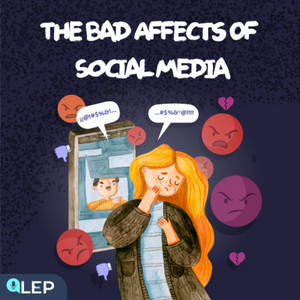
Today's topic is serious but super important, how social media affects our mental health.
Don't worry, we'll keep it simple, real, and hopefully helpful.
And, yes, I promise to only tell some bad jokes.
Let's begin with a story.
Emma is 15. She used to be a happy, active student.
But in the past year, things changed.
What happened? She started spending five to six hours a day on social media, scrolling through Instagram, seeing perfect pictures of her friends, comparing herself.
Slowly, Emma started feeling like she wasn't good enough.
She became sad, stopped talking to people, and her grades dropped.
This is not just Emma.
Yeah, a lot of young people feel this way.
Research shows that depression rates have increased by 60 % in teenagers.
And sadly, the suicide rate for teenage girls went up by 30 % between 2010 and 2021 — the same time when smartphones and social media became popular.
OK, that's scary, but why is this happening?
Let's discuss more about this.
During the COVID -19 pandemic, things got worse.
A U .S. report in 2021 showed that teen screen time increased by 81 percent.
Yep, everyone was stuck at home.
So, social media became the only way to connect, but too much screen time made people feel tired, sad, and lonely.
There's a name for this—Zoom Fatigue.
It means feeling tired and stressed after many hours of video calls or screen time.
Even though you're sitting, your brain is working really hard. You try to smile, look into the camera, listen carefully, and keep your energy up all at the same time.
I used to feel more tired after online school than a full day at real school.
And it didn't stop when school ended.
Many teens started checking their phones right when they woke up and right before sleeping.
That habit is dangerous.
Your brain needs time to rest. If you look at bright screens before bed, your brain thinks it's still daytime.
That makes it harder to fall asleep and can confuse your body clock.
What doctors call the circadian rhythm.
And if your sleep is bad, your mood is bad.
You feel tired, stressed, and sometimes even hopeless.
OK, Gwen. Now let's talk about the brain.
Yes, the brain, especially the teenage brain.
It's still growing and changing a lot.
Right. You know how a cake isn't ready if you take it out of the oven too soon?
Well, teenage brains are like half -baked brownies.
Still warm, still gooey, still figuring things out.
Ha, ha, exactly. And one very important part is called the prefrontal cortex. It helps with smart decisions, controlling emotions, and thinking about the future.
Which is why teens sometimes think, Should I study for my exam or watch ten hours of TikTok?
Yes, because the prefrontal cortex doesn't fully develop until around age 25.
25? That explains why I kept texting my ex at 2 a .m. in college.
Haha, maybe. So because that part of the brain is still growing, teens feel emotions more deeply and care more about what others think.
It's not weakness. It's wiring.
Teenage brains are like emotional roller coasters with no seat belts.
But do you think this has anything to do with gender, Gwen?
Yes. Studies show that teenage girls are more affected by social media than boys.
A question for you.
Why do you think that is?
Hmm, because girls have better fashion sense?
And boys just wear the same hoodie all week?
Close! But it's more about comparison.
Girls are more likely to compare how they look—to models, influencers, and even classmates online.
Ah yes, the scroll of doom.
Look at her skin, her hair, her vacation, her perfect cat.
Meanwhile, I'm eating cereal in my pajamas at 3 p .m. And girls often care more about relationships and social connection.
So, when they feel left out or don't get likes, it really hurts.
So, the same app, like Instagram or TikTok, can be fun for one person, but painful for another.
Boys are affected, too, but usually in different ways like gaming addiction, online bullying, or anger.
So, basically, no one's safe unless you're living in a cave with no Wi -Fi.
But let's be honest, even then you'd probably still try to connect to your neighbor's signal.
Haha, true. But seriously, girls aged 12 to 17 are especially at risk for anxiety, depression, and low self -esteem from social media.
That's why we need to talk about this.
Not to scare people but to help them understand – and maybe be a little kinder to themselves.
Exactly. Learning how the brain works helps us protect it and each other.
We've talked about the brain.
Now let's step into the wild world of social media platforms. Buckle up because not all platforms are created equal.
Totally. Each one is like a different planet with its own rules, vibes, and traps.
Let's start with Instagram.
Ah yes, Instagram, The land of perfect sunsets, six -pack abs, and people drinking coffee on balconies you can't afford. Exactly.
It's all about perfect photos, filters, and flawless poses.
And that constant pressure to look good?
It's linked to the highest rates of body image issues in depression, especially in teenage girls, as we discussed earlier.
Because when everyone looks like they just walked out of a fashion magazine, you start to feel like your real life isn't good enough, even though you're just a normal human being.
Now let's move to TikTok.
This one is tricky.
It's fun, it's fast, it's funny, but it's also super addictive.
TikTok's algorithm is like a mind reader.
Give it 40 minutes, and it knows more about you than your best friend.
I watched one cat video, and suddenly my feed was 90 % cats wearing sunglasses.
That's the thing. TikTok uses short, fast videos that give your brain quick hits of dopamine, the feel good chemical.
But it's not always harmless, is it?
Yeah. TikTok can quickly take you from something innocent, like healthy recipes, to extreme diet tips, or even eating disorder content.
It's all because of how the algorithm works.
It's like falling into a rabbit hole.
One second you're watching someone make avocado toast, the next you're thinking, Should I stop eating carbs forever?
Relatable. Then we've got Snapchat.
A lot of teens love it for quick chats and funny filters, but there's pressure too.
Oh yes. Streaks. You message your friend every day to keep your streak alive.
One missed day and boom.
This streak also happens in chats between friends on TikTok.
It turns communication into a numbers game.
That daily pressure to reply can make you anxious, even when you don't feel like talking.
Now Facebook, is that still a thing?
Gen Z doesn't really hang out there anymore, but their parents and teachers sure do.
And don't forget your aunt posting 22 vacation photos in one day.
you're reaching the right decision makers.
You can even target buyers by job title, industry, company, seniority, skills.
Wait, did I say job title yet?
Get started today and see how you can avoid the void and reach the right buyers with LinkedIn ads.
We'll even give you a $100 credit on your next campaign.
Get started at LinkedIn .com slash results.
Terms and Conditions Apply.
This podcast is brought to you by Aura.
By the time you hear about a data breach, your Our information has already been exposed for months.
On average, companies take 277 days to report a breach. That's nine months where hackers have access to your personal data.
That's why we're thrilled to partner with Aura.
Aura is an all -in -one digital safety solution that monitors the dark web for your phone number, email, and social security number, sending real -time alerts if your info is found.
It also includes a VPN, password manager, and data broker removal to help keep you safe.
For a limited time, Aura is offering a 14 day free trial plus a dark web scan to check if your personal information has been leaked.
All for free at Aura .com slash safety.
That's Aura .com slash safety to sign up and protect your loved ones.
That's A -U -R -A .com slash safety.
Terms apply, check the site for details.
Jokes aside, all these platforms have one thing in common. They're designed to keep you scrolling.
Right. Ever heard of variable rewards?
It's like playing a slot machine.
Sometimes you post a photo and get tons of likes.
Other times crickets.
That unpredictable reward system makes your brain go, maybe next time I'll win big.
So you keep checking and scrolling and refreshing again and again.
And the companies behind these platforms?
They know this. Internal documents like the famous Facebook files show that meta knew about the negative impact on teens.
But they chose to focus on engagement instead.
In other words, likes over lives.
Harsh, but kind of true.
That's why it's important to understand the design behind these platforms. They're not neutral tools, they're engineered to capture your attention.
And keep it. Okay, we've been talking about the impact of social media, but now it's time for the facts.
Not feelings, not rumors.
Just cold, hard science.
Brace yourselves. The data might just surprise you or scare you a little or both.
A study from the University of San Diego analyzed over 200 ,000 teenagers and found that those who spend more than five hours per day on electronic devices are 71 % more likely to have suicidal thoughts or behaviors.
71 percent. That's not a little bump.
That's a full -on red alert.
And it's not just this one study.
Researcher Jonathan Haidt analyzed data across 40 countries and found that social media's impact varies a lot depending on cultural context.
Like in many Asian countries, there are stronger protective systems, family ties, strict school structures, more afterschool programs. These ways help reduce the damage.
But what about countries where teens are more independent and online more often?
The effects are much harsher.
So if we want to protect young people, what should we do?
We need more than opinions.
We need data. But here's the catch, that data is locked inside big tech companies.
A former employee, Frances Haugen, leaked internal research showing that Facebook knew Instagram was harming teenage girls' body image.
They knew and still did nothing.
Why? Because fixing it might have meant fewer likes, fewer hours spent scrolling, fewer profits.
But it's not all dark.
Some universities are creating secure programs where researchers can access anonymous social media data without violating user privacy.
And some governments aren't waiting.
The US is discussing a law called COSA, Kids Online Safety Act.
It would force platforms to give researchers access and assess risks.
That's great information, Leo.
Europe's already ahead with the Digital Services Act, requiring platforms to be transparent about algorithms and content moderation.
And in California, they've passed laws that force companies to design digital products with kids in mind.
It is called the California Age Appropriate Design Code, right?
Bingo! All right, parents, teachers, this one's for you.
You're basically the digital bodyguards for your kids.
Yes. There are awesome tools out there.
Apps like Bark, Custodio, and Apple Screen Time let you monitor screen usage and even filter dangerous content.
I tried to outsmart Apple Screen Time once, and I failed miserably.
There's also the movement, Wait Until Eighth.
It encourages parents to delay giving smartphones or access to social media until at least eighth grade.
Which is genius. Give kids time to develop emotional muscles before throwing them into the chaos of the internet.
If you're a parent listening, maybe ask yourself, Is my child ready for social media or am I just giving in to peer pressure?
And let's not forget teachers.
Finland leads the way with a national program teaching students how to spot fake news, check sources, and use social media responsibly.
Digital literacy is the new life skill.
Healing is a very important part of this because, once the damage is done, we need mental health support.
And if social media has already made you feel anxious, sad, or stressed, you're not alone.
You don't have to deal with it by yourself.
That's right. many schools now have something called School -Based Health Centers, or SBHCs.
They're places right inside the school where students can talk to a counselor if they're feeling down or overwhelmed.
And the best part? You don't have to wait months or deal with confusing paperwork.
You can just get help.
And some colleges, like Stanford, even have classes on something called digital wellness.
That's just a fancy way of saying they help students learn how to use phones in a healthy way.
We're not saying you have to delete every app or disappear from the internet.
We're just saying you can be in control, again.
Not the phone, not the algorithm.
You. So what does the future look like?
Is there hope? Always.
People are waking up to the dark side of social media.
And now, they're working on smart, kinder solutions.
Some apps are starting to hide like counts, or limit endless scrolling.
And when you've been on for too long, they might give you a gentle nudge like, Hey, maybe go outside for five minutes.
Imagine your phone saying, drink some water, touch some grass.
Now that's the kind of notification we need.
Straightforward but real.
There's also talk about using AI to protect users, like detecting harmful content, or even signs that someone might be feeling depressed.
And governments are stepping in, too.
Some experts say platforms should pass a safety check, just like food or medicine, before they launch new features.
There's also the idea of setting age limits based on brain science— like no social media under 13.
And between 13 and 16?
Maybe use it but with limits.
Oh, and here's a wild one.
Some are even talking about a screen time tax.
So the longer an app keeps you hooked, the more they pay.
That way companies might start designing apps that respect your time.
That would be a huge shift from how long can we keep them online to how can we help people live better lives.
So, yeah, social media isn't all bad, but it's powerful.
Don't let the bad effects of social media on your mental health.
If you're listening to this and struggling, maybe comparing yourself, maybe feeling stuck, know this...
You're not weird, you're not broken, you're human and you're definitely not alone.
Talk to someone. A friend.
A parent. A teacher.
A counselor. You don't have to fight the algorithm alone.
And hey, if your phone's stressing you out, try putting it down for a bit.
Stretch. Hug your dog.
Call your mother. She misses you.
Thank you so much for joining us today.
If this episode helped you, or made you smile, share it with someone you care about.
We've got more coming.
So hit that follow button.
But only after you've taken a break.
Deal? Deal. Until next time, breathe deep.
Be kind to yourself.
And don't let the scroll control your soul.
At Planet Fitness, we're declaring it.
This is the year of getting stronger, and you can get started now by saving when you join today.
We have all the best in -class equipment you could ever need, and you can work out your way on your time at any convenient location near you.
Most open 24 hours.
So let's do Join Planet Fitness today and save. Just one dollar down, 15 dollars a month.
Offer ends May 16th.
See Home Club for details.
This podcast is brought to you by Aura.
Imagine waking up to find your bank account drained, bills for loans you never took out, a warrant for your arrest, all because someone stole your identity.
Hackers aren't waiting, why are you?
That's why we're thrilled to partner with Aura.
Your personal data is a goldmine for hackers and Aura helps lock it down.
Aura monitors the dark web, blocks data brokers from selling your information, includes a VPN for private browsing, and a password manager to secure your accounts before criminals break in.
For a limited time, Aura is offering our listeners a 14 -day free trial plus a dark web scan to check if your personal information has been leaked.
All for free at Aura .com slash safety.
That's Aura .com slash safety to sign up and start protecting yourself and your loved ones.
That's AURA .com slash safety.
Terms apply. Check the site for details.
A -Cast powers the world's best podcasts.
Here's a show that we recommend.
Remember blowing into a video game cartridge or taping songs off the radio?
How about Saturday We are Mike Filoia and Charles McB.
Two comedians getting nostalgic and asking their nagging question.
Are we old? Relive the laughs, the cringes, and the nostalgia.
Are we old? Podcast right here on ACAST. a cast helps creators launch grow and monetize their podcast everywhere a cast calm