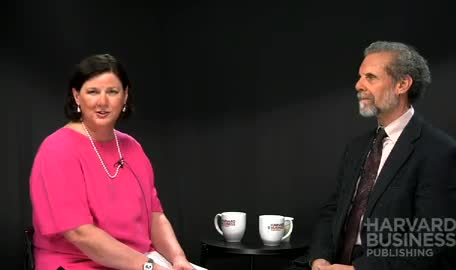
Hello, I'm Diane Kutu, senior editor at Harvard Business Review.
And I'm delighted to have today as my guest Dan Goleman.
Dan is a psychologist known around the world for his expertise in social and emotional intelligence.
He is also the co-author of the Harvard Business Review article Social Intelligence and the Biology of Leadership.
Dan, welcome to the program.
Thanks.
It's a real pleasure to be here.
Great to have you.
Dan, we've invited you because we want to talk about social and emotional intelligence and how they affect organizations and leaders.
So let's just start at the beginning.
Emotional intelligence, what is it and why is it important for us?
Emotional intelligence refers to how we handle ourselves.
Are we aware of our feelings, our passions, the things that turn us on, the things that turn us off?
What makes us effective, what gets in the way?
And also how we manage our emotions.
Do we let things interrupt our ability to focus, to get work done effectively or not?
And empathy, recognizing other people's emotions, knowing how the other person sees things, how they're feeling, and using that all to interact with people effectively.
You know, your work has changed how leaders and businesses do their work around the world.
Can you think of a leader who's changed how he's done his work or how she's done her work, based on your insights into emotional intelligence?
Well, I hear about hundreds, but I can't name any.
I can think of a very highly placed executive who was hearing from direct reports that things weren't going so well.
The messages came, for example, in the form of people leaving, as well as a lot of grumblings.
And it turned out that when he really faced what was going on, people were saying you just don't listen, you just tell us what you think.
You say you want to hear what we know, and we know a lot, but you don't really seem to care about it.
What he had to do was get better at the social intelligence ability of listening, of tuning in to other people.
And it's a real problem for many executives because, of course, you know a lot, but you don't know everything.
But because you're the boss, people defer to you.
So they start listening.
But the really excellent, the outstanding leaders we find are people who first listen and get other people to say what they think and what they know.
And then to put that all together for a higher order integration, that's real leadership.
That's what he had to learn.
And through coaching, he was able to change.
And his business performance.
The performance of his unit was much, much better afterward than before.
So the level of a leader's emotional intelligence affects organizational performance.
We have so much data now about 10 years of accumulated data from organizations of all kinds, showing that there's a direct correlation between the emotional intelligence of leadership at every level and how that organization performs, by whatever performance metric you want to use.
Well, but it seems to me that leaders often think they have more emotional intelligence than they do.
How do you begin to assess your level of emotional intelligence?
Actually, I think we all think we have more emotional intelligence than we do.
One of the most brutal ways is to ask your teenage child.
But at work, what you can do is ask other people.
Because it turns out that we ourselves are not the best gauge of how we're impacting other people.
But other people, if you can get them to be candid, can tell you what your strengths are and we all have them and what you can get better at.
And that's the most interesting, valuable information, because that's where any leader can get a bump in improvement.
By getting better, say, at listening, as that executive did, you can become a more effective leader.
And therefore because you depend on other people for your success.
By getting better at listening to them, helping them develop, helping them do their jobs well, the whole organization benefits.
Interesting.
Dan, you talk about emotional intelligence and I'm very curious how you got from that to social intelligence.
Well, emotional intelligence.
When I first wrote it was prompted for me by a new breakthrough in brain science, in our understanding of the emotional centers of the brain and how that affects our ability to think well.
It turns out that when we're upset, it hampers our ability to process information, to think creatively.
We fall back on over-learned primitive behaviors, and it makes us dysfunctional.
But if we're passionate about what we're doing, if we're motivated or in the throes of positive emotion, we think very, very clearly.
So there was immediate, obvious implication for business there.
And I wrote about that.
My new work on social intelligence has been stimulated by the same thing.
Big breakthrough in brain science.
Now they're studying not just one brain and one body and one person, but two, the interaction.
We're finding out that this is the key to why a leader like Herb Kelleher at Southwest was so spectacularly successful in growing that airline.
We've been looking at video of Herb Kelleher just walking down the aisle hallway at Love Field in Dallas and it's as though there were a circle of good feeling radiating around him wherever he went.
Everyone passengers personnel, you know passers-by all of a sudden light up and beam because he was someone who engaged people, who was positive and who let you know that he was tuning into you and he was doing it with such positivity that it was contagious for you.
Now, how about leaders who don't have that natural born instinct?
How can they use your insights on emotional and social intelligence in order to improve their leadership expertise?
First of all, for leadership, it's social intelligence that our data is showing counts the most.
Social intelligence is being able to tune into other people, to read them, to know how they're thinking about things, what they're feeling right now, and using that to communicate effectively with them.
And the good news is that, even though we learn our habits for example, what kind of listener are you?
We learn those early in life.
We can change them at any point if we're motivated, if we know what to do and if we have a little help.
So there's an easy five-step process basically for enhancing social intelligence abilities in a leader.
First, the question to ask yourself is, do you care?
Are you motivated?
Because it's going to take a little effort.
Second, get some feedback.
It's not, you're actually probably the worst person to judge where you need to improve.
You need to ask the people around you in a way where they can be candid, they can be honest.
And that's often with a 360 device where they anonymously rate you.
You don't know who said it, but you're getting the truth.
You look at that profile And you identify your strengths, your weaknesses, where I can get better, where can I get a bump?
Then you make a learning agreement with yourself to do it in a better way at every naturally occurring opportunity.
If you do that for a few months, you see real change.
So how can a company use social intelligence in order to increase organizational performance?
So many companies are doing that now.
I just spent the morning with a group where a national insurance company, a global pharmaceutical company, a world famous medical center were all doing the same thing with emotional intelligence.
They're using it to enhance the effectiveness of their leadership, but also to change the culture.
And the way they're doing it is by integrating it into the HR function.
They're trying to hire people who have these abilities already.
That was the strategy that Southwest used.
They looked for people who were like Little Herb Kelleher's.
And it worked great.
It worked beautifully for them.
They're promoting for these abilities.
It becomes part of how you're evaluated and part of what's looked for in taking people to the next level in the organization.
And they're also putting a lot of effort into individual development to help everybody grow these abilities to a greater strength.
So if we were to go back and sum up for our audience today, you would say the difference between emotional and social intelligence is
Emotional intelligence really has to do with self-mastery, how you handle yourself.
And it makes outstanding individual performers.
There are so many people in the world of work that are excellent, but they're excellent because of their own efforts.
And they have very good discipline.
They have very good motivation.
They have drive.
These are individual abilities.
But when it comes to leadership, your success depends on everyone else's being effective.
So you need to be successful by influencing persuading developing growing inspiring, motivating other people.
That's the social intelligence ability.
It requires empathy and requires skilled interaction, and that's what makes a great leader.
Dan, one of the problems that companies really have is figuring out how to hire people, because it's so difficult to hire people and know what their emotional and social intelligence levels are.
So how do you go about trying to find little Herb Kelleher's?
Well, first of all, if you're looking for a Herb Kelleher type, you have to expand the criterion, because Herb was a unique individual.
He was extremely extroverted, extremely up.
But social intelligence doesn't always look like that.
One of the sure signs of social intelligence is rapport.
You feel comfortable with the person.
You feel they're paying full attention.
You feel they are really listening to you.
They're really attuning.
They're really empathizing.
And we all know what that feels like.
We feel felt.
When you're with someone like that, you have chemistry.
That's one of the sure signs.
Dan Goleman, thank you very much.
Diane Cotu, it was a real pleasure.
Thank you.