Discussion keeps the world turning.
This is Roundtable.
You're listening to Roundtable with myself He Young.
I'm joined by Yu Shun and Steve Hatherly in the studio coming up.
Spaniards have their siestas and the Chinese take our lunch naps.
Both are about the midday recharge.
With recent research suggesting that napping could delay brain aging, do you think we're on to something?
That these cultures have known all along.
And is eating in front of the TV a guilty pleasure or a hidden health hazard?
While it's tempting to enjoy a delicious meal while binge -watching your favorite show, could that distraction lead to overeating or eating too less?
Our podcast listeners can find us at Roundtable China on Apple Podcast.
You can reach us via email.
Roundtable podcast at qq .com.
Now, all right, let's shift gears into a different topic.
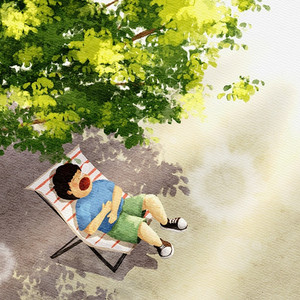
In China, the napping culture persists.
Extending from the curb all the way to sometimes even the corner office.
Kindergarteners have it down to a science.
Lunch, play, nap, repeat.
By the time they enter the workforce, their seasoned nappers fully prepared to uphold this cherished tradition.
City dwellers in Shanghai and Zhejiang, though, might scoff at the notion of a lunch and nap schedule.
There's too much pressure to stay alert and productive for work.
Why not take a cue from the 70 % of respondents in the 2023 China Health, China Healthy Sleep White Paper released by the China Sleep Research Society and embraced the joy of napping.
What more do we know about these napping figures in China?
So the study actually found folks in central China's Hunan province naps the least, which is about 48%.
Then comes mega city like Shanghai, which is 49%.
And eastern China's Zhejiang province comes in third and doesn't nap that much in comparison to others, which is 58 .7%.
Wow, those numbers are still pretty high though, you know, talking about, oh, they're last on the list in Hunan province, 48 .4 % of people nap.
Oh, Shanghai? No, they're super low on the list.
Only 49 .6 % of people taken up.
That's half of the people in Shanghai that take a nap on a regular basis.
No, may I just also say that are the respondents.
That's true. Yeah, because when it's lunchtime and you walk around, there are some people napping, but certainly there are plenty more who are not.
Oh sure. I'm just suggesting that it's still pretty impressive the numbers and it is a sign that napping culture here does exist, which by the way, I'm in full support of.
And also one interesting thing is that white paper also indicates that Guangdong in southern China ranks first in nap duration with an average of about 40 minutes, while among those who nap, the average nap timing, Shanghai, Zhejiang, and Jiangsu is under 35 minutes, placing them in the middle range.
And actually I think 35 minutes is not that short.
It's basically the average length of a nap.
It depends on how long it takes you to fall asleep, but 35 minutes is a pretty good nap.
Yeah, that sounds like a power nap.
And for us who are on roundtable, we never get to nap.
And I've not taken a lunch break for 10 years because the show goes out live at 1 p .m.
Beijing time. So it kind of also depends on your work.
So why aren't Hunan, Shanghai, and Zhejiang residents so keen in napping?
The regional differences in napping habits are quite complex.
You know, it is influenced by factors such as the level of economic development and social customs, and a common experience plays a significant role.
The faster the pace of their lives, the harder it is to maintain a napping habit.
Just like what is happening in this studio, right?
If you have something to do in the afternoon or at noon, you cannot have the time to nap.
I mean, I've heard of, everybody knows, right?
In Spain, the siesta.
For a few hours after lunch each day, the city kind of calms down, the cities around Spain calm down.
Although I was reading that that part of their culture is starting to disappear a little bit.
What I was surprised to find out was that China had a napping culture.
I'd never heard about it before.
I've seen it, you know, walking around, not on the streets or anything like that, but I've seen people working in shops after lunch.
You know, where's the worker?
And then you look behind the counter, oh there they are, taking a little nap.
That's awesome. But I didn't know it was connected to a napping culture here.
What's the, what's the reasoning behind the the Chinese nap culture?
I was thinking about this and especially in hot summers, see when you go into the streets, you will see, you know, the street with shops are quite vacant.
People are just inside and taking a nap.
So when I, so I was thinking back when I was in maybe kindergarten, you know, this probably a habit that formed from a young age.
First of all, starting from kindergarten, there is a nap time to ensure the children's sleep quality or nap or sleep time.
We have that in Canada too.
Yeah. And then in elementary school, it might also be related to the length of the school day I was thinking, which is quite long from maybe seven to eight in the morning and then to four or five o 'clock in the afternoon.
Okay. Which means a mid break is quite necessary for the students to rest and be to be recharged, I think.
So because I know in some countries where schools ends earlier, the shorter school day might make napping less necessary.
Yeah. In Canada, I went to school from 9 a .m.
to 3 p .m. and that's including recess in the morning and also including your one hour for lunch as well.
So yeah, we were never given a nap time and I don't think it was necessary to be honest.
And also, where do you sleep?
Yeah, right. Well, anywhere if you're tired enough.
On the desk or, you know, a lot of students, right, I mean, back then we have a little pillow we brought with ourselves and then we put on the desk and then we just crouch and sleep.
So you have your face down to sleep and sort of get a little shut -eye.
However you are comfortable with.
Uh -huh. Maybe you're just sighted in your face.
With your cheek on your desk.
It's good for you, right?
There's plenty of reasons to take a nap.
There's been lots and lots and lots and lots of studies that have told us why it's good for us.
And we do know that there's napping cultures from around the world.
I was looking for ones that I didn't know before our discussion today.
And like I said, I'm familiar with the one in Spain.
What I didn't know is about the one in Scandinavian countries.
Iceland is an example.
Finland is an example as well.
In Scandinavian culture, this might be shocking to you.
Even babies as young as two weeks old take a nap.
That's not the shocking part.
The shocking part is where they take a nap.
Outside, even in the wintertime.
So in Sweden, for example, I was watching a video series and they'll say it's quite common to see baby carriages outside a cafe while mid -afternoon coffee time.
And they put the baby monitor inside the carriage with the baby.
And the baby's bundled up nice and warm, by the way.
And they leave them outside to sleep.
And there have been studies done in Finland by a university there claiming the benefits of sleeping outside because of the fresh air is good for your lungs and you sleep longer and you sleep deeper.
So that's learned from a childhood age in Scandinavian countries.
Aren't babies sleep 80 % of their time?
But it's common as they grow up.
They get used to that type of, because it's just a part of their culture there.
So are you saying that for grown -ups in these Scandinavian countries, they also take a nap?
Oh, they nap. But I don't think they nap outside in baby carriages.
I think that's, they don't have ones that are big enough for that.
But anyway, yeah, the outdoor napping habit, it was a public health initiative by Nordic maternity clinics in the early 20th century.
And like I said, they promote the idea of sleeping outdoors.
We don't have a napping culture in Canada, like I said.
They don't have one in America, as far as I know, as well.
If you look at stories about why napping culture doesn't exist in America, it's, they say it's about that grind, go, go, go attitude that they have for their workplace.
Well, then I think you may, you know, concern a little bit about the aging of your brain, because I saw from some of the studies.
The aging of my brain specifically.
Because, okay, according to this study, okay, this is a study from University College London and University of the Republic in Uruguay.
Uruguay, yeah. Uruguay suggests that regular napping might help delay brain shrinkage, potentially protecting against cognitive decline as we age.
So, on average, the brain volume difference between habitual nappers and non -nappers was equivalent to about 2 .5 and 6 .5 years of aging, which means that if you don't take a nap, your brain, your brains might be up to 2 .5 to 6 .5 years older compared to your peers who do nap.
And by the way, if you do nap, do you know how to nap properly?
You got to follow the 30 -90 rule.
What's that? Either nap for less than 30 minutes so that you don't fall into a deep sleep or the opposite.
Aim for a full 90 minutes, an hour and a half to complete one sleep cycle and then wake up refreshed.
So, either less than 30 or at least 90.
Oh, well, these are important figures to remember.
And apparently, if you nap, another benefit is you'll have lower risk for heart problems and it might even help you get into shape and it could boost your creativity.
Do you agree with these things?
I think so. You know, I was thinking, you know, I am someone who actually needs nap because sometimes I can feel really, really, you know, dizzy if I don't take a nap and the whole afternoon will be just out of control and I cannot focus at all.
But if I can have a 30 or 20 -minute nap, everything gets better.
You can get focused, you can get, you know, think about the things that you're going to do or just mapping the things that you're going to do.
Hmm. When you don't get enough sleep, do you feel hungrier?
Oh, hangry. Oh, really?
Hungry and angry. Then this study was correct.
It was a 2020 study that was focused on women that found the more sleep deprived women were.
I don't know why it only focused on women, but that's what they did in this study.
The more sleep deprived women were, the more likely they were to consume sugar or fatty foods or caffeine.
And according to that study, if you lack quality sleep, it could lead to overeating because if you're not getting enough sleep, it's said that it stimulates hunger and then suppresses hormone signals that communicate fullness to your brain.
So you feel hungrier if you're not sleeping enough or napping enough.
I'm a big advocate of this policy.
If you're hungry, eat.
If you're tired, sleep.
That's it. That's my theory about life.
If you're bored, do something fun.
You know what I mean?
Yeah. If things were just so clear and simple and we follow the Bible of Steve, yeah, things would just be a lot easier.
Yeah. I mean, listen to your body, I guess, is what I'm trying to say.
Your body will tell you, right?
I think that's a great point.
In today's very busy world, and I can't remember, there's a big, big word for it.
But basically, it's trying to encapsulate that we're becoming less and less connected with the true cause of our bodies.
For example, during summertime, we're in air -conditioned rooms, so it's cool.
Then we don't really know when your body actually maybe wants to sweat to let out the toxins or whatever, but staying in close contact with the true cause of your body, I think, is just increasingly difficult when we're living in concrete jungles, so to speak.
And also, I wonder though, yes, maybe your work demands you to behave a certain way.
Otherwise, you don't get your work done.
I'll take our job as an example again.
Can I change when this show goes out live?
No, I can't. So therefore, sorry if I may just indulge in using myself in the example again.
Your biological clock has been trained, because you know, you must be most alert, you need to perform at top form as you can at one o 'clock every day.
And therefore, I'm sharpest at this time.
And I'm drowsy after four, I think.
Ah, there's your nap time.
4 p .m. by the sounds of things.
But can you take a nap?
No, you can't. So therefore, you're just used to this kind of rhythm now.
I think there's a stigma, too, with napping.
People think if you take a nap, you're lazy.
Oh, really? Hold on.
I don't agree with this at all, but I think there seems to be a negative connotation that comes with napping.
Like it's for babies and the elderly, and if you're not in one of those categories, then you're being lazy.
And is this a cultural difference?
We see what Steve brings to the table.
And what about you, Yuxuan?
Do you see or do you think that Chinese people perceive napping as maybe you're not being very professional?
You know, in some way, because you just said at four o 'clock, maybe the time that you I'm tired or body feels like you need a nap, but you said, I can't.
But why you can't? Because, okay, you were in the office.
Oh, you guys are like hounding me, putting me on the spot like this.
I think that is why maybe we have that kind of mindset that, okay, if you are sleeping in the office, then when people are seeing you unconsciously and then you get to sleep, then it's probably the way that people treat, okay, you look a little bit unprofessional because you are not doing your job.
But I disagree with that.
Yeah, you're not saying that you agree with that.
You're just saying people might perceive it that way.
I agree that people might perceive that, but I also disagree that if somebody in the office needs to close their eyes for 10 minutes or 15 or 20, then do it.
It means you're tired and you need it.
So go for it. I've also thought about this issue before because I really need and like to take a nap when I need it.
But later I consider that if I don't take a nap, it could lead to a decrease in work efficiency, which might have more serious consequences if I don't.
Oh, that's a really good point.
And you've almost got me convinced.
You can justify it anyway you want.
For better efficiency.
Listen, at four o 'clock this afternoon, we'll get you a little binky.
We'll get you a soother and put on some soft music and you can drift away to Dreamland for 20 minutes.
That sounds so nice.
And not feel guilty about it.
And yes, I think that's the most important part.
And actually in some of those fancy tech companies or whatnot, they're promoting a napping pods or napping areas for people to get a power nap if they need it.
And I think, yeah, that sounds really nice.
Yeah, let's all go back to our kindergarten days, please.
Life never gets better than when you're three years old.
That's so true. Coming up, is eating in front of the TV bad for you?
Stay tuned. Looking for passion?
How about fiery debate?
Want to hear about current events in China from different perspectives?
Then tune in to Roundtable where East meets West and understanding is the goal.
It's the hour of Roundtable with myself He Young.
I'm joined by Steve Hatherly and Yuxian.
Sitting down to your favorite show with a plate of yummy food for you to eat while you watch sounds pretty good, doesn't it?
But could the distraction of watching while eating lead you eating more, either at the time or even later?
Some research suggests it might lead you to eat less or not at all.
And there is plenty of research to suggest it tempts us to feed our tummies way more than we actually need.
Yeah, so do you eat and watch something at the same time?
I do, yeah. I'm putting on a drama or some kind of show while I'm eating something.
Yeah, I do that almost all the time, actually.
I actually didn't have that habit back then, but now you do.
I do because back then I finished my meal just so quickly, even before I can find something to watch.
But after, you know, my family has a habit of, you know, not starting their meal until they've found something to watch.
So I gradually developed this habit too.
So you say in your household, when you're dining with mom and dad, you have the TV on.
Yes. That's like a sin in my household.
Oh us, you know, chatting a little bit, asking about how is your day, having a family moment and no TV and intrusion whatsoever.
Well, this is from the BBC.
Monique Alblas, who is an assistant professor of communication science at the University of Amsterdam, wanted to know about the connection between eating and watching television at the same time.
Scientists have known for a long time that our bigger environment, our wider environment plays a really key role in our diet.
That's not a surprise.
And there's a lot of research that shows there's a link between watching TV and a higher risk of obesity, largely due to lower levels of exercise that come with the sedentary behavior, you know, not moving around, always sitting on the sofa.
But that doesn't exactly explain the connection between watching TV and eating at the same time.
But here's the deal.
According to Monique Alblas, watching TV may also be affecting how much we eat too, because being distracted is one of the leading theories behind why we may eat more when we're watching our favorite show.
You know, there is a term online.
Now you call these thing as electronic pickles or tien zu jia, it's hot.
So because pickles are often eaten with meals, right?
And then these are like your electronic pickles when you are having your meals.
And in this way, you're eating more without even noticing that you're eating more.
Yep. And one, I think, important thing that we need to mention is that eating more or while distracted can lead you to eat something that you shouldn't eat.
Yes, exactly. You hit the nail on the head.
That's exactly what Monique Alblas found when we are too into a plot, right?
Let's say you're watching a really great movie and you're eating at the same time, when you're super into the story, then you're not paying attention to what you're eating.
So you're not aware of your body's signal telling you that you're full.
So you just keep eating and eating and eating.
That's also research suggesting that we don't remember what we've eaten when we're consuming food in front of the TV.
And then we can't estimate what we have eaten already and what we need to eat later on in the day or later on in the evening.
And that could lead us to eat more in the evening because we weren't paying attention to the quantity of food that we were eating when we were watching TV.
That is so true. And also, this is interesting.
Maybe for the fact it might coincide with the habit of so many of maybe our potential listeners or folks who lead a busy life in the big cities in China.
A lot of us are living on our own and then you gradually get into this habit that is you don't want to feel lonely being alone.
And therefore, after a long day of work, you come home, you put the TV on, or you put your iPad on, or I've seen people watch from their big screen smartphones in restaurants eating alone because you want something to be on of your choice and keeping you company.
And the result of that, while you're eating, is you don't know, you don't pay attention what you're putting into your mouth.
Yep, exactly. There are some actually reports, you know, women who accidentally swallowed a date pit that punctured her stomach wall, which is serious.
Because not paying attention to the food.
Yes. And that is why a lot of doctors are suggesting that we need to eat slowly and chewing thoroughly and avoiding distractions like watching TV or using a phone.
Yeah. And another thing that they say, this is another study done by a researcher named Flor van Meer, a data science researcher at Wageningen Food Safety Research in the Netherlands.
And Flor van Meer found a connection with this.
When you're not paying attention to your food, you don't get the same level of satisfaction from the food.
So when you're done with that food, your brain says, huh, I'm not quite, I'm not happy yet.
Give me some more because you're not satisfied with the food that you've eaten because you're not paying attention.
Now, so far, we've only spoken about paying attention and being distracted.
Let me ask you this question.
Do you think it matters what you are watching?
Like a sad drama or a horror movie or a comedy?
Do you think there's any connection there?
It's a very good question, but I'll push it to the extreme as an example.
I know a friend who watches Hannibal while she eats.
Oh dear. Hannibal the cannibal.
Not where we want to go to, but yes, I would think that, well, if you're super into this show or it's like so much suspense that's keeping you glued to the plot, the screen, then I'll probably eat more.
It's not necessarily about paying attention to the screen.
There's a theory out there that says humans always are trying to meet a hedonic goal.
And that means that we expect to get a certain amount of pleasure during any given day or any given activity, including food.
And if we don't achieve that, then we seek it elsewhere.
So my point is, according to this theory, if you're not satisfied with the show that you're watching, if the TV show doesn't live up to your expectations, you're not getting that hedonic goal satisfied.
You're not getting that level of pleasure that your brain is seeking out every day.
And if you don't get it from the show or the movie, you're going to try to get it from food and eat something else.
Does that mean, though, I'm paying a little bit more attention to what I'm eating then, since I'm not being so satisfied with the visual cues that I'm receiving.
And then if I know that, okay, this comes from personal experience once when I was still a student in London, living by myself, and I got this whole big discounted cake back home from Waitrose, which is very nice.
And it was meant for, my plan was at least three servings for three days.
Guess what? I was watching Come See Lila, which was a very fascinating reality show at the time, was laughing, having so much fun with it.
I ate up the whole big cake for six people at one setting.
Oh, really? So I guess I really enjoyed it, and then I ate a lot too.
And you weren't paying attention.
When we go to a movie theater and we get a giant popcorn, we're not paying attention to that popcorn when we're watching the movie.
And you just keep going through the motion hand in bucket, hand to mouth, hand in bucket, hand to mouth.
Anyway, take what you want from this research.
Take what you want from the study with a grain of salt or with a grain of sugar, maybe we can say here as well.
Since we're speaking so many about brain, because I think back then, our parents just taught us not to eat while watching because the brain will just be influenced while you were watching TV, and then it will affect your, I mean, digestion.
Oh, there you go. Yeah.
And also pay attention.
If the character is eating on screen, you're likely to eat with that character.
And also if the program is a quick action film, according to the study results, you're probably going to eat more there too.
And we don't have time to get deep into this, but there's a book called Mindless Eating, published in 2006.
It Changed My Mind.
It tells you to, well, just advises you to be more mindful and be connected with the food that you're putting into your mouth.
And that brings us to the end of today's round table.
We'll see you next time.
Nap time for Hyung.