You're listening to Roundtable with myself, He Yang.
I'm joined by Steve Hatherly and Yu Shun in the studio.
Coming up. Instant noodles used to be the default travel snack in China.
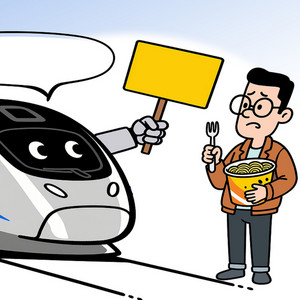
But some high-speed rail stations now have stopped selling them, saying the smell bothers others. from cup noodles to noisy kids and dusty work clothes.
Public transport is becoming a stage for clashes between personal choice and collective comfort.
So, whose comfort should come first? Need a boost to crush the week?
Our special segment Motivational Monday is your ultimate adrenaline shot to kick things off strong our podcast listeners can find us at roundtable china on Apple podcast.
Got a question that's keeping you curious from social issues to tech and everything in between.
Let us take a stab at it. Email us at roundtablepodcast at qq.com.
Emails are fine, but voice memos are always a tad better because we're a radio show slash podcast after all.
Now on Round Table. For Chinese train travelers in the 1990s, 2000s, and even the 2010s, a boiling hot conversation cup of instant noodles was the default quick fix on long journeys.
But how things have changed now. Guangzhou East Railway Station stopped selling them in its shops, saying the strong smell could disturb fellow passengers. with the caveat that individuals can still bring their own.
Yet cup noodles are only one of many disputes in a closed public space. complaints about children shouting endlessly without parental discipline, or prejudice against workers boarding in dusty clothes after a long workday show how public transport has become a flashpoint for everyday frictions in these confined spaces where strangers sit side by side Even small personal choices, how we eat, how our kids behave, or what we wear can clash with the so-called collective comfort.
So the question is, when personal freedom meets shared space, how much should we give away? to others.
So you should sum it up for us. What are the main disputes? on the public transport in recent years all about. basically is the thing that is selling instant noodles or not.
In this specific station, they're replacing them with dry mixed noodles.
I assume it's because... The dry mix ones give off rather like weaker smell.
Um, and then staff, they're confirmed if passengers want instant noodles, they'll have to buy them outside the station.
But in some other railway stations, Even though you... First of all, it's banned in buying... instant noodles in the railway station and then Even though you brought them into the carriage, passengers are not allowed to eat them on the train.
Yeah, I don't know if I understand this because I've been on the high-speed train. and the lady sitting next to me was eating a cup of instant noodles oh it was quite the recipe she bought a sausage that she had like she brought scissors and she was chopping the sausage.
Yeah. She was, she was cooking. She wasn't just eating.
She was cooking. Um, But anyway, I wasn't bothered by the smell of the noodles, not one bit.
But those were the dried cup noodles. What are we talking about here?
Like noodles that are... Pre-cooked, you buy them in the train station and then you bring them on to the train with you.
No, it's more like the classic instant cup noodles that I believe was... invented by some Japanese person years and years ago.
So basically, It comes in a cup or in a bowl, maybe some would say in plastic foam.
And then you unzip it and you pour in boiling hot water, which is provided on all treatments. trains in China and then you put the lead back seal it again and then just let it cook for like five minutes and then open.
Yeah. And it's now ready to eat and it comes with odor.
See, and also I've mentioned in the lead, for years, at least for Chinese millennials that was born in the 1980s and early 1990s, this was part of the childhood memory of traveling. on chinese trains well back then well those were the regular trains with the green paint and it was considered as a nice meal.
But now things have really changed. People are saying that, well, at least you've got a voice strong enough to let the railway authorities, at least of that particular station, say that, oh, actually, this is the smell is so strong for so many people apparently they don't like it and we wanna Yeah.
I mean, this isn't a nationwide thing, right?
Some are doing this. Some aren't. In certain train stations, certain locations, shops still sell instant noodles and passengers are free to eat them.
Interestingly, though, 12306, that's the official ticketing platform platform for trains here in China, they had earlier advised, it wasn't a regulation, it was just kind of advising passengers not to eat pungent foods like durian Or instant noodles on board.
Look, I'm okay with the noodles. Anybody brings a durian on board the train.
I'm taking the bus thank you yeah I'm actually getting into a quite nerdy direction in why people will feel so sometimes offended when they're smelling these kind of things.
One thing is that when people are eating it, it is quite different from people who aren't so your receptor of from your nose and your mouth will make you realize it is a pleasant meal.
But some people who are not eating it, they will only accept it by their nose.
In that way, people will feel differently.
Sometimes when you're eating it, you don't even smell anything.
Yeah. Yeah. Right. Yeah. You broke down the science of it.
I like that. But all of this has opened up this big debate here in China.
And the debate is, it's not about noodles per se, right?
It's the bigger debate is how to behave in spaces that are shared public spaces.
Yeah. I wonder if there could be another nuance about this.
For example, not just on the high-speed rail but also in the subway, we've heard these complaints about a fellow passenger eating baozi. or the steamed bun with the filling inside.
If we turn our attention to the subway, I think everybody can sort of empathize with the busy worker who's rushing onto the subway who haven't had breakfast and therefore had the baozi.
But apparently some people say, that potent, disgusting smell.
And I don't know, I just kind of feel like Can't you, like, be a little bit more understanding?
But I understand. Yeah, that's just, I think.
That's why not everybody actually agrees with, oh, there's a collective voice saying, back to the high speed rail example. that some people think that this is really acceptable having somebody, oh, like Steve,
You said you sat next to a lady who was having the cup noodles and it didn't bother you. but you also have this other group of people and they're particularly loud online, it seems like that they're saying, we don't want this at all.
And as if, anybody who's supporting having the cup noodles, the boiling hot cup noodles, on a train is like a completely different spaceship.
But I also understand that online, it's where disputes intensify and it doesn't necessarily reflect people's true behavior or thought in real life.
For those who don't live in China, you might not realize how heated a debate it is in China.
Do you have some thoughts about this about, you know, just why it touches a nerve for so many Chinese people when we're talking about this.
Yeah, when you are mentioning that's a kind of... individual behavior and a kind of collective expectation or state of mind when when you can be a little bit understanding to those people.
Of course, the trip is long and it is quite an easy way to get a meal on the train, right?
But when we're thinking about this, yes, this is kind of a personal or individual benefit when this people is eating instant noodles on the train.
Also, this is personal benefits of people who dislike it this is my like like attitude of, okay, I am on the train.
I am share a part of that public space. you are enjoying your meal.
Well, I also want to enjoy a very fresh air. understand that side too the only reason I wasn't bothered by the cup noodles is because I wasn't bothered by the smell of the cup If she had been munching on a durian, I would have very much been bothered by that, and I would have been... online with the Chinese netizens complaining that, about this.
So I understand 100% the other side. I'm Team Noodle.
But I do understand the other side where people can feel like this is a shared public space.
This is not your private kitchen. And therefore keep it to sandwiches, keep it to things that are cookies. potato chips, whatever.
Keep it to things that don't obviously have a smell that could potentially. offend someone else in the train.
Again, it's a shared public space. Yeah, and there's an interesting caveat there, too, that these so-called no-noodle suggestions or sometimes bands, at least you can't get them from the railway station shop.
It only occurs on high speed rail. And I did a little bit of checking.
Actually, the... average ticket price of high-speed rail is two to four times more expensive than the regular trains in China today, and we still have those regular slow trains in that iconic green paint.
And for those trains, you don't see this kind of ban.
And I would think that a lot of folks are still happily having their cup noodles and and there might be this subtle discrepancy I'm not even sure if that's the right word of a sociologist. economic difference here that is for high-speed rail although a lot of people take it but it's still a certain section of the population with Sorry to interrupt, but if that – by that logic then – the Baozhou subway story wouldn't be relevant, right?
Because everybody takes the subway too, but people were offended. people were offended there.
Well that... Okay, I... I'm not sure if I follow immediately, but let me just continue on my sort of thread of thought here.
That is for those who've already paid more, if you look at the general population of China, because high-speed rail tickets is actually that much more expensive than regular trains.
And then... you can argue whether it's this group of people with this preference or somehow that people might feel that if I've paid a certain level of premium then I would like things this way and on the regular trains coated in green paint.
This is not a discussion or this is not something of train authority rule that has been rolled out.
I'm not sure if I answered what you said there, but...
But yes, the high speed rail train or this public transportation carriage is an interesting place.
Another source of complaint comes from noisy kids.
And this has happened in in recent years.
I know you guys have talked about dealing with noisy kids in a recent show.
I wonder how much of this is about the arguments we just mentioned already about certain groups of people who travel via high-speed rail, Or maybe is there some kind of public perception change towards we expect better behaved kids or are kids just a lot of a number of them are behaving so poorly and then there it's It generated this discussion.
Yeah, this was an episode not so long ago.
You did the story. It was about a train conductor who... who hand out exam papers to noisy kids and give them a reward.
Yeah, and that was it that was a train ride down south and it was a very long train ride Which I think was an important point to the story because you know know except expecting kids to stay quiet for that long but yeah You know, in the summertime, a lot of families travel and there There were a lot of complaints about kids on trains, on social media, people described carriages where seven or eight children were all shouting at the same time or quote, or quote, two boys are racing in the aisles screaming for an hour while their parents laugh. and make videos Terrible.
Probably from one of those Chinese tool apps, I would think.
Another passenger was sick. and was sharing how children were kicking his seat nonstop while the parents were egging the children on.
That's quite rude, isn't it? And then another... told the story where they were wearing noise-canceling headphones, but the shrieks...
The shrieks of the children were unbearable.
And after polite reminders failed... That passenger ended up in a shouting match with the father of those kids.
Well, people can get really mad, and also just by listening to what Steve...
Just said it gives me a headache. Do you think it's reasonable that...
Well, certainly, at least there's a big... dispute a big discussion that's going online about How can we better deal with the noisy kids?
Yeah, and actually in the previous episode I was mentioning about the education from the parents and two other panelists was arguing with me about the the kids should have that like um shouting area or tolerance oh when when we are when we're thinking about in the nature of the children but of course we need to consider the situation when they are taking such a long trip on train.
But the thing is that still in these kind of confined public spaces when we're discussing it. the thing is that we need to think about others when we have that kind of, Well, I was one of the panelists that you were referencing before.
And I was one that disagreed with you at that time when you were completely throwing all parents under the bus.
And I said, no, that's not fair. Because you can prepare a child as much as you want.
You can say, hey, listen, we're going on a long train ride.
You need to keep it cool. Because there's other people around, alright?
Do you agree? Mm-hmm. You promise? Mm-hmm.
And then an hour later, if the kid explodes...
You cannot control it. There's nothing you can do about it.
Actually, there's an interesting sort of comparison tale that's been told here and that's one of the times when I truly think that international communication is essential here, that is. we've seen on Chinese social media and we've heard from people say, look at those kids from the u s or other countries They're so well behaved.
Oh, the Canadian ones must be. And it almost like sort of opened eyes to a lot of people and say, you know, we should not take it for granted.
We should not just swallow it. that there are noisy kids running around. look at how come like, oh those kids from Japan, you know, you see on social media and things a red note and all these social media platforms you can see videos from all over the world and it's like How come those kids are so well-behaved and the one I see is like...
And then I think the most annoying part is when the parents aren't really saying anything. when they seem as if they're indulging.
Or encouraging them and making videos for them.
That's the worst. While they're kicking someone's seat.
That's just not that's not acceptable. There's one other example that's garnered a lot of attention this year about the public space that is, when construction workers come on to the public transportation compartment, whether it's on a train or let's say the subway and then they have dusty work clothes on and this piece of news made it was a tearjerker for some people just saying that all these folks after a long day of work and then they they refrain from sitting on the seat when there is an empty seat. seat and then they were just standing or squatting. just so that their so-called dirty clothes don't dirty the seat and people were this generated like an outcry of people saying,
How these workers are so considerate and can't society be more considerate?
And those who maybe hold a lower voice on social media on this one, who showed prejudice and bias towards the workers. so-called dusty clothes, they were definitely the ones that sort of got the flack.
And what about this example? It's again generating this heated debate about the public space etiquette.
From another side of this incident, There's an elderly man began hurly insults to a construction worker sitting next to him.
In these worker clothes he and he mocked this workers appearance and then.
Just... doing insulting and saying he looked like beggars and demanding that he shouldn't sit next to him.
Despite the provocation, the worker remained calm and other passengers actually now stepped in to help de-escalate the situation.
A police act later detained the elderly men for disturbing public order and actually all of the surroundings I wish the video were just telling that the elderly men you should not do that and this is a public space and they have the right to sit there and you don't have the right to tell them to leave.
So this incident has sparked widespread discussion online with many expressing support for the workers and highlighting the important role they play in the city's daily life.
Yeah, I mean, you don't have any right to treat another human being, like they're a lesser human being, simply because they... of what they do for a living.
That's disgusting behavior, right? That said, I understand if you're on the subway and you have you're off to an important business meeting or something, and it's important that you be looking your best.
And a construction worker comes on and their clothes are very dusty.
I'm not talking about the human being inside those clothes.
I wanna be clear about that. I'm talking about the clothes themselves.
And you don't want to get yourself dusty because you're off to an important event.
I get that. I get it, but it doesn't justify the behavior.
And I don't condone that. telling someone you can't sit next to me.
That's horrible. You stand up and you move, right?
If you're in that spot. And how about this?
If you see a construction worker who comes onto the subway... and you're not really that tired, why don't you stand up and offer your seat to that person? because they've been working in grueling conditions, backbreaking conditions. all day long.
And what they do with their life is not easy at all.
Yeah. So what's the solution then? I thought of one.
I don't know if this is practical or not.
I was at the subway one day. This is amazing about Beijing.
I don't know if they do this in other cities.
And also, I don't think they do this at every subway station in Beijing.
But one day it was raining. And as I was exiting the subway station, they offered me one of those cheap raincoats.
You know what I mean? Like the pretty thin ones.
They were offering those to all the people that were going outside because it had suddenly started raining.
And people didn't have their umbrellas with them.
How about this? What if they had those plastic coverings available... for construction workers or anyone for that matter. to put on before they entered into the subway.
I don't know if that's a feasible solution or not, but...
Well, in light of all these three case scenarios, I don't think...
Most people are just cold-blooded, judgmental jerks. take the construction workers on the subway, those who avoid dirty, quote unquote, dirtying the seats, and even choose to stand or what they're so appreciated because they show consideration for others.
And in turn, they're usually They responded with understanding and respect.
And that's why criticism tends to fall on the few passengers who judge them unfairly.
By contrast, noisy kids often get the rep, the bad rep. because the parents aren't showing the same kind of consideration.
When adults let their children shout or run around without discipline, the parents and their kids do draw the side eyes and complaints. in shared spaces, it really comes down to whether people make the small effort to respect others around them.
And if you do, I might be a little bit too optimistic, but I guess I am an idealist when it comes to this issue.
When you show that consideration, I think there's a good chance that you're going to get something back in return.
Coming up next, Motivational Monday. Mondays.
Yushun, what do you have for us? Yeah, so recently a Chinese animated film called The Legend of Luo Xiaohui 2 has been A box office hit, and it not only brings laughter and tears to me, but also sparks deep reflection on what it means to live as your true self.
You know, many viewers praise the film for its strong sense of authenticity as it shows that everyone has their own unique perspective and way of seeing the world.
This movie is about the magical... things and magical world magical power that you can have that kind of thing but uh the main point that I would like to mention is that in the movie when the main character asked whether the villain is truly a bad person the reply is don't ask me you can have your own answer so That actually, I think, gives me a sense of idea that there has never been a single standard answer to what the world is like.
You can have your own answer. you know be brave enough to walk your own path stay true to your feelings and thoughts and paint the world in the way that you perceive it, It may not be perfect, but it will be real.
And it may not be grand, but it will be unique. so remember the way that you are R shapes the way that you see the world and the way you see the world shapes the direction of your life. live out your own sense of authenticity, and embrace both your uniqueness and the world's diversity.
Unless you're in a shared public space. and see the world how other people might perceive it in that moment. yeah um what's your motivational monday steve motivational monday Kind of on the heels of what we were talking about just a moment ago. about judging other people.
I love this quote. When you judge another person, you're not defining them, you're defining yourself.
If you're judging another person, you're not showing their true colors.
You're showing your own. So, everyone you meet, this is another quote from Robin Williams that I love.
Everyone you meet is fighting a battle that you know nothing about.
So be kind always. Yes, be kind to one another because you really have no idea what goes on in another person's life.
And so, with that very positive notion and message for everyone, we close today's show.
Thank you so much, Steve Hatherly, and Yushun for joining the discussion.
Thank you for tuning in. You can always find us on Apple Podcasts at Roundtable China.
And if you're feeling extra, feeling great, please send us a voice memo to Ram.
Roundtable podcast at QQ.com so we can share your voice with the world.
I'm Ha Young. We'll see you next time.