Language has power.
It can persuade and inspire and help us get ahead, but at the same time it can really work against us.
It can close doors, cause a whole bunch of miscommunications and even hurt the way that we think about ourselves.
So today I wanted to talk about how a few magic words or small shifts in language can really help us become better communicators and move closer towards the life that we want.
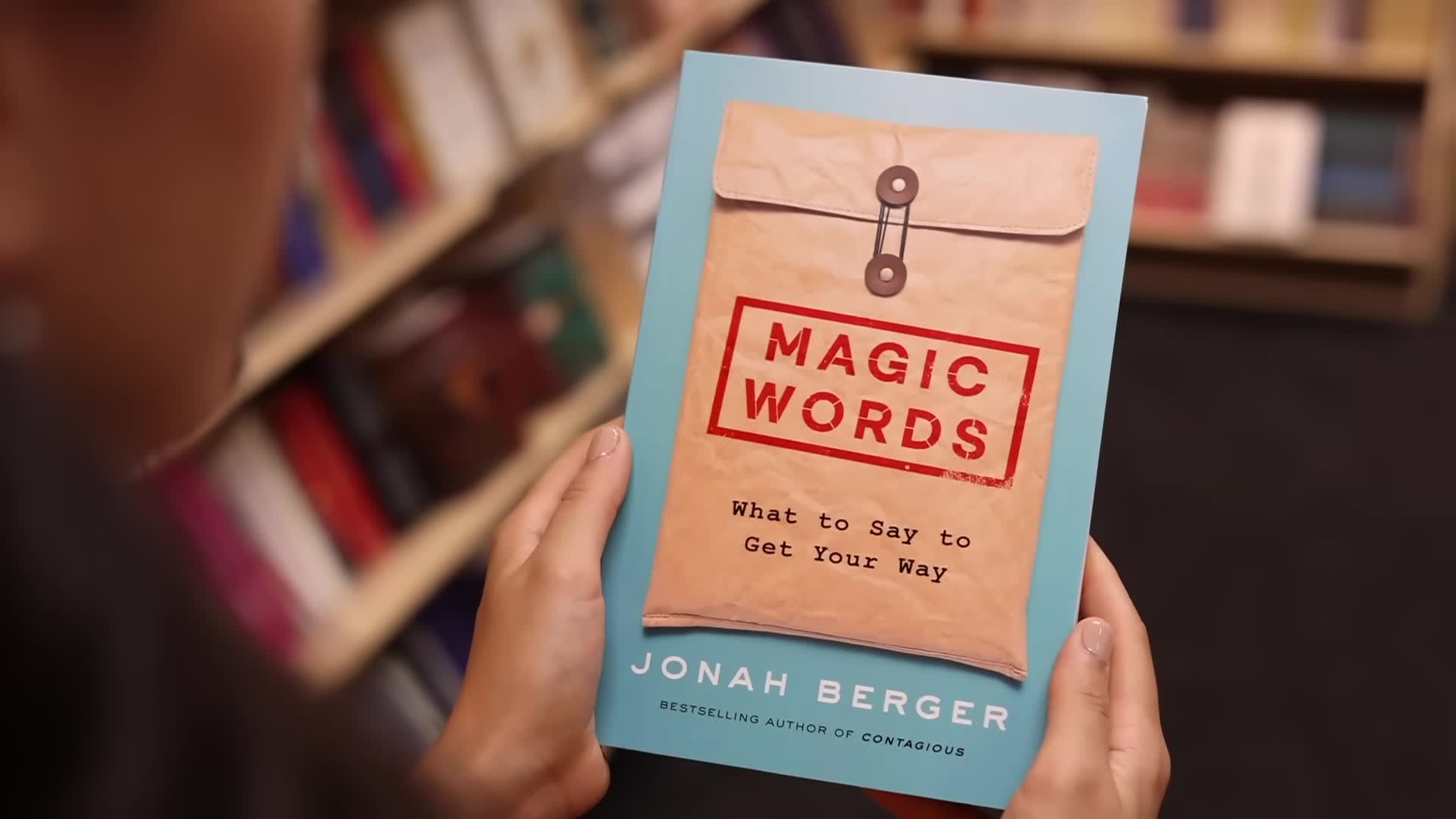
And a lot of them are actually beautifully captured in a book I recently listened to called Magic Words by Jonah Berger.
It's a great read.
I'll link it for you below.
But for now, let's dive in.
One, turn actions into identities.
So there was this nursery classroom in California where researchers tried something interesting.
They asked one group of preschoolers to help clean up, and then they asked the other group to be helpers and clean up.
But that tiny little shift in wording made a huge difference from a verb to help to a noun, a helper.
The group of kids that were asked to be helpers actually helped significantly more, and they were more likely to help again later.
Why?
Because the verb help is just an action.
You do it once and move on.
But the noun helper is an identity.
It describes who you are. and identities are powerful.
Because when you feel like it's part of who you are, you don't feel like you have to force it.
You just act in alignment with it.
It also works so well in how we connect with other people.
Essentially, if you and someone else aren't seeing eye to eye, instead of saying something like can you be more understanding?
You can try, you've always been such an understanding person.
Can we talk about this?
It's less criticism and it's more like an invitation for them to show up as their best self.
And people, most people, want to live up to that positive version of themselves.
Two, shift away from first person language.
Sometimes the way we say things can build walls without us meaning to.
So let's first talk relationships, whether this is friends, family, partner, doesn't matter.
If things are getting heated or emotional and you're using you or I, which is first person language, it can accidentally sound like blame, even if that wasn't our intention.
So if I were to say to my partner, you never have time for me, it can come across as an accusation.
You did this to me.
Now compare that instead to saying, it feels like we haven't had much time together lately.
The you and I have disappeared and so does the blame.
It now focuses on the situation instead of the person, and so it makes it feel a lot more caring and less confrontational.
And you can use this little language shift when you're talking to yourself as well.
If you were to say, I'm so bad at this, the I makes it personal.
It turns one moment of frustration into self-judgment.
If you were instead to say, though, this isn't going the way it's supposed to.
Notice how the I is gone, how the focus moves from I'm the problem to the situation is the problem.
And when the situation is the problem, we can ask ourselves, you know, how can I fix this?
Three, replace should with could.
The word should, I've always felt like it's just pressure.
It carries with it the sense of like guilt and obligation.
Like there's only one right answer and you've been getting it wrong.
Like I should work out more.
I should eat better.
I should be further ahead by now.
Every time we say the word?
Should we create a gap between who we are and who we think we're supposed to be?
And that feels heavy, right?
But if we were to change that one word instead to could, the energy completely changes.
I could go for a walk after lunch.
I could make something nourishing for dinner.
I could spend a few minutes working on my project.
It shifts our mindset from guilt to choice, from I have to, to I get to.
And the research backs this up that using high pressure or controlling language words like you must you have to, you should it makes people push back.
It triggers something that psychologists call psychological reactance, which is essentially our brain saying, nope, I don't want to do that because our freedom feels threatened and we don't like that.
We want self-determination.
But now, when the same message is phrased in a more open way you could, you might consider.
One option is to people become far more receptive because you're supporting their autonomy.
So this works anytime you're talking to other people or even to yourself.
Four, replace but with and.
How many times have you heard something like what you wrote was really good, but it's like the moment we hear the word, but everything that came before it disappears.
It's like hitting the delete button on the compliment.
So instead of using but, try using and.
I've always felt that and is a bridge instead of a wall.
It connects ideas instead of canceling them out.
For example, if you were to say, you're doing great, but here's what to fix.
You could instead say, you're doing great, and here's what could make it even better.
It changes the tone.
It goes from being corrective to collaborative.
And we can also use that whenever we're talking to ourselves.
You know, instead of, I did a lot, but I could have done more.
You could try, yeah, I did a lot and I can keep improving.
But creates tension and builds connection.
Five.
Add a because.
This one might sound small and trivial, but it can actually be really helpful, which is just to add the word because
There's a very well-known psychology experiment where researchers tested what would happen if they approached people who are about to use the photocopier and ask if they could cut a head.
They tried three different versions of the same request.
In the first version, they gave no reason at all.
Excuse me, may I use the copier?
About 60% of the people said yes.
In the second group, they gave a clear, meaningful reason for why they wanted to budge ahead.
Excuse me, may I use the copier because I'm in a rush?
Compliance then jumped to about 94%.
In the third group, they gave a reason that wasn't even helpful.
It was practically just filler, but they still used the word because.
Excuse me, may I use the copier?
Because I need to make more copies.
Even still, surprisingly, compliance was over 90%.
What this shows is that people respond far more positively when they hear the word because, followed by a reason.
Why?
Because it gives the request a sense of logic and purpose.
Our intention becomes clear and that little bit of clarity makes us more willing to cooperate.
So let's say for example, you're in a meeting and you feel like it's running long.
Instead of saying, can we wrap this up soon?
Which can sound abrupt, maybe even rude.
You could instead say, can we wrap this up soon?
Because I want to be mindful of everyone's time.
It's the same request, but now instead of it feeling pushy, it feels thoughtful.
And you can use this whenever you're talking to yourself too.
Instead of saying I need to get this done, you could try saying I need to get this done because I'm gonna feel so much better once it's off my plate.
That word because really just puts your why in focus.
And when you remember your reason, motivation naturally follows.
But I'd love to hear from you.
I'm curious if there are any language swaps that you make yourself or that you'd like to make after watching this video.
I always think we can learn from each other's examples.
Thanks so much for hanging with me today.
I really appreciate it.
Pickup Limes signing off and I'll see you in the next video.