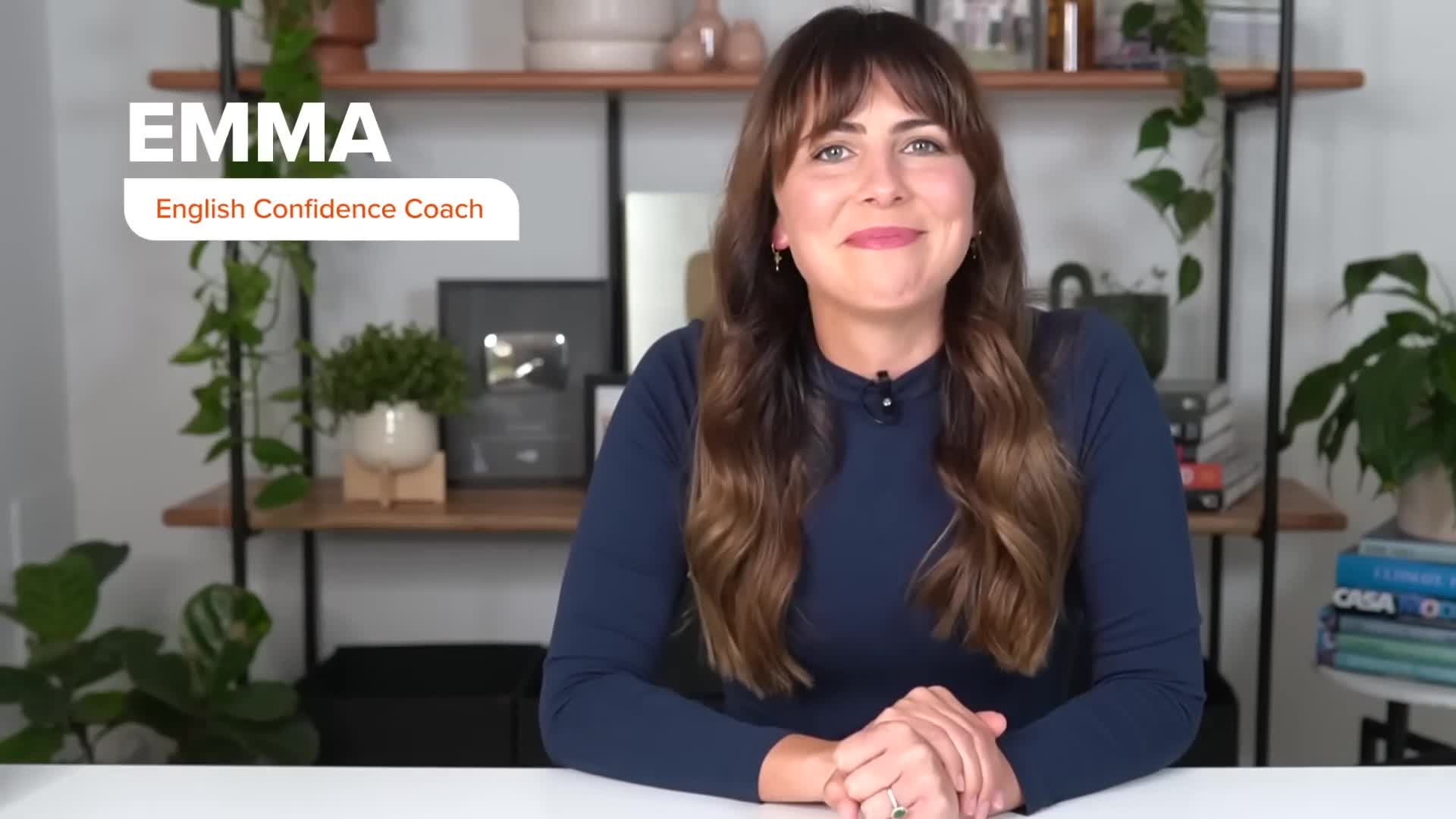
Well hey there I'm Emma from mmmEnglish!
Today, I'm sharing my top seven tips for keeping a conversation going in English, and so yes, I am talking about small talk.
It's a super important part of daily life in an English-speaking country if you communicate with other English speakers, but it can be a little bit intimidating.
Even native English speakers find themselves feeling awkward or uncomfortable and wondering where the conversation is going to go next.
So today we're going to learn some practical tips that will help you to survive and to thrive in any English conversation.
So let's get stuck in!
Do you feel like your English speaking skills are holding you back?
Others aren't really seeing you for who you really are.
Anytime I had to talk with natives, I was just so unconfident because I was afraid of making mistakes all the time.
Most of the time I read in English and I understand.
I watched the videos with the subtitles, but in that moment to speak, I felt afraid, I felt shame.
It's time to break free from those negative feelings and find your English voice with Hey Lady.
We understand the challenges that women face on their English journey and that's why we're growing a supportive community of women who are working towards the same goal.
Speaking English with confidence and ease from when I joined to today is that chance to talk with people without fear of judgment.
When we see each other, we're so happy and we have the opportunity to get to know new people all the time.
I mean, it's really amazing.
For me it's really like a dream come true actually.
Join Hey Lady today and start living your best life in English.
To find out more, look for the link down in the description below.
So, like I said, I'm going to share seven great ways to boost your English conversation skills, and the first one is to start by making a list of your favourite things to talk about.
Things that you're passionate about or knowledgeable about activities hobbies projects ideas, things that you love and things that excite you.
I'm passionate about drawing and hiking so I find them really easy to talk about.
I could talk about the beautiful hikes that I've been on for hours, beautiful parts of the country.
Now, if you have a weird or an obscure interest, maybe you might think that no one else will care about it, but actually the opposite is true.
People will either find it really interesting because it's different and they didn't know anything about it, or they might even share that they also have that same interest, and then you'll find yourself engaging really easily in a meaningful conversation with someone because you have that same weird interest.
So make a list.
It doesn't have to be long.
Make sure you read it a few times and that you're familiar with it so you can instantly think of that list when you need it, when you're stuck in a conversation.
So yeah, it was a really nice weekend.
Oh, that's cool.
Yeah.
Awesome.
Do you like to go hiking?
Do you know if there's any good hiking trails in the area?
And next time you find yourself stalling in a conversation, instead of freaking out, just try to remember that list and steer the conversation towards one of those topics.
Your never fail topics.
So when the time comes to start asking questions in a conversation, ask open questions.
An open question is one that starts with a WH word like who, what, where, when, why, how, annoyingly it's not a W. and which.
So open questions are great because they give the other person a chance to answer more broadly or more openly, give more of an answer, whereas with closed questions the answer is usually just yes or no.
It's difficult to keep going from there.
Is this the line?
Yeah.
Is this the queue?
How long have you been waiting?
Taking a little while, but it's moving quicker now.
Can you see how open questions give you more chance to speak freely.
So instead of saying are you from here, say where are you from, instead of saying do you like your new job?
Try, What do you like about your new job?
Now, it's not always possible to reframe a closed question into an open one, but it's one thing to keep in mind when you're practising English conversation skills.
Open questions tend to lead to more interesting discussion.
Another great way to keep the conversation going is to use question tags.
This is a really simple technique that you can use to turn just about any statement into a question.
A question tag is just a two or three word tag that you add to the end of a statement, and it's a great tool for getting confirmation or inviting the other person to contribute their thoughts to a conversation.
It's a beautiful day, isn't it?
You're new here, aren't you?
Question tags follow a pretty simple pattern.
You use the verb from the main statement, so here it's be or is, and we take that verb and we add it to the end of the sentence together with the same pronoun from the statement.
It's a beautiful day, isn't it?
If the statement is positive then the tag is negative and vice versa.
We haven't stopped working all week, have we?
I have a whole lesson about question tags, don't I?
You can check it out up here.
In a conversation you need to show that you're interested in what the other person is saying.
You have to show that you're listening.
Listening actively shows the other person that you're not just waiting for your turn to talk, you're actually invested and that you want to hear what they have to say.
That makes them feel good.
So the first thing that you can do is show them that you're listening with gestures.
Nod your head when you agree with something.
Raise your eyebrows when they say something surprising, react when they say something shocking and shake your head when you disagree with something.
When your conversation partner sees that you're engaged and listening, they'll want to keep talking.
You can use short affirmations like, ah, I see, I know, sure, I understand.
Really?
So I ordered the parts that the customer wanted.
Sure.
But the shipping is going to be really expensive.
Really?
Yeah, I don't know what to do.
I think I'm going to have to call them back and see if they're okay with that.
I see.
Another trick to show that you're actively listening is to throw out some little echo questions.
So the whole company is going on a team building retreat next month and I'm really not looking forward to it.
Aren't you?
For starters, my boss is a bit of a creep.
Is he?
Yeah, and some of my colleagues are a little bit weird.
Are they?
So these little phrases are almost like you're asking for confirmation.
They can also show that what the other person is saying is surprising or really interesting.
So they're kind of similar to question tags. all you have to do is echo the verb and the pronoun.
Are you?
Did they?
I'm gonna tell you something and then you try interjecting with an echo question.
My niece is starting kindergarten next week.
Is she?
We went away last weekend.
Did you?
You can also paraphrase to show that you're listening and this is also a sneaky way of checking that you understood something correctly like maybe you didn't quite hear or you didn't quite understand what they said but instead of freaking out and saying I don't understand, you can try echoing like this.
So I just got off the phone with Mary.
She quit her job.
She quit her job.
Apparently her boss is too controlling.
So she quit.
She's only got a week of work left.
Only one week?
Yeah, only one week.
And then she goes on annual leave.
That's crazy.
I know, right?
You can literally just repeat what the other person said it's very common or you can repeat what you think they said, and they will probably say the same thing back to you and then maybe add a little bit more detail.
So it's a useful tool it makes for fun engaging conversations.
Practising these active listening skills will help you to get that natural back and forth rhythm of a conversation going.
It's a really great essential skill to practise.
My next tip for advanced speaking practice is actually to not speak at all.
Let them do the talking.
Don't be afraid of that silence, awkward silence.
Too often we just blurt out whatever thing we can think of because we're afraid of that silence.
But the chances are the other person is also worried about that silence.
And you can take advantage of that.
You can sit back.
You can let them fill in the silence.
Let them come to the conversation.
How's this weather, hey?
Yeah, it's been raining all day.
Now I feel like this one is kind of obvious but I'm gonna say it anyway.
Practice, practice, practice.
Get out into the world and start having conversations with real people.
Chat to the checkout person at your supermarket.
Talk to your neighbour or the person sitting next to you on the tram.
The more practice that you get, the easier it will become.
And, of course, you can join an online speaking community, a community just like Hey Lady, where you can show up regularly, get as much speaking practice as you need, immerse yourself amongst other English speakers and really develop those conversation skills in a natural, organic way.
And last of all, Memorise some expressions that are useful in English conversations.
I have a few videos that introduce a whole bunch of really useful common expressions that come up all the time in English conversations.
One's linked up here.
But learning studying remembering, using these expressions regularly help them to sink into your mind so that you can always draw on them when you need them.
Phrases for starting a conversation like what have you been up to lately?
Or how was your weekend?
Or any comment to do with the weather, and then learn some simple expressions for ending a conversation like I'd better keep moving or it was nice chatting.
At a bare minimum, having these phrases ready to go should help you out anytime you need them.
So there you have it!
You've got some great new tools for helping you to talk in English, to keep a conversation going and if you want to learn some of the exact expressions and phrases to use in different situations, make sure you check out one of these lessons next.
Thanks for joining me today, I'll see you in the next lesson!