Hello, everybody.
This is Teacher Levy.
Today we'll do another slow English video.
This time I'll talk about a couple, two personal experiences which I was debating on whether or not to share, but I think it's okay.
So i'll talk about in-person lessons and my experience with them and a couple situations and experiences from having those in-person lessons the takeaways remember, takeaways are lessons, so We'll talk about those and I'll give some recommendations as well.
So if you have in-person one-on-one lessons, these could be helpful.
Perhaps a bit different for group classes.
Although I think group classes are also valuable, they're different, different.
You have to share the space and share the time with others, so obviously that's probably the biggest difference.
So, but there are advantages also to group lessons.
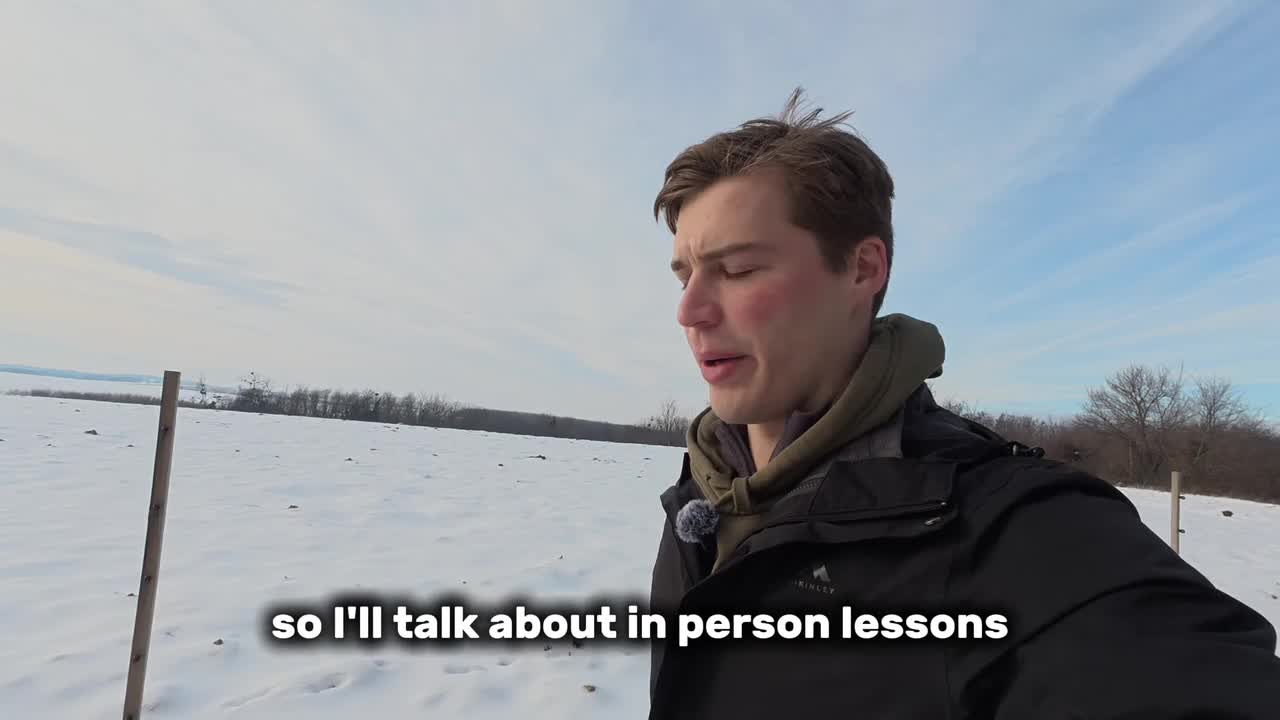
A lot of people have asked not ask it, but asked about my surroundings when I film.
So there you go.
There's a lot of snow, but while you're moving, it's not so cold.
So it seems like a beautiful day to do a video.
One of my goals for this year was to try longer form videos.
When I mean longer, I mean I've done 20, 25 minutes, but I want to do over an hour.
And originally.
Originally, I wanted or wanted to do these inside, but it's such a beautiful day that, with the snow, that perhaps this is also a good idea.
Hopefully, the sound of me walking through the snow won't be too loud or too distracting to listen, because I'm aware that, and we have the woods here, So I'm aware that some of you watch, or rather listen to, these videos while driving or doing chores, tasks like washing the dishes or doing laundry.
We say doing laundry if you're washing your clothes.
So in that case you don't always see what I'm talking about in the videos.
You're mostly focused on listening, comprehension.
These videos are designed for intermediate or when we speak quickly.
Intermediate to advanced level learners who are looking to improve their listening comprehension.
Check this out.
And also work on their pronunciation through shadowing or specific words which you haven't heard.
You can practice saying them out loud either during the video or afterwards.
I would recommend everybody to write them down, add it to your list, your vocabulary list, and then practice exercises like speaking to yourself or writing, where you can put these words into use and make sentences with them.
So I was just asked recently about improving your vocabulary and getting used to used not used getting used to using new terms, new vocabulary.
I don't think there is a perfect solution.
It varies varies, it changes, case by case, case by case, person by person or situation by situation.
It varies, it changes.
We can say it differs situation by situation.
So writing is one of the tools.
Obviously, having classes and speaking with your teacher is another one of those tools.
Speaking to yourself And also just paying attention when you're watching movies or TV shows.
We say TV shows.
A lot of my students like to say TV series.
I usually say TV shows.
So when we're watching TV shows we can pay attention and see if we recognize any words or expressions that we've been learning.
So, but I just wanted to say that it was on my mind.
On my mind, I was thinking about that.
So the in-person lessons.
I've had two more significant experiences with students having daily conversation lessons with me.
And when I mean daily, I'm not referring to just one hour per day.
These were more significant, notice significant.
These were hours four, five hours every day that I spent with the students, some of which were actually all of them were for work.
And one of them was a very international student from China forgot which city, but she was the CFO, which is the chief financial officer.
Just like, just like we have CEO, people say CEO, but we would say CEO is the chief executive officer.
So these positions, if you're learning business English, are valuable to note down, to write down and to memorize.
Almost everybody in business or in an office environment uses them.
These are useful.
All the C-level executives.
We say C-level executives like CEO, CFO.
And the first thing with the in-person lessons that I think are very valuable is the confidence that you get from attending in-person lessons will cut through the confidence that you get from having in-person lessons, which is different than having online lessons.
There's something about having the other person next to you and paying attention to everything you're saying.
There's a benefit to that, and I think some of that can only come from in-person lessons.
It doesn't necessarily need to be a native speaker.
I think it's okay if you have somebody who's great at English, but It's their second language.
I think that's fine.
It doesn't need to be somebody who makes no mistakes and they speak perfectly.
In fact, there are advantages.
One of the in-person lessons students that I was helping was a very beginner. and almost A1 level.
And I would have found it helpful to have a third party.
A third party could be an outsider, another person who could translate from English to Chinese.
And I did have that person for some time, but a lot of the time they weren't there.
So they were doing something else and it resulted in or it led to it resulted in the student having to use Google Translate a lot, which is fine.
I'm not against Google Translate.
I think you're still learning, but sometimes it becomes a crutch.
A crutch is something we depend on, something we lean onto.
So Google Translate can be a crutch.
If you constantly have a friend while you're traveling who is helping you with English, with ordering food and getting drinks, that can be a crutch as well, because you're not relying on yourself.
You're constantly relying on your friend to speak on your behalf, to speak for you.
We can say speak on your behalf.
So that is one takeaway is that if you are a very beginner, pay attention, if you're able to find somebody who speaks your native language and get into the routine some kind of program where you could meet with them on a regular basis and have them translate for you the things that they know.
Sometimes two languages aren't exactly the same.
In fact that's pretty common so in that case you don't always have a direct translation.
You have some phrases or sentences which don't exactly fit the same way as they would in English.
So in those cases, I would recommend even having someone who's either bilingual bilingual meaning they speak two languages on a native level or someone who's very proficient at English and they can speak your native language and have them help you with translation and with looking up the exact definitions to things, how to explain things.
So that's the first takeaway.
The other one i wanted to mention there are so many, but the other one i wanted to mention is confidence.
I was in a hotel and we were doing exercises with the student, more specifically, writing practice.
These are things you can do with a teacher, by the way.
I found it to be very helpful, in fact, to do writing exercises in person.
In the past I used to do writing exercises for homework, give students essays or not a whole essay, but a couple paragraphs to write oh.
But I found that when you're able to have the student write and you're correcting them at the same time, it can be really helpful.
They're able to get recommendations or adjustments right on the spot.
On the spot, meaning at that time and at that place.
Something about that instantly helps them fix it in their mind and i found it to be very fast in terms of from one day to the next, you already see improvements in the patterns, patterns in the patterns of how they're writing and how they're thinking.
They're more focused on the corrections that happened the day before.
So We were doing writing practice and we needed a pencil, not a pen.
Notice not a pen, but a pencil.
I like pens.
Some people like the fact that with a pencil, you have an eraser to erase what you have written.
Written what you have written.
So that is a benefit.
They also have erasable pens nowadays.
So, but anyways, she wanted a pencil and she went to the It wasn't the hotel reception.
It was in a cafe.
She went to one of the workers and asked for a pencil.
Before I got to stand up, I wanted, wanted, I wanted to go get one.
And she got up and asked and eventually the worker, the waiter was unsure of what she wanted.
She didn't understand the pronunciation.
So the student went out to the reception and asked at the front desk of the hotel lobby.
Now this confidence is really important because it pushes you past your perceived, perceived from perception, your perceived comfort zone and your perceived boundaries.
Sometimes we set in language limitations on ourselves, we think we shouldn't speak too much, or we start thinking about what if the others won't understand me and how embarrassing that might be.
And from this thinking pattern again we have pattern.
From this thinking pattern we stop ourselves from even trying.
So I was really proud of her display of confidence in asking workers or waiters for things.
I would have liked to have seen her ask again and again and even try to show with your hands what you're asking for.
And I would say in a hotel, the workers are more accustomed to hearing different pronunciations.
So I don't think it's the same as talking to strangers in America, but I tell the story to many of my students that some of my friends in the US they only travel to places within, within is inside.
They only travel to places within the US and they have little contact with foreigners.
Even in school, when we had exchange students.
Exchange students, which some of you might have been or are now.
You go to a different country to learn their language and you spend a few months in a school, immersed immersed is surrounded, immersed by the language.
This way you have the right environment and the idea is you'll learn about not only the language but the culture of the people living in that country.
But when we had exchange students in school, they all spoke English very well.
From my experience.
We had exchange students from Spain that I met and we also had French exchange students.
I didn't meet them because that was for the French class.
So it was a different part of the school or for the students who were learning French.
So, but they spoke very well.
The US sometimes , You'll go out there and they'll have a more difficult time to understand if you make pronunciation mistakes, but that doesn't mean that you should shy away from, to not want to do, to be afraid of doing.
We can say to shy away from the opportunity to speak.
So that's the foundation of confidence in a language and in general confidence in yourself.
And another story which is from my group classes was a student who had many months of group lessons, small groups, groups of three four, sometimes five, including myself.
So these were small groups, but even then you have to split the time with everybody.
So you have questions and we go around in a circle and answer those questions.
This student joined weekly, sometimes twice a week.
Notice we have once, twice, three times.
So he would join once, sometimes twice a week for a few months, and then he said he would go to Germany for work.
It was some kind of not an internship.
An internship is common for college or university students who are getting a part-time job, sometimes full-time job, to gain experience.
We can say to gain, to get to gain experience.
So this was not an internship, but it was some kind of work opportunity opportunity for him to go out to Germany for a month or something similar to that.
After he came back he joined the classes again And I asked him did the few months of classes help in his speaking while he was out there?
Did it help improve his speaking?
And I wanted him, or wanted him to be honest, just so I could gather feedback about what to change or adjust.
And he was honest.
He said, not really.
It didn't really improve his speaking, he felt.
But he said his confidence was drastically improved.
Drastically, very improved.
And he said.
By the time he got to germany after taking a few months worth of lessons, he said he felt comfortable speaking to new people, expressing his opinions, even if his grammar or pronunciation wasn't perfect.
By the way, he has pretty good pronunciation.
Sometimes grammar mistakes, but that happens with everybody.
And that was one of the first times when I started considering the importance of building someone's confidence alongside their other areas, or the other areas of their English, like vocabulary or pronunciation, or fixing grammar mistakes, to build their confidence.
I think in person helps a lot.
So this student who I just talked about was taking online group classes, but the student who came and we had lessons in the city was doing hours of English practice every day.
We would go see different things, go to museums and to different sites in the city and practice describing what we see and building real vocabulary.
That is why Now, that experience is a bit similar to the concept of watching a movie or TV show in English, where you're able to immerse yourself and see and hear the words, the expressions in English in the moment.
If you're crossing the street, you can say this is a crosswalk, we have to wait and then we'll cross the crosswalk.
These are things that now, with TV shows or movies which I wouldn't recommend in the past, I now do because I think it's useful.
I think it helps to work on your comprehensible input, which we've talked about a lot.
The idea that you're learning similar to a child, or how a child would learn when they're still barely speaking, speaking very little, barely speaking or not even speaking.
They're observing.
Observing is watching and seeing and listening, but they're also absorbing absorbing, gathering the information from around them.
This is the idea of comprehensible input is to, in the beginning, not focus entirely or mostly, even on speaking, but to have these situations where you're listening or watching something in English and You're just taking in.
Input is to take in the information from your senses.
Senses like seeing, hearing in a movie.
We can watch the movie.
We can also hear or listen to the movie.
So our senses are working. and we're not trying to break down grammar or we're not trying to speak.
We're just absorbing or taking in the information.
So now I've been more open to that idea.
It might even, might.
It might even be better than speaking out loud to yourself, which used to be my number one recommendation.
Of course, the best is to move to the country, whichever country that speaks your target language.
Target language, I mean the language you're trying to learn, but that's rare.
And even then people still sometimes need extra help or an extra push to keep them going and to keep their progression for English.
So everybody's different.
With comprehensible input, the one important important factor is you want to find a level which is first and first and foremost firstly first and foremost i would recommend native speakers in terms of comprehensible input so like we talked about in the beginning, when we have a beginner who wants to take in-person lessons, I think it's fine and even perhaps beneficial or more beneficial to have someone who's bilingual or they're non-native, native, non-native but they speak very well, very proficient.
That way they can explain different ideas or words or concepts to you in your own language.
When it comes to, we can say regarding, or when it comes to comprehensible input, I would recommend native speakers.
So with movies it's easy, because we have a lot of Hollywood and Disney movies which have native English speakers.
And I would find a level that's just a bit harder than what you're comfortable with.
If you watch kids cartoons which are slower and more simple, I would get comfortable and then level up to dramas or something more difficult which challenges you and you don't fully understand everything that you are seeing or listening to.
In terms of subtitles, people always ask.
I don't think it makes a big difference whether or not you're using subtitles.
I've never had, because I've never needed double captions or subtitles where you have English and then underneath you have your own language.
So I've never done that.
Even with Spanish, I remember watching Shrek in class and we just had Spanish subtitles.
So having subtitles or not with comprehensible input, I don't think it makes much of a difference.
If you're at a level where you're able to listen to these videos and understand the majority most we can say the majority of what i'm saying then i don't think you would have a problem doing the same thing with movies or tv shows.
In fact I might even say those would be more beneficial because you have more things going on, more vocabulary.
They're not only a podcast where people sit and have a conversation, but you're able to connect pictures to words.
I had a day with the in-person classes where we spent some time in a market a fresh market where they had different vendors.
Vendors, people selling fruits, vegetables, meat, other clothing.
They had hats, custom with fur and different items.
And we went through some of the vocabulary for vegetables like tomatoes tomatoes peppers, red peppers, green peppers eggplants, zucchini.
These things.
When you're there in person and you're able to touch the vegetable or fruit and then listen to the pronunciation, hear the way someone is pronouncing it, it registers better.
In my opinion, it registers better, you understand it better than if you were just reading it from a book or talking about it at a table.
So we have these differences.
I think the momentum you get from a very long and detailed experience four hours, five hours of English every day is incredible.
If you're able to keep it going.
Obviously, some people will sign up for courses or in-person workshops.
Sometimes they're called boot camps English boot camps and they have this big boost in confidence and also in ability.
Their listening ability, speaking ability, even writing and reading, are improved and they go back to their own environment and get back to their usual routine.
And unfortunately they start to fade away or fade back into, move back into their old routines and not have that same enthusiasm or the same drive as they did during the time that they spent having in-person lessons.
I don't know what's the best way to counter this or to fix this.
I think some of it needs to come from a passion, and perhaps that's one of the things to look for or look into developing when you're having these experiences is to find a way to stay passionate about English so that you can work it into your schedule and you can find a way to add it to your daily routine.
I had a coach for Muay Thai, which I've talked about, Thai boxing or Muay Thai, which is a hobby of mine.
And I told the coach my goals for that year, which just ended.
I told him I wanted to do these things and I felt like I was too busy and I couldn't make time to regularly train, which led me to slip and to put off some of those goals.
In reality, in reality.
In reality, I had work and other things which are or could be listed as excuses.
And he said, we're able to make time for whatever we truly want to do.
And I think if English becomes a passion, becomes something that you're able to put into your work, into your family life, into your routine, it's a much easier problem to solve than if you don't implement it in that way.
So it'll be different.
It'll be different for everybody, but you have to, as they say, to trust the process and continuously tweak to tweak to adjust your goals and your methods.
I just told someone recently if they set a learning system or structure for three months and they assess or they test themselves, compare themselves.
This could be as simple as recording yourself speaking about a topic and then going back and doing the same thing three months later and comparing the differences.
It could be pronunciation, it could be vocabulary that you're working on, but if you're doing it consistently, three months should be enough time to see results, at least some results that you're on the right path.
You're on the right path or on the right track.
If not, then it's time to switch your learning methods or your teacher.
So don't be afraid to try different teachers and find one who works for you and You feel like you get along and you're able to have a faster pace of development or of learning.
One of the stories recently came from a student who told me that she was feeling not satisfied but she was feeling comfortable with her English.
But during our classes I would always encourage her and obviously correct her mistakes and work on different issues that she was having, but from a positive state of mind.
And she recently went traveling to i forgot where this was, but somewhere in south america and she met foreigners from the other side of the world who spoke good English.
And she said they could understand her when she was speaking in English and she could understand them.
And she spent, I'm not sure, three days with them hanging out.
We've talked about hanging out, spending time socially, spent three days with them hanging out talking, joking around, and she said she was so happy about the fact that she could communicate with these other people her age and use english.
She said that she thought i was just being nice when I was complimenting her on her progress and her English.
She didn't believe that she could do that.
That doesn't mean that everybody can do that, but sometimes we might overlook, or rather undervalue ourselves in the sense of what we're capable of.
It's kind of what I started talking about in the beginning.
So I'll give an overview about in-person versus online, versus learning by yourself, which I just met recently another student from Mexico who watches the videos, and she's a self-taught English speaker.
She's teaching herself.
She's learning by herself and she did a great job.
She did a great job.
She watches videos constantly.
I can tell that She's worked on her vocabulary.
She has occasions or times when she has to speak to foreigners because of her job.
But of course, it's never enough.
And we always need to look for more opportunities.
So she joined a class So self-learning compared to online or in-person, obviously the in-person I think nowadays is the least convenient in terms of time and finding someone and having a place where you can have the lessons.
A lot of times the cost as well, either paying more for the lessons or having to travel somewhere, stay in a hotel.
So financially, it's obvious the online, or even the learning by yourself, would be the number one pick.
I would like to have a combination put together where there is a formula or setup that people can apply, maybe once a year.
Have a recommendation for how to split up your time when learning a language.
Should it be 10 in person, 90 online, and then 15 of your free time spent practicing by yourself self-learning, self-teaching?
I don't know if that's the correct formula.
But even when you're learning by yourself, it's worth investing time and money.
I had a video about three or four months ago, maybe longer, because I remember I was in the water.
I went to a lake and I filmed in the water.
So it must have been longer than four months.
Some of you might have watched it.
I spoke about my teaching experience and the takeaways a little similar to this video.
And one of the pieces of advice that someone gave in terms of learning or accumulating, gathering knowledge, is to invest two things time and money, and those will help build a strong foundation, or rather a stronger commitment, if you're investing your time, and also your money, into it.
So there's plenty of online courses and tools.
Now, AI is developing quickly and I was having a conversation yesterday about the possible improvements that AI can have learning English English education both in schools and also outside of school, by yourself signing up with an English bot.
I think they're called English bots, which are basically a copy of a real person and they have a personality.
They have a distinct, they have features physically.
You can see their avatar or the person, the way they look.
They also have their own personalities.
So this is something that's still developing, but some students subscribed to some of these ai platforms and they've told me it's been beneficial for them to spend an hour or two hours a week talking with these ai bots or ai avatars and improving their english that way.
So i've tried some in the past few months And I don't think that those are the best.
I signed up for a couple of these platforms, but I think there's something that can supplement, something that can supplement your other English studies.
This is almost diversification, or diversifying yourself in your own english system or program where you have speaking lessons, but you're also joining the book clubs, the book uh lives, the book challenge lives, and you have your own vocabulary list and you have set goals which you're able to track.
That was The point of the last two videos.
Was me talking about setting goals for English and someone asked me if I set goals and I do?
I was told by a friend two years ago about two years ago that if you write down your goals, there's a certain or certain percentage chance that you'll.
It's a higher chance that you will achieve those goals which you wrote down.
So nowadays, with microsoft word and google documents, you're able to a new folder or file and write down those goals with dates and constantly go back and add to them.
I like to have uh, different dates on my files so i can see in what time frame, timeframe or length of time I have done exactly what.
Sometimes you might go back after a week or two and notice that you barely did anything, which is normal, but that's a sign that you shouldn't expect much growth in that area, in that field.
There's a saying that there's no such thing as something for nothing, meaning we have to put in effort or action to get something out of it in return.
So the documents, or having a setup where you're able to track your progress and your goals for 2026 is key.
I think all my students should do it.
And I've been harping or telling them a lot, especially the past few weeks, that this should be a priority.
They should prioritize doing this outside of english.
I'm not concerned with the students, but for english it's something that's very important.
So, in terms of in-person lessons versus online or learning by yourself, i think the combination is the best.
The unfortunate reality.
Reality is i've heard stories from students who went out to a different country the UK or Canada where they signed up for an English experience and it wasn't worth the money and it was very expensive.
So you have to do your due diligence, due diligence is research.
So you should do your due diligence, look into it, but sometimes it's similar to rolling the dice.
Rolling the dice meaning you roll the dice and it's based on luck whether or not you will get your expected outcome.
So sometimes it's like that.
Online is better in regards to you're able to try out more opportunities or options for less of an investment in both time and money.
And the self-learning I think is one of the most practical, especially on YouTube.
There are so many teachers and free lessons.
I would even recommend stepping outside, outside of the English learning field and finding a video, as my students suggested, finding a channel for a hobby that you're already interested in.
He was interested in geography and history and he found a relatively big channel that focused on explaining different regions in the world Southeastern Asia, and different provinces and, for example, China.
And it's very visual.
While you're watching these videos.
It's not focused on providing content for English learners, but rather viewers around the world who already speak English.
But this is in connection to comprehensible input where, even if you don't understand everything, you're interested in the field or in that type of content and you'll naturally learn.
So you can stray away from a little the english, go into videos or content on hobbies, things you're things you're interested in and try to diversify the content that you're watching and definitely set time limits or have a breakdown of the year into quarters, which i recommend.
A quarter is three months.
In school we had quarters which were actually less than three months because of summer break.
But it breaks the year into four parts.
Just like when you, we have coins for currency.
One of the coins we have in the US is for 25 cents and it's called a quarter.
So i would recommend breaking the year into quarters and having a three month time frame for whatever you'd like to do.
If it's speaking, then i, like i said earlier, i think recording yourself today and then three months later is the perfect way to do it.
Obviously, there's Also the possibility of taking IOLTS test, a language test, a Cambridge test.
Those can be a little pricey.
Pricey meaning expensive.
And those are broken into four parts.
Usually.
But recording yourself is good.
If you're working on pronunciation specifically, then you can have a longer recording reading, for example, and just practice that segment for three months, come back to it and you'll have hopefully, a good result.
Some of these words in English, regarding pronunciation are up for memorization.
I mean, you have to memorize them.
For example, I had a comment from one of the videos.
Someone asked, when do we know the O-U-R sound?
For example, hour versus tour.
To go on a tour, or I'll be home in one hour.
They're different sounds.
And I didn't have any explanation.
And upon further research, I found that there is no specific rule.
These words we have to memorize and get used to pronouncing them the correct way.
And of course, if you spend a lot of time And with the language, it comes naturally.
If you don't, it's a little more difficult.
But reading out loud and recording yourself for a longer period maybe 20 minutes you'll cover a lot of different words hopefully, and that will serve as a good start.
So that's my recommendation.
Thanks everybody for joining.
If you support these videos, like and subscribe and let me know if this is a good length.
This was hopefully over an hour.
It's one of my goals for this year for English for the channel.
So let me know what you thought and I'll see you next time.
And I'll update soon on the book challenge people have been asking.
And I have a book in mind and I will just double check another book that a student recommended and we'll get one out or decided as soon as possible.
So I wanna get back to the live streams.
I think they're beneficial and it gets people into a rhythm of consistently reading.
So it's one of the benefits.
Thank you everybody for joining and talk to you next time.
Have a good day.
Bye-bye.