Hello, everybody.
This is Teacher Levi.
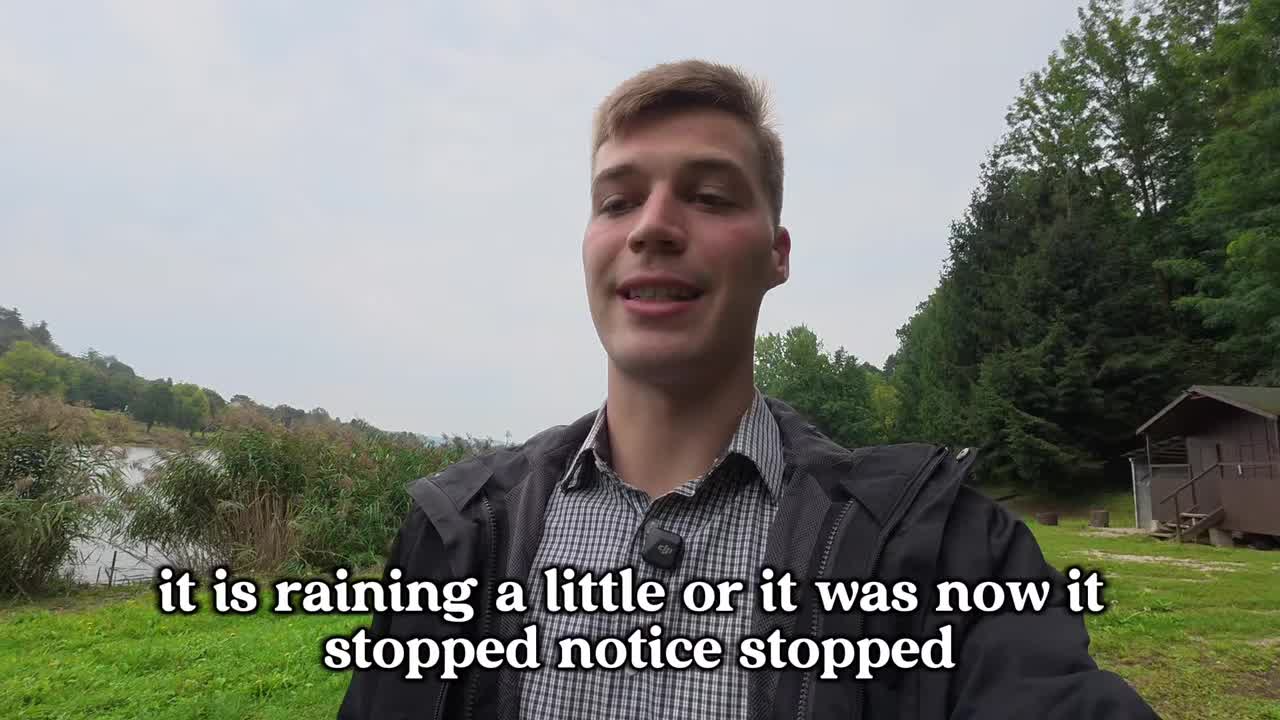
Today, we are by a lake, as you can see, and we'll be making another slow English video.
It is raining a little, or it was now.
It stopped notice stopped, not stop it, and it might be drizzling later.
If it is raining a little, a little bit, we can say drizzling.
It is drizzling, so It is also overcast, you can see.
And we have the water here.
I wanted to walk around the lake, but that might not happen because I don't see a trail behind me.
So maybe that won't happen today.
I wanted also to speak about idioms American idioms and we will have the phrasal verbs live stream this Monday.
I know I was supposed to do a live stream recently, on Monday, but I didn't have time to do it.
I was busy working so I had to push it.
Notice to reschedule.
We can say to push it to next Monday.
So we will talk about phrasal verbs and I have two videos already speaking about 16, 16 phrasal verbs.
So review those before the live stream if you have a chance, and we will be talking about those and also trying to use them in the class or the live stream lesson.
So that will be the idea of what we will do.
Look at these.
I have spoken about this before two times.
So reads. reads.
Looks like there is a path here.
So I will see if we can find a way to get to the other side of the lake.
Many of you know that in a lot of my videos, we go hiking.
We love nature.
We have steps there going up the hill.
I don't want to do that.
I just want to be near the lake, but There's no other way but up this hill.
So let's see if I get lost, then I will turn around and find my way back.
So these videos are designed to help you improve your listening comprehension.
It is also useful, it is also useful for pronunciation practice.
There is a method called shadowing, which I have talked about numerous times.
If we say many times, we can say numerous times.
So shadowing is a good exercise that you can do with these videos.
Look how muddy the trail is.
So this is the result of heavy rain.
Now I also notice that I am walking farther away from the lake which is down there.
You can see the light from the water, so that's ideally.
Ideally is what is ideal.
Ideally, i would go down there, but there is no trail, so I would need to go across this area.
I don't know if I want to do that but maybe.
If you have been in one of my lessons, then you might have heard some idioms that we discuss during class.
These might be familiar to you, but for those who are just learning, these might be new or new.
Sometimes You can hear people saying new or also new.
It might be new for you.
I had to take my jacket off because it is getting surprisingly hot walking through the woods.
So anyways, if you would like to speak with me, you can find the link in the description to join the speaking lessons.
This video is designed for intermediate to advanced level students, and idioms are a good way to level up your English, to speak better, to improve.
This way you will sound more articulate and you can use less words or fewer words to describe something and it could have a deeper meaning.
For example call the shots.
This is always the first idiom that i teach.
To call the shots is to make the decisions.
Notice not take or do, but we can say to make decisions.
The shot caller is the person who makes the decisions.
Your boss can be the shot caller. in the office or at the office.
And maybe you're the shot caller at home.
You call the shots.
You make the decisions at your house.
Some of these idioms are from sports.
You don't need to watch sports to use these idioms, but it may help if you watch sports.
You might have heard these idioms before or some of these idioms before.
The next one is cheap shot.
Cheap shot A cheap shot means to take advantage of someone while they are down.
They might be in a bad situation.
They may be sad miserable hurt, and you take advantage them during that time.
That is a cheap shot.
We can use the verb take so to take a cheap shot.
Now, in a everyday life scenario, notice scenario If there is something which you are uncomfortable notice uncomfortable about, for example, maybe your weight, or you are very shy and somebody makes fun of you about those things, that can also be considered a cheap shot because they are taking advantage of your weakness or weaknesses.
So that is a cheap shot.
Someone can take a cheap shot at you.
I have decided to go down to the water because I can't seem to find a way except through here, so let's see if I can get there.
So I forgot to record, so I have been talking to the camera for maybe 20 notice, 20 or 20 minutes.
I spoke about comprehensible input and I also walked out on this tree which is above the water.
So there's the water and we're above the water standing on the tree.
Now I wanted to share how we can describe this activity or this action using comprehensible input, but I noticed that I wasn't filming and I am already on the tree and I got my pants dirty.
Got my pants dirty And now I'm thinking this is not such a good idea.
So the moss here on the tree, the green moss is very slippery, especially when it just rained.
So it's been raining today and everything is wet.
I am wearing flip-flops.
So that is not a good combination to walk above water on a tree which is wet while wearing flip-flops.
So I will leave now.
It would be nice to have a trail here so that I wouldn't have to climb through the forest to get to the water.
Look at that moss.
That is moss all along the tree on the bark.
So I wanted to share the idiom, get it off your chest.
If there is something that is bothering you and you are going to share it or want to share it, you can say I need to get something off my chest.
If you have a coworker who is struggling with something and you notice that they are quiet or they're not behaving the same as usual, you can ask is there something that you need to get off your chest?
Off of your chest is also fine.
Another one that's useful is give me a hand.
Help me out.
Could you give me a hand with this?
Can I give you a hand?
If you see that somebody needs help, we can ask, hey, could I give you a hand with that?
Which is, could I help you with that?
Could I, can I give you a hand?
This is a useful one.
And I think in everyday life we can use this idiom at work or outside of work.
Another idiom that we can use is play it by ear.
Play it by ear means to do something without a plan, or to start doing something and figure out notice, figure out the plan.
As you go forward, as you start doing something, that is to play it by ear, you can say What is the plan.
How will we do this product launch?
Your team leader might say, well I'm not sure yet.
I guess we'll have to play it by ear.
So we will have to come up with the plan as we progress, as we move forward.
I'll play it by ear.
Now, when it comes to your English learning journey or process, I don't recommend to play it by ear.
I recommend having a plan.
Some things are okay to play it by ear, but for English I recommend getting a schedule and putting together different tasks.
Notice different. tasks and goals which you can write down and stick to so you can follow that plan.
That is a better, notice better, idea.
Another idiom which I like is neck of the woods or we can say your neck of the woods.
Your neck of the woods is the general area, notice area, general area where someone lives.
So if you are near your friend's house not at or at their house, but near their house we can say I'm in your neck of the woods.
I'm near you.
I'm in your neck of the woods.
You can also say to someone hey, if you're in my neck of the woods, come visit me.
Look at this.
These are the stairs which we saw earlier going up the hill all the way up.
We will not go that way today.
So, in your neck of the woods, If I'm in your neck of the woods, I will pay a visit, which means I will visit you.
I will pay a visit.
Neck of the woods, a great one you can practice using with family, friends or in your riding practice.
In my neck of the woods, I like to do this.
In my neck of the woods.
I usually go hiking because I am surrounded by nature.
For example, we could say
Guys, practice using these idioms. try to work them into your everyday English practice.
Of course, some will be easier to use and some will be harder, but the idea is to start using them and this way you will not forget these idioms.
So that is the idea.
Of course, this takes practice and you can add more to your list, but this is a good start to have.
I will see you soon.
I will also have a new members video soon for the members.
So stay tuned.
Thank you for your support, for your comments, and thank you to my students for their support and doing their homework as well.
So I hope you have a great day.
If you support these videos, feel free to like and subscribe, and I will see you next time.
Now it is raining.
You can see the lake.
It is raining.
So I will get going.
I have a class soon.
So thank you for your time and see you next time.
Bye bye.