Hello everybody.
This is teacher levy.
Today we'll be making another slow english video.
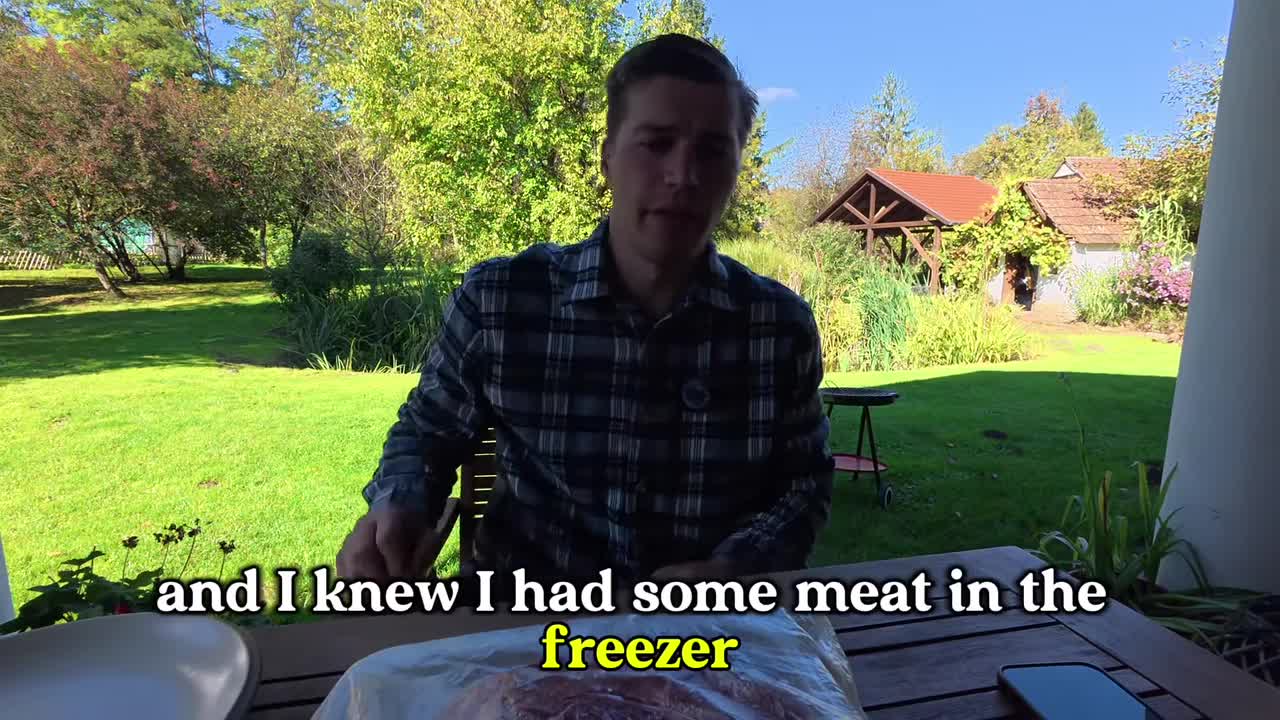
This time we'll be cooking on the grill back there on a charcoal grill.
So i wanted to make brazilian barbecue and I knew I had some meat in the freezer.
I thought it was steak, but I actually have brisket.
So this is brisket, not steak.
It has to be cooked differently.
We have to light up the charcoal and start the grill because it will take some time to heat up.
So we will do that first.
I am not an expert at cooking, but this is what we have.
All right, this is the grill, small grill.
This is called the griddle.
This is the griddle and this is charcoal in here.
This is called charcoal and we have an empty egg box.
This is for a dozen eggs.
12 is a dozen eggs.
I saw on the tutorials for cooking that that is a good way to light up the charcoal to get it to burn quicker.
So this might take some time.
I don't have so much time so i will try to speed up the process somehow, maybe by blowing on the fire.
So let's see.
All right, we want to take off the griddle and put this coal or charcoal in here.
We want to fill it half way, so only have charcoal on one side of the grill.
This is for indirect heating.
We can have direct heating and indirect heating.
The trick I saw is to put the charcoal into the compartments, these 12 different compartments here.
And I heard that is a good way to start the fire.
So I saw it on YouTube.
Let's see if it works.
I don't have lighter fluid.
I maybe should have gotten lighter fluid, but I don't have any.
So we will have to improvise.
Okay, so we will fill this up and put some more into this compartment here.
And then we will close the box, put it on one half and add some more on the side to maximize our heat.
And then we can light this on fire.
So I'll take this paper which I got from the bag.
I'll light this on fire.
See how it burns.
Okay, it doesn't want it.
Okay, here we go.
See, we have a lighter, this is a lighter, and we have the fire starting.
Okay, it's burning well.
This is good.
While this is burning, as it heats up, we will cut the brisket, so i will get a smaller size so that it will cook faster.
A lot of people have mentioned that this will take a lot of time to heat up, but i have some experience making fires.
I was a boy scout for many years.
I was doing scouting.
We can say if you are a Boy Scout, you are scouting.
So this will heat up nice and quick and without using lighter fluid.
And while we wait for this to heat up, let's go cut the meat.
Okay, so here is the brisket.
Excuse the mess here.
This is what we will use.
This is aluminum wrap to wrap the meat, but first we'll wrap it in butcher paper.
This is not exactly butcher paper, but it is similar, so we'll wrap it in this first, and then the aluminum Notice aluminum, aluminum.
Now, some people might put a brisket the size of this on their grill.
I don't have time to wait for this to cook, so I'll have to slice thinner.
We have thick and thin, thinner pieces.
I have my knife and I also should remove some fat.
Check this out.
Look at this fat here.
Keep in mind, I am not an expert.
I don't cook.
I almost never cook.
This is not my expertise or as they say, not my forte.
So, but we'll cut this This knife is very dull.
The knife is not sharp.
The knife is not sharp.
It is dull.
So... So I should find a different knife.
But this is the one we have.
So...
I know some of this fat you can leave on.
You don't need to take off all the fat, but some of it we can.
So I don't know the exact rule for how much fat you should have on this piece of meat.
So perhaps I'll take off this here.
This knife is very dull, you can see.
This is a good piece here.
This is fine, I think.
We have some fat, I think I'll leave that.
Good for health.
Okay, that's one piece.
We have.
This is a bit harder here, so I won't use this.
This piece is fine.
Let me get another knife.
We'll try this new knife here.
See how well this cuts.
All could get this piece.
Oh, this is better.
You can see it slices.
We're slicing, slicing through the meat, and this is a sharp knife.
We have a layer of fat here, so i'll remove this the best I can.
And this will be dog food.
This is more time consuming than I thought.
If something takes a lot of time, we can say time consuming.
It consumes a lot of time.
Okay, so these are our four slices of brisket.
I cut these thin so that they will cook faster than usually people have thicker pieces.
Now, or they put the whole brisket on there together.
So we won't do that today.
Now I made a little dry rub here.
This is salt, black pepper, and red pepper, I think.
This is also seasoning, so to season the meat.
It's dry rub because it's not moist.
It's dry.
So we will apply this on all sides of the meat.
And we will be very generous.
So that means we will put a lot of seasoning on the meat.
Now we can flip or flip over the slices and add the dry rub to the back side of these.
Okay everybody, like I said, we are tight on time, which means we don't have a lot of time.
We have our four slices here of the brisket now.
I wanted to quickly point out, or show notice point, to point out, that we have half the grill uh, burning.
Well, it's not burning, but we have the charcoal only on half of the grill and the other half is empty.
This is called indirect heat.
So we'll put the meat on this side that has no charcoal and it will not get direct heat.
This would be direct heat and this side would be indirect heat.
So a tip my student recommended for the steak originally was to hold your hand five centimeters above the griddle, and if you can hold it for five seconds and then you have to pull it away because it is so hot, then you have about the right temperature for your grill.
So i will try to do that.
About five centimeters and one two three, four.
That is burning my hand.
So four seconds.
I think we're ready to go.
So let's put the meat on the griddle.
This is the griddle and it will start cooking.
Okay, so there's the meat, it's on the griddle.
Now we can.
I will try to position this to cover all the meat the best I can.
So maybe like this, like this, that should work.
So I'll let this sit And I'll also show you something else in a second.
So another thing I wanted to show is this is a thermometer or a meat thermometer.
For other food, it's useful as well.
Perhaps you can stick in the metal part into the meat and check the temperature.
So it has both Celsius and Fahrenheit degrees.
We can say 100 degrees celsius, for example.
So we have this and i also have a sweet potato.
So i will wrap this up to wrap up, and the butcher paper or similar to that, and the aluminum foil, and put it on the griddle as well.
I would put it under griddle, but i might have to go away for a while and then come back later, so i think it's better to keep it above the coals.
So that's what we'll do.
So i got the sweet potato on the griddle here it is, it's hot, so we'll let that sit, i think, for at least an hour before it's ready.
Maybe i should flip it after an hour.
I'm not sure we'll play it by ear.
We have learned that before.
Play it by ear is we're not following a plan or a strict plan here.
We'll see what happens and then adjust accordingly.
So we'll also flip meat and I wanted to share what I saw in a video, which is to spray the meat with a mixture.
This is a mixture of apple cider vinegar and water.
It's 80 apple cider vinegar, 20 water, so about that's the ratio 80 20.
So I'll put this in here and then spray the meat.
I don't know if I should spray both sides or just one side.
I'll do both.
This will help.
We can pour the mixture into the spray bottle.
This is like a spray bottle, maybe for plants, I don't know, but um see, it sprays.
You can smell the apple cider vinegar and this will help keep the meat moist so it won't dry out too much.
So let's remove the pan, and i adjusted the coals a little so i'll spray And then I'll flip them one by one.
So I can see these have been cooking a little.
They're not ready yet.
Perhaps I should have made a bigger fire to start. but this is fine.
So that's done.
Now we'll put the pan back and let this sit for another hour at least.
And then I think after that I'm supposed to wrap them up like the sweet potato and let them sit for another 30 minutes.
And then I'll check the temperature and see what it's like on the inside the meat, and we might be ready.
It'll take at least another hour and a half, maybe two hours.
So I'll see you after.
All right, everybody, we have the finished result here.
I will show you what I made.
So we have the brisket.
And we have the sweet potato.
I put some salt and pepper on here, and you can see I have some juice from the meat.
I cheated or I changed the plan a little.
I was supposed to finish on the grill, but it was taking literally, notice literally, hours.
So I took it off the grill and I cooked it in the pan for a couple minutes.
So the smell is terrific.
I don't know how well it came out.
So we'll see.
Usually you want the brisket to be tender and soft.
So let's give it a shot.
Good flavor, but very chewy.
So I didn't nail the tenderness that I would have liked, but not bad.
Good flavor.
Now we'll try the sweet potato.
Very soft.
This I did cook well.
Terrific.
The sweet potato is amazing.
So I think overall, not bad.
I wanted or wanted to make Brazilian barbecue, but this is how it turned out.
We had brisket instead of steak, and that's fine.
I had fun trying to cook on a grill.
Of course, you could have a big gas-powered grill, but...
These are maybe more exciting.
You never know how long the coals are going to burn or if you need to check it more frequently and make sure you have the right heat, the right temperature.
So that's fun.
I hope you learned some vocabulary.
Perhaps you improved your listening comprehension.
I want to thank you for your support, your comments, your messages, and your feedback.
It's truly appreciated.
If you would like to speak with me, you can find the link in the description.
If you support these videos, feel free to like and subscribe, and I'll see you next time.
Thank you, and bye bye.
I also have some Worchester sauce, which could go well with this.
I'll also try that out.