Hello everybody.
This is teacher levy.
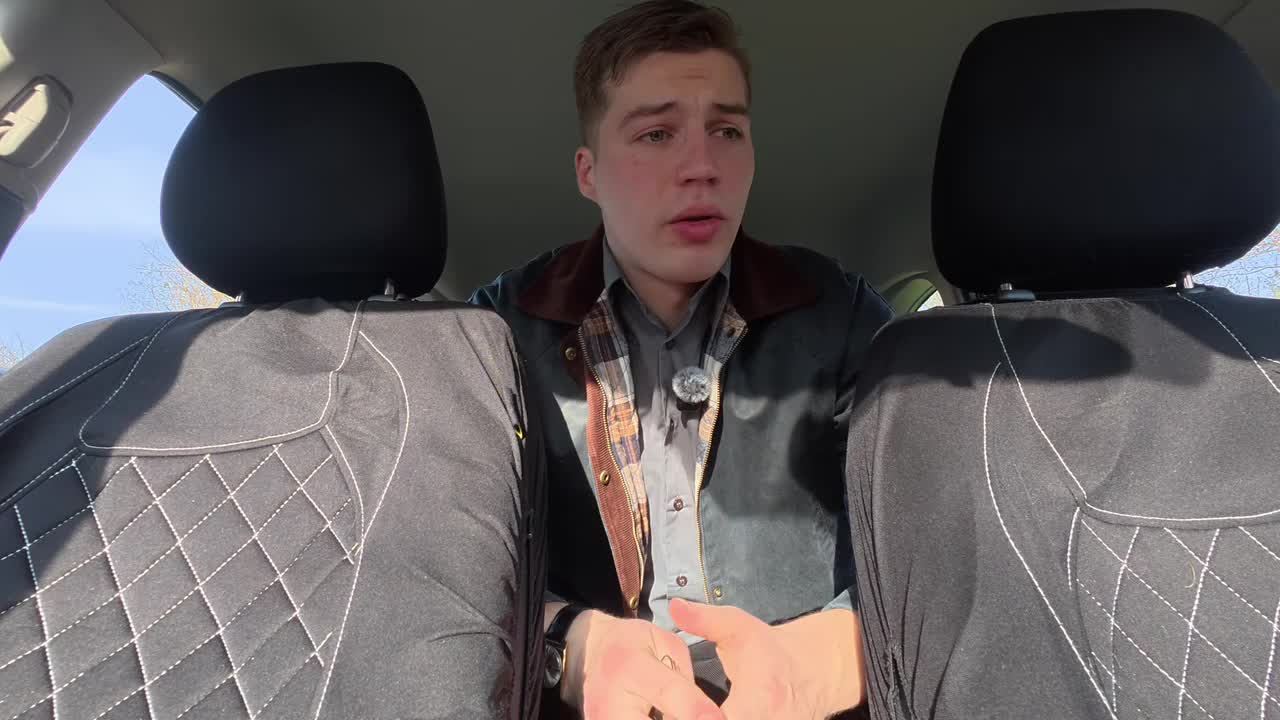
As you can see, i am sitting in a car, more specifically in the back seat of a car, So I wanted, or wanted, to make a video describing different parts of the interior of a car in English.
And we can also go through vocabulary for what we say when we're in a car, and hopefully this will be useful to some of you, or even many of you.
When you're driving, or you are in a taxi or you're just sitting in a car, you will know what the different items are and how you can speak inside of a car in English.
So thanks for joining.
Okay, so let's get started.
We're in the back seat.
Again, we can say we're sitting in the back. or we're sitting in the back seat.
Obviously, these are seats.
We have one, two, three seats.
So these are the seats in the back.
But i can say i'm sitting in the back, i'm sitting in the back of the car or i'm sitting in the back seat or seat.
What do we have here in the back seat?
So we have a seat belt and when we sit here we say to buckle.
To buckle is to put on to buckle your seatbelt.
This is to buckle your seatbelt.
Now my seatbelt is on.
It is buckled.
Sometimes we can say to buckle up or buckle in, but it is enough to say to buckle, to buckle your seatbelt.
Take off our seatbelt or undo our seatbelt.
Like I said earlier, these are passenger seats.
We are passengers in the back.
These would be the back passenger seats and this would be the front passenger seat.
So obviously the only seat left is the driver's seat.
So back here we are passengers.
We also have floor mats.
These are floor mats.
We have this rug here underneath.
I don't know if you can see, we have the floor mat and this rug.
These seats are a cloth material.
Some of you might have leather seats, or I'm not sure if there are any other materials.
I think cloth or leather are the most common.
But maybe I am missing something.
We have a pocket behind the seat, the front seat.
Here we have a pocket.
We also have decent leg space.
When we say leg space is how much space we have between our seat and the seat up front.
Just like when we are in an airplane, we also want to have enough leg space.
We can also say leg room, but leg space to stretch our legs.
And we can obviously or hopefully move these seats up or move them forward and we can stretch our legs out, stretch out our legs more.
We have a manual window crank to crank the window And notice we have manual for manual labor or manual work and also manual window crank.
We use our hands.
We have the interior door handle and a manual lock unlock feature and that is it for the back.
Obviously, back here is the trunk, or in british they say boot, the boot that is more accessible from the outside.
Or if you fold down, we can press this and fold down the seats.
So a lot of cars have the possibility to fold down the seats.
Okay, so let's move up to the front passenger and the driver's seat.
Okay.
So now I'm sitting in the front driver's seat.
This is the passenger's seat as well.
As we say, to sit shotgun, I want to sit shotgun means sitting next to the driver's seat.
So sitting shotgun, or I want to sit shotgun, okay.
So the driver's seat.
We have, first and foremost, the pedals.
Let me pull up this handle and scoot back to scoot back, move back my seat okay.
So we have again a floor mat and we have the pedals.
These are the pedals.
We say pedals and let's go through what we have here.
So if you have an automatic car like in the US, we have mostly automatic cars auto-matic, automatic cars then you have two pedals.
Here in Europe, in most countries, to my knowledge, they have manual cars, so they have three pedals.
And let's go through what these pedals are.
So the first pedal on the left is the clutch, so that is the clutch all the way on the left.
After that, in the middle, is the brake, So the clutch, the brake, and we say on the right, we say the gas.
So the gas.
Those people who drive know that when you start the car and you put it into first gear, you have to balance the clutch and the gas.
Something like this.
You push down the clutch and the gas, and you slowly release the clutch while you give it some gas.
So that is basically how a manual car works.
I want to share what a manual car is.
A manual car we shift, We can say we shift between gears and we have here the gear stick or shifter, or gear shift or the stick.
We have many names, but gear stick is maybe the best.
This is why in the US we call these cars stick cars, can say you drive a stick or a stick shift car, stick shift or manual, because you manually change the gears, you push down all the way on the clutch and then you're able to move it into first and then second, then up, middle to third, down to fourth, up and to the right for fifth, and then the last one is to the right and down for reverse.
The R is for reverse while you have the clutch all the way down.
We have the keys and with a lock and unlock button, when the keys are in the ignition, we say to put the keys in the ignition and then start the engine.
And we start the engine.
Now the engine is on or our car is turned on, and then we can turn off the engine, turn our keys and remove the keys.
Okay, so let's get into some of what we use during a drive or what we use while driving.
So first, what everybody wants is to honk, to honk the horn.
This is the horn.
We can see airbag here srs, i don't know, maybe safety, but this, there is an airbag in here.
We have some buttons that are less important.
For example this is important the volume control.
So if you're listening to music or if you're on a phone call or listening to my youtube videos in the car, then you can adjust to adjust the volume.
You can skip between songs or videos.
The mode is to switch between different modes, radio or Bluetooth.
This is the mute button.
Bluetooth to pick up a phone call.
This is to hang up, I think.
Now we have our lights, we have our headlights.
We can say headlights, we can see they're on and if we press forward, those are our high beams.
At night, when it is very dark, we turn on our high beams.
So we have high beams and we can also.
These high beams are on if we press this lever forward.
If we bring it back, they're off.
If we hold it, then we can quickly turn them on or off.
Let me turn the car on.
We don't want to drain the battery.
It's not my car.
Here we have the seatbelt icon.
We talked about wearing to wear or to put on your seatbelt, to buckle your seatbelt.
Hey, buckle up or buckle in.
So now I will put on my seatbelt and the sign is no longer there.
Here we have our speedometer.
Speedometer is like speed meter, a meter to measure speed, to measure our speed.
We say speedometer, speedometer kilometers per hour, because we're in hungary, and also how much fuel we have down here, And also this is for RPM, which I believe is revolutions per minute, if I'm not wrong.
Obviously, the red is the danger zone.
So, I try not to go into that area.
We have the air vents.
Air vents to open or close or turn to angle.
Can you angle the air vents towards me?
Vents are like ventilation.
So air vents, air ventilation.
Up front we have window switches.
This is automatic lock.
Unlock the doors, switch.
Here we have a window lock.
And then this is for adjusting our mirrors, or mirror volume adjustment.
This is for the bass, i think if you're listening to music we have our hazards.
So if we turn this on, you can see it puts both our signals on.
We call this our hazards.
To push down on this lever, we have our left turn signal And then we bring it back to middle.
There's nothing.
And then we raise it to the right and we have our right turn signal.
We have AC, air conditioning.
We have cold or hot.
We have the intensity or how strong you want it to be, in four different levels.
We have the direction from the air vents, if you want it, in the front, on your feet, windshield.
Oh, i forgot one more thing which is different in some cars, but we have the handbrake so we can pull this up.
Now it is pulled up because we are parked people also say parking brake, so but i call it the handbrake.
We can push this button in and pull it up slightly and then bring it down.
Or when we're parking or after we have parked, we can raise the handbrake or the parking brake.
And this shifter or stick or gear stick is in neutral.
We know that it is in neutral because we can move it left to right.
If it is in first gear, we can't move it.
But if it is in neutral, we can move it left to right.
We also have plugs or some kind of outlet here for charging your phone or your camera.
Because I might need to charge my camera.
So that is about it.
I hope that that was helpful and you're able to better describe, when you're inside a car, what is happening and what vocabulary you can use at that time.
So thank you for joining.
If i missed something or if you have further questions, then let me know in the comments and maybe i'll make another video for the exterior of a car, although maybe that is less important than the interior.
So thank you for watching.
I appreciate your time.
If you like these videos, then feel free to like and subscribe.
If you would like to speak with me, The link is in the description of the video.
And also thank you for the members who have joined and who have been with the program for some time now.
Thank you.
And I'll see you next time.
I'll see you on the live stream soon as well for the book challenge.
And have a great, great day.
Talk to you next time.
Bye.