Hello everybody, this is Teacher Levy.
Today we'll be filming another slow English video.
This time we'll be talking about American slang.
I'll share some common ones and I'll also share a couple which are more trendy nowadays.
So things that you might find on social media.
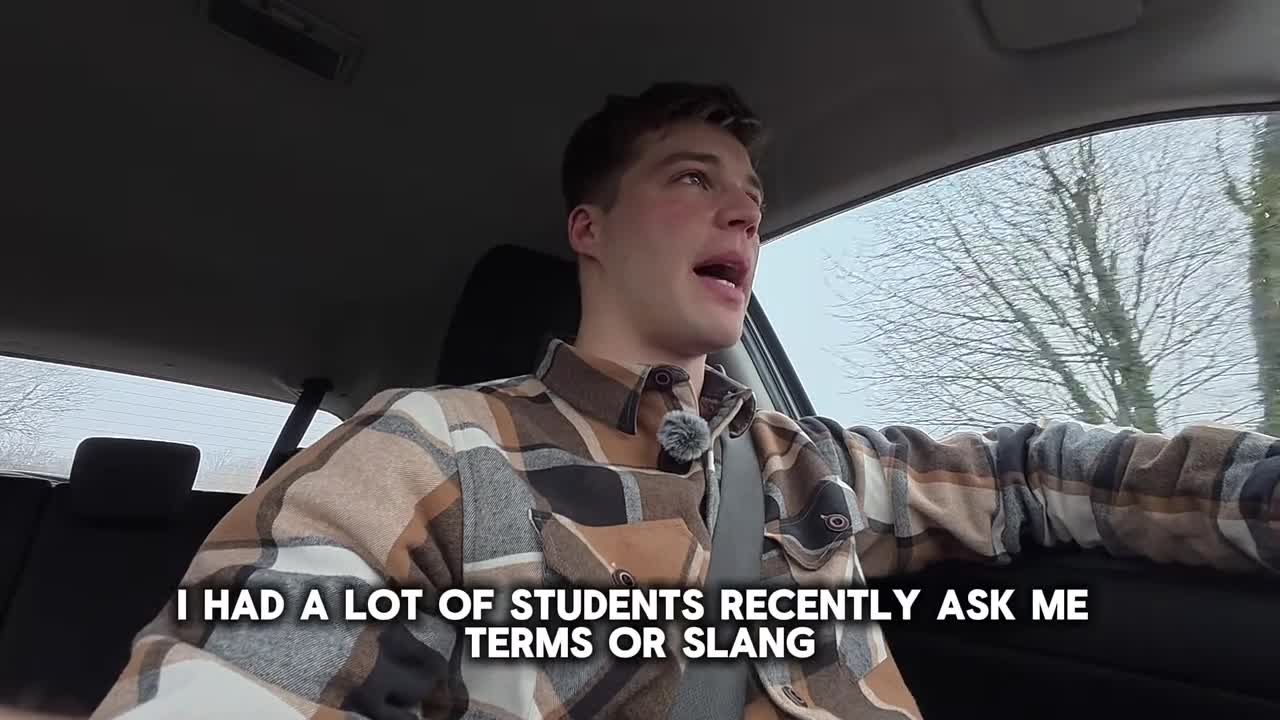
I had a lot of students recently ask me terms or slang which is common for the younger generations to use, especially on YouTube or TikTok or Instagram.
You might hear or see these terms.
So I'll cover some of those, not all of them, because I think a lot of it is not useful.
So but I will cover some of it and I'll cover some more traditional ones as well.
So we have a lot of useful slang today.
For those of you just listening, that's okay.
You don't need to watch.
I'll try to focus on only speaking, but I will show this.
Check this out.
Some ice on the water.
That looks interesting.
Okay, so we'll talk about slang.
I also want to share that the Book Challenge is back.
So I posted recently the new book for the Book Challenge.
It will be the I Survived series, book series.
And the title is The Destruction of Pompeii. which is a shorter book.
I haven't read it before, but I believe it was suggested by Ariel, if I remember correctly.
Anyways, I'll put the comment.
So he suggested the series.
And that is the book will do.
I'll also put a picture of the front cover for the book so that you can see what I'm talking about.
And I'll give some time for everybody to find the book, whether online or from your local library or from a bookstore or the audiobook, as some of you did in the past for the other books.
So that's the update.
I am also still waiting for my copy, so it should be arriving soon, i think within a week of or a week from today.
So we'll continue the live streams and that will be the next book.
So even if you don't follow along or you miss a couple streams, I think there's still useful information in there that you can learn from or add to your vocabulary.
We try to highlight different words or terms or expressions and practice using them in sentences, which is a good tool.
By the way, i recommend everybody to have vocabulary lists.
I've mentioned it numerous times but to practice using those terms in sentences is also very important, important.
Okay, so that's that.
Okay, so we'll go down some slang.
I have a list and, like I said, I'll share some old ones or more traditional ones and we'll review a couple like goat.
Um well, goat is the greatest of all time and we usually say this for people.
We can say it for different industries, like this person is the goat of art or of English.
Or this person is the GOAT of basketball.
So GOAT, G-O-A-T, is greatest of all time.
So that's a good one.
You might hear it.
I have seen a lot of things online where people say this person's the GOAT or that person's the GOAT.
So just so you know, some of these might be better just for you to know.
You don't necessarily need to use these in your conversations if you don't want to.
The next one, bummer.
Bummer is something that is disappointing.
Disappointing.
We can say disappointing.
Something that is a disappointing situation.
For example, if you have a conversation with someone, they might ask hey, were you able to go to your Christmas party at work?
I heard it was a lot of fun.
And you respond, no, I couldn't because I had to go to my kids' rehearsal at school.
Oh, that's a bummer.
Or they might say, oh, what a bummer.
What a bummer.
Okay.
So bummer is a good one.
Don't be confused.
If someone calls someone a bum, that is a negative term.
So if someone is a bum, perhaps they are lazy or they are not a productive person, that is a bum, and bummer is a disappointing situation.
So what a bummer.
So if you say i feel bummed out, which is also a different context, i feel bummed out, similar to I feel disappointed.
I feel let down.
There's let let down.
I feel bummed out, I feel let down, I feel disappointed.
Next, one which is a good one is no-brainer.
If something is a no-brainer, notice we say something is a no-brainer or that's a no-brainer.
Oh, i signed up um to the gym because there was a christmas special and it was ten dollars for three months.
Oh, that's a no-brainer to sign up.
So oh, that's an obvious choice or an easy decision.
So making that decision was a no-brainer.
Sometimes I hear my students say, I took a decision.
We like to say, make.
I made a decision.
I'm making a decision.
I will make a decision.
So, no-brainer.
The next one, which I like, is in the loop.
In the loop.
We can also have the opposite, which is out of the loop.
I'm out of the loop or I'm in the loop.
Being in the loop is being informed.
So if i'm in the loop, i know what's going on, i know the relevant information.
If i'm out of out of, If I'm out of the loop, I don't know what's happening.
I don't know what's going on in a certain situation.
These could be applied to different contexts.
For example, work.
If you left for two weeks to go on vacation, we say vacation, the british people say holiday.
So if you went on vacation for two weeks and then you come back to work and people say, What are your thoughts on this new deal or this new client that we're bringing on to bring on a client?
I'm not sure.
I'm out of the loop.
I haven't been here for two weeks.
Okay, so I'm out of the loop.
I'm not informed.
I don't have the relevant information.
Okay, let's look at some of the newer slang terms.
First and foremost, let's mention to ghost.
Sometimes, when you're texting someone, you have a steady flow.
Maybe every hour you text and they respond, and this goes on for a couple days or a few weeks and then suddenly they stop responding out of the blue.
Remember out of the blue, suddenly they stop responding to your text messages or your texts.
This is the perfect time or place where you could say I got ghosted, was ghosted by this person, I got ghosted by this person, so you can get ghosted.
You can also ghost someone.
Remember?
A ghost is a scary spirit and they can disappear.
You can't see a ghost, so to ghost someone is to suddenly disappear, to stop responding or replying to them, and this way you are ghosting them.
So to ghost a common term nowadays for texting, also for other platforms if you're messaging or somehow communicating and they stop suddenly without giving you a reason, you got ghosted.
We say you got ghosted.
Okay.
So I also wanted, or wanted to talk about a slightly different topic, but something that is important for everybody learning English.
And this is the mindset.
A student recommended that I talk about this topic.
So I'll talk about it briefly in this video.
And perhaps we will touch on this or talk about this again.
Mention this again later in a future video.
But I had a lot of students in the past who came to class and they would talk about their disadvantages.
Notice we have advantage or advantage, and we also have a disadvantage or disadvantages.
Disadvantages, disadvantages.
A popular one is age.
Age a lot of people reference or they refer to when they list reasons for why they're not progressing or why it's harder for them to improve or learn English.
Sometimes I share stories which have teenagers or younger people who learn English through movies or making friends, sometimes online, and they learn the language rapidly rapidly, quickly.
And then sometimes I hear the rebuttal or rebuttal or pushback about well, they're young and I'm older and my brain isn't as fast as theirs.
It doesn't process information. the same as a young person's brain or mind.
And they have these self-limiting beliefs we call self-limiting, self-limiting beliefs.
And it's important to not have those.
My perspective on the age conversation was there's a saying quite common that with age comes wisdom.
And that is perhaps one of the advantages that older people have on younger people.
They have maybe more wisdom, not always, but they have more wisdom.
A lot of times they're more organized.
They have goals.
They have an objective. that they're trying to reach.
And younger people sometimes are all over the place, meaning they're not focused.
They're trying different things.
They're experimenting.
And so there are these advantages and disadvantages.
So using age as not an excuse, but as a reason, something to focus on, I think is detrimental.
Detrimental.
So it becomes a weakness and it holds you back from observing or paying attention to the advantages that you might have.
There's a saying that I've heard before, but my student reminded me.
It's something like this.
I might butcher it meaning, might not say it perfectly, but it goes like if you think you can or if you think you can't, you're right.
Can and can't or can't can be tricky the pronunciation.
So you can or you can't.
When it comes to these words, I recommend emphasizing the ending.
We have can and we have can't or can't, can't.
So if you think you can or you can't, you're right.
So just pointing to the fact that we are going to either help ourselves or not in the way that we're thinking while learning English,
This is a big part of it.
We've talked about persistence.
We've talked about other things related to mindset and a student's mindset.
That's beneficial and the habit of looking at people say, look at the bright side, but it's also not being too concerned of the wisdom or the information that other people say.
You hear a lot of conventional wisdom, that people say that with age you learn slower than somebody who's younger, or if you don't live in an english-speaking country it's more difficult, And I think there's a truth in that.
But focusing on the positives is key.
So that's a little reminder.
I think sometimes people need to hear the explanation of something like this, and then it will open up a new reality for some people.
For some people won't change anything, so but it might have been helpful for some.
So thank you for watching.
There's a new feature.
If you got to the end of the video that is called hype your phone.
So if you're watching on the computer or your TV I think it's not there but on the phone you can find a hype button and it promotes the video.
It's a new feature, so let's try it.
If you have your phone, try to click on the hype button.
I think you have three uses per week.
So if you don't mind, let's see what it does.
And thank you for watching.
Keep practicing English.
And we'll also do, like I mentioned, the book challenge soon, probably in February, because Most likely definitely in February.
So thank you for the support, like always.
And if you like these videos, then like and subscribe.
And I will see you next time.
Thank you and bye-bye.