Hello and welcome back to the Easy English Podcast.
I'm your host Oliver and a very warm welcome to our episode today.
We are talking about a dream that many English learners have.
We've all seen movies where a character can maybe put on some headphones, they go to sleep or they click a button and they wake up speaking a new language perfectly.
In our busy world, this idea of passive learning... is quite appealing.
The idea of improving without effort, without putting actual work in, it's quite tempting, right?
But is it real or is it just a myth?
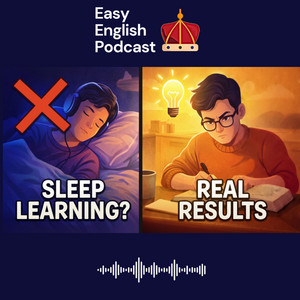
Today we're going to look at how your brain actually works at nighttime, when you're maybe passively learning, and the real difference between passive and active learning.
I've picked this topic because recently I've seen a lot of stuff about passively learning.
So I wanted to break it down because I know some people ask me, Is it real?
Does it help?
So let's have a look at that today.
First, as always, we are going to learn some key vocabulary for the topic.
So, before we do that, and before we learn our five key words and phrases, make sure that you're following and subscribed to the Easy English Podcast.
It's the best way to get updates of each new episode every single week.
And over 60% of listeners are not subscribed or following.
Let's have a look at our key vocabulary.
The first word is subconscious, subconscious, subconscious.
And this is the part of the mind that works even when you're not thinking about it.
This can be used as a noun and an adjective.
So you could say a subconscious thought.
That is an adjective.
You could say you're subconscious.
That's the part of the brain that we just defined.
Our second phrase today is passive input.
Passive input.
Passive input is language that you hear in the background while you're doing something else.
For example, a podcast, the radio, some sound that is in the background.
Our third phrase today, active attention.
Active attention.
This is when you focus 100% on what you're hearing or reading.
So hopefully you are giving this podcast your active attention right now, as I'm telling you these key words.
Our fourth word or phrase is gatekeeper, gatekeeper.
And a gatekeeper is a person or thing.
In this case, it's a part of the brain that controls who or what can enter.
So a gatekeeper, it controls who or what can enter into something.
And finally, our last word today is reinforce.
Reinforce.
And this is a verb.
And it means to make something stronger like a memory or a habit.
So we reinforce memories and we reinforce habits.
It's a great phrase to save and to use when we talk about learning.
Okay, let's be honest, you cannot learn a brand new language from zero while you're asleep.
I'm going to say that from the start.
I've seen lots of people saying that you can listen to courses, you can listen to audio and you will naturally learn the language from doing so.
If you play an advanced recording of English tonight and you don't know the words yet, you won't magically know them tomorrow.
Even if you do this, you know a thousand nights in a row, you probably likely won't understand fully all of those words.
And this is because of the part of your brain that is called the thalamus.
Don't worry about the name of it, but think of it like the gatekeeper in your mind.
And we talked about it a little bit before about memories with sleep.
And when you fall into a deep sleep, The gatekeeper closes that door.
So it closes the door and it stops most things from outside from getting into your brain.
So why does it do it?
It does it to protect you.
If your brain tried to learn new difficult things all night, you would never feel rested.
You would wake up feeling exhausted.
And it would probably feel like you hadn't really slept at all, to be honest.
For your brain to truly record information, it needs to be awake and focused on it.
So, I will explain a little bit more about this.
But first, I also made a recent episode.
It's on the Easy English Patreon that you might find interesting.
I was talking about why culturally people in the UK are more indirect.
But we were looking at it a little bit more in depth.
So talking about the theory of politeness.
Why is it a thing?
Why does it exist?
It's something that I've asked myself many times in the UK.
Why does politeness exist?
What function does it serve?
And why is it a part of the culture here?
So if you're interested in that topic and you want to support Easy English, make sure to become a Patreon supporter and you will get access to a bonus episode every single week, as well as each episode that we make with full transcripts, with PDF documents, and you get access to vocabulary flip cards for for each episode as well.
So you get a lot there and it really, really helps to keep the show going and support the growth of Easy English.
Okay, so let's have a look at background noise.
Many students try something called passive listening when it comes to language learning and when it comes to English.
And this is when you have an English podcast playing in the background.
So while you're doing something else, maybe you're cooking or cleaning or driving.
This is good, but if you aren't really listening, if your brain is actually focused on something else, it will be kind of difficult to let the English sink into your brain.
And the problem is that your brain is very smart.
It knows how to ignore things.
If you don't pay active attention to something, if you're not directing your focus and your attention at it, your brain will start to treat it like white noise, like background noise.
White noise is the sound of a fan or refrigerator, for example, or static.
You hear it, but you're not listening to it.
It's there in the background.
And the problem is, if you're listening to podcasts like even this one and you're focused on something else, your brain may start to treat it like white noise.
Does it help at all listening to white noise English, I guess?
A little bit.
It can help you get used to the sounds and the speed of English, but it won't really help you to learn new vocabulary or grammar.
The research really isn't there from just passively listening to learn.
You have to actively focus and listen to something.
So don't get me wrong, I'm not saying that listening to English is not worthwhile.
I'm saying that if you want to improve and see full benefits, you need to move from just hearing English to actually listening.
So on the opposite side, how do you actually use your subconscious?
Even though you can't learn new things while sleeping, you can use your subconscious, the subconscious part of your mind, to reinforce what you already know.
And here's how you can do it correctly.
So the 10 minute review is a great way.
Instead of listening while you sleep, which some people do, and it's becoming a popular genre study for just 10 minutes immediately before you go to bed.
This might sound silly, but there is some research behind this.
And if it's your cup of tea, if it's something you want to try, go for it.
When you sleep, your brain replays the last things that you thought about.
So this is a known phenomenon, I guess.
This helps move the words that you're thinking about from your short-term memory to your long-term memory.
So I guess you could call it a little bit of a vocabulary hack.
So if you do your vocabulary flip cards just before you go to sleep, your brain in theory will have them fresh in your head and it can help move it to your long-term memory.
That's pretty cool, to be honest.
You can also use a familiar audio.
So if you want to listen to something that's in the background, you could choose a podcast or a story that you've already studied before.
Or maybe you've studied it and you understood it even better.
So because your brain already knows the meaning, the background, listening it helps glue those words into your mind already.
Another way to use your subconscious is the shadowing trick.
Don't worry about that name.
What it simply means is, instead of just letting the audio play, try to repeat a few sentences out loud every few minutes.
So you can even do it with this podcast.
You can pause occasionally, not all the time.
You can pause and repeat what I have said.
And the small part of this active work, it tells your brain that what you're doing is important.
This information is important.
I am focusing on this.
It keeps it from being background noise.
So I'm not saying you have to do this, but it is a good option to try and help yourself to focus on the podcast content, to focus on the series that you're watching, and not just to passively consume it.
Okay, so now we have the listener spotlight.
And today's question, well, last week's question that I asked was on the topic of binge watching.
If you haven't listened to that episode yet, go and check it out.
It was a really good one, I think.
And it's about binge watching, what it is, and about what we can binge as well.
So I asked if you binge anything and to tell me a little bit about it.
It didn't have to be TV or movies.
It could be something else that you binge.
And we had a lot of really great comments.
And I'm going to read a couple today.
So the first comment I had from a user, Cheeky Park.
And they said, Hello, I am new watching your channel.
I am looking forward my English.
So looking forward, I guess, with your English.
I am binging the Abbott Elementary series.
I don't know if I am writing the right sentence.
Thank you.
No, you're doing very well.
That's a great comment.
And thank you very much for writing a comment and reaching out to share with us.
And I'm glad that you found a series, an English series that you enjoy.
And hopefully it's helping with your language learning as well.
So thank you very much for leaving a comment.
And I hope to see you in the comment section again.
Okay.
Another comment that we had is was from Eva, and Eva said Hi Oliver no, I never did binge watch TV or movies, but I did binge playing block puzzle in my mobile in the evening.
I used to tell myself I'll quit if I mess up this game but I didn't and I played until midnight.
Then I couldn't fall asleep because I continued to place blocks in my mind.
After a few months, I decided to quit.
It wasn't easy, but I did it.
This time, I prefer doing yoga, walking, reading, and of course, learning English in my free time.
Bye.
Thank you very much Eva, for explaining that and for telling us about your experience with binging the block puzzle games.
I know those games can be very addictive sometimes as well.
So thank you very much for leaving that comment.
You've done a very good effort writing that as well with good English.
So thank you.
Another great comment from Diego, who says, Hi Oliver, this is an interesting topic.
I'm not into watching telly.
However, my wife really enjoys binge watching Netflix.
If she finds a film or series that she likes, then she will be glued to the screen.
Binge watching at night can make people feel sluggish the next day due to the lack of sleep.
That's why I prefer harnessing the power of it rather than watching telly at night.
This was an excellent comment, very well written and great vocabulary.
I especially love this word telly.
So it is, I think, a very British way of saying television or TV.
I don't say it so much, but I hear some of my family say telly.
But yeah, I wonder if they use this word in the US too.
I don't think so.
But really great word and excellent vocabulary, especially sluggish.
So sluggish is a little bit tired and slow.
Great, great vocabulary, Diego.
So thank you everyone for your comments.
There were so many more that I just don't have time to read, unfortunately.
But I'm going to ask a question for next week's episode.
I'm going to challenge each and every one of you to try to answer this question in the comments.
If you're listening on Spotify or YouTube, write a comment and try to answer.
I want you to tell me How do you learn English?
So tell me how you learn English.
The question is, how do you learn English?
You can tell me in any way.
Do you study vocabulary?
Do you have a routine where you do it two or three times per day?
Do you learn for 15 minutes in the evening?
Maybe you're listening to this podcast on the way to work.
What is your study routine?
How do you learn English?
Let me know and try to answer and I will read a few of these in the next week's episode.
This one is important to answer because I think that some of these answers could help others.
And you can read each other's comments on YouTube or on Spotify and see what you're doing and what they're doing.
What sort of techniques and study routines do we all have?
Okay, that brings us back to the topic.
So when we're talking about this passive learning, I think this is a very new thing, especially with the internet, where people want to do everything passively.
They want to do things without effort.
It's probably becoming even more of a problem because of AI.
I think AI is great, but of course it can cause people to become a little bit lazy and dependent on it for their work.
But generally, we see this even with work.
So sometimes people talk about wanting to have passive income.
They want to make money from doing nothing actively.
So building something which makes them money and they don't have to do any work going forward.
But the reality is not much is passive unless you already have a lot of money.
And the same with language learning.
Not much of it is truly passive.
Yes, it helps being in another country that speaks the language.
Yes, it helps to be surrounded by the language.
Of course, it helps as well to listen to it and to have lots of input.
And I've made episodes in the past about immersion and about getting lots and lots of input.
And I strongly believe that this is extremely important.
But this episode is about telling you that this input that I've talked about, it needs to be active.
You can't just take it and not do anything with it, not focus on it, not use it and not learn it.
There is always an active element.
And I felt this was important to make because I make a podcast for English learners.
And lots of you listen to this podcast.
And the people that have the most success with this podcast will be the ones that use the vocabulary, the ones that actively listen, the ones that maybe take it a step further and try to summarize the topic afterwards or leave a comment.
The more engaged you are with the content, whether it's focus, whether it's using it, the better you probably will learn from it and retain the new knowledge, the new pronunciation, the new vocabulary.
So I want to encourage you to actively study.
Don't get into a routine of just consuming English content and not doing anything with it.
So I hope this podcast really motivates you to do some more active learning with your English routine.
Remember, leave a comment in the description below or in the episode telling me how you learn English, what your routine is, and share it with others.
I would love to see and I would love to read each and every one of them.
Thank you so much for watching.
Remember to follow and subscribe if you're new or you haven't yet.
And I will see you in our next episode of the Easy English Podcast.
Goodbye.