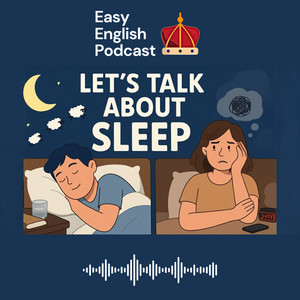
Hello and welcome back to the Easy English Podcast.
I'm your host Oliver and today we are going to the land of dreams.
We are talking about sleep.
Sleep is a topic that I've covered a few times on this podcast, but today we are going to explore it a little bit further.
We're going to look what sleep actually is and how it can possibly help with your English language learning.
So stick around to find out.
And for English language learners in general.
We talk about sleep And you need to take your language beyond the simple I'm tired or I'm going to sleep for advanced fluency.
So you're going to learn some new vocabulary, some more advanced vocabulary today related to sleep, to help expand your vocabulary in English.
Interestingly enough, I was looking at the statistics for the podcast this week.
And over 70 of listeners are not following or subscribed, have a lot more listens and downloads than we do followers and subscribers.
So if you are listening, make sure that you're following or subscribed, on whatever platform you are on.
Let's look at today's key vocabulary and learn some words to listen for in today's episode.
Our first word for the day is consolidation, consolidation, consolidation, consolidation.
And this is the process where the brain turns short-term memories into long-term memories.
Sleep is essential for long-term consolidation of new vocabulary.
Our second word today is neural pathways.
Rather a phrase than a word.
Neural pathways.
And these are the roads in your brain that connect bits of information.
This word neural is usually an adjective in relation to the brain and how the brain works.
Speaking a language builds strong neural pathways in the brain.
Our third phrase for today is circadian rhythm.
Circadian rhythm.
Two words there, but they make one phrase for this topic.
And your circadian rhythm... is your internal 24-hour body clock.
And it regulates, so it decides, when you feel sleepy and when you feel awake.
So when to sleep and when to be awake.
That is your circadian rhythm which decides this.
Our fourth phrase today is cognitive load.
Cognitive load.
And this is the amount of mental effort that is being used in your memory right now.
So when you have high cognitive load, you are using a lot of your memory, a lot of your brain.
There's a lot of effort going on.
And our final word today is restorative.
Restorative.
And this is having the ability to restore.
It's an adjective about something which restores maybe health, strength, or a feeling of being well.
Oh, those were quite hard phrases and words today.
So let's get in.
We'll get straight in to the main episode already.
So let's talk a little bit about the stages of sleep and what it is.
So sleep is not simply a flat state.
So you don't just fall asleep and that is all it is.
It is a very structured state.
Almost, well, a very structured process which has different stages in the sleep cycle.
And understanding these cycles is very important to understand how we learn in the cycles.
To how we are learning while we sleep, essentially.
And sleep can be split into two separate sections in general.
The first is non-rapid eye movement sleep.
So this is the physical repair stage of sleep.
And during this non-rapid eye movement sleep, your body is repairing parts of itself bits of DNA cells or even your immune system.
And for English learners, this stage of sleep is when your fact based memories, so like vocabulary or phrases or grammar rules, are taken from your temporary short term memories and moved to your long term memories in your brain so that you can remember them for longer.
Then the second type of sleep, the second type of stage is REM.
So REM or rapid eye movement sleep.
And REM is when your brain activity is very high.
So it gets very high, almost like you are awake, but you're still asleep.
And this stage is very important for understanding.
So when your brain is working things out.
So, for an English language learner, this could be where your brain is working out some of the flow or the rhythm, or even the emotional tone of English.
So really, sleep can be a language learner's secret weapon.
Many students, especially if you have an exam, you stay up very late until maybe 2 or 3am to try and study to get as much into your head as you can before an exam or maybe a big test in school or university.
However, the science about sleep and learning tells us the opposite.
If you don't sleep, you are essentially deleting, removing the work that you just did.
And we'll break this into steps.
Number one, the consolidation process.
Consolidation.
The consolidation process.
Think of your brain as a sponge.
During the day, you are absorbing, you're soaking up new English words and signs.
But a sponge can only hold so much water.
Sleep, it squeezes the sponge, moving all of those new words into permanent storage.
Maybe it's squeezing the water into a bucket, and that bucket is your long-term memory.
And sleep does this so that you can store more things in that sponge the next day.
This is called memory consolidation.
The second point here is the brain flush.
During sleep, your brain uses a system to wash away toxins that build up during the day.
If you feel a brain fog or you start to feel a little bit... It might not be a lack of talent.
It might not be that your brain hasn't had the chance to you know, maybe recover.
It probably is that your brain hasn't actually had the chance to get rid of all of that bad stuff, that waste from the previous day's study session.
Another point about sleep and language learning is have you ever had a dream in English?
It's something I'm curious about with other learners.
If you have had a dream in English, this is a fantastic milestone.
It means that your brain is actively integrating the language into your subconscious mind.
During REM, rapid eye movement sleep, your brain is practicing social situations as well.
And it makes them feel more natural when you wake up.
So once your brain is starting to have dreams in English, this is a great sign that you are using English in your subconscious.
And that's a huge milestone of fluency with the language.
So we know sleep is very important, we know it's extremely important for learning a language, but what are some things which stop us from getting enough?
In 2026, probably our greatest enemy is what we call blue light.
Our brains are evolutionarily designed to respond to the sun.
We see the sun.
In the morning time, it's there.
In the evening time or night time, it's gone.
And this light from the sun is processed by our circadian rhythm, which tells us when we need to be asleep and when we need to wake up.
But when we use blue light, it tricks us.
We think, oh, it's time to be awake, even if it's late night.
So looking at phones late at night or screens, kind of like I'm doing right now, I'm looking at a screen which I probably shouldn't be.
It tricks our brains into thinking it's daytime which can stop this chemical called melatonin, which makes us sleepy, from being released.
This leads to insomnia, where you can't sleep, which prevents the brain from starting that consolidation that we need for remembering our English learning.
So what is the best way to use sleep to help you study English?
And this is something called the study sleep technique.
There's a lot of research on this, and it shows that reviewing your most difficult English material, like phrasal verbs, for example, right before bed, followed by eight hours of sleep, results in much higher retention than studying in the morning.
So, although you might feel a little bit tired in the evening, it shows that if you do your English language learning in the evening, when you feel a bit more tired, so closer to sleep, you will probably remember and learn much faster than if you do it in the morning.
And it makes sense.
If you're learning in the morning, you have the rest of the day to go, with lots of new information being put on top of what you're learning.
But of course, this doesn't mean that you shouldn't learn in the morning.
You should learn when is best for you. doing some learning is better than none at all.
So stick to your habit and your routine that you have, because the difference is probably not that big and it's not worth moving the time that you're learning if the evening time doesn't really suit.
But maybe in the evening you want to read a nice phrasal verb book, like Phrasal Verbs Are Easy, which you can buy in the link in the description below.
It's my book that teaches you phrasal verbs, reinforcing those from context using short stories.
The link, as always, is down below.
It's still on sale for our winter sale.
Okay, now this brings us to my favorite part of the show, where we celebrate the progress of our global Easy English community.
Looking at your answers to my questions,
And last week we had an episode about British and American English, the differences between them and why those types of English became so different.
And I had a lot of answers on this one, some very great answers.
And I would like to read you today some of those answers to celebrate the great job that you're all doing commenting.
I read each and every comment on this podcast and on YouTube as well.
So do leave them.
I really enjoy reading them.
I enjoy seeing your progress.
And although I don't get the chance to respond to every single one, I do make the effort to try and read them all.
Our first answer to this question is from Diego.
And Diego said, Hi Oliver, I'm Diego from Ecuador, but I moved to England three years ago.
Listening to your podcast is a great way to start my week on the right foot.
That's great, Diego.
I'm glad that you enjoy them, particularly starting your week.
I'm more into British English as I live and work in the UK.
The use of American or British English depends on your environment.
As an example, in my previous job in England I was presenting some information and I was corrected by a colleague.
The word organization.
My bad was to use organization with a Z. I'll never forget it.
That's a really good point Diego, about the S and the Z.
Sometimes British and also Americans can be quite particular about this.
So really great point.
And it makes total sense that you're focusing on British English living here in the UK.
Thank you for your comment and I hope to see you around on the channel on the podcast comments.
We had another comment from Voros Anamaria.
And they said, hi Oliver, I am from Hungary.
Wow, we have a lot of Hungarian listeners.
I can see from the statistics, it's amazing.
And Anna Maria says, I prefer to learn British English because it is the origin.
And I love your northern accent.
I think accents are important to be preserved.
It is part of the culture.
But to return to your original question, if I spoke English fluently, it would not be important which version.
I love that comment.
It's a really great comment from multiple ways.
I agree.
I think it's important to have accents.
And it's also important for you guys, for everyone listening, to understand different accents.
Not just an accent from London, but different parts of the UK and America too.
Great comment.
Very, very good comment.
And I hope to see you in the comment section in the future as well.
We had a comment from Casa Kim, and they said, I often mix them up when it comes to pronunciation.
But for words, I might use the American ones more often.
Ah, very good.
Yes, I agree with pronunciation.
It can be quite difficult, even for native speakers.
Some of them will learn maybe the incorrect pronunciation for their country.
But...
It's due to media.
We hear so many different versions of different words.
And it's fine.
As long as people understand each other, as we understand you and you understand me, it's not a problem.
So thank you very much for all of your amazing comments.
For next week's episode for the listener spotlight, I'm going to ask you a question about sleep and dreams.
My first question is, have you ever had a dream in English?
If so, tell me about that dream.
Maybe you spoke in English.
Maybe you heard something.
Maybe you dreamt about English, but in your native language.
Tell me about your dreams related to English.
And I will read some dream-related comments in next week's episode.
So do leave the comments.
I read each and every one.
Okay, thank you so much for listening.
In summary, sleep is not a lack of productivity.
It is not something which we do not need.
It is essential.
It is the foundation of our learning.
By respecting your circadian rhythm and allowing for memory consolidation, you are setting yourself up to learn the best you can in English.
So I hope this podcast episode has inspired you to get more sleep when you're learning.
So to learn English and to make sure you're getting the adequate, correct amount of sleep afterwards as well.
Thank you so much for listening.
Remember to follow and subscribe if you're new.
Rate the podcast five stars.
And I will see you in next week's episode.
And if you want to support even further, you can join the Easy English Patreon and get access to bonus episodes and content every week.
Thank you and have a lovely rest of your week.
Goodbye.