Ted Audio Collective. You're listening to Ted Talks Daily where we bring you new ideas to spark your curiosity every day.
I'm your host, Elise Hu.
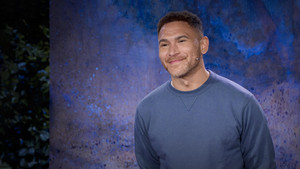
Today, educator Jerome Hunter offers a starting point to shift the norms of masculinity in a more healthy direction.
The middle school teacher offers a framework for redefining masculinity for boys because they're at an age when it can make a huge difference.
But first, a quick break to hear from our sponsors.
And now, our Ted Talk of the Day.
Whenever I tell people I work at a middle school, they often lean back and suck their teeth.
It's like they're having a visceral reaction to the mere mention of those years.
And it makes sense. Middle school is a time like no other.
It's when significant biological, neurological, and emotional changes are happening all at the same time.
So how do middle schoolers respond to these changes?
Well, some might ignore deodorant or overuse Axe Body Spray.
You can find them holding up the walls during the school dance.
And there's usually a desire to be treated like an adult, but they can't quite let go of their action figures.
And like many middle school students, I was earnest, I was goofy, and I was just discovering who I wanted to be.
Now, I had no idea that I'd go on to teach middle school.
They say the grade levels you teach are most reflective of your personality.
So I'm not quite sure what it says about me that I later went on to found a middle school for boys.
But in all seriousness, it didn't take long as a teacher to realize that my male students were acting kind of strange.
I remember there was this one year where we were doing a get to know you activity where students would use old magazines to create collages representing who they were.
And many of the collages had all the things that typical middle schoolers like the outdoors, sports, the latest fashion, the hottest shoes, you know, all the important stuff.
However, there were some that were not exactly what I had in mind.
A group of middle school boys created these collages that were comical, if not concerning.
It was almost as if they had made templates of who they thought that they should be.
Girls in bikinis, fast cars, professional wrestlers, first person shooter video games, you get the idea.
One collage actually had to have had at least 25 different images of Kim Kardashian.
And this wasn't an isolated incident, whether it was going down a somewhat sketchy YouTube rabbit hole, or mindlessly indulging in meme culture which we know can get really hairy, really fast.
I was noticing a pattern with my boys.
Instead of chalking it up as mindless activities or typical middle school behavior, I decided to investigate.
I became a mentor for an after-school program called My Brother's Keeper.
And in this space, we could have more in-depth conversations.
Inspired by the 2016 presidential debates, I asked this group of boys an age-old question, does absolute power corrupt absolutely?
Students began to discuss amongst themselves.
And then I asked, now what would you do if you had this kind of power?
And what if it was unchecked?
Students continued talking, and then they shared out.
Many of them said that they would use their power for good or even share it.
And as I listened, I felt hopeful, realizing that young men could take a different path.
And then I brought the group together and I just said, does it have to be this way?
Their collective light bulbs lit up, realizing that they could reject this version of masculinity.
And at the same time, I too had an aha moment.
It became clear to me that middle school boys are so impressionable and so full of potential.
But what if I told you those same middle school boys could lead us to a more just and equitable society by redefining masculinity?
Now, in the days and weeks that followed, I continued to reflect on this idea.
What actually is masculinity?
If we reject the gender binary and affirm people of all genders, how does masculinity fit into that?
What are the expectations of masculinity when it comes to race, class, and other social factors?
I knew that middle school was fertile ground for this work.
And my reflection led me to identify three critical skills that middle schoolers can practice to redefine masculinity.
I call them the three C's.
The first one is confidence.
The second is communication.
And the third is community.
Now, these three C's stand as the pillars of my school to show people that middle schoolers can redefine masculinity.
And now, back to the episode.
Now, number one, confidence is essential to teach in middle school.
Students are exploring their identities and they're more open to abstract thinking.
I believe that having a healthy and balanced confidence allows boys to feel good about who they are, rather than feeling uncomfortable for trying to be someone they're not.
It's different than simply being praised or rewarded for achievements, but rather rooted in a deep sense of self.
And so what my school does is move away from either or thinking.
Instead of boys believing that they have to choose between being smart or athletic, poetic or pragmatic, we guide our boys to a more holistic version of masculinity that includes both and.
As Bell Hooks and Olga Silverstein said, we need men who are empathetic and strong, autonomous and connected, responsible to self, friends, family, to community, and capable of understanding how those responsibilities are ultimately inseparable.
And from a purely academic standpoint, we provide opportunities to teach confidence through cross-curricular work and projects that include math, science, the humanities, art, homec, sports, to show them that deep learning and critical thinking often require an integration of all of these subjects.
Teaching confidence allows boys to understand that there's an entire spectrum of how they can express themselves, and they can feel good and value the complexity of their identity and stand firm in it with confidence.
The second C represents communication.
Now, communication is key.
To counter the messages that society tells boys to constrict their emotions, my school practices a variety of communication methods, both intra-personally and inter-personally.
Now, intra-personally is how you communicate with yourself, and inter-personally is how you communicate with others.
An example of our intra-personal communication methods is we'll have students arrive at their desks at the beginning of the day, they'll close their eyes, breathe evenly for about a minute, so they can just check in with themselves, see how they're doing, what they're thinking, how they're feeling, and it allows them to put a frame around their thoughts and emotions
so they can focus on it a little more deeply throughout the day.
Students also keep gratitude journals.
Research shows that when students express gratitude on a regular basis, this is positive emotions toward themselves and toward others.
An inter-personal practice that we like to do is at the end of the day, we'll have students gather in a circle to offer an appreciation for someone or something, open it up to an apology, or talk about a social issue that might be on their hearts.
And we normalize these forms of communication to show boys that it is perfectly human to open your minds and your hearts to your community.
Now, the third C represents community.
To counter this false sense of individualism and having to pull yourself up by your bootstraps, while we also know that there is great value in teaching our boys the importance of independence, it can be stymied when taken to an extreme.
And so, what we do is we engage in an inquiry process where we observe what's going on in our communities, either locally, nationally, or globally, and then pose an essential question.
One year, we posed an essential question to our students that asked, how can we create a community where everyone feels a sense of belonging?
Students took this question, they generated initial thoughts, they sought multiple perspectives from their peers, their teachers, community leaders.
And then they came back to us and said, we'd like to address homelessness in Seattle.
We love this idea, and so we partnered with a local construction company to design, build, and donate a tiny house.
Now, what we realized is through this community learning process, students felt a greater sense of satisfaction with studying, taking academic risks, and just valuing the overall learning process.
In addition, students felt more comfortable taking on leadership roles inside and outside of the classroom.
One thing to note, that in each of these three Cs, the adults involved modeled this new version of masculinity to prove to students that they don't have to fit into a stereotype.
And while I'm often impressed by the vulnerability and kindness of each of my students, it's still a middle school.
It's this liminal space between childhood and adulthood.
And amongst our sophisticated conversations, there's a lot of nonsensical humor.
And very few of them have taken up regular uses of deodorant.
And I know that this is lifelong work and there's no quick fix.
But they show me that a better future is possible.
What if masculinity meant having a healthy and balanced confidence, communicating clearly, being connected to your community?
Just imagine how different our world would be.
My students don't only show me that this future is possible, but this future is here, with middle school boys leading the way.
Thank you. That was Jerome Hunter at the 2023 TED ED Educator Talks Salon.
If you're curious about Ted's curation, find out more at ted.com slash curation guidelines.
And that's it for today.
TED Talks Daily is part of the TED Audio Collective.
This episode was produced and edited by our team, Martha Estefanos, Oliver Friedman, Brian Green, Autumn Thompson, and Alejandra Salazar.
It was mixed by Christopher Faizie, Bogan.
Additional support from Emma Topner and Daniela Balarezzo.
I'm Elise Hu, I'll be back tomorrow with a fresh idea for your feet.
Thanks for listening.