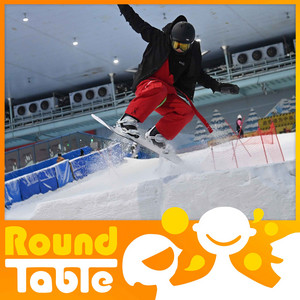
In southern China, where the weather is warmer, winter means a construction project.
And you'll find it inside a mall, a mountain of steel and manufactured snow where pros train and the after-ski activities include a spicy hot pot.
That sounds yummy.
It's a perfect permanent cold in the middle of a tropical city.
But how does a region bring the hobbies of the cold north to the warm south?
We are live from our studios in Beijing.
This is Roundtable.
I'm Steve.
Thank you very much for sharing your time with us today.
And for the show, I'm with Fei Fei and Ding Hong.
First up, ever had that dream when you're walking through a tropical, humid city in your flip-flops and then you round a corner and stumble into a literal winter wonderland?
Well, in southern china that's not a dream at all.
It's just a saturday afternoon at the mall.
I'm talking about a world where ski season never ends because the mountains are made of steel and the snow is manufactured by giant machines that run 24 7.
It's a place where you can go from sweltering heat to sub-zero slopes in the time it takes to ride an escalator.
But it's not just about escaping the sun.
It's a billion-dollar industry that's turning northern sports into a southern lifestyle, complete with kids training from the pros.
And, believe it or not yes indeed, a spicy hot pot for you, served right at the edge of the snow slopes.
But there are a couple of questions.
How do you build a mountain in the middle of a metropolis?
And what happens when that electricity bill comes due?
How much is that?
Got to be expensive, right?
Dingheng and Fei-Fei, good afternoon to you both.
Winter sports gone way down south and very, very popular at that.
Exactly.
On some level.
We would say that maybe on some balance sheets of these different ski resorts or ice rinks, the bills coming from the south sometimes can even compete with those in the northern part.
For example, where ski resorts used to be concentrated in Xinjiang or northeastern China?
I think we talked about ice hockey on Roundtable before.
Is that basically the birthplace for ice hockey in China is in Heilongjiang, which is the northeastern part of China?
But now in southern part particularly, for example, in Shanghai, in Shenzhen or just areas around that on the eastern and even southern part, that they are seeing an explosion in these new venues for ski resorts and ice rinks.
For example, take Shanghai.
As an example, the number of people participating in these ice and snow sports skyrocketed from 600000, that is, in 2017, to over 5 million last year.
More and more people getting involved.
Ding Hung, this isn't new though, right?
I mean, the concept of an indoor ski resort goes back to about...
Before 2015, around 2013, yeah?
Yeah, I think the data I have gathered is since 2013, more exactly.
And the number of indoor ski resorts in China has been growing steadily.
But recently, we have really seen the birth of really those record-breaking super resorts.
For example...
In September 2024 in Shenzhen, there is this Qianhai Ice and Snow World opening its doors as the world's largest, basically the largest indoor ski resort.
It covers more than 100,000 square meters.
It's so big that it can handle more than 5,000 visitors a day.
I was watching a video from that particular resort this morning and it's huge.
I had actually seen another video before.
I was watching a different one today.
And it was this vlogger who was there with his wife.
And he took the escalator from, I think it was the subway, directly to it.
Or maybe there was a little bit of a walk.
But anyway, it wasn't that far away from the main transport.
And yeah, you go in and there's this kind of shopping mall atmosphere.
And then all of a sudden, boom, there's the entrance to this giant indoor ski world.
And when he went inside it is yeah, I guess it's still the.
I don't know if it's still the largest in the world, if it qualifies for that.
It was at one point.
But anyway, it's just huge, like just way bigger than you could possibly imagine.
Exactly.
Yeah, I think I also watched a video.
I don't remember if this particular Qinghai ice and snow world in Shenzhen, but it's also some vloggers from Europe.
And they traveled to China, either in Shenzhen or in Shanghai, and they went to one of these indoor resorts.
And the first thing when they step into that through that entrance, they were like well, this smells like a big refrigerator.
Yeah, because it's cold in there.
Yeah.
And also because of, I think, all the equipment used to keep the temperature stable around maybe around zero degrees, and also snow in snowmaking and to make it bit of a cooler compared to outside.
And that's, I think, of the vivid expression description of what exactly this world is.
Yeah, I mean you're stepping from summering into winter.
There was another video I watched about the Shanghai resort, which we'll get to in just a sec, but the reporter said that it was 32 degrees outside on that particular day and And then you walk through the door and it's minus five inside the snow world, inside the ski resort.
So, yeah, you're literally walking from one season into another season in a matter of steps.
So the skiing, of course, I mean, that's obvious that you can do that.
But what else?
What other kinds of experiences can we find here?
Well, i think uh, the thing we have to mention here is that if you are just imagining a just a simple wide slope in a cold room, i guess you are basically largely missing the the the bigger picture, because nowadays, it seems, indoor ski resorts in southern china have really turned skiing from a purely sport into a multi-scenario lifestyle that is mixed with say, sporting events, high-end consumer events and even some pretty surprising food.
Have you tried, for example, or have you ever...
Thought about like after skiing and you go to another nearby restaurant and try some nice restaurant.
And try some nice hot pots.
That's the scenario they have realized in Kunming, the provincial capital of Yunnan province.
Yeah, and those hot pot tables are right next to the slopes.
They're literally right there.
So it's kind of the all-in-one experience.
You've got the shopping.
You've got the exercising from the skiing or the snowboarding.
You've got the food culture.
You've got the hotels that are right at the same location, too.
Yeah.
And thinking about that for residents from the southern regions, they probably have never seen snow throughout their entire lifetime.
And I think so.
That's the reason they have never have this attachment to all the ice and snow sports, like skiing, like skating.
Not just not a part of the culture, not a part of the culture historically.
Yeah.
So by offering venues like this, it's not feeling like you have to plan a whole trip to another region or another whole culture, but it's like a mall travel.
And it's easy, it's affordable, it's accessible.
And besides just trying some skiing for a few hours, you can go shopping, maybe for some international brands.
Yeah, it's really smart.
And I didn't think about this until right now.
But when you have maybe, a ski location in the north and it's there for skiing and snowboarding and maybe some places for the kids to play too,
You'll have your restaurants, of course, on site.
You'll have your hotels on site.
But if you visit there, you are visiting to ski or to snowboard.
Otherwise, you're probably not going there.
But with these southern facilities...
This is important, because it might be the first time that people are ever trying skiing or snowboarding in their life.
But even if they're not interested in it, you still have plenty of reasons to visit the resort, though.
Yeah, so that's what makes this design all the smarter.
I would say it's like a big indoor playground Yeah, so this kind of an indoor resorts integrated into massive, bigger commercial complexes.
So the skiing is kind of the entrance and to a much bigger spending experiences like hotels, like bars, like shopping malls and even in some places there was water parks next to it.
So for people that aren't really involved or devoted to the sports, it's just nice to have it as a way of entertainment, and not just for the locals or the people from the surrounding regions.
But apparently these indoor resorts, for example in yunnan the resort there They're attracting tourist groups from Southeast Asian countries like Thailand and Malaysia, who maybe don't have their own indoor ski facilities but are still curious about it.
And it's a shorter flight for them to go to Yunnan than it is to come up to the far northern regions of China.
And also for students as well.
Like for younger people, these resorts are also their first encounter with real snow.
Well, it's still man-made snow, but it's still real snow.
It's not on the pictures or on your phones.
So right now, schools in these southern regions are also organizing tours where kids can not only experience skiing or skating or snowboarding, they can also learn the science about how snow forms, and you know, just basically about winter climate.
And, for example, we also have a case of a group of middle schoolers from Guangxi, which is the southern part of China as well, recently traveled to a little bit of north, to Guilin in Guizhou province.
And they are saying that it's their first time in their life seeing anything like um other than a tv screen of the winter.
Yeah, so what could be more vivid than you know learning these first hands?
Really, when you're situated in that scenario, like As somebody who grew up in southern China, of course, my hometown is Zhejiang Province
We see natural snow.
It snows during winter.
But even for kids growing up in Guangdong Guangxi, if they stay in Guangdong for their entire life, there is really no chance.
They're never going to see it.
They're never going to see snow.
So there you go.
Lots of fun stuff to do when you visit these places.
And because there's so much fun stuff to do, the market is big and the market is growing.
There's data from the China Ski Industry White Paper that tells us that, among the more than 700 ski resorts currently in operation nationwide, around 80 of those are indoor facility.
Now that, of course... is a relatively small proportion of the entire pie, if you will.
But that contribution is particularly significant because in just one year, between 2024 and 2025, those indoor ski resorts the 80 that I talked about they recorded a total of 56 million skier visits, and that is worth 21 of the country's total ski visits during that period.
So, indoor or outdoor, it is a significant portion of the entire picture.
And also, if we look at the locations of their indoor facilities, about a third of them are located in the wealthier part of china, for example, in the yangtze river delta or the pearl river delta, in shanghai, in shenzhen and the neighboring regions, And they are willing to spend not only on the gears, on the sport itself, and also about the activities we just talked about, on the bars, on the hotels, on the meals.
And that is a massive spending power.
Like internationally, it is Dubai that built also a massive indoor ski.
Yeah, they built theirs a long time ago.
I think it was the early.
Don't quote me.
I think it was the early 2000s, though, when they built theirs.
And at the time, I think at the time, the Dubai one was the biggest in the world.
Everybody wants to claim that all the time.
Right.
And I think it was Dubai at the time.
But yeah, I see the connection you're making.
There is that if the region is a well-developed region where people the citizens of the region have money to spend, then this is a good way for them to do it.
Yeah, and also on the other side is also economic decision, like thinking about, for those who regularly ski or snowboard or skating, the tickets that if you live in Shanghai or Shenzhen, for example, the tickets to one of these indoor places can run from 400 to 420 yuan, which is about 60 dollars um, for a four hour experience.
That's 420 for four hours, for four hours, but you don't need to spend on accommodation and transportation, you just, you know, it's a probably a subway right away or drive away.
But if you travel to, for example, chongli in hebei, which is one of the skiing and snowboarding um destination in china, They charge a little bit less for a four-hour trip.
It is about 360 kuai to 500 yuan for four hours.
But you need to pay accommodation for a person from Shanghai or Shenzhen.
Probably you need to plan a week time there.
That means five to seven days of hotels, transportation, flight tickets, train tickets.
And also you need to ask for leaves from your wife.
Yeah, it's an organized trip.
It's not just a wake up on Saturday morning and, oh, let's take the subway to go skiing today.
Yeah, it's not that type of thing, right?
They say that there is also and I agree with this It gives people the opportunity to perhaps try something that they may be interested in and support, a market that they might, or an industry that they might be interested in that maybe they wouldn't have tried before.
And I think, you know, your example that you just used, Feifei, holds true here.
Because it is an organized event to go to a northern ski resort.
And that's true if you're from the northern part, right?
Yeah, even.
But it's even more true if you're from the southern parts.
Now, if you've never tried this type of thing before, then you might be discouraged from doing that because of the high costs associated with plane tickets or train tickets plus rentals, plus food, plus hotel, plus all of those things.
So that's the advantage of having this down south, too.
Yeah, even for some of my friends who ski, who snowboard.
Every year I checked with them have you traveled to Xinjiang to actually snowboarding in one of the best places for snowboarding in China?
They were like, but that costs a lot of money and I probably need to have at least two weeks time.
And it's just too much of a burden, both financially and also when it comes to time.
I can't just have two weeks away from my family and work.
So that's the reason, even though I'm a snowboarder, I've never gone to Xinjiang in particular.
So I think it's even true when it comes to a sort of a mature not professional, but amateur snowboarder.
But when it comes to first timers like beginners like us, are you going to ask for two weeks time off and spend probably a tenth of a thousand yuan to travel to Xinjiang for that?
But if it's like two hours drive away to a shopping mall.
More likely to happen, yeah.
Now, parents are seeing this as an opportunity for their kids as well.
The parent-child users.
This is from Industry Insights.
Parent-child users make up about 19 of the ice and snow market.
And these parents see skiing as a way to invest in their kids, Ding Hong.
Why would they see this as an investment?
Yeah uh now, first of all, i myself uh, is not a parent, is not a a father, so i am not really in a good position to, to to have any say in this regard, but in my very you know layman's understanding, probably it might help.
Um, kids builds their physical strength that's the most important thing and maybe mentally perseverance, etc.
And it gives them a so-called global standard hobby.
You know, because snow skiing if you think about, like the reputation people like Eileen Gu have gained well, that's really international standard hobby, right?
There's no doubt about that.
And plus, I guess kids who learn to ski tend to keep doing it like creating a sticky customer base for for a long time.
So uh, from a policy perspective, this is um a source of um future.
Uh, consumer power.
Um, somehow i feel like um future customer base.
Yeah yeah, cultivating.
Somehow i feel like this kind of um indoor, indoor ski resorts in southern part of china and those natural mountainous ski resorts in northern China, for example they are supplementary towards each other, like those indoor facilities might be able to stimulating the initial interest in the enthusiasm for the local residents for example for a resident in Shanghai and then maybe, after they cultivated their long-term interest, someday they will um, they will go to those really natural mountainous ski resorts and contribute to the local spending.
Kids who, kids who learn to ski and snowboard from a very young age, tend to love it very much, because This is just my opinion but they don't Number one, they're fearless.
Yeah.
I mean, they don't care.
They'll go screaming down a mountain at 200 miles an hour without a care in the world.
But number two because they're so small if they do fall, or when they do fall, the opportunity to get really hurt is lessened.
Yes.
We have that expression in English, the bigger they are, the harder they fall.
Adults who learn snowboarding have to fall further to the ground...
And therefore they might try it once and get hurt a little bit and think I never want to do that again.
Yeah, that's my experience.
I guess this is also true for roller skating.
If you become an adult and you start learning this technique, it's really, really difficult to master.
Yeah.
All right.
Well, let's get to the challenges of running one of these giant parks in the middle of a warm southern city.
It's a tough business, isn't it?
In the industry, there are speed bumps.
That is for sure.
Yeah.
First of all, building this resort in the first place is, of course, expensive.
You know thinking about, you know the mega size that they're getting from one of the a lot of them are claiming to be the world's largest.
And you can imagine the amount of materials put into place into building these facilities, the amount of stills.
And also when it comes to the cooling system, to the snow making.
For example, at the Shenzhen Qinghai Ice and Snow World we just talked about, it used 42000 tons of steel just for the structure.
And that means a total investment of 10 billion yuan.
And that's not an easy task, I would say, to do.
And then thinking about the energy consumption as well to power such a massive structure and the electricity bills, for example, for cooling and snowmaking.
And also thinking about they have to run the cooling system pretty much 24-7.
Yeah, you can't turn it off.
Your snow will be gone the next day.
So, according to some of the industry insiders, the energy costs actually eat up nearly half of their total operating budget.
Yeah, that's not surprising.
Some of the indoor resorts in the South, they're paying...
Tens of millions of won every single year just in electricity bills to keep the snow from turning into a giant puddle.
And that means that you're going to have to wait a long time to make any money out of these places, because they are so much to build and they are so much to run on a daily basis.
It takes some time to see your ROI, right?
Your return on investment.
It usually takes about five to eight years, apparently, to pay for themselves.
But for the outdoor resorts, five to eight years.
For the indoor resorts, maybe 10 to 15 years.
So it's a big investment and you're hoping to keep it going for a long time.
Yeah, so if i am a investor with just a lukewarm monetary power, i would really give a second, give it a second thought before making any decision, like in whether this investment is worthwhile.
So like do i really have to wait for like 15 years Before I see the profits return?
It's like having a kid, isn't it?
Yeah.
You got to wait 15 years or more before you get your return on investment.
You also need to think in long term.
These facilities normally run more than 15 years.
Yeah.
Hopefully.
Yeah, hopefully.
But for example, they are also thinking about how to cutting down all these costs as well.
For example, the Shenzhen Xi'an one.
They're using a new technology that basically their walls, their roofs and their windows are made of solar panels.
So that can help cut down about 20% of their electricity demand.
Significant.
Using renewables to help pay for those expensive bills.
And then I guess you've got what I talked about before the potential for the one and done tourists who come and try it out and maybe don't love it.
Not the facility.
I mean, don't love the sport.
Don't love snowboarding.
Don't love skiing.
Have you both tried snowboarding?
You said you tried snowboarding?
I tried it once.
That's not for me.
Why did you quit so quickly?
Because I fall all the time and I come back with a lot of bruises on my body, even in a natural environment.
It's just it's a personal choice.
It's just not for me.
But when it comes to, you know, indoor snow skiing resource, I think a lot.
I heard a lot of complaints about you.
Know you are skiing but you don't get to see the natural sceneries, the mountains, the trees.
I mean, that's being picky, isn't it?
If you can be downtown in a tropical environment and ski or snowboard.
I mean, what are you complaining about?
Yeah.
People just want more all the time.
It's big business.
It is very, very big business.
And those numbers might seem a little bit surprising that the indoor facilities contribute so much to the entire economic picture.
But it just shows that down south, they're keeping things cool as well.
Ready, get ready, get ready for super night.
Here in Beijing, lights come on.
New Year's beat is moving strong.
Step by step, feel the sound.
Happy smiles all around.
Feel the rhythm, feel the force.
Here it comes. with pride.
Near or far, old or new, warm wishes sent to you.
Here in Nairobi, hearts are bright.
Hope is strong, the future's light.
From this desk to every door, Strong and bold, full of drive.
This is the year, the year of the horse.
Keep moving on, don't slow down, From every street to every town.
Old year gone, new dreams start.
One world.
One beat, one song.
Here we are, run so near, run so far.
Feel the fire, feel the force.
Celebrate the year of the horse.
Happy New Year, stay bright.
This is our super night.
Fast and free, strong of force.