Takeaway Chinese where you can take some Chinese away and experience progress day by day.
Takeaway Chinese, we will promise you a difference.
Welcome to Takeaway Chinese I'm Nian Hoh Lin with Steve Hatherly in the studio.
Hi Steve! Hello to you, thanks for having me back.
Always a pleasure doing Takeaway Chinese with you.
I've been doing TikTok with Chinese for a really long time, and I've had different partners, but you hold a fresh perspective in learning the language because you've been here around a year, and you're a fast learner as well.
I appreciate that. I'm starting to slowly, slowly pick up things, but a little later, I want to practice a new sentence that I learned with you, and I want to ask about help for pronunciation.
Oh, I'd love to help.
In the meantime, I was kind of wondering because you've been to many places, you've learned many different languages, local culture, and have you ever been to Central Asia?
I've been to the east side of Asia, obviously, and the south part of Asia, but I've never been to the central part of Asia before.
Or Europe for that matter.
Ah, I find it an exotic place, because when I was a little girl, I heard about the concept of Silk Road.
Silk Road, back then, I thought it's a road decorated by beautiful silk.
And I was told it's a road doing the trade and the goods are mostly silk related from the China end, selling to the outside of the country and of course, tea and other type of goods trading back from outside of China to the country.
It's also through that road.
And that goes back hundreds of years right?
Yes, hundreds and thousands of years.
And that is when I find that part of the world quite interesting because it's kind of like a place with mixed cultures.
You get to be exposed to the then very prosperous and very advanced Chinese culture.
and there are the Europe culture and they collide in the Central Asia area and I find it fun and fascinating.
Why do you find that fascinating?
Because the collision of different cultures and the mixture of different cultures generating new things and also evolve to definitely something that has never been there before.
And also you get to see different cultures in that area as well so that diversity is also quite interesting.
I find that if you are not from a particular place anything can feel exotic right if you didn't grow up with it if you haven't had an opportunity to spend time with it albeit a food or a language or people or what -have -you or inside a country or a city then yeah it can feel exotic and And for me that's one of the romantic feelings that I love about the world is that, you know, being from Nova Scotia in Canada, which is a relatively small place, with limited opportunities to travel when I was young.
Let me rephrase that.
I had a lot of opportunities to travel, but just not through various parts of the world.
But when I got older and then I moved, then, yeah, I know that feeling of exotic.
and I know that feeling of experiencing cultures and languages and foods for the first time and it's a fun feeling isn't it and it's it's an exciting feeling and it makes the planet feel both huge and tiny at the same time.
Right? And in the meantime, do you know how to say Central Asia in Chinese?
I do not! It's actually easy because Central would be down in the middle or central and yeah Asia yeah yeah that's Central Asia yeah yes and you've also got don't yeah Eastern Asia okay yeah no yeah that'll be Oh South yes because do you know why I know that because I went to the Beijing South railway station recently.
And when you go there, even though the signs are written in English, it said Beijing Nan.
So I knew I was at the Beijing South railway station and so when it said Beijing Nan I said, oh Nan equals South.
Yes, and also Dongnan yah.
Dongnan yah. Yes, that's Southeast. Oh, Southeast. So it's quite direct when it comes to the geology terms of different places or different areas, origins in Asia.
Have you visited that part of the world extensively for a long ...
No, no. I really want to.
I want to go and check out, and being a part that is on the other end of the Silk Road, definitely, it has its charm.
But in today's world, in a world when we say the world is flat, when we say the entire earth is just a village, we get to communicate with each other so easily, China and Central Asia have even a closer relationship, because many of the Central Asian countries are bordering China, bordering for instance Xinjiang, Uyghur autonomous region, one, meaning that the communication and cooperation can be extensively carried out, and also the communication among these two parts would trigger more interesting projects, we can learn from each other, we can help each other, and that is why the idea of further
cooperating with our neighboring countries in Central Asia is so important for China.
Yeah, you're right, and this is something that I didn't realize before I moved to China.
You know, when you move to a country you start paying attention to the world map in a little bit more detail than you did before.
So of course, everybody in the world knows that China is a huge country, but I didn't realize that on the western borders of China, you know, it was touching Tajikistan or Kyrgyzstan or Kazakhstan or help me out.
There's the other. I think there's two more.
There's Bhutan, yeah, but there's also Afghanistan and Pakistan, right?
That are bordering China, and yeah, you're right, it borders Nepal, it borders India, and I didn't realize the border of China touched all of those different countries.
So what you said before about China having a relationship there, I mean it obviously makes sense that those relationships exist. Mmm and for today, we are going to learn about the fascinating culture and history in those places the stories that we share together between China and the Central Asia countries and probably some fun Chinese you can take away sounds good We're going outside of China to practice our Chinese today.
Oh, yes So for those of you who are interested in Chinese culture and want to get a grip on the Chinese language this is the show for you!
Stick with us for 30 minutes and you soon see the rewards, and for more fun Chinese learning, follow our Facebook page LearnChinese to watch many fun videos and live streams. But now let's provide you with some free Chinese for a takeaway.
The first Chinese I really like to share is Shenmih.
Shenmih. Mysterious.
Mmmm. Shenmih. Shenmai.
We use mysterious to describe that part of the world quite much because of the Silk Road because of the ancient stories related to Central Asia and Shenmai is mysterious.
Shenmai. Shenmai. Mm -hmm.
So how can we make a sentence there, that place is so mysterious.
You can say that you can say Zhongya hen Shenmai.
Zhongya hen Yes, central Asia is mysterious, you can also say...
This is an ancient and also mysterious country.
I think I'll stick with Zhongya in Shenmik.
That's a little bit shorter.
I was trying to teach you Guolao as well.
You lost me a Guolao.
Guolao means ancient.
Ah, Guolao. Yes. LAO means with older age or with years.
GU DAI would be ancient so GULAO is an ancient with a long history kind of place.
And besides SHEN MI and GULAO we can also use QIJUAN to describe that part of the world.
QIJUAN. QIJUAN means surreal.
So qī kārī is the meaning of shen qī, magical.
And huàn, huàn zhì huàn means illusion, but in a good way.
So qī huàn together is fantastical, it's surreal, it's something very nice and qī huàn has to be both surreal and fantastical, so with a certain sense of fantasy of old stories or legendary stories in the past kind of feeling attached to it.
What about something that feels distant or far away?
Because often times when we talk about exotic places or exotic lands, they are distant and they are far away.
Yes, the word for it would be 南 Troll.
南 Troll. Yes, both 南 Troll and 南 Troll carries the meaning of distant.
when you are using you it has to be really far away.
Okay you know what I was gonna ask you right?
Like if you're talking about if you live on the west side of Beijing and you invite your friend let's go to chow yang for dinner then can your friend say no you can but you're exaggerating?
I understand that's good to know though.
So you can be a little sarcastic with your language with this particular word word yeah you know it's too far away but generally speaking if you're using you have to at least talk about I don't know Canada right I think I've shared about this for thousands of years the network of routes known as the Silk Road contributed to the exchange of goods and ideas among diverse cultures and do you know how to say Silk Road silk road.
I think I heard this before.
It's four syllables.
Is it four characters?
Yes, it is four characters.
S -I -C -C -U something something.
It is four characters and it is S -C -O -G -L -U.
S -C -O -G -L -U? S is silk.
And when we say silk, we think also about the thread, not only the fabric, right?
and C -O -G -L -U is definitely just the fabric.
So, sìchǒu together would be the material silk.
Yup. Got it. Sìchǒu.
And, zhì is ancient apostrophe s.
We know nowadays, apostrophe s would be de.
And in ancient Chinese, there is this character zhì serving that function.
Which is why nowadays, a lot of said phrases, many idioms, and some really formal way of saying things would also include the Chinese character, zhi.
Oh, so road is not zhi lu.
Road is lu. But zhi lu is not road.
No, no, no, zhi is the functional character.
Got it. So, zhi gong zhi jia for instance.
Zhi gong is employee.
Jia is home. So the home of the employees.
Employees' home. So apostrophe S or of.
but it's again a term that you can definitely use in these days because it's already a set term but do not try to create your own term with the character you most definitely would get it wrong oh okay uh in even in modern Chinese that must be very commonly used because in English you you can say...
the house of my friend right but nobody talks like that it sounds weird so you'd say my friend's house it's not about that it's more about you can replace almost all the places when you use the with ....
yet it would be weird because ...
is an ancient time character so it's not about the structure or the order of the words put together it's more about the character precisely the character ...
so ... is not commonly used anymore it's been replaced by ...
it is commonly used but only in said phrases not in sentences that you can use lightheartedly or easily.
I see. So 櫀櫀穿山 would be the Silk Road.
櫀櫀穿山. Yes, well it is neither an actual road nor a single route.
The term instead refers to a network of routes, from when the Han Dynasty of China opened trade in 130 BC, thousands of years ago.
I said what I said I thought it was hundreds of years ago around I don't know maybe around the third 12 1300s I thought.
Oh, it goes back way before that time.
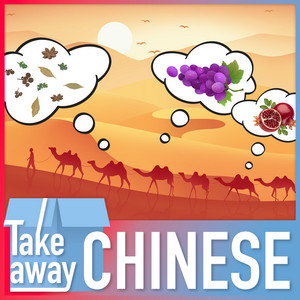
Way back. And an abundance of goods traveled along the Silk Road merchants carried silk from China to Europe and other favorite commodities from Asia included Jade Yu.
Uh -huh. And other precious stones, porcelain Z, T, CHA.
CHA? Yes! And spices.
Spices... how do you say spices?
Xang liang. Xian liang.
Xian liang I would assume would be spices or tiao liang.
Tiao liang is more like condiments because you can use spices in not only cooking but also other function like in a perfume bag something like that.
And in exchange, horses, glassware, textiles, and manufactured goods traveled eastward. So, Sichou Zhilu, a very romantic root network with a long history and has been serving people along the way for quite a long time.
I mean, if you can imagine, yeah, I was wrong about the timeline, I thought it was later on the planet that the Silk Road actually started.
But if you can imagine at that time, the exchange, the exchanges that were taking place, because it wouldn't have just been silk and spices and other things.
This is thousands of kilometers long, right?
So you would have been exchanging cultures and ideas and language, maybe not on purpose but at least inadvertently.
There would have been a lot more being exchanged than the simple goods I think.
I think it's hard to overstate the importance of the Silk Road on history.
Religion and ideas spread along the Silk Road just as fluidly as goods.
Tons along the route grew into multicultural cities and exchange of information gave rise to new technologies and innovation that would change the world and since the trade is between China and Europe the countries alongside the Silk Road, I'm talking about the central Asian countries, have definitely also benefited quite a lot from the Silk Road.
Even till today, the Silk Road or the Belt and Road, the Maritime Silk Road and Silk Road and the Economic Belt, the whole idea is still serving people along the way, helping people, getting know each other better, cooperating and exchange ideas and start a project together, do research together, support each other in different ways.
Yeah, because it was like this natural path or corridor or lane or whatever you want to call it, that linked China to so many other parts of the world and that's what allowed that exchange to take place.
In 2023, China and Central Asia hold a summit together.
They left a lot of different results, different memorandum of understanding, different cooperating plans, different projects that they plan to work on together.
I would love to talk about those in Chinese, but I find the level of Chinese language a bit too hard regarding agricultural research and technology advancement cooperation projects yeah so instead let's talk a little about the goods and exotic items introduced to China through the Western regions along the Silk Road teach us do you know one of my favorite fruits is introduced to China along the Silk Road and that is grapes Oh introduced to China to China uh -huh and grapes in Chinese is polls oh Paul T firearm yes it's easy isn't it Yeah, that is easy.
It is easy. Yet, if you are able to say this tongue twister to repeat this tongue twister in Chinese, you would be a master.
OK. So that is, You can't.
OK, so I didn't even try because my brain just immediately said no. Your brain knows when to say no. Pòtau grapes I'm still processing that one.
Okay sodocs means to eat hmm Pòtau we know is grapes, eat grapes, Ch 'pòtau.
Pòtò. Yes, pò means to not to do something mmm and tò means to spit.
Oh. Mm -hmm and the pòtau again it's grape yeah and pi is the skin the grape skin.
Okay. So ch 'pòtau, pòtau, pòtau pi eat grapes without spitting out the skins.
Okay let try. I'm going to go slow one time and then I'll try to speed up.
Qifu tao bo tu pou tao pi.
Yes! You're good! Bo qifu tao tao tou pou tao pi.
Wait... is that the next part?
Yes! No, I'm not finish with...
That was slowly... Okay let me try again.
A little faster. Qifu tao bo tou pou tao pi Uh huh!
That is the T and P sound in Chinese.
That's been practiced with this tongue twister.
Oh, I see. Yeah, that first part's not tough.
If that were the end, I would say that were easy but it keeps going and then it's really hard. And pú chừ pú tà tào tú pú tà pí basically means don't eat grapes, yet spit out the skin.
Which makes no sense, but I think tongue twisters don't make any sense.
It's just to practice the flexibility of your tongue and lips, and, you know, the combination.
Do you not eat the grape skins?
I don't. Do you? Sometimes.
Oh, really? yeah people think I'm being lazy or sometimes I'm just yeah if the grapes are seedless then I'll just eat the whole grape well we know grapes I think you would also call them grapes but there are the kind of grapes with really really thin skin that is really hard to peel them those grapes I would eat or the ones with thicker skin you put the whole grape in your mouth and then pop the inside out and then spit out the the skin.
Yes that's really good too.
Yes, yes, yes. So grape or grapes.
And if you take a look at the Chinese characters of Pu Tao, the outside of Pu Tao are the characters are quite similar to each other.
There's only just tiny one part in the middle of the character that look different from each other.
The rest part look pretty the same.
Okay and another one is uh pomegranate.
Oh how do you say pomegranate?
Shíliǒ Shíliǒ uh -huh Shíliǒ Shíliǒ One thing about this word is that Shíliǒ the second character in shíliǒ is the light tone Shíliǒ yes so is pù tā pù tāo?
Yes so instead of the one two three four tone it's the light tone pù tāo Shíliǒ and Huetao.
Huetao. Huetao is walnut.
Walnuts? Yeah, Huetao.
Huetao. I used to stay in Xinjiang for over a month for a business trip and I visited the hometown of Huetao.
Oh, really the hometown of walnuts.
Yes, walnuts was introduced to Xinjiang and then rooted there and that County got really prosperous in the walnut industry.
They grow different types of walnuts.
They process the walnuts into walnut milk.
It's walnut juice, but it's white.
Yeah, it's called walnut.
Yes, that's why it's called walnut milk in Chinese.
We use hě tăo nài. Hă tăo nài?
Yes, nai is milk so it's called walnut milk in Chinese and they process walnuts in different ways.
You know, generally the walnuts are consumed when they're dried, but the fresh ones are also very tasty.
Do they taste different?
They taste sweet! Oh, really?
It has that whole sense of sweetness and freshness.
Really tasty, huai hong.
Mm, I'm not really a fan of walnuts, and I've...
but I've never had the super fresh ones before.
You should try it, it's really different, in a good way.
And there's also sesame, buddy.
Chiuma. Chiuma. Mm -hmm.
Chiuma. Chiuma. Sesame.
Yes. That was also introduced to China during the old Silk Road days.
Yes. and another one I personally find very beautiful would be carpets ditang again when I was traveling in Xinjiang, the carpets there are beautiful the patterns and you definitely get to feel the exotic flavor of the carpets I would assume some of the patterns are introduced to Xinjiang from Central Asian countries the way that the lines collide with each other, the coloring, the matching, it's beautiful.
Those types of carpets, if you want to buy them in Canada, I'm guessing they're imported, they can be very, very, very, very expensive.
Yes, and I think many of those are handmade.
That also contributes to the price tag.
And the size some of them can be quite small, but some of them can be absolutely huge right the rugs Yeah, and those can be really expensive to be D lessons.
D is the ground and tan can be translated to blanket So a blanket that you put on the ground would be a carpet a floor blanket of your blanket.
I like that Yeah, sweet.
Huh? D time. Mm -hmm.
So those are stuff mostly edible stuff introduced to China through the Silk Road.
But a very important item or goods introduced from China through the Silk Road to the outside world would definitely be Cha tea.
Yes of course that that one is the one that I think I knew about but I didn't know about pomegranates or sesames or walnuts.
Cha Cha is tea. Cha is tea.
That is why besides Silk Road there is also another road or another road or something you know it's not just a road it's a network or a trading path is called the Cha Ma Gu Tao, yes we know it's ancient, tao is the road so it would be an ancient road and cha is tea, ma is horse, so the route trading tea for horse or you know, the majority of the goods would be tea and horse.
So that is the chā ma gu tà.
So, then, therefore, the words must be similar through those regions all the way to China for tea and maybe horse, too?
Yes, I would assume so.
And that is the beauty of communication, not only tangible goods, intangible skills, but also culture, but also people's beliefs.
I think along the Silk Road, people would share similar folklores and folk songs that they would chant while doing business on the Silk Road, and those part of the culture would stay at the area and continue to be evolved and to be transformed by local people and would definitely also change the developing course of the local area.
Yeah, I think a lot of people in the western part of the world, myself included, might not we always hear about like oh ancient tea ceremonies, tea culture, things we hear about it but I don't think anybody that maybe that's not fair to say.
I didn't know how old it was and so when I moved to Asia and I started to learn about you know how old tea was and it goes back to the Silk Road and trading, then those tea ceremonies and the importance of those tea ceremonies made a lot more sense.
For sure and with a background, a shared culture and shared history like this, it's very easy for China and neighboring countries to further collaborate in this day and age.
Yeah it makes a lot more sense when you have the history in place that you can carry on with that relationship.
Maybe in the future we can talk more about the fund cooperation projects and stories between China and Central Asian countries, as well as among China and any other countries that share this really beautiful history and cultural similarities.
I would enjoy that very much!
That brings us to the end of today's Takeaway Chinese.
I'm Yang Honglin with Steve here in the studio.
For more episodes of the show, you can visit our website at radio .cjtn .com and go to the column podcast. You can also visit the show and read the script there.
Find us wherever you listen to your favorite podcast just search for Takeaway Chinese.
Don't forget to leave your questions comments and a five star rating.
Thank you, and we didn't get to my question I had for you today, but we'll just save it for the beginning or maybe the middle of next show.
We will! No problem.
I'm Steve and thanks for having me.
See you next time!