Hello and welcome to the NVIDIA AI Podcast.
I'm your host, Noah Kravitz. Before we get started, a quick update on the podcast.
If you're a regular listener, you might have noticed We're publishing more.
The AI podcast is now four times a month, and we're also now hosted on Spotify.
You can still get the podcast wherever you've been getting it.
But we are now hosting with Spotify and wanted to mention that.
So please, whether you listen on Spotify, Apple Podcasts, anywhere else, take a moment to subscribe, leave a review if you're so inclined.
We appreciate it. Also, we have a new homepage, the podcast.
If you want to go through all the past episodes, pick out the ones you're interested in, scan by topic. ai-podcast.nvidia.com is the new home for the podcast on NVIDIA's domain, ai-podcast.nvidia.com.
With that being said, let's get to today's episode.
For several years now, NVIDIA has been partnering with Siemens, the Germany-based global leader in industrial automation to unlock industrial digitization.
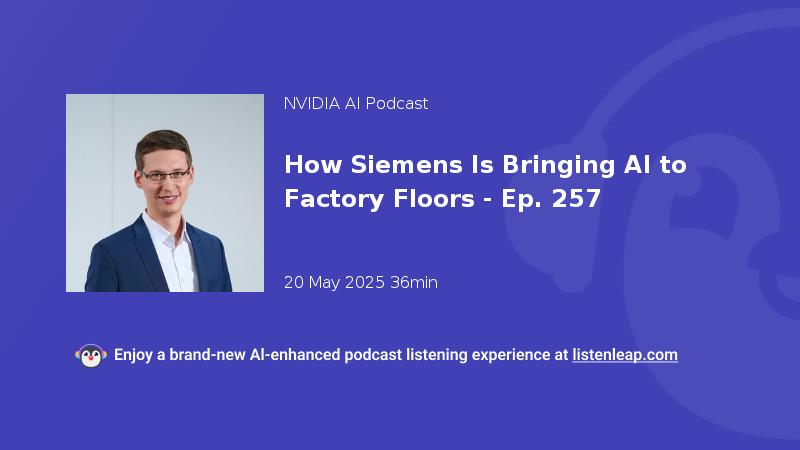
Here to talk about the partnership and the role of AI on the shop floor is Matthias Loskill, Matthias is the Head of Virtual Control and Industrial AI at Siemens Factory Automation. where he's driving innovation and integrating cutting-edge AI solutions into industrial applications.
Matthias, welcome, and thank you so much for joining the AI podcast.
Thanks for having me. Excited to be part of this podcast.
Excited to have you. So if you would, could you start by telling us a little bit about your role at Siemens? yeah so maybe i have one of the most exciting jobs at siemens i would say so i'm i oversee a software business in the areas of industrial ai and also virtual controls with about virtualization of our PLCs, so controlling the factories.
These are really like the brains of the factories out there around the world. and really ramping up a software business based on these new technologies coming from virtualization, and ai bringing those to the to the customers bringing those technologies to the shop room For people who maybe aren't so familiar with Siemens or perhaps recognize the name, but aren't privy to all of what Siemens does.
Maybe could you give a brief rundown of what Siemens does?
Yeah, so Siemens is a technology company leading in industry and industrial automation and digitalization.
That's the part of Siemens where I come from. but also we are in the areas of infrastructure and mobility for example so if you If you drive a train in Germany, for example, it might be built by Siemens. we also built smart buildings and infrastructures in data centers and so on so really Across the different sectors, we see a lot of products from Siemens today.
Right. So you have a great overview when it comes to what's happening with AI. other advanced technologies sort of generally around manufacturing and industry in Germany and throughout the world.
Yes. Great. So let's talk about this collaboration.
How did the partnership between Siemens and NVIDIA begin?
Well, it all started in 2022 when Siemens and Nvidia have partnered to bring the industrial metaverse to life by connecting Siemens Accelerator with NVIDIA Omniverse.
Essentially this is about high fidelity digital twins and real-time simulation tools.
Since that time, We've recognized that our shared vision also includes bringing AI into industrial applications, so exactly that area that I've mentioned before, We want to make AI more relevant for manufacturing sectors, making it more applicable to accelerate digital transformation.
And if you think about it, it's just a perfect fit.
Nvidia is leading in accelerated computing, well known from gaming, obviously, but also for simulation, or AI training and execution.
Siemens, as I said, is a technology company leading in industrial automation.
We've implemented many AI projects in the industry with our customers and also our own factories in the past.
We've learned a lot what it takes to make AI applicable to manufacturing, making AI industrial grade, how we called it.
We know what our customers need to make it more accessible.
So in my view, it is a highly synergistic partnership.
Absolutely. And why now? What's going on in the global manufacturing industry at this moment in time that made you think, you know, this is the time, this is where? where we're going to bring these advanced technologies, make AI more accessible across industry.
I believe it's both a technology push because technologies in the AI space get more and more ready with deep learning advancements and also now nowadays gen ai we see that those technologies get more and more applicable to industries But also we see a growing demand from manufacturing companies, from machine builders, from different industries like food and beverage or automotive manufacturing, for example, they all face new challenges where AI potentially can help For example, there is a lack of labor.
We see a skills gap widening as experienced professionals retire.
In particular, last years, there were a lot of supply chain disruptions, so we need to find ways to get more resilient.
Factories and production facilities are moved back to high cost countries, which in the end means you have to increase the level of automation as well and boosting efficiency.
So all of these challenges coming together, we clearly see that manufacturing sector is really at an important turning point now.
They have to use the latest and greatest technologies to get to another level of automation and getting into a level of more intelligence in industrial automation.
For example, we see that manual tasks are more and more replaced by AI enhanced automation, like AI powered robots, or other forms of physical AI like autonomous machines.
And also there are tools like simulations or digital twins really essential in these cases because you first have to design and optimize interactions between human beings and those intelligent machines before you bring it to the real world.
So all of that new stuff coming together, that's why I believe now is the time to really apply AI, digital twins, simulation, virtualization on a broad scale in industrial settings.
Right. And for clarification, you mentioned Siemens Accelerator earlier.
Can I just ask what is Accelerator? Yes, Xcelerator actually has different facets.
So it's on the one hand side, a platform where we provide different new offerings usually software-based offerings to our customers it's also an ecosystem so there are many many partners onboarded who provide their services based on this platform.
And Siemens Accelerator is also kind of a promise to the market that we accompany technologies during their transformation.
Got it. Okay. Thank you. So to get back to manufacturing, you mentioned One of the things that AI can do, and robots being a manifestation of AI, And obviously a topic of much interest this year as we're recording it, we're seeing more and more robots being brought to factory fleets, talk of humanoid robots in consumers' homes, early adopters' homes. and that kind of thing.
When we're talking about using AI and automation broadly to eliminate these manual, highly repetitive tasks that both get sort of boring for humans, but also are perhaps below the level of work that humans can and should be doing.
Do you have a vision or how do you look at humans and AI-powered robots and other automations working together in a manufacturing environment?
That's a good question. I touched on it, I believe.
Yes. In the end, there might be areas where AI enhanced automation really replaces human tasks because they are just plain repetitive or dangerous so the degree of automation really will increase massively in those areas and maybe the human workers will take over more thoughtful activities.
But I also see that there will be a lot of areas in industrial production, depending on the type industry sector type of producing companies, they will also see more and more collaborative setups. where humans interact with cobots.
Obviously, we see that coming now already, but even humanoid robots in the future, maybe, too. really interact with the human workers, getting support and augmentation from AI-based And before we get into talking about some of the real-world use cases, which I'm excited to hear about,
I wanted to kind of look at the flip side.
There are obviously many advantages, many pluses to bringing AI deeper into the manufacturing world.
But what are some of the challenges that a company like Siemens faces right now?
Yeah, so I believe industrial AI still has a way to go.
And actually, this is also shown in recent studies by Gartner or Boston Consulting Group.
I believe the numbers in these studies speak volumes.
The bottom line is manufacturing companies are struggling to turn the potential of AI into business value at scale.
If you have a look at the statistics, they say nearly 40% think AI is not I mean, it's not like in the consumer world, we're not talking about recommendation of your favorite movie.
We are talking about critical setups, big investments into machinery.
We are talking about health and safety of human workers. you better get it right if you have AI embedded into the factory floor and maybe even controlling or optimizing the runtime of Absolutely.
So it's really important to have trustworthiness and to explain the reasoning behind predictions of DR models.
And second, there were statistics about a staggering 92% lack of AI skilled experts.
And that's also our experience. from customer interaction.
So there are many, many customers out there who still lack AI experts because in the end these are rare and expensive resources as you know this might get better i mean we clearly see that educational programs in the AI area are getting more and more around the globe.
So this will be a bit more relaxed in the near future.
So for smaller companies in particular, we see this as a big issue.
And third, we see that only 16%, according to the studies, of companies achieve their ai related goals again we can confirm that so usually we see something like 70 to 80 percent at least of ai projects in industry that fail to deliver the return of invest that was actually expected.
Do you have any insight into why that's so?
Yeah, so first there is the challenge of scaling AI from proof of concept to broad rollout in factories.
Almost every AI-related project starts from scratch.
That's what we've experienced. That means customers usually develop everything anew instead of having a standardized infrastructure and software stack in place, and they just take care of the ai pipeline to solve the use case right right and every ai project is like an it project on its own Second, this also applies to the AI component itself.
There is either a lack of AI knowledge and skilled experts, as we discussed, or data science teams train their own models repeatedly, solving specific use cases but not scaling for all relevant use cases in the factories.
This means more and more companies have gained experience with AI
And in industrial production, they have implemented some initial use cases and actually proven the value AI could bring.
However, they get stuck in the proof of concept phase.
The challenge lies in operationalizing and rolling out AI from single use cases to scaling it out to many machines, lines, or factories.
And we believe for this, standardized software infrastructure is really key.
And we believe we have some solutions for this, actually.
Great. Should we talk about some of the real world use cases and applications you've been working on?
Sure, happy to. Great. Why don't we start with Inspecto?
Yeah, so Inspecto is actually, I would say, in the area of democratizing AI.
So For us, it's really important to say we provide industrial AI for everyone.
So this means for small companies without any AI expertise.
This is where we want to democratize AI usage, but also for enterprises where it's more about the scaling challenge that i've mentioned right inspecto in simple terms is an out-of-the-box AI-driven visual quality inspection system.
To explain what's so special about it, Let's briefly talk about quality inspection and manufacturing.
I believe this might be interesting to understand.
Absolutely. Essentially, this involves checking the quality of the product you want to produce.
This can include quality checks of final product, intermediate products, components, or final packaging.
For example, you want to know if there are any defects like scratches or dents, or you want to see if there are missing components or foreign objects.
Today, this task is still manual in many cases.
But the problem is humans tend to overlook certain defects, especially after long shifts, you can imagine.
That's what I was thinking. If I was scanning for scratches and dents by the end of my shift, I'd probably be missing things. obviously and that's why in the end automating quality inspection is a clear goal for many manufacturing companies Sure.
Often this is done visually with a camera mounted to take pictures of the products, might be moving on a conveyor belt and In the end, you want to get an output whether the product is acceptable or not.
Essentially you say, is it okay or not okay?
That's the most simple quality inspection you can imagine.
There are also more complex ones like classification of different defect types or measurement of the product and so on. the challenge here is every product is different every variant of the product can be different and there are many different types of defects that you might not even be able to foresee So you need a lot of expertise, actually, experts from different domains to solve this usually, because you must choose the right camera, configure all the parameters, you must optimize the lighting, you need somebody to collect data, label it, train the AI model, and so on and so forth.
And this is where Inspector comes into play.
You don't need a computer vision expert to select the right camera, the lighting, the lens, and so on.
You don't need an AI expert to train an AI model.
Everything is pre-configured, hardware and software, and Inspecto comes with pre-trained AI models inside.
These models have been trained on millions of curated labeled industrial images.
This makes it so robust and convenient to adapt to your specific product that you actually want to expect.
You just present a few good examples in the end, and you don't even have to show pictures of defects.
Okay, so that's what I was wondering. Can Inspecto work across any industry?
Is it limited to certain industries? And then you mentioned at the end, you can just present... samples of what an approved product looks like, right?
And then does Inspecto train on that and then can work on whatever product you happen to give it?
Exactly. So it can be trained on good samples only.
You need something around 20. That's a good number usually.
So this means you can set it up within... or less than one hour, we say, you can get it running, and it's all for use case.
It's actually working best for every rigid object I would say, so for everything around metal pieces, electronics, plastics, and so on.
It doesn't work so well for naturally grown object like I don't know, bananas.
It's a bit more tricky to expect, obviously.
Bananas are always a problem. Because there's more variation for those kind of products.
It's typical when we have other solutions for that.
Right, right. So, Inspector is mainly used in in industries around a metal forming plastics production electronics manufacturing but in the end It can also be used in completely different setups.
For example, we have customers inspecting whole car bodies. with Inspector mounted to robot arms, moving around and taking pictures of really big objects.
So the sky's the limit in this case. And we see that our customers get creative and find even applications we haven't even thought about.
It can be really applied to a very broad range of applications.
There are hundreds of installations out there in the market already and maybe i can mention one specific customer please i believe it's quite quite a nice example It's called MTCON.
That's a very small German company producing connectors, electrical components.
And it's so interesting because obviously they don't have any data science experience.
They don't have AI experts or machine vision know-how.
But they have the big challenge to automate their visual quality inspection to be faster and to save costs.
So the use case is about recognizing bent parts and deviations in connectors with very delicate contacts. pressed into plastic bodies.
So that's exactly such a use case I mentioned. this is where inspector really helped to set up a reliable robust quality inspection system and they can adapt it and change the inspection settings on their own.
So they don't have to call Siemens to do that.
They don't need the service to do that, but they can do it on their own.
Even the operators are able to use the system.
Right. And that speaks to your point earlier about the value of the mission to democratize these tools.
If you're able to As you said, get this set up in an hour or so and run it and change the parameters. without a data science expert, without a computer vision expert on your team, and the operators even who are running the manufacturing lines can tweak inspecto as needed as they go i mean that that's that speaks to democratization so well yes I also understand that there's a collaborative aspect to Inspecto that drives value.
Yeah. So in the end, that also applies to the other other topics we we will discuss later i think if we talk about more the bigger enterprises using our and industrialized suite, it's always the same thing in the end.
We use NVIDIA's hardware and software solutions to embed the power of gpus into our industrial pcs to run so to execute ai close to the shop floor to accelerate the inferencing of complex AI models on the shop floor.
And that's really crucial because we usually talk about really high requirements in terms of performance, low latency.
So all the magic of AI execution must happen close to the machine, close to critical processes.
And this also holds true for Inspecto. Actually, we will release a version soon, which sits on top of our IPC BX59A with an NVIDIA L for GPU inside.
And that's really then a high-speed inspection system that we can bring to the market.
Oh, fantastic. So I'm going to ask you about another use case, maybe on the other end of the spectrum, at least size of the company-wise, and that's Audi.
Yes, that's a really famous example in the meantime.
So we talked about it on the Henova page just recently.
We started collaboration with Audi, so German car manufacturer, one of my favorites, France, by the way.
Really like that. They have a use case in the body shop involving the welding of different metal pieces of the car body. okay such a car body has around 5 000 belt spots that are made by robots that can carry belt guns If you assume such a factory usually produces around, let's say, 1000 cars per day, that makes 5 million belt spots every day.
Still, that's a process with manual sample inspection to identify defective belt spots or belt spatter that must be removed afterwards because it's can be dangerous for those human workers or also the components of the car.
Right. So you're talking about manual inspection of, what was it, 5 million or 1 million weld spots a day?
Yeah, so it's a sample inspection, so they don't inspect every well.
Right, right, okay. But only a few ones. still it's a labor-intensive and costly task.
And to solve this problem and to automate the process of world's better detection or they build an AI model with their own data science team.
They took pictures of the entire car body, trained the AI model to use detected defects and even automated the removal of worlds.
That's pretty impressive in my opinion because they use AI to really create huge value for their own production and really create a big business impact. in an industrial sector like automotive, which has been optimized over decades to really high levels.
Right, that's a huge leap, sounds like. So I believe this is really a breakthrough and they are also convinced about this use case.
They really want to roll it out and where we came into play as Siemens.
They approached us because they needed support to scale the AI solution.
They had high speed requirements in terms of AI execution close to the shop floor.
That's exactly what we provide with Industrial AI Suite.
This is a software to deploy, manage and execute AI models, not only for one use case, or one production line, but as a standardized infrastructure across whole factory networks.
It spans from cloud to the shop floor. So data scientists can still work in their favorite machine learning environment in the cloud and train their R models.
Then they hand over the AI model via standardized interfaces to our industrial AI suite, which then supports the deployment to the shop floor.
And all of this is built on the Siemens Industrial Edge platform, which delivers the reliability and security all you need.
So with this solution, we close the a complete machine learning operations cycle.
I don't know if this is known. It's a bit like DevOps for machine learning, so it's like an infinity loop, you can imagine.
Because you have to collect the data, you have to choose the right algorithm and train your model, validate your model, then deploy it to the shop floor in this case. executed, so that's the inferencing part.
And then you also have to monitor if the AI model still works, if the performance is still OK, and then potentially even retrain and closing the loop.
And that's exactly what we are providing as a blueprint to enterprises with their own data science teams, or some also have partners like startups or system integrated solution providers, building the AI models for them.
This is, in the end, the basis to really scale AI on the shop floor.
Right. And I was thinking, as you were talking about the example of automating the welding inspection and even automating, I think you said some of the removal of splices. ladders in an environment like an automotive company, a manufacturer, where you have a you know different production lines doing different parts and different cars that are based on i'm going to expose my my I know enough about cars to be dangerous, right?
But my understanding is you have different models that are built on the same architectures and so I would imagine a system like yours could be scaled up to meet the needs of a new model or a new model on top of an architecture, but then also, as you said, can be adjusted sort of on the fly and can be retrained.
And then I would imagine that the same scalable approach applies to completely other industries as well.
That's exactly the point and the value proposition.
And by the way, we also had collaboration in this context.
So as I said before, it's not only Inspector, but also for these complex AI models solving even more complex use cases like high-speed inspection in areas like automotive we collaborated to bring everything together from Siemens and from NVIDIA in terms of hardware and software.
So what Aldi uses is also the Siemens IPC with the media GPU inside.
And on top of this is our AI inference server, which which leverages various NVIDIA software components like Triton to accelerate the inferencing of the AI model.
And we actually measured the outcome quite precisely.
So we were able to achieve up to 25-fold acceleration in AI execution directly on shop floor, close to where the critical processes occur.
And that's really what helped Audi to meet their latency and high speed requirements, increasing productivity and robustness of the solution.
Right. Amazing. So you've been talking a lot about these AI solutions that you can bring right to the shop floor for a smaller company like MT Connectivity you mentioned or you know, one of the biggest automotive companies in the world and Audi and how you can just get these solutions up and running whatever your relative level of expertise is when it comes to AI, data science, computer vision.
But as you alluded to at the beginning, there are a lot of folks out there and even experts in the field who are struggling to bring AI models to their own shop floors.
Are there models out on the market now complex models that are delivering a major benefit and how can they be brought to these floors where perhaps folks are struggling to realize Yeah, so I mean even in the in the deep learning space or the classical space you see already there are pre-trained models or foundational models out there that can be used as a basis but you usually have to fine-tune, maybe even retrain those models based on industrial data.
So it's not something like you could just use it out of the box and just apply it directly.
So that's still one of the hurdles we see that this is feasible.
So usually this can be done by an AI expert who is a bit more experienced, but it's more making this really robust and reliable and usable in these industrial settings.
That's really the key challenge that we perceive.
And if you talk about generative AI and large language models, it's obvious that you don't start training those from scratch, but you use one of those being available in that space.
But again, you have to fine tune it based on industrial data, based on maybe also proprietary documents of industry companies.
I'm speaking with Matthias Loskill, Matthias is the Head of Virtual Control and Industrial AI at Siemens Factory Automation.
We've been talking about the partnership between Siemens and NVIDIA that has resulted in all kinds of advanced technologies, accelerated computing, Obviously, the power of AI being brought to manufacturing environments and right to the shop floor, as Matthias has been detailing. now what are the next steps in this collaboration between siemens and nvidia so we clearly want to continue working closely with our customers and understand their needs and further develop and enhance the joint developments that we've discussed today.
We also want to provide these products to further industry sectors, making AI accessible to a broad range of companies.
Besides that, there are two fields that I would like to highlight.
One is the field of AI-enhanced robotics, I see still a huge potential for an intensified collaboration there.
So we've worked together in the context of AI-driven piece-picking robots already.
You can imagine those are, for example, important in the areas of warehouses or warehouses intralogistics.
Just think about your favorite online shop where you put together different items and put those into your shopping basket.
And you can imagine those items must somehow be packed into a box or a postal package.
Right. It's not just magic. That's not magic.
It's a manual task actually today in many cases still.
And this is because those items can look completely different.
So it's not possible to program a robot to be able to pick all those different products and pack those into some boxes. that's where we we've worked together on a product we call semantic robot pick ai Pro, so it's piece picking solution.
It's able to cross arbitrary unseen objects. based on a foundational model.
Okay. So these robots are able to identify and pick an object that they haven't seen before.
Yeah, so in the end what we do is taking pictures of the items to be packed and the system is able to analyze these pictures and send an output to the robot arm, which tells the robot okay this is the optimal grasping point you could say right so the robot knows by seeing and reasoning about the environments, say, how to handle those different objects.
It does completely arbitrary forms and shapes.
That's a big challenge, but we, in the end, show that this is feasible.
Right. A piece of sheet metal. I'm making these up, but a piece of sheet metal is entirely different to grab onto than a cardboard box or what have you.
Exactly. Yeah. Amazing. this area still see potential to improve robustness and adaptability of the model by using synthetic data generation for pre-training.
For example, we investigated NVIDIA ISAAC SIM on Omniverse together.
So, you know, there is still simulation to reality gap, how we call that.
So if you train an AI model in the virtual world based on synthetic data, to transfer that model to the real world, you usually have this problem that it's not really working. you still need some real world pictures or some additional training processes to really fine tune it and adapt it to the real world.
And this is where photorealistic simulation comes into play.
So the more realistic simulations get, the easier it will be for us to pre-train those models in the simulation world and then deploy to the real world.
Right. Besides that, I see actually a second point.
So we haven't spoken about Genetic AI yet.
Obviously, these are the hottest topics.
Yes. This is also the next wave of AI-powered applications in industries, I believe.
So in that context, we have our Siemens industrial co-pilots, which are in in the end, generatively AI-powered assistance that can support humans and optimize processes along the entire industrial value chain.
For example, there is an industrial co-pilot for engineering, supporting automation engineers by generating code or test cases or optimizing code in terms of performance, for example.
We also see Copilot supporting operators or service technicians during the operations phase of a machine.
This is like a super experienced digital colleague, you could imagine.
Yep. Available around the clock and you can ask any question about machine failures or problems with production.
With NVIDIA, we collaborated on bringing the industrial copilot for operations to the shop floor.
That means we want to provide it on-premise, so locally running close to the machine rather than being hosted in a Cloud environment.
The major reason is that many Many of our customers have security concerns or must have full control over the data, so they don't want to send any sensitive production data out of the factory network.
Thank you. Of course, that means executing the large language model directly on the industrial PC close to the shop floor and the worker can then interact with the system and ask questions about real-time process data or maintenance documents.
How are the co-pilots being received on the shop floor?
You mentioned kind of at the top about the sort of the trustworthiness gap and Well, just general, you know, the things that come with adopting new technologies.
And I'm wondering down on the floor itself, the people operating the machinery and the production lines.
Have you had a chance to get feedback on how the co-pilots are being used and received?
Yeah. It's like with all new technologies, people have to get used to it and they have to see the that there is a benefit for their work.
In the end, it must make their life easier and must be conveniently used.
We clearly get a lot of positive feedback in this area because in the end, these are smart assistants.
So we don't force operators to use those, but it's more like an option for them if they need support or if they want to be faster in finishing their work.
It's the same thing in the office space nowadays, right?
Absolutely. not like you must use it but you get more used to it and you get more efficient and maybe you save half an hour a day so that's It's more like a positive thing for most of the users that we talk to.
I believe this might be more tricky or there will be a bigger challenge in terms of accessibility. when we talk about agentic AI, because these are not assistants, but these are more like agents automating whole workflows. making their own decisions, making their own reasoning.
So this will be tricky in industrial setups.
I believe there's still a way to go. On the other hand side, this has huge business potential.
Yes. You can automate processes that are still highly manual today.
You can save a lot of costs. You can be much quicker in solving complex tasks, dividing those into subtasks that can be handled by AI agents that actually execute and reason on their own.
On the other hand side, It's a challenge.
I believe that's not completely solved yet how this will exactly work.
For example, how do you avoid that collaborating AI agents drive crazy?
How do you give them certain guardrails that come close deterministic behavior, which is often needed in industrial settings.
We're also working on that, but I think it's still a bit more research heavy to see how those AI agents can become industrial grade and expand our co-pilots with a gently click.
And so in talking about agentic AI and running agents on premises, I understand understand that your industrial co-pilot for operations utilizes NVIDIA NIM microservices.
Exactly. This really helped us to bring it on-premise and run it on-site, so to say, close to the machine.
And this really helps to make real-time queries about the operational data and also document to facilitate rapid decision-making and for the customers reduce downtimes.
Right. So having it as close as possible to the floor really facilitates, I would imagine, the kind of decisions you have to make, as you said, in real time on the fly when the production environment is going.
Mateus, there's so much industrial AI and manufacturing.
We really appreciate you taking the time to come on and detail. at least some of what Siemens is doing in the partnership with NVIDIA.
It's exciting stuff and as you said, it's the moment where everything is transforming and the manufacturing space certainly is part For listeners who want to know more about any everything that we've been talking about, are there places online where you can direct them to go learn more?
Sure, so just use your favorite search engine and type in Siemens Industrial AI.
And you will find several websites, actually a topic page on the Siemens website, talking about industrial AI.
And then you can go deeper and also get more information about InSpector, industrial AI the topics we've mentioned today.
And besides that, you can also look up Siemens It's written with an X. So you can also have a look at this, look at the marketplace and learn more about our digital transformation solution.
Fantastic. Mattias Loskill, thank you again so much for taking the time to join the podcast.
Best of luck to you and everyone at Siemens on all the important work you're doing.
Thank you. It was a pleasure. Thank you.
¶¶