Hello, welcome to Roundtable where we serve up piping hot debates on the issues that sizzle in China and beyond.
I'm Niu Honglin.
If grades disappeared tomorrow, would students stop learning or start learning differently?
That question is no longer theoretical.
From Chinese primary schools to American college classrooms, teachers and policymakers are actively experimenting with what happens when exams lose their central role.
Today Roundtable invites you to discuss if we stop measuring performance, will the experience of learning itself improve?
For this episode, I'm joined by Yushan and Steve Hatherly.
Now grab your virtual compass and follow us to the heart of the discussion.
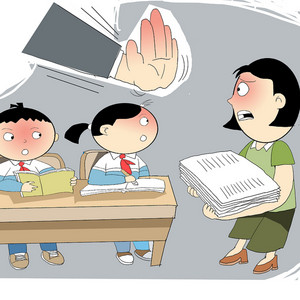
Education authorities in China are tightening restrictions on routine exams, limiting rankings and removing written tests for younger students, part of a broader effort to reduce academic pressure and refocus schools on holistic development.
Meanwhile, in classrooms across the United States and other countries, educators are independently questioning whether traditional grades do serve learning at all.
Together, these shifts point to a global rethinking of how success in education is defined.
Let's start with the news here in China the new policy, exactly what they are about and what are our views towards these.
Yeah, to start with, there's been a new notice, a brand new one that's released just this December by the general office of the MOE, which is the Ministry of Education here in China, referring to the notice on further strengthening the management of routine exams in primary and secondary schools.
So it's the latest directive aimed at slimming down the daily exam burden for primary and secondary students here in China.
And actually, there are many areas that's being covered in this latest notice.
There's those that for the students, for the schools and for the administrative bureaus.
But these are not entirely new here.
Many have been first mentioned back in 2021, as part of the very famous double reduction reform here in China which, if you don't know, is actually a national initiative begun in back in 2021 that aims to reduce the crushing academic burden and kind of protect our kids out there.
Crushing is a big word.
Crushing, yeah, that's strong.
That was about reducing homework and also reducing tutoring outside of school times, right?
Yeah, that's what the reform was best known for, but it actually covers far more than just homework and outside school tutoring.
It also covers on how reduced exam matters And which kind of has been mentioned again in the very latest and newly released notice here.
So that includes For first graders that's typically kids of six to seven years old and also the second graders as well.
They will no longer face written, paper and pencil exams.
Did you hear that, kids?
We can hear them screaming through our headsets.
No more written exams for six and seven year olds.
Excuse me.
But even just saying that out loud. no more exams for six-year-olds.
Kind of makes sense.
It sounds correct, doesn't it?
And then for other grades.
In China's compulsory educational system, that's a system that covers from first grade to ninth grade.
So we're talking about those that's between the second grade and ninth grade now.
For them, the schools are restricted to just one final exam per semester.
And then for middle school students, schools may arrange one midterm exam based on the per practical needs of different subjects.
But that's about it.
And then there's also a ban on the so-called shadow regional exam.
So that means that the large-scale exams across districts for schools are no longer allowed for primary students or for non-graduating middle and high school years, meaning that the schools they sometimes do it within the same district or within the same city across schools and kind of start this exam.
That's not really meant for a finalizing of this master and stuff like that.
I was a little bit confused by that term, a shadow exam.
So is that, like a district within a city will decide, all the schools within that district will decide to issue that exam.
Yes, the idea is to see whether or not the students in your schools are performing well or performing better than students in other schools.
So for these kinds of exams to exist.
We see, I think I remember when I was in primary school and secondary school to start with.
I remember at the end of a semester there would be a huge paper being put onto the wall and with everybody's name on that paper, from my grade.
And it's from top to the bottom, based on the scores, the overall scores that you get from all the different subjects.
That's one type.
And that's being made public to everyone in the school.
Yes.
And another thing was the shuttle examination.
That usually happens to those who are in the largest, where the greatest grades were.
Excuse me, I think they are the largest or oldest in the school.
So in primary school, it will be the sixth graders.
In middle school, it will be the third graders, the senior ones in the school.
And it is for them to have a general idea of where they are in the city, because at that time I remembered it's either in the city or in the region that your ranking would determine which high school or which middle school you get into.
So those are for the purpose for students to have an overall idea.
Yeah, and you can see how, if you were at the top of that list, it would be a time of celebration and pride.
But if you found yourself from the middle towards the bottom of that list, then that's obviously going to be soul crushing and potentially embarrassing.
Speaking of high schools.
So the number of exams for high school students that's going to be strictly limited now.
And there's also going to be an elimination of public rankings and score worship.
They call it score worship.
So schools are now really prohibited, strictly prohibited from publishing exam results or ranking students based on their scores.
And instead of raw numbers, schools must use level-based evaluations.
What I mean by that is A or B or C or D, And they have to find ways to inform parents of progress without fostering this kind of what they call point-chasing environment.
Many of these have already been mentioned four years ago back in 2021, including the stop ranking kids, stop paper exams for first and second graders.
Stop well, not stop, like lessen the mock exam, etc.
But what sounds different now is how the kids are being evaluated, especially what you just mentioned, Steve the level-based evaluations of A B C D, instead of just looking at numbers of scores.
That's something new this year.
And instead of just looking at banning the ranking, teachers and schools in general are looking at kids in a more holistic way than ever before.
And, over the years, many Chinese cities.
They have actually already adopted the level-based evaluation.
Shanghai, for example, it kind of began as the first as far as I can find.
Already back in 2016, they are adopting this level-based evaluation system.
And then Guangzhou in 2018, that's all even before the double reduction was first mentioned.
And then Beijing.
I'm not sure exactly when, but it's also around the time of 2021 2022, similar to Chongqing and Hangzhou.
So it's not exactly the very first time this is being mentioned, but we are seeing an expanding of scale in adopting the policies alike all over China nowadays.
There is a shift in the world of education.
I remember, back when I was in primary school and middle school, the reason that the teachers are ranking students, and then they would separate the students into different classrooms or into different classes based on the ranking.
That was because there were too many kids in the schools.
How many students would have been in the school or in the or per class.
At my time it was around 70 to 80 students in my class in primary school many, many students.
And the problem was that, because we were primary school students and we react to the knowledge differently, some students are faster because maybe they're older, relatively speaking, maybe they're just more sensitive and mature to certain subjects.
And if you do not separate them, there will be phenomenon where there would be phenomenon that some students have already totally mastered the knowledge where others haven't even started grasping or understanding it, and at that time, ranking them, putting them into different classes, is a way to make sure that kids are learning, are using the valuable time in classes, and that was the trend at that time and a little bit later we see that with more and more kids focusing a bit more, a bit too much, on the score, on the ranking, and instead of learning the language they started to learn.
Quote-unquote tricks in understanding the questions, answering the questions.
We have different little tricks.
You're turning it into a game almost.
Almost.
You learn the rule and you play the game.
It's not necessarily because you understand the rule of math, the nature of physics from a fundamental, deeper level, but because you learn the tricks.
You see it as equation and you solve it.
Yeah.
Now.
Now taking that into account, and then taking into account that, based on your scores, classes in the past may have been reshuffled or you might change a teacher, might change the seating in the classrooms.
It's kind of like labeling the students.
So if you know as a student, if you know that's going to happen to you if you don't perform well, that shifts the focus away from learning the subject all of a sudden, onto the the pressure of existing within the society of school and the social hierarchy, and it will probably too, take away from the fun of learning any particular subject that you might not be excelling at yeah, but Growing up from my age I cannot tell, but ask, because at my time I thought yes, examinations can sometimes be cruel.
Having my names on the paper moving up and down based on my performance on just one exam with multiple subjects might be a little bit harsh, but it was fair.
It was totally fair.
I know my scores don't lie, but at this kind of yeah, if we're using this kind of way to measure, to evaluate students, how can we make sure that all of the opportunities are still very fairly distributed to the students and they are given the same level or relatively more fairly attention from teacher?
Well, I mean, experts will tell you that exams and quizzes yeah, they still matter.
They're not completely useless, but they are not the only way to evaluate learning, because truly understanding whether a child is learning and developing the content being taught in the class that requires ongoing and process based evaluations, and there are different options on how you can do that.
You can assess how students complete small research projects or give presentations or tackle other performance based tasks, and this is kind of the idea behind alternative grading is that not everything needs to be done through.
Here's the content.
Now I'll test you on it.
Here's more content, now I'll test you on it.
And since now there are ideally to be fewer exams, the next goal, especially for the schools, I think, is to better their question design and enhance overall exam quality.
For those that still remains, you know, the finals, the midterms.
And a lot of educational, research and exam authorities out there.
They're at pressure nowadays because they are responsible for guiding and supporting the management of routine exams, with stronger oversight of question design and quality control.
And here's what I found really interesting, and that's brand new this year too.
So it's specified in the latest notice that question designers and reviewers must be separated.
And in principle, at least three reviewers are required for quality checks of the exam paper.
You see, that's how schools, or rather the educational authorities locally we're mentioning a very large spectrum of different authorities here, but in general they are required to really supervise the exam qualities to maintain a relatively sustainable environment even after there are fewer exams in the future.
Yeah, and it totally makes sense.
I don't know if it exists in English, but in Chinese we have a term, a word 知识点.
That means knowledge point.
We're viewing it as an exact point of knowledge, like 1 plus 1 equals 2.
That is one knowledge point.
And to test that point, you design a question for that knowledge point.
But growing older, growing up, you realize they're not points.
They're linked together.
They're connected with each other.
So some students learn things differently.
Maybe they are gaining or accumulating these language points, but at a certain point they got the epiphany.
They suddenly understand everything.
So constantly testing them would not help their learning process.
Well, yeah, because it doesn't necessarily mean that they're not capable of learning it.
It just means they may not have learned it in that specified period of time that was dedicated to that knowledge point, as you called it in the classroom.
But when you can shift away from the let's call it teaching for testing.
If you can shift away from that to different types of evaluation where schools can paint perhaps a better picture or a more complete picture, accurate picture of how students are actually growing and learning in developing, not just how they perform on a test, then you develop a kind of And they refer to that in the education world.
They call it teaching portfolios or education portfolios, student portfolios, where it's a body of knowledge that students acquire over a period of time to show that they grasp the concepts being taught, not when they, specifically on what day they grasp the concepts.
So the point for still the compulsory education, the primary school and middle school students, we're not saying we stop testing whether or not they grasp the knowledge.
It's just we're doing it in a different way.
But the shift from scoring as the primary, let's say, standard to measure the performance of students have definitely be shifting, slowly but very firmly, towards trying to see or assess the performance of learning of students, to see whether or not they have the ability to learn the knowledge, not only to see whether they grasp the knowledge and it's not only for compulsory education.
In China, this goes to Even higher education and on July 25th, Peking University dropped the news for undergraduates starting with the class of 2025.
The university scrapped GPA across all departments and adopted a different way to grade the students.
And it's kind of like an alternative way.
And we have interviewed a postgraduate student to see whether or not this is welcomed.
Personally, I'm very much in favor of this kind of reform.
Looking back at my own classmates and my undergraduate experience, we were constantly stressed about GPA.
Every exam, every assignment felt nerve-wracking.
Over time, that pressure drained the joy out of learning.
Instead of being motivated by curiosity or understanding, we were pushed toward a kind of grade-first, utility-driven mindset.
We might call meritocracy taken to an extreme.
I also think GPA reflects a certain institutional shortcut, reducing a student's entire learning experience to a single score because it's easier to measure.
But from a student's perspective, Love learning itself matters far more.
So, compared with systems obsessed with scores and rankings, this reform has a better chance of helping students reconnect with learning not as a competition but as a process of growth.
And this is a third year postgraduate student.
And yes, students are loving it.
No, it's not because they're not evaluated anymore.
It's because it helps them to learn happier and better.
How about teachers?
Well for teachers.
I actually asked around mostly from a friend who currently works in the middle school in Beijing nowadays.
So, according to her, their midterm and final exam altogether account for 70 of a student's semester grade, with another 30 coming from day-to-day performance.
That includes homework, activity, presentation, all adding up together.
And the schools, they only release grade levels, not numerical scores or rankings.
And it's really interesting.
For a few years she mentioned, they've adopted this evaluation method exam of band A to band D.
So A is for students graded between 85 to 100 as per scores and B is for 75 to 84.
C is for 60 to 74, and then D for anything below 60.
So teachers, they still write the actual score on the exam paper, but what's different nowadays is that they don't release it.
You know it.
You keep it to yourself.
You want to chat about it?
Well, we don't stop you from exchanging scores, but it's not the purpose anymore.
So during parent meetings teachers will only share like how many students fall into each grade band and the class average.
They stop kind of pass on the anxiety for parents to you know worry about oh, which position my kid belongs to now.
Yeah, this is better for parents too, maybe.
Yeah.
And the teachers themselves.
They, you know, for middle schools, there's music teacher for this class, or a Chinese teacher, an English teacher, a math teacher.
And then there's one teacher, that's the 班主任, the teacher in charge.
And these teacher in charge.
They have what they call a big chart that kind of incorporates all of the students in their class and as well as how they perform in each major.
And with that big chart they have what they call the internal records to just identify which students show strength on which subject and who needs extra support on that certain subject.
So, you see, the trend here is not, you know, releasing your rank, letting you and the parents know where you are.
We're creating anxiety or anything, but it's for how we can better help you, knowing that you have this, you know, shown of weakness or strength.
Yeah.
And that's one of the concepts behind alternative grading is that the parents and the teachers and the students are all working together to where the students' strengths are identified, but also where the students' weaknesses are identified too, so that it's more of a holistic approach to education or to the particular content being taught, as opposed to the focused on the test.
And we mentioned this at the beginning of our show that is, it's not only happening in China, it's happening all around the world.
And uh, United States, for example, have been doing this, have been officially talking about replacing grades.
Yeah, I mean, this is being discussed.
Over the past 10 to 15 years there's been a little bit more momentum towards alternative grading, and that's been driven by research that shows that the traditional way of giving grades often fails to reflect real learning in the student's.
It also reduces their motivation when you give them traditional grades, because if they don't excel then they lose interest in the subject, or they can anyway.
That kind of focuses on fear, too.
The fear culture of testing when you're, you know, are you going to do well or not?
Some students just don't do well on tests, or even on that day, they might be having a bad day.
And it encourages cheating sometimes.
If the students feel that they're not prepared for a particular test, they might be encouraged to find alternative methods, if you will.
That's in America, and they're looking at it in other countries as well.
Finland is ranked among the top in terms of global education rankings, and they use a narrative-based assessment system where they evaluate students throughout qualitative feedback rather than numerical scores where they'll talk to the students and the parents is what I was talking about before and And let them know where they stand.
Yes.
And we've also interviewed a Canadian teacher.
Yes, who happens to be my sister.
So I wouldn't call it an interview per se.
She's an elementary school teacher in Ottawa, the capital of Canada.
And I wanted to know her thoughts on alternative grading and if it's really realistic or not.
And this is what she said.
Alternative grading, I think, is a terrific idea.
Provincial curriculum documents indicate goals that should be accomplished by the end of a grade.
However, units and strands of learning are taught and evaluated one at a time.
For instance, two digit by two digit multiplication is taught and evaluated once throughout the school year.
If alternative grading was a practice, then students would identify what they need to work on to master this concept and have until the end of the year to achieve this goal.
That is a major and important benefit.
What might prohibit alternative grading, however, in my opinion, is twofold.
One is that government funding for public education is low.
Classroom numbers are high.
A local middle school here has 42 students in a grade six class.
Imagine a homeroom teacher teaching multiple subjects to 42 students.
And the reality of that is that, of those 42 students, there are a number of learning and behavioral challenges.
Support staff and classrooms need to increase.
We simply do not have enough educational assistance.
In order to allow teachers to transform their grading practices, a mindset and monetary shift needs to occur by the people making the decisions, many of whom have never set foot in a classroom.
All that being said, alternative grading seems to be student-driven and, with buy-in by school boards, teachers and the students themselves, it could be game-changing.
Yeah, so thank you to my sister for sharing her thoughts on that.
I think she brings up really great points.
Alternative grading in a vacuum on paper is perfect.
But the reality for schools, even in Canada, where you'll have 42 students in a grade six class, is that When you don't have proper funding from the government and you also have to deal with learning and behavioral issues right, that eats into class time as well.
It's just not really that realistic to implement it nationwide and make it a government mandate, because you need more money, you need more resources and you need to have the teachers be able to spend more individual time with students than they have right now.
And, on top of that, the reason that we're moving to alternative grading, we're moving to not ranking students solely based on their scores, is for the purpose that we want to make sure each and every student.
They're different, they are sensitive to different subjects, they're talented in different areas.
We want to make sure they can find their talent, they can grow to the best version that they hope they can get, which is why this also requires more than just alternative grading.
It requires teachers and policymakers to design other, better form to give kids the incentive they need to start loving to, To learn, and we have different examples in China.
I don't know if you had experience of playing the room escape kind of games in some of those games.
There are different questions you need to solve to get to the password of a certain door.
That is one way of learning and some schools are doing that to a class of students and also in real life situations.
The students are required to solve problems in real life situations in different groups.
It's their group session or their group mission that teachers are observing and they're guiding them and definitely still also evaluating their performances throughout the problem-solving journey, not only to see who solves the problem first, but to see who has contributed to the mission in what ways and what kind of talent they show up in the solving of problems.
And these creative and innovative ways are needed.
But it also requires time, requires time, experiment to see whether or not it fits the students in your class.
And we are even raising requirements for teachers as well.
I think we're at the start of something new, but something promising here.
Because remember how you feel if you've ever participated in a gaokao.
The college entrance examination.
You get there, you finish the Gaokao and you feel such a big relief that I finished my previous primary, middle school and high school learning.
But why?
Why is there such a big relief?
There should be accomplished feelings as well, but it doesn't mean that it puts an end or a full stop of lifelong learning or the habit of liking learning.
See, that's where we're trying to kind of shift the mindset here that we shouldn't feel like learning kind of pause or stops after a certain exam, whatever that exam might be big or small.
But rather learning itself is what matters in school for both kids and schools.
I feel relief when I finish filling out the airport arrival card.
I can't imagine what finishing the Gaokao must feel like.
Yeah, you should try it.
It was fun.
And, of course, students are also trying different types or learning different things around the world.
And also, of course, here in China, we also conduct social and emotional learning.
We also conduct education for sustainable development from awareness to action kind of learning.
And also there's the teaching of how to learn beyond classrooms after school's finished.
By saying finished, I mean after school, graduate from postgraduate or from a doctorate degree.
You still need to learn.
All these abilities are very important students beyond school.
I think the point of all of this discussion about alternative grading and all related topics is how can we put the students in the best position possible so that they can learn as much as they possibly can, and how can teachers perform their abilities to the best of of their ability to.