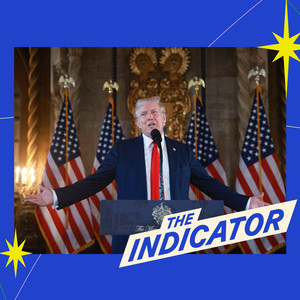
NPR. At his press conference last week, former President Donald Trump talked about his dream relationship with the US central bank, the Federal Reserve.
I feel the President should have at least say in there yeah I feel that strongly I think that, in my case, I made a lot of money, I was very successful, and I think I have a better instinct than, in many cases, people that would be on the Federal Reserve or the chairman.
Presidential candidate for the Democratic Party Kamala Harris, though had a rather different take.
The Fed is an independent entity and as president, I would never interfere in the decisions that the Fed makes.
All right, a fight over economics?
That sounds like a case for the indicator.
Together. this is The Indicator from Planet Money.
i'm heading with this.
I'm G description Waitlen Wong today.
On the show, and age old tension.
The Federal Reserve versus the President, we explain how central banks around the world become independent and why most economists wanted to stay that way.
Support for this podcast and the following message come from mint mobile.
Mint Mobile is dropping huge savings for the new year by offering any three month plan for only $15 a month!
Switch to Mint Mobile and new customers can get half off an unlimited plan until February 2nd.
Go to MINT MOBILE dot com slash indicator to learn more.
New customers on first three month plan only!
Speed slower above 40 GB on unlimited plan.
Additional taxes, fees, and restrictions apply.
See Mint Mobile for details.
This message comes from Green Light.
Parents rank financial literacy as the number one most difficult life skill to teach.
With Greenlight, the debit card and money app for families, kids learn to earn, save, and spend nicely.
Get started risk free at greenlight .com slash npr.
Support for NPR and the following message come from Edward Jones.
What does it mean to be rich?
Is it having a million stories to share?
Is it having more time to give?
Edward Jones' financial advisors will support what matters to you.
Edward Jones, member, SIPC.
The Federal Reserve, the US central bank, has two big goals, getting prices stable and jobs plentiful.
And its decisions are independent from politicians when it takes actions on things like changing interest rates to lower inflation, which we're laser focused on today.
Right. We learned that the Consumer Price Index rose 2 .9 % year on year in July.
That's a huge improvement from mid -2022 when inflation was over 9%.
University of Texas at Austin economist Karla Binder reckons that decrease was accelerated by the Fed's independence from political meddling.
The Fed's job was made easier by its independence, and inflation could have been even worse had the Fed not been independent.
Raising interest rates is a challenging lever to pull.
This brings down prices by slowing the economy down.
It makes new mortgages more expensive.
if it puts people temporarily out of work, so it's not a popular line of action for any politician.
If their goal is to get elected in a few months or even in a few years, they're not going to worry about the long run consequences of their policy actions, so lower interest rates, maybe they boost the economy right now but in the longer run, maybe lead to inflation.
The Fed has more credibility, investors and the public generally believe it will try to do what it takes.
And that's important in getting the job done.
And when we say the Fed is independent, we don't mean it's completely separated from democracy.
While a president can't say lower interest rates when they feel like they're getting too high, the Fed is accountable to the public in other ways.
Right, the president appoints the members of the Federal Reserve Board.
The Federal Reserve's goals—low inflation and high jobs—are set by Congress.
And the agency is accountable to Congress.
Just last month, Republican Senator John Kennedy grilled Fed Chair Jerome Powell.
I got two seconds, so what are you going to lower interest rates?
I'm, today, not going to be sending any signals about the timing of any future actions.
As much as politicians might want to control interest rates, they can't.
And that's thanks to an accord between the Treasury and the Federal Reserve in 1951.
In the US, inflation was running high after World War II and during the Korean War, but the Fed had a problem.
It was effectively controlled by the Treasury Department, which was led by the President's Treasury Secretary.
And that got in the way of the Fed doing its main job, influencing the money supply, keeping inflation down, aka monetary policy.
What's called the Treasury Fed Accord of 1951, is when the Fed finally was granted independence to be able to conduct monetary policy the way we would think of it today.
That didn't mean that presidents didn't try to influence the Fed, like think of Arthur Burns, Fed chair in the 1970s.
Most famous would be Richard Nixon when he was pressuring Arthur Burns for looser monetary policy to try to help his reelection chances.
Lyndon Johnson also twisted the screws on his Fed Chair at the time and through the 1970s and 80s a consensus started to emerge among economists.
The job of central banks to bring down inflation was a lot easier without politicians getting in the way, trying to pressure the lever down, and in return for more autonomy, central banks could be more transparent about their decision As economists came to recognize the benefits of transparency and of independence,
it kind of became more accepted and more part of the culture at the Fed and even the culture at central banks around the world.
The Bank of Japan, the Bank of Mexico, and the Bank of England became independent in the 1990s.
The European central bank was built as independent from day one, and the evidence suggests that independence works to control inflation.
Karolina Gariga is a political science professor at the University of Essex in the UK.
Karolina and her co -authors Research finds that countries with more independent central banks have lower levels of inflation.
But like all good social scientists, she's quick to note that correlation doesn't always equal causation.
It's not causation, but it's a pretty strong correlation location that holds across time from the seventies to two years ago and across different kinds of governments.
A very strong correlation that is definitely pointing at a direction and winking.
Exactly. Carolina also talks about countries that have eroded their central bank independence.
You can see central bankers being fired and then inflation spiking.
I mean, I'm from Argentina and I can give you many examples.
And this has happened not only in Argentina, has happened in Turkey.
he has happened, when an attack on Central Bank scraping becomes public, you can see these strikes going up.
Caroline Binder, CUT Austin, admitted that the consensus grew that central bank independence was a good thing.
This led to a norm.
Presidents were letting the central banks do their thing.
Until this 2016 election, when Trump started publicly and loudly criticizing the federal Reserve that continued into his presidency.
He appointed Fed Chair Jerome Powell, but started making these public swipes against him from 2018.
This was a major shift in the president's relationship with the Fed.
There had been a norm for many years that the president wouldn't — well, I don't know which presidents had Twitter, but they wouldn't go on Twitter or something like that ranting about the Federal Reserve.
So that was a shift in kind of what was seen as, um, acceptable for a president to do.
And with Donald Trump's comments now, it seemed that he's saying that if he's elected, there might be more structural change, giving the president more input.
Donald Trump's vice presidential candidate, J .D.
Vance supported this over the weekend.
If the American people don't like our interest rate policy, they should elect somebody different to change that policy.
Nothing should be above democratic debate in this country when it comes to the big questions confronting the United States.
Both Carolina and Carla think that it's a bad idea.
Carla says these comments are revealing.
You frequently have presidents who disagree with what the Federal Reserve does, and they almost always disagree on the side of, we should have looser policy, we should have lower interest rates, so it shows you, well if we had left monetary policy in the hands of the president, we would have had more
inflation. That said, Karolah says the public does want accountability.
Like, how did we even get such high inflation?
What went wrong? How can we avoid that happening again?
The Fed should give them a kind of accountability.
Should be transparent about the mistakes they made and what they learned and what they might change.
Karolah does think there is a grain of truth there in the frustrations that might lead someone wanting a politician to strung on the economists.
Think about what we've been through.
the high inflation, the pandemic, and then the global financial crisis before that.
The Fed was scrambling to help of course, and that meant expanding its role and taking on unconventional new action, like buying up tons of mortgage securities and bonds.
You can see why there are more calls for more oversight of the Fed, or calls to constrain it if it's seen as maybe going beyond what its original intentions were.
Are we just asking too much of the Fed?
Do we want the Fed to solve all of our problems?
We do. We ask too much of the Fed and not enough of what we can do ourselves.
Okay, John F. Kennedy.
Wow, what a pep talk, I love it.
This episode was produced by Corey Bridges with Engineering by Cino I wasn't afraid of it.
I was fact -checked by Sir Juarez and edited by Kate Kroll Cannon.
The indicators are production of NPR.
Support for NPR and the following message coming from IXL Learning.
IXL Learning uses advanced algorithms to give the right help to each kid, no matter the age or personality.
Get an exclusive 20 % off IXL membership when you sign up today at Machineootative .com.
support for NPR and the following message come from Rosetta Stone the perfect app to achieve your language learning goals no matter how busy your schedule gets.
It's designed to maximize study time with immersive ten -minute lessons and audio practice for your commute plus tailor your learning plan for specific objectives like travel get Rosetta stones lifetime membership for 50 % off and unlimited access to 25 language courses learn more at Rosetta atastone .com slash
npr.